

What Is the Lightning Network? Bitcoin's Layer 2 Explained
By Josh Heine, Content Strategist at Simple Mining
Published August 20, 2026
The Lightning Network is a payment protocol built on top of Bitcoin that settles transactions off-chain in about a second for fees measured in fractions of a satoshi. Bitcoin's base layer favors security and final settlement over speed. Lightning trades in the opposite direction: it moves everyday payments off the blockchain and reserves the base layer for opening, closing, and disputing payment channels. Lightning extends what Bitcoin can do without changing what miners secure.
On this page · 13 sections
- What Is the Lightning Network?
- Why Bitcoin Needs a Layer 2 Solution
- How the Lightning Network Works
- Benefits of the Lightning Network
- Lightning Network vs. On-Chain Bitcoin Transactions
- How to Use the Lightning Network
- Lightning Network Wallets
- Is the Lightning Network Safe?
- Lightning Network Limitations
- How the Lightning Network Depends on Bitcoin Miners
- Why Lightning Network Matters for Bitcoin's Future
- FAQs About the Lightning Network
- Start Using Bitcoin With Confidence
Key Takeaways
- The Lightning Network is Bitcoin's Layer 2 payment protocol. It moves payments off-chain through channels and settles final balances back to the blockchain.
- Routed payments complete in about a second. On-chain confirmations take about ten minutes to hours.
- Network routing fees run fractions of a satoshi per hop. Wallets often charge their own fees on top.
- Lightning handles micropayments too small to send on-chain, and its design supports volumes far past the base layer's ceiling.
- Every channel open, close, and dispute is an on-chain transaction that a Bitcoin miner confirms.
What Is the Lightning Network?
The Lightning Network is a second layer payment protocol that runs on top of Bitcoin and settles payments off-chain through two-party channels. Layer 2 means it operates above the base blockchain known as Layer 1 while relying on it for security and final settlement. Off-chain means individual payments update balances inside a channel instead of writing to the blockchain. Only the transactions that open or close a channel touch the base layer.
A payment channel works like a bar tab. Open it once, run any number of rounds against it, and settle one final bill. The blockchain sees the tab open and the tab close.
Why Bitcoin Needs a Layer 2 Solution
Bitcoin needs a Layer 2 because the base layer processes a capped number of transactions and a new block arrives about every ten minutes. That ceiling is a design choice that keeps the blockchain verifiable on ordinary hardware. The cap comes from the roughly 2,000 to 4,000 transactions a Bitcoin block can hold. When demand for block space spikes, how Bitcoin transaction fees bid for block space in sat/vB decides who confirms first. A $3 coffee can end up costing more in fees than in coffee.
Lightning answers by taking the volume off-chain. Millions of payments can flow through channels while the base layer records only their opening and closing states.
How the Lightning Network Works
The Lightning Network works in three steps: two parties open a payment channel on-chain, payments route off-chain across connected nodes, and the channel closes with a final settlement back to the blockchain. The base layer sees the endpoints and Lightning handles everything in between.
1. Opening a Payment Channel
Two parties fund a shared on-chain output and that output is the channel: the funding transaction commits both balances to the shared unspent transaction output a channel open creates. Once it confirms, the two parties can pay each other back and forth without touching the chain. Each payment is a signed update to the channel's internal ledger. Modern channels are built with Taproot, which makes channel opens indistinguishable from ordinary payments on the blockchain.
2. Routing Payments Across Nodes
You do not need a direct channel with someone to pay them. Payments hop across intermediary Lightning nodes until they reach the recipient. Onion routing wraps the payment in layers of encryption, so each intermediary sees the previous hop and the next one but never the full route. The packet stays the same size at every hop, re-padded with random filler, so no node can count layers to work out where it sits in the route. Hash time-locked contracts make each hop atomic: a node either passes the payment forward and earns a small fee or the whole payment unwinds.
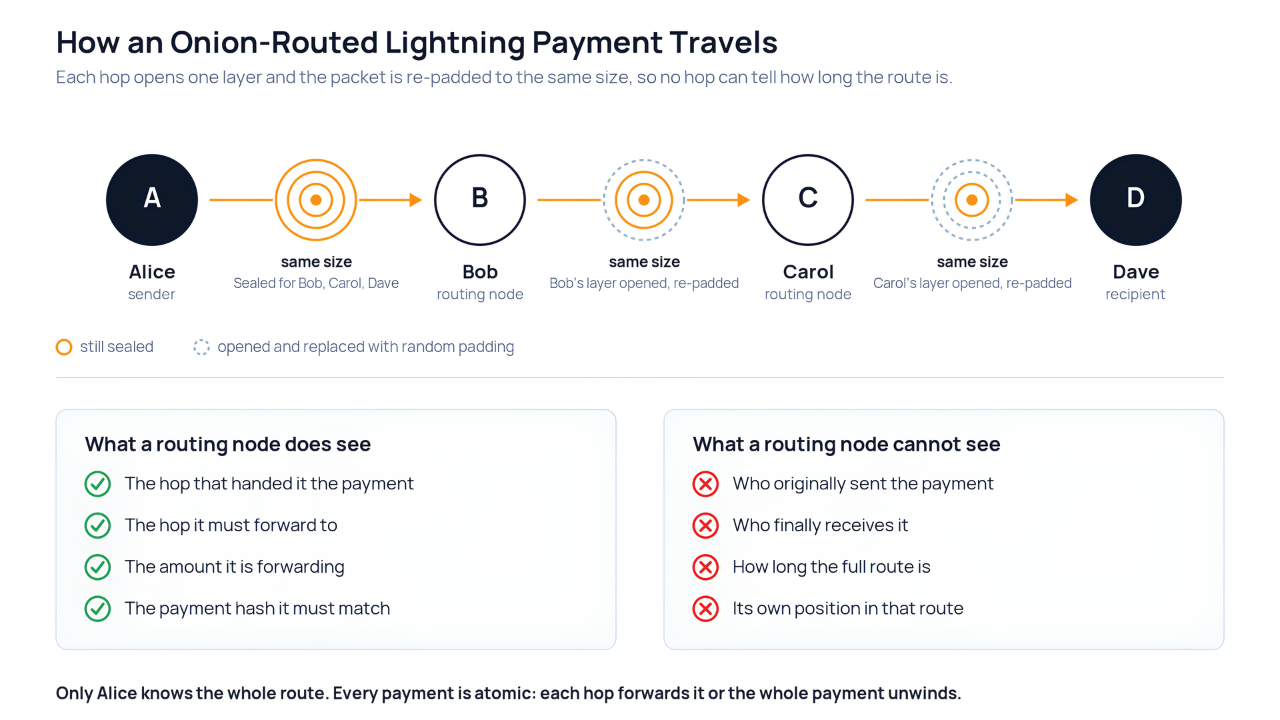
No intermediary can steal funds in flight. A Lightning node plays a different role than a Bitcoin node validating every transaction against consensus rules. The two cooperate: Lightning nodes watch the base layer to enforce their channels.
3. Closing the Channel and Settling On-Chain
Closing a channel always writes the final balances back to the Bitcoin blockchain. In a cooperative close both parties sign one settlement transaction and split the funds per the latest channel state. A force close is the dispute path: either party can broadcast the latest commitment transaction without the other's consent, and the closer's funds sit behind a timelock while the counterparty checks the state.
Broadcasting an outdated state is how a cheater tries to claw back spent funds. The penalty is severe: the counterparty can claim the entire channel balance. Every settlement passes through the Bitcoin mempool where every channel transaction queues for confirmation and pays the market fee rate to get mined.
Benefits of the Lightning Network
The Lightning Network's benefits come down to speed, cost, throughput, and payment sizes the base layer cannot serve.
- Speed: Routed payments settle in about a second.
- Low fees: Network routing fees run fractions of a satoshi per hop.
- Throughput: The protocol's design supports transaction volumes far past the base layer's ceiling.
- Micropayments: Lightning moves amounts too small to send on-chain, down to single satoshis.
Near-Instant Transaction Speeds
A routed Lightning payment completes in about a second and sub-second in good conditions. On-chain settlement keeps its own demand: when finality on an immutable ledger is the point, users still pay for block space.
Routing Fees and What They Actually Cost
Lightning users pay two distinct fees and one of them belongs to the network. Routing fees follow a set structure: each node along the route charges a small base fee plus a proportional rate on the payment amount. Medians sit near 0.5 sats base and around 100 parts per million per hop. A $20 payment across three hops costs on the order of 10 sats. Lightning meters payments in thousandths of a satoshi, the smallest unit the base layer can move, which is what makes a sub-satoshi routing fee possible at all.
The second fee belongs to your wallet. Phoenix charges a percentage plus a few sats to send and a liquidity fee to receive. Muun routes every Lightning payment through an on-chain swap, so its fees follow the mempool.
Lightning Network vs. On-Chain Bitcoin Transactions
Lightning suits small and frequent payments while on-chain Bitcoin suits large transfers where final settlement matters most. The two layers split the work rather than compete for it.
| Feature | Lightning Network | On-Chain Bitcoin |
|---|---|---|
| Speed | About a second | Minutes to hours |
| Fees | Fractions of a satoshi per hop | Variable, can be high |
| Best for | Small, frequent payments | Large, final settlements |
| Settlement | Off-chain until channel closes | Directly on blockchain |
| Privacy | Individual payments are not recorded on the public blockchain | All transactions public |
Use Lightning for coffee, tips, streaming sats, and remittances in the everyday range. Move size on-chain when permanence is the point: a confirmed transaction sits in a block the whole network has verified, and six confirmations make reversing it impractical.
How to Use the Lightning Network
You can use the Lightning Network in four steps: pick a wallet, fund it, open a channel, and pay. Most consumer wallets compress those steps into minutes.
1. Choose a Lightning-Compatible Wallet
Pick a wallet with built-in Lightning support. Custodial apps handle everything for you while self-custodial apps hand you the keys and the responsibility.
2. Fund Your Wallet with Bitcoin
Fund over Lightning where possible. Withdraw from an exchange that supports Lightning and the funds arrive spendable in seconds. Sending on-chain works too: the wallet opens a channel for you, and that first channel carries a one-time on-chain cost.
3. Let the Wallet Open Your Channel
Most consumer wallets open channels for you in the background. Manual setup means locking funds into a channel with a well-connected node.
4. Send or Receive Payments
Scan a Lightning invoice or QR code and confirm the amount. The payment lands in about a second. To receive, your wallet generates an invoice for the sender to pay.
Lightning Network Wallets
Three wallets cover the practical range for US users: Phoenix, Cash App, and Muun.
- Phoenix: Self-custodial. It runs a Lightning node on your phone and manages channels and liquidity on its own. The liquidity is automatic but not free.
- Cash App: Custodial. Mainstream and zero setup, available in the US excluding New York.
- Muun: Self-custodial with one unified balance. Every Lightning payment executes as an on-chain submarine swap, so its fees track on-chain fees and rise with congestion.
Is the Lightning Network Safe?
The Lightning Network is safe when you understand what Bitcoin enforces and what it leaves to you. Settlement and the penalty rules are enforced by Bitcoin itself. A cheater who broadcasts an old channel state risks losing the entire channel balance to the counterparty.
What Lightning does not give you is cold storage's passivity. A self-custodial user must stay online enough to catch a fraudulent close or delegate that watch to a watchtower service. Custodial wallets remove that burden and replace it with trust in the provider. Smart contract protections prevent theft by routing intermediaries, not every kind of loss.
Lightning Network Limitations
The Lightning Network's limits show up in three places: liquidity, channel management, and routing dependability.
Liquidity and Channel Capacity
A channel can only move what its participants locked into it. Receiving needs inbound liquidity and sending needs outbound. Average public channel capacity sits near 0.11 to 0.13 BTC, so larger payments split across multiple routes or fail.
Channel Management Complexity
Custodial means no channel management and no liquidity to think about. Self-custodial means both, plus staying reachable so your wallet can defend its channels. The right starting question is which Bitcoin wallet holds your keys, and whether a third party holds them instead.
Routing Reliability
A payment fails when no route with enough liquidity exists between sender and recipient. Well-run nodes beat the network's reputation: River measured a 99.7% success rate across 308,000 payments on its own node in 2023. That figure describes one professional operation rather than the network as a whole.
How the Lightning Network Depends on Bitcoin Miners
Lightning does not replace Bitcoin miners; it depends on them twice over. Every channel open and close is an on-chain transaction that a miner includes in a block. The penalty mechanism that keeps channels honest works because a miner confirms the punishing transaction. A cheated party's claim on a channel balance is just data until it lands in a block. The security Lightning users lean on is the same proof-of-work security miners produce every ten minutes, and a faster payment layer on top gives that work more to secure.
Why Lightning Network Matters for Bitcoin's Future
Lightning matters because it is compounding where it counts: real integrations. Major exchanges support Lightning deposits and withdrawals. Merchant processors settle over it. Mining pools pay out across it, with BOLT12 Lightning payouts at the Ocean Bitcoin mining pool leading the way.
Whether that adds up to spendable money today still depends on which stores accept Bitcoin. Payments that were impossible on-chain are routine on Lightning, and the base layer keeps doing what it does best: final settlement.
FAQs About the Lightning Network
What is Lightning Network on Cash App?
Cash App's Lightning integration lets you send and receive Bitcoin in about a second from inside the app with no setup. Cash App is custodial, which means Block holds the Bitcoin on your behalf. The feature is available in the US excluding New York.
Can I send Bitcoin from Lightning Network to a regular wallet?
Yes. Your wallet performs an on-chain swap or splice behind the scenes and you pay standard mining fees for that transaction. You do not close a channel by hand.
How much Bitcoin can I send on Lightning Network?
The amount depends on your channel capacity and the liquidity along the payment route. Average public channel capacity is about 0.11 to 0.13 BTC, so larger payments split across multiple routes or fail. Lightning is built for smaller and more frequent payments rather than large transfers.
Do I need to run a node to use Lightning Network?
No. Most Lightning wallets connect to existing nodes on their own. Running your own node gives you more control and privacy over your transactions.
Start Using Bitcoin With Confidence
Lightning makes Bitcoin spendable and miners make Bitcoin exist. If owning the production side of that stack appeals to you, you can buy Bitcoin miners from our inventory and let hosted Bitcoin Mining turn that purchase into hands-off Bitcoin production for a bundled all-in rate of $0.065 to $0.08 per kWh. Your miners earn the sats that Lightning moves while our team handles power, uptime, and repairs.