

What Is a UTXO? Understanding Bitcoin's Transaction Model
By Josh Heine, Content Strategist at Simple Mining
Updated March 10, 2026Published May 31, 2024
A UTXO (Unspent Transaction Output) is a discrete piece of Bitcoin sitting in your wallet, waiting to be spent. Unlike a bank account that shows a running balance, Bitcoin tracks individual chunks of value, each one locked to your address until you decide to move it.
Most wallet interfaces hide this complexity behind a single number. But underneath that balance, your Bitcoin exists as separate pieces. How you manage those pieces affects everything from transaction fees to privacy. This guide covers how UTXOs work, why they matter for miners and investors, and how to keep future costs low.
On this page · 16 sections
- What Is a UTXO
- How Bitcoin Creates UTXOs
- How UTXOs Work in Bitcoin Transactions
- What Is an Example of a UTXO
- How UTXOs Affect Bitcoin Transaction Fees
- What Is Bitcoin Dust
- Why UTXOs Matter for Bitcoin Users
- What Is UTXO Management
- UTXO Management Best Practices
- How to Consolidate and Optimize Your UTXOs
- UTXO Security Considerations
- UTXO Model vs Account Model
- How the Lightning Network Relates to UTXOs
- Which Blockchains Use the UTXO Model
- Why Understanding UTXOs Strengthens Your Mining Strategy
- FAQs About UTXOs
Key Takeaways
- A UTXO (Unspent Transaction Output) is a discrete chunk of Bitcoin locked to your address, and your wallet balance is the sum of all UTXOs you control.
- Transaction fees depend on how many UTXOs you spend (data size), not the amount of BTC being sent.
- Dust refers to any UTXO too small to spend economically (i.e., where the transaction fee would exceed its value), and it typically accumulates from frequent small transactions or mining pool payouts.
- Consolidate UTXOs during low-fee periods to reduce future costs, and use wallets with coin control for better fee and privacy management.
- Mining pool payout structure directly affects UTXO accumulation, making it a often-overlooked factor in true mining profitability.
What Is a UTXO
A UTXO (Unspent Transaction Output) is a specific amount of Bitcoin that you control with your private key. The term stands for "unspent transaction output," and it's the foundational unit of value on the Bitcoin network.
Think of UTXOs like physical bills in your wallet. You don't have a "balance" of $47. You have a $20 bill, another $20, a $5, and two $1s. Your wallet software adds them up and shows you a total. Underneath, Bitcoin sees each piece as a separate object.
- UTXO meaning: Unspent Transaction Output, a specific amount of Bitcoin available to spend
- Balance calculation: Your wallet sums all UTXOs tied to your addresses
- Key distinction: Bitcoin tracks individual outputs, not account balances
Every UTXO is locked to a specific Bitcoin address. Only the person holding the corresponding private key can unlock and spend it. Once spent, that UTXO is permanently removed from the network and replaced by new outputs. The collection of all unspent outputs across the entire network is called the UTXO set.
How Bitcoin Creates UTXOs
UTXOs come into existence as outputs of confirmed transactions. When a miner adds a new block to the blockchain, the coinbase transaction creates brand-new UTXOs as the block reward. After the 2024 halving, that reward is 3.125 BTC per block.
Beyond mining rewards, every regular Bitcoin transaction also creates UTXOs. When someone sends you Bitcoin, the network generates a new UTXO assigned to your address. That output sits in the global UTXO set until you decide to spend it.
How UTXOs Work in Bitcoin Transactions
Every Bitcoin transaction follows a simple pattern: consume existing UTXOs as inputs, create new UTXOs as outputs. The inputs are destroyed in the process, and fresh outputs take their place.
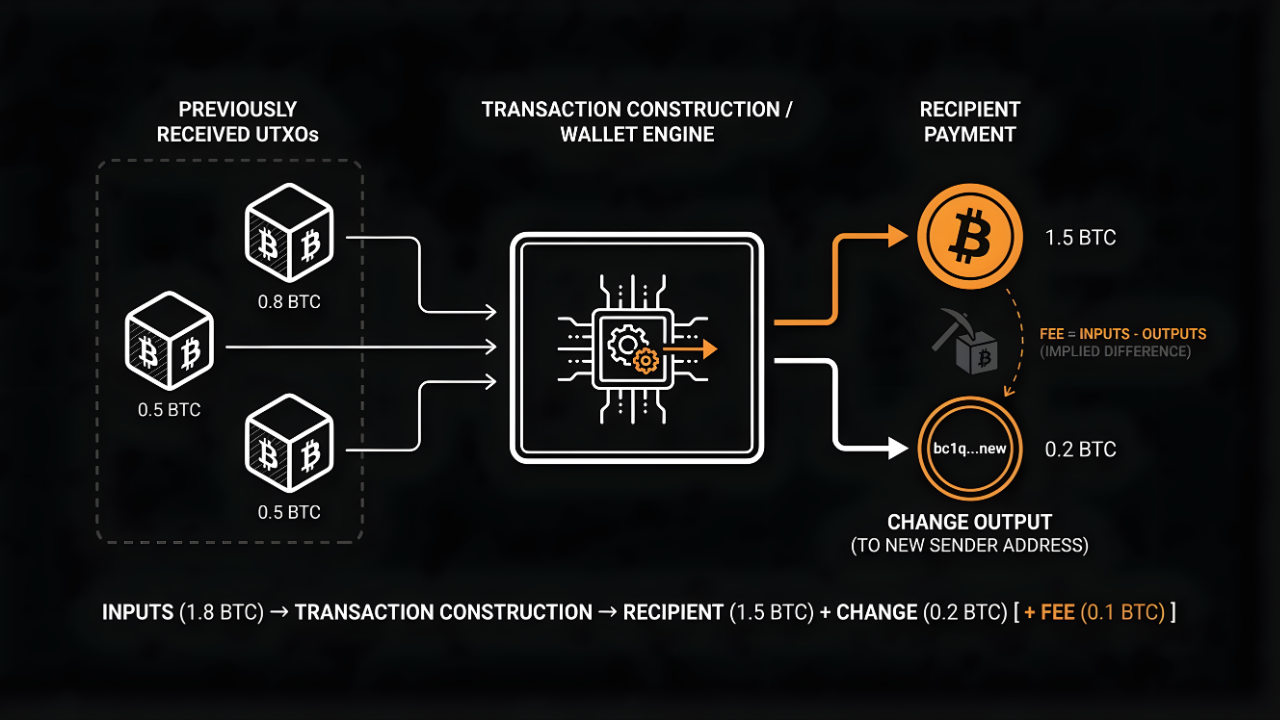
The cash analogy makes this clear. If you have a $10 bill and want to buy something for $3, you can't tear off 30% of the bill. You hand over the whole $10 and receive $7 in change. Bitcoin works the same way.
- Inputs: UTXOs being spent (destroyed after use)
- Outputs: New UTXOs created for recipient and change
- Single-use rule: Each UTXO can only be spent once, then it's removed from the active UTXO set
When you send Bitcoin, your wallet selects one or more UTXOs that together cover the amount plus fees. The transaction consumes those UTXOs entirely and creates new ones: one for the recipient and one returning the "change" to you.
What Is an Example of a UTXO
You receive 1 BTC from a friend. This creates a single UTXO worth 1 BTC, locked to your address.
Later, you send 0.3 BTC to someone else. Your wallet constructs a transaction that consumes your entire 1 BTC UTXO as the input. Two new outputs are created: 0.3 BTC goes to the recipient's address, and approximately 0.6997 BTC returns to you as change. The remaining 0.0003 BTC goes to miners as the transaction fee.
Your original 1 BTC UTXO no longer exists. In its place, you now have a 0.6997 BTC UTXO, and the recipient has a 0.3 BTC UTXO. Both are fresh outputs that can be spent in future transactions.
How UTXOs Affect Bitcoin Transaction Fees
Transaction fees on Bitcoin depend on data size, not the amount of BTC being sent. More input UTXOs mean a larger transaction in bytes, which means higher fees.
Imagine paying for a $100 item with a single $100 bill versus paying with 100 individual $1 bills. The second option takes more physical space and effort. A transaction spending 10 small UTXOs costs more in fees than one spending a single large UTXO, even if both send the same amount of Bitcoin.
This is why UTXO management matters. Miners and frequent Bitcoin users who accumulate many small UTXOs face surprisingly high fees when they want to move funds. A $2 billion Bitcoin transaction in 2021 cost only $0.78 in fees because it used minimal inputs. Meanwhile, a $50 transaction with dozens of small UTXOs could cost several dollars.
What Is Bitcoin Dust
Dust refers to UTXOs so small that the fee required to spend them exceeds their value. These tiny outputs become effectively unspendable, stuck in your wallet and impossible to move economically.
Dust typically accumulates from many small transactions or frequent mining pool payouts. If you receive 0.00001 BTC payouts daily, you'll end up with hundreds of tiny UTXOs. When network fees spike, spending any single one costs more than it's worth. A common rule of thumb for economical viability: UTXOs smaller than 500,000 satoshis (0.005 BTC) risk becoming dust during high-fee periods, though the technical dust limit for relayable outputs is much lower (around 546 satoshis for standard P2PKH transactions).
Why UTXOs Matter for Bitcoin Users
The UTXO model has direct implications for security, costs, and privacy.
- Security: Each output can only be consumed once, making double-spending impossible under normal circumstances
- Fee optimization: Fewer, larger UTXOs mean lower transaction costs when you spend
- Privacy: UTXO selection affects transaction traceability, since combining UTXOs from different sources in one transaction links those funds on the public blockchain
Understanding these trade-offs helps you make better decisions about how you receive, store, and spend Bitcoin.
What Is UTXO Management
UTXO management is the practice of organizing and consolidating your unspent outputs to reduce future fees and avoid dust accumulation. It involves combining small UTXOs, preventing unnecessary fragmentation, and timing transactions to minimize costs.
Without active management, your wallet can accumulate dozens or hundreds of small UTXOs. Each one adds complexity and cost to future transactions. Miners receiving frequent pool payouts face this problem constantly. Professional operations (including hosted mining services) often handle UTXO optimization automatically by batching payouts and consolidating during low-fee windows.
UTXO Management Best Practices
The most effective UTXO practices involve timing consolidation to low-fee windows and minimizing the creation of small outputs.
Consolidate UTXOs During Low-Fee Periods
Network fees fluctuate based on mempool congestion. During quiet periods, fees might drop to 1–2 sats/vbyte. That's the ideal time to combine multiple small UTXOs into fewer larger ones. You pay a small fee now to avoid a much larger fee later. Check mempool.space for current fee conditions before consolidating.
Avoid Creating Small Unspent Outputs
When possible, request payments to single addresses rather than splitting funds across many small transactions. If you're setting up mining pool payouts, consider higher payout thresholds that result in fewer, larger UTXOs arriving in your wallet.
Use Wallets With UTXO Controls
Wallets with "coin control" features let you select exactly which UTXOs to spend in a transaction. This gives you control over fees and privacy that automatic selection can't match. Sparrow and Electrum both offer it, as does Bitcoin Core's built-in coin control.
Monitor Your UTXO Set Regularly
Review your UTXOs periodically to identify dust or consolidation opportunities. Some wallets display individual UTXOs directly. Others require you to export transaction data. Knowing what you have is the first step to managing it well.
How to Consolidate and Optimize Your UTXOs
Consolidation is straightforward: send all your UTXOs to yourself in a single transaction. This consumes many small inputs and creates one larger output.
The process works best during low-fee periods. Watch mempool congestion and wait for fees to drop before consolidating. A transaction that costs $50 during peak congestion might cost $5 a few days later.
| Consolidation Timing | Typical Fee Environment | Recommendation |
|---|---|---|
| Weekend/low activity | 1–5 sats/vbyte | Ideal for consolidation |
| Normal weekday | 10–20 sats/vbyte | Acceptable for moderate consolidation |
| High congestion | 50+ sats/vbyte | Wait unless urgent |
Some hosted mining services handle consolidation for clients, batching payouts and optimizing during the best windows. This is one of the practical advantages of working with an experienced operator.
UTXO Security Considerations
Each UTXO is cryptographically locked to a specific address, requiring the corresponding private key to spend. No key, no access. Once a UTXO is spent, it's permanently removed from the active set. You can't spend the same output twice because it no longer exists after the first spend.
One consideration: spending from an address reveals its public key on the blockchain. While this doesn't compromise funds immediately, it reduces cryptographic protection compared to an unspent address. Many privacy-conscious users generate new addresses for each transaction to mitigate this.
UTXO Model vs Account Model
Bitcoin tracks individual unspent outputs (UTXO model), while Ethereum tracks running account balances (account model). The difference is fundamental to how each network handles ownership and verification.
| Feature | UTXO Model (Bitcoin) | Account Model (Ethereum) |
|---|---|---|
| Balance tracking | Sum of individual outputs | Running account balance |
| Transaction structure | Consumes and creates outputs | Debits and credits accounts |
| Privacy | Higher (new addresses per transaction) | Lower (single account address) |
| Parallel processing | Easier (independent UTXOs) | More complex (sequential state) |
The UTXO model can offer stronger privacy because different addresses can be used for different transactions without inherently linking them, though on-chain analysis can still reveal patterns. The account model is simpler to understand (it works like a bank account) but sacrifices some privacy and auditability. Bitcoin's model makes total supply verification straightforward: the UTXO set accounts for every spendable coin.
How the Lightning Network Relates to UTXOs
The Lightning Network is Bitcoin's layer-2 scaling solution, and it's built directly on UTXOs. Opening a Lightning channel requires an on-chain transaction that creates a special UTXO shared between two parties. Taproot makes those channel opens look like ordinary payments on-chain.
Once a Lightning channel is open, thousands of transactions can happen off-chain without creating new UTXOs on the main blockchain. Only when the channel closes does another on-chain transaction settle the final balances. This design helps with both scalability and UTXO set management.
Which Blockchains Use the UTXO Model
Bitcoin pioneered the UTXO model, but several other blockchains adopted the same approach:
- Bitcoin (the original implementation)
- Litecoin
- Bitcoin Cash
- Cardano (extended UTXO model)
- Zcash
- Dogecoin
Each implementation has variations, but the core concept remains: track individual unspent outputs rather than account balances.
Why Understanding UTXOs Strengthens Your Mining Strategy
Mining pool payouts create UTXOs, and payout structure directly affects long-term costs. Frequent small payouts produce many small UTXOs that cost more to consolidate later. Less frequent, larger payouts mean fewer UTXOs and lower future fees.
When evaluating a mining operation, ask how payouts are structured. Some pools pay out daily regardless of amount. Others wait until you've accumulated a meaningful balance. The difference can add up to hundreds of dollars per year in consolidation costs, which most profitability calculators overlook.
UTXO awareness also helps you calculate true mining profitability. It's not just hashrate and electricity. Future consolidation fees eat into returns. Hosted mining services like Simple Mining often optimize payout structures and batch consolidations to reduce this burden, handling the technical details so miners can focus on accumulating Bitcoin.
FAQs About UTXOs
How many UTXOs should I have?
There's no universal ideal number. It depends on your transaction patterns and fee tolerance. Fewer larger UTXOs are more cost-efficient to spend than many small ones. A good rule of thumb: if a UTXO is worth less than a typical transaction fee, it's too small.
Can UTXOs expire or be lost?
UTXOs never expire on the Bitcoin blockchain. However, they become permanently inaccessible if you lose the private keys controlling them. Lost UTXOs remain in the UTXO set forever but can never be spent.
Do all Bitcoin wallets show individual UTXOs?
Most wallets display only your total balance, hiding the underlying UTXOs. Wallets with "coin control" features (like Sparrow, Electrum, or Bitcoin Core) let you view and select specific UTXOs for transactions.
How do mining pool payouts create UTXOs?
Each payout from a mining pool creates a new UTXO in your wallet. If your pool pays out 0.001 BTC daily, you'll accumulate 365 small UTXOs per year. When you eventually spend or consolidate, fees scale with the number of inputs. Payout threshold settings are an important consideration for miners.