

What is the Bitcoin Mempool and How Does It Work?
By Josh Heine, Content Strategist at Simple Mining
Updated June 23, 2026Published December 3, 2025
The Bitcoin mempool is the waiting room for every unconfirmed transaction on the network. When you send Bitcoin, your transaction does not go straight into a block. It sits in the mempool until a miner selects it. Understanding how this queue works gives you control over fees and confirmation times. This is essential knowledge for anyone who moves Bitcoin on-chain.
On this page · 12 sections
- What Is the Bitcoin Mempool
- How the Bitcoin Mempool Works
- Why the Mempool Matters for Bitcoin Transactions
- How Transaction Fees Affect Mempool Priority
- How Long Unconfirmed Transactions Stay in the Mempool
- How to Speed Up a Pending Bitcoin Transaction
- How Miners Select Transactions from the Mempool
- How to Check Bitcoin Mempool Status
- Will Bitcoin Be Lost in the Mempool
- Why Bitcoin Miners Track Mempool Conditions
- FAQs
- Mempool Literacy Is Mining Literacy
Key Takeaways
- The Bitcoin mempool is a temporary waiting area for unconfirmed transactions on each node
- Miners select transactions from the mempool based on fee rates (sat/vbyte)
- Block space is limited to ~4 million weight units so users compete through fees during high demand
- RBF and CPFP are tools to accelerate stuck transactions
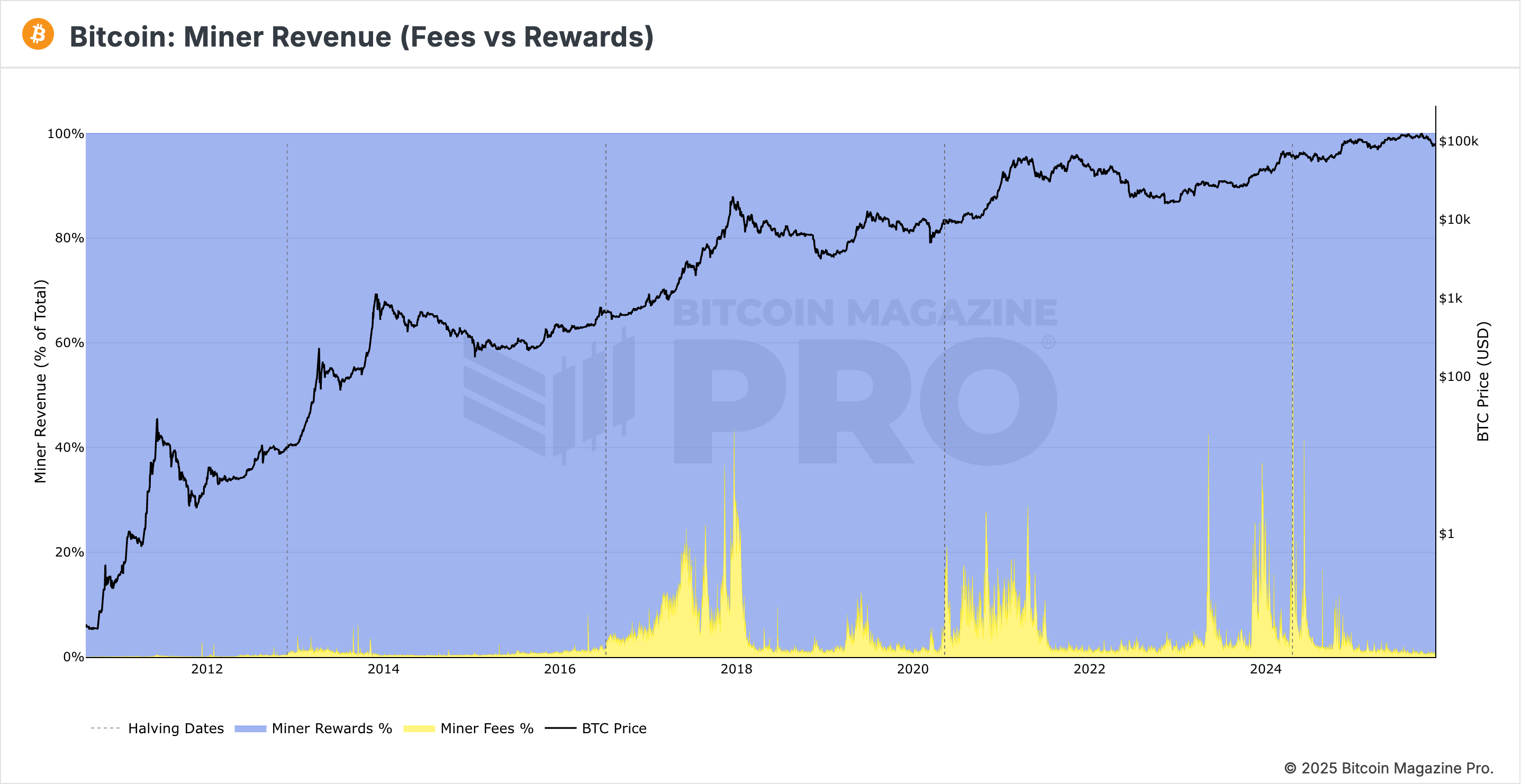
- Transaction fees can spike to 15-90% of miner revenue during bull markets and special events
What Is the Bitcoin Mempool
The mempool is a temporary storage area for pending Bitcoin transactions. Think of it as the lobby of a concert hall. Everyone with a ticket waits there until an usher (miner) calls their section to enter the venue (blockchain). It is the first stop the moment you hit "send" on a Bitcoin transaction.
Three things define it:
- Memory pool: "Mempool" is short for "memory pool," because each node keeps these pending transactions in its memory (RAM) rather than on disk.
- Unconfirmed transactions: A transaction is "unconfirmed" until a miner includes it in a block. Until then it has zero confirmations and is not yet final.
- Temporary storage: Transactions do not live here permanently. They either get confirmed into a block or, if they linger too long, get dropped from the queue.
Each full node on the Bitcoin network maintains its own mempool. There is no single global mempool. When you broadcast a transaction from your wallet, it travels across the peer-to-peer network. Each node that receives it validates the transaction and adds it to its local mempool. This decentralized design prevents any single point of failure.
The mempool lives in a node's memory, though Bitcoin Core saves it to disk on shutdown and restores it on restart. Transactions that have not confirmed can be re-broadcast by wallets. This keeps pending transactions alive until miners include them in a block.
How the Bitcoin Mempool Works
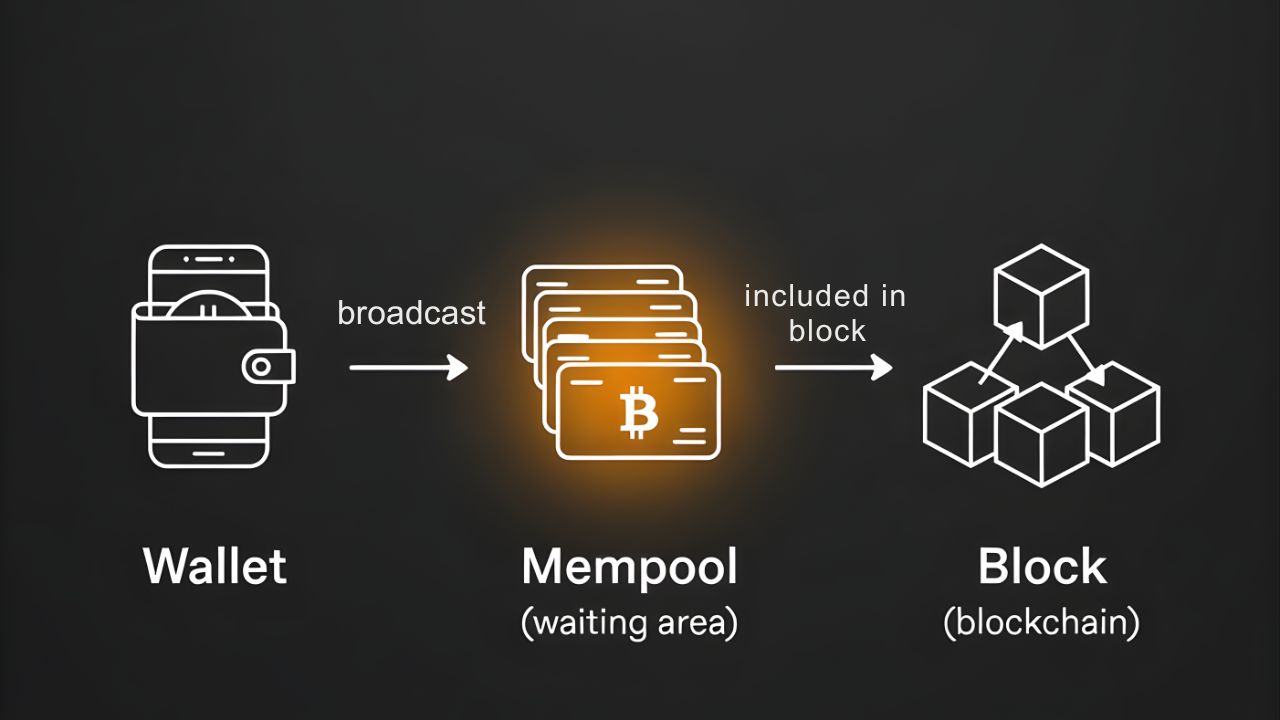
A Bitcoin transaction moves from your wallet to the blockchain in three phases: it is broadcast across the network, validated and held in each node's mempool, then selected by a miner and confirmed in a block.
Transaction Broadcast and Propagation
You open your wallet, enter the recipient address and amount, and the wallet creates and signs the transaction with your private key. Your wallet then sends that signed transaction to the full nodes it is connected to, and each node relays it to its peers. This spreading from node to node is called propagation, and within seconds your transaction reaches thousands of nodes across the network.
Mempool Validation and Storage
Before a node accepts your transaction, it checks it against the network's rules: that the signature is valid, that you actually own the coins, and that you are not trying to spend the same coins twice (a double-spend). If the transaction passes, the node adds it to its own local mempool. Because every full node keeps its own copy, there is no single global mempool, though the copies overlap heavily since nodes share transactions with each other.
Block Inclusion and Confirmation
Miners pull transactions from their mempool to build a candidate block. They prioritize transactions that pay higher fees per unit of data (sat/vbyte). A transaction paying 50 sat/vbyte gets selected before one paying 10 sat/vbyte. When a miner finds a valid hash, it broadcasts the new block; nodes verify it and remove those transactions from their mempools. Your transaction now has one confirmation, and each additional block adds another. Most recipients consider 3-6 confirmations sufficient for large amounts.
| Factor | Mempool | Confirmed Block |
|---|---|---|
| Location | Node RAM | Blockchain (disk) |
| Permanence | Temporary | Immutable |
| Security | Zero confirmations | Secured by proof-of-work |
| Reversibility | Can be replaced (RBF) | Cannot be altered |
| Settlement | Pending | Final |
The mempool is not the blockchain. Transactions in the mempool have zero confirmations. They carry risk until a miner includes them in a valid block. Merchants accepting zero-confirmation payments take on reversal risk. Once a transaction enters a block, it becomes part of the permanent record. After 6 confirmations, the transaction has about 60 minutes of accumulated proof-of-work protecting it. For a deeper technical dive, Learn Me A Bitcoin covers the cryptographic details.
Why the Mempool Matters for Bitcoin Transactions
The mempool is more than a waiting room. It is where Bitcoin enforces its rules and sets the price of block space before anything reaches the blockchain.
- Network security: Every transaction is validated against consensus rules in the mempool before it can ever enter a block.
- Transaction ordering: The mempool is where the network decides which transactions get processed first, based on the fees they pay.
- Fee market: Because block space is limited, the mempool creates an open auction where users bid for faster confirmation.
How Transaction Fees Affect Mempool Priority
Your fee is the single biggest factor in how fast your transaction confirms. Miners are paid from the transaction fees in each block, so they fill blocks with the most valuable transactions first. Pay a competitive fee and you move to the front of the line; pay too little and you wait.
Fee Rate and Satoshis per Byte
What matters is your fee rate, not your total fee. Fee rate is measured in sat/vbyte (satoshis per virtual byte), and miners rank transactions by how many sats they pay per unit of block space. A small transaction paying 50 sat/vbyte beats a larger one paying 30 sat/vbyte, even if the larger one pays more in total.
Here is the math. A standard transaction is about 250 vbytes. At 20 sat/vbyte that is 5,000 sats; at 100 sat/vbyte during congestion the same transaction costs 25,000 sats — the identical transfer at five times the fee.
Dynamic Fee Estimation
Wallets estimate an appropriate fee by reading current mempool conditions. When the mempool is full, suggested fees climb; when it drains, they fall. This is why the same transfer can cost a few cents one day and several dollars the next.
Low Fee Consequences
If you attach a fee that is too low for current demand, your transaction sits in the mempool waiting for the backlog to clear. That can take hours or days, and if it never becomes competitive, most nodes eventually drop it.
How Long Unconfirmed Transactions Stay in the Mempool
Most nodes drop transactions from their mempool after about 2 weeks if they remain unconfirmed. However, wallets can re-broadcast transactions to keep them alive. Well-funded transactions typically confirm within minutes to hours. Being dropped does not mean your money is gone — the coins simply return to your control in your wallet, ready to send again.
How to Speed Up a Pending Bitcoin Transaction
If your transaction is stuck, you have three options.
Replace-by-Fee
Replace-By-Fee (RBF) lets the sender rebroadcast the same transaction with a higher fee, replacing the original in the mempool. Your wallet has to support RBF. Traditionally the original transaction also had to signal that it was replaceable, but most nodes now accept full RBF, so even unflagged transactions can usually be replaced.
Child Pays for Parent
Child-Pays-For-Parent (CPFP) lets the recipient spend an output from the stuck transaction in a new transaction that pays a high fee. Miners have to confirm the original "parent" to collect the "child," so both get pulled in together. CPFP works even when RBF is not available, since it does not need the sender.
Waiting for Mempool to Clear
If your transaction is not urgent, you can simply wait. During low-activity periods like weekends and off-peak hours, the mempool drains and even low-fee transactions confirm once miners need them to fill blocks.
How Miners Select Transactions from the Mempool
Miners pull transactions from their mempool to build the most profitable block they can. Their incentive is simple: maximize fee revenue within a fixed amount of block space.
- Fee maximization: Miners pick the highest sat/vbyte transactions first to earn the most per block.
- Block size limits: Only about 4 million weight units of transaction data fit in each block, so space is the constraint they optimize against.
- Profit optimization: Professional mining operations factor live mempool conditions into their revenue projections and block templates, and the mining pool they use determines how those fees get paid out.
How to Check Bitcoin Mempool Status
Before you send, it is worth checking how busy the network is so you can set the right fee. A few tools make this easy.
Mempool.space
Visit mempool.space to see real-time mempool data including pending transactions, fee estimates, and block projections. This open-source explorer aggregates data from multiple nodes and shows current network congestion levels.
Blockchain Explorers
Other explorers like Blockchain.com and Blockstream also display mempool data and let you look up a specific transaction by its ID to see whether it has confirmed.
Bitcoin Node Software
If you run your own full node, you have direct access to your local mempool through the Bitcoin Core node software, which is the most private and authoritative way to check status.
Will Bitcoin Be Lost in the Mempool
No. Bitcoin cannot be lost simply by sitting in the mempool. Your funds aren't lost while a transaction is unconfirmed. They are just waiting for a miner to include them in a block. An unconfirmed transaction has only two possible outcomes: it eventually confirms, or it gets dropped after about two weeks and the coins become spendable again in your wallet. If it is stuck behind a low fee, you can speed it up with RBF or CPFP rather than wait.
Why Bitcoin Miners Track Mempool Conditions
Miners earn revenue from two sources: the block subsidy and transaction fees. The block subsidy is 3.125 BTC after the April 2024 halving. Transaction fees add variable income on top. When the mempool fills with high-fee transactions, miners earn more per block, which raises hashprice (revenue per terahash). That is why professional operations watch the mempool closely — fee spikes are upside, and reading congestion patterns helps them build better block templates.
In the weeks following the April 2024 halving, fees repeatedly surpassed 90% of the total block reward. Some individual blocks paid miners 25-40 BTC in fees alone, dwarfing the fixed 3.125 BTC subsidy. New protocols like DATUM let individual miners build their own block templates from the mempool, reducing reliance on pool operators.
For most people, tracking the mempool by hand is not realistic — it is a full-time job. At Simple Mining, we run 40,000+ ASICs for 1000+ clients at facilities with $0.065-0.08/kWh all-in power costs and a ~60% renewable energy mix. We maintain 95% uptime through on-site repairs, and when transaction fees spike, your miners capture that upside. For those exploring Bitcoin mining, our hosting service manages these technical details while you keep full ownership of your hardware.
FAQs
What does mempool mean?
Mempool is short for "memory pool." It's the waiting area where each Bitcoin node holds valid, unconfirmed transactions in its memory (RAM) until a miner selects them for a block. Every full node maintains its own mempool, so there is no single global mempool.
What is sat/vbyte?
Sat/vbyte (satoshis per virtual byte) is the unit Bitcoin uses to measure transaction fee rates. Each transaction has a size in virtual bytes, and the sat/vbyte rate determines how much you pay per byte of block space. Higher rates incentivize miners to include your transaction faster. A standard 250-vbyte transaction at 20 sat/vbyte pays 5,000 satoshis in total fees.
What is the difference between RBF and CPFP?
Replace-By-Fee (RBF) lets the sender resubmit an unconfirmed transaction with a higher fee, replacing the original in the mempool. Child-Pays-For-Parent (CPFP) lets the recipient create a new transaction that spends an output from the stuck parent and includes a high fee, incentivizing miners to include both transactions together. RBF requires sender wallet support; CPFP works without sender cooperation.
What happens when the Bitcoin mempool is empty?
An empty mempool means low network demand and minimal fees. Transactions confirm at the minimum relay fee of about 1 sat/vbyte. This is rare during active market periods and typically occurs during extended bear markets or weekends.
Can I cancel a Bitcoin transaction in the mempool?
Not directly — Bitcoin has no "cancel" button. But while a transaction is still unconfirmed, you can effectively undo it with Replace-By-Fee: rebroadcast a higher-fee transaction that sends the coins back to an address you control, and miners will confirm that version instead of the original.
Does every Bitcoin node have its own mempool?
Yes. Each full node maintains its own independent mempool in memory. The lists overlap heavily because nodes constantly share transactions with each other, but they are never guaranteed to be identical, since each node applies its own relay and size limits.
What is the largest the Bitcoin mempool has ever been?
The mempool has swelled to hundreds of megabytes of pending transactions during peak congestion — periods like the 2017 bull run, the April 2024 halving, and Ordinals/inscription waves — leaving tens of thousands of low-fee transactions waiting for days until demand eased.
How does mempool congestion affect Bitcoin mining profitability?
Congestion is good for miners. When the mempool is full of high-fee transactions, each block carries more fee revenue on top of the fixed subsidy, raising effective hashprice. This is one reason mining operations monitor mempool conditions closely — fee-heavy periods can meaningfully boost daily revenue.
Mempool Literacy Is Mining Literacy
The Bitcoin mempool teaches you that block space is a scarce resource with a price. Understanding this fee market makes you a more capable Bitcoin holder and potential miner.
Ready to participate in the Bitcoin fee market as a miner? Start a 7-day free trial with Simple Mining.