

What Is Taproot in Bitcoin?
By Josh Heine, Content Strategist at Simple Mining
Updated August 17, 2026Published July 20, 2026
Taproot is the largest Bitcoin upgrade since SegWit in 2017. It activated at block 709,632 on November 14, 2021 and introduced Schnorr signatures, a new output type, and a revised scripting language. The upgrade makes complex transactions cheaper and more private. It also set off a chain of events that reshaped miner fee revenue. Here is what Taproot does in plain English.
Key Takeaways
- Taproot is a soft fork that activated at block 709,632 on November 14, 2021 after about 90% of miners signaled support.
- The upgrade adds Schnorr signatures through a new output type called Pay-to-Taproot (P2TR). ECDSA remains valid and still signs most transactions.
- Complex spends like multisig can look identical to simple payments on chain, which improves privacy and lowers fees.
- Miners needed no hardware changes. ASICs hash block headers while node software enforces the new rules.
- Inscriptions built on Taproot drove episodic miner fee spikes from 2023 onward, not a permanent revenue floor.
What Is Taproot in Bitcoin
Taproot is a soft fork upgrade to Bitcoin that improves privacy, lowers fees for complex transactions, and expands what Bitcoin scripts can do. It activated in November 2021 as a bundle of three Bitcoin Improvement Proposals: BIP 340, BIP 341, and BIP 342.
A soft fork tightens Bitcoin's rules in a backward compatible way. Nodes that never upgraded stay on the same network and keep following the same chain. That backward compatibility is how a soft fork tightens the rules without splitting the chain.
The headline feature is uniformity. Before Taproot, a multisignature spend looked different from a single key payment on the blockchain. Taproot lets both look the same. An observer sees one key and one signature either way.
How Taproot Works
Taproot works by combining three components: Schnorr signatures, MAST, and Tapscript. Each component ships in its own BIP. Together they create a new way to lock and spend Bitcoin called Pay-to-Taproot (P2TR). A P2TR output can hide many spending conditions behind a single public key.
Schnorr Signatures
Schnorr signatures are a digital signature scheme that Taproot adds to Bitcoin. Bitcoin launched with a scheme called ECDSA and Schnorr does not replace it. ECDSA remains valid for legacy and SegWit v0 outputs and it still signs most transactions today. Schnorr is available through P2TR outputs.
The standout feature is aggregation. Key aggregation: multiple parties sign with a single combined signature. A 3-of-3 multisig can settle with one 64-byte Schnorr signature instead of three ECDSA signatures near 72 bytes each. Less data on chain means lower fees for the spender.
MAST
MAST stands for Merkelized Alternative Script Trees. A MAST structure organizes multiple spending conditions into a Merkle tree and commits only the tree's fingerprint on chain. When someone spends the output, the transaction reveals only the one condition in use. Every unused condition stays hidden forever.
Older script types work in reverse. Every possible spending condition sits in public view whether it executes or not. MAST flips that default from public to private.
Tapscript
Tapscript is the updated scripting language that validates Taproot spends. It revises Bitcoin's opcodes to verify Schnorr signatures and MAST paths. Tapscript also adds versioning, which makes future upgrades easier to deploy. Bitcoin's scripting stays narrow on purpose, a conservative design choice that limits complexity.
BIP 340, BIP 341, and BIP 342
Three proposals define the upgrade:
- BIP 340: the Schnorr signature specification
- BIP 341: the Taproot output structure, covering P2TR and MAST integration
- BIP 342: the Tapscript validation rules
One detail ties them together. Every P2TR output is a SegWit version 1 output, so every Taproot transaction is also a SegWit transaction.
Benefits of Taproot for Bitcoin
Taproot benefits Bitcoin through stronger privacy, lower fees for complex spends, and more capable scripts. Users who never touch Taproot still gain because uniform transactions raise the privacy floor for the whole network.
Improved Transaction Privacy
Privacy improves because Taproot transactions look uniform. A multisig vault, a timelocked contract, and a simple payment can all appear identical on chain. The privacy comes from uniformity rather than encryption. Observers cannot tell which type of spend they are looking at, which shifts how traceable Bitcoin transactions are for chain analysts.
The Lightning Network gains too. Lightning channels open with 2-of-2 multisig transactions and Taproot makes those channel opens indistinguishable from ordinary payments. One trade-off deserves a mention. P2TR outputs place a public key on chain at receipt, a detail that features in debates over whether quantum computing can break Bitcoin.
Lower Fees and Greater Efficiency
Taproot lowers fees by shrinking the data a spend consumes. Schnorr signatures are smaller than ECDSA signatures and MAST reveals one script instead of all of them. Spending from a Taproot address is cheaper than from legacy addresses, which lowers Bitcoin transaction fees. The savings grow with complexity because multisig collapses many signatures into one.
Smart Contract Capabilities
Taproot expands what Bitcoin contracts can do without loosening the protocol's conservative design. Multisig custody, timelocks, and recovery paths become cheaper to build and easier to keep private. An institution can run a complex vault that settles on chain as a plain payment. Lightning benefits as well since its channels are built on Bitcoin's unspent transaction outputs (UTXOs).
Taproot vs SegWit
Taproot builds on SegWit rather than replacing it. Every Pay-to-Taproot output is a SegWit version 1 output, so the two upgrades form one lineage.
| Feature | SegWit | Taproot |
|---|---|---|
| Activation year | 2017 | 2021 |
| Primary focus | Malleability fix, block capacity | Privacy, efficiency, script flexibility |
| Signature scheme | ECDSA | Schnorr (added alongside ECDSA) |
| Privacy impact | Minimal | Significant |
| Output version | SegWit v0 | SegWit v1 (P2TR) |
SegWit restructured how blocks measure size and created weight-adjusted block capacity. Taproot uses that same structure and layers Schnorr and MAST on top. Think of SegWit as the foundation and Taproot as the second story.
How Taproot Affects Bitcoin Mining
Taproot changed nothing about how miners mine and required no hardware changes. ASICs hash block headers and stay agnostic to script rules. Node software enforces Taproot, not mining hardware.
The fee math deserves precision. Taproot makes many transactions smaller, which saves users money rather than raising miner revenue. Miner fee revenue depends on demand for block space, not on transaction count.
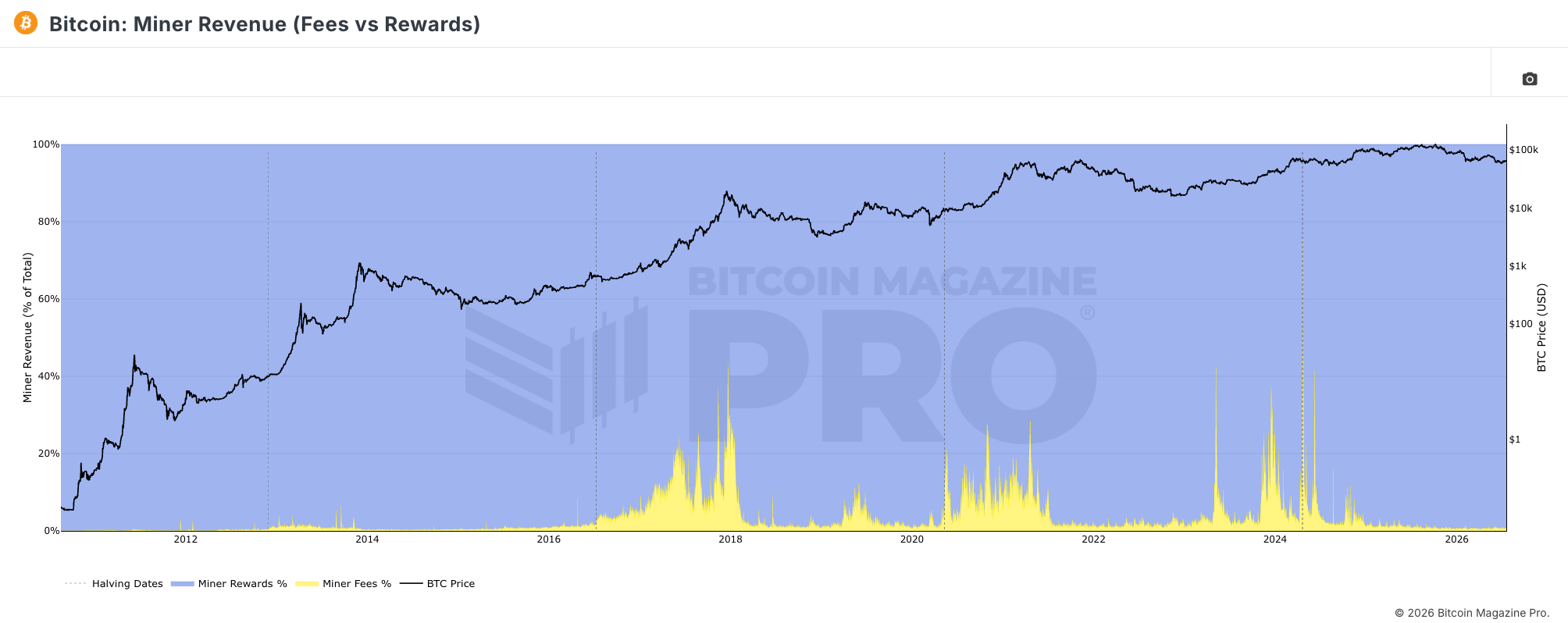
The real mining story arrived by accident. From early 2023, developers used Taproot's script space to embed images and data on chain through inscriptions and the Ordinals protocol. Demand for block space surged. Network fees totaled about 23,445 BTC in 2023 against about 5,375 BTC in 2022. The Runes launch on halving day in April 2024 pushed about 37.6 BTC of fees into a single block against a 3.125 BTC subsidy.
Treat those spikes as episodic upside rather than a revenue floor. Fees fell back to a low single digit share of miner revenue by late 2024. A machine that sits offline during a fee spike earns nothing from it. That is why uptime discipline matters more in a fee driven market. Simple Mining runs hosted machines at 95% average uptime with precision billing, so clients pay only for the hours their hardware spends hashing and capture fee events when they hit.
Taproot Activation and Adoption
Taproot activated at block 709,632 on November 14, 2021 through a miner signaling process called Speedy Trial. About 90% of hashrate signaled support in June 2021, which locked the upgrade in for November.
Speedy Trial is a BIP 9 style deployment. Miners signal readiness inside the blocks they mine during a fixed window. The signaling timeline shows how fast consensus formed compared with the SegWit fight of 2017. Once locked in, enforcement fell to node software rather than to miners. The rules shipped in Bitcoin Core version 21.1, the reference implementation most Bitcoin nodes run.
Adoption remains a minority of Bitcoin transactions. Usage spiked above 40% during the 2024 inscription and Runes wave, then settled lower as that demand cooled. That 40% figure measures adoption, defined as the share of transactions with at least one Taproot input. Glassnode's live Taproot adoption chart tracks the current share. Wallet and exchange support keeps widening even while transaction share moves with market cycles.
FAQs about Taproot in Bitcoin
Is Taproot a hard fork or soft fork?
Taproot is a soft fork. The upgrade tightens Bitcoin's rules in a backward compatible way, so nodes that never upgraded remain on the same network. No chain split occurred at activation.
Do Bitcoin holders need to do anything after Taproot?
No. Bitcoin held before the upgrade remains valid and spendable with no action required. Wallets add Taproot support on their own schedules, so holders can start using Taproot addresses whenever their wallet offers them.
Does Taproot affect transaction fees for miners?
Not on its own. Taproot makes many transactions smaller, which saves users money rather than raising miner revenue. Inscription activity built on Taproot has driven episodic fee spikes since 2023, though miner fee revenue always depends on demand for block space.
What is the difference between Taproot and the Lightning Network?
Taproot is a base layer protocol upgrade. The Lightning Network is a separate Layer 2 payment system built on top of Bitcoin. Taproot improves Lightning by making channel opens look like ordinary payments on the blockchain.
How widely is Taproot being used today?
Taproot signs a minority of Bitcoin transactions. Usage spiked above 40% during the 2024 inscription wave and settled lower once that demand cooled. Adoption keeps growing as more wallets and exchanges add support.
What Taproot Means for Bitcoin Miners and Investors
For miners Taproot proves that fee markets can move fast. The upgrade cost nothing to adopt and later delivered episodic fee windfalls through inscriptions. Model fee revenue as variance rather than baseline and keep machines online to capture the spikes.
For investors Taproot signals that Bitcoin still evolves with care. The network shipped its biggest change in four years without a chain split. That restraint is a feature rather than a limitation. A protocol that upgrades without drama is a protocol worth securing.
The best upgrades are the ones nobody has to notice. If you want mining exposure without running hardware yourself, test the experience with Simple Mining's free 7-day trial with 235 TH/s before you commit capital.