

What Is a Merkle Tree? How It Works
By Josh Heine, Content Strategist at Simple Mining
Published July 22, 2026
A Merkle tree is the structure that lets Bitcoin prove one transaction belongs to a block without checking every other transaction. It condenses thousands of records into a single fingerprint called the Merkle root. Every Bitcoin block relies on one. Understanding the tree explains how the network verifies data at scale with almost no overhead.
Key Takeaways
- A Merkle tree condenses every transaction in a Bitcoin block into one hash called the Merkle root.
- The tree is built from the bottom up by hashing transactions in pairs until one hash remains.
- A Merkle proof shows a transaction belongs to a block using only a handful of hashes.
- SPV wallets use Merkle proofs to confirm a transaction is included without downloading the full blockchain.
- Miners hash the Merkle root inside the 80-byte block header during proof of work.
What Is a Merkle Tree
A Merkle tree is a data structure that condenses a large set of data into one hash called the root hash. It is also known as a hash tree. Each piece of data sits at the bottom of the tree as a hashed leaf. Each level above combines two hashes into one until a single hash remains at the top. Anyone who trusts that top hash can verify any piece of data below it without downloading the full set.
The building block is the cryptographic hash function. In Bitcoin each transaction runs through the same SHA-256 hash function that secures the rest of the network. A hash acts like a fingerprint for data. It has a fixed length and it is infeasible to forge.
Three terms come up again and again:
- Hash tree: another name for a Merkle tree. The two terms are interchangeable.
- Cryptographic hash function: a function that converts any data into a fixed-length fingerprint that is infeasible to forge.
- Root hash: the single hash at the top of the tree that represents all the data beneath it.
How a Merkle Tree Works
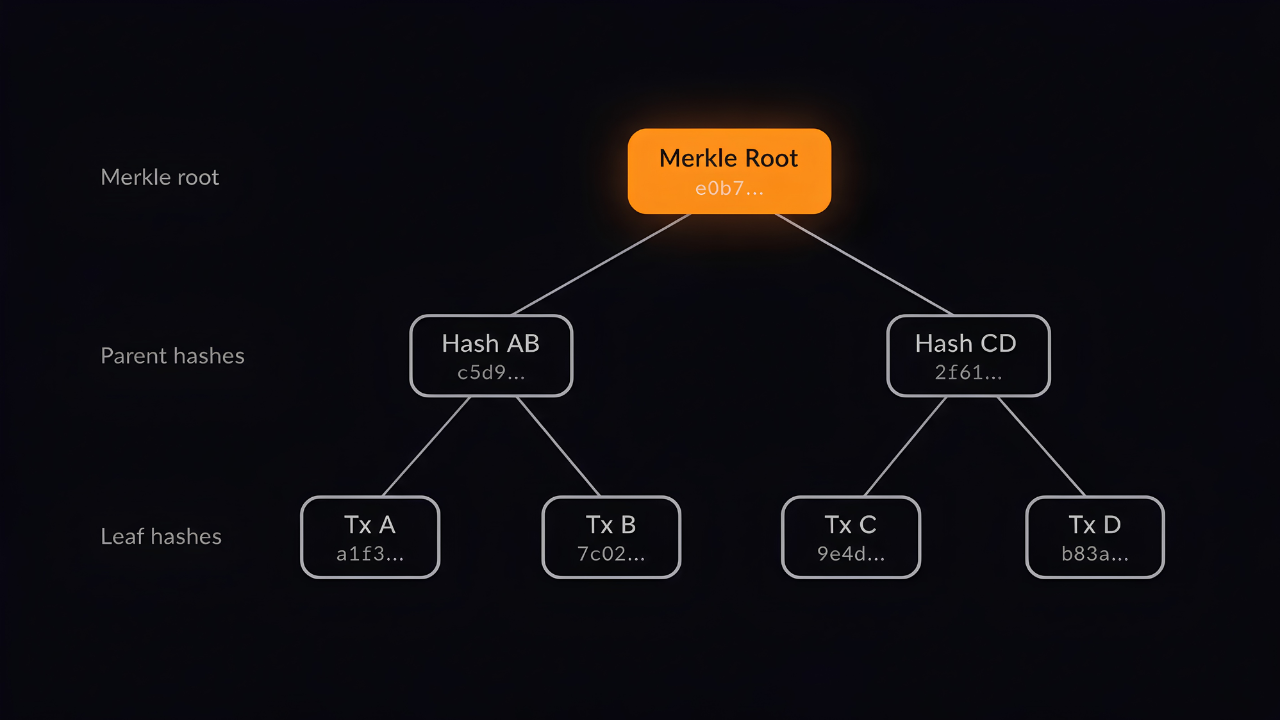
A Merkle tree works by hashing data in pairs from the bottom up until one hash remains at the top. The structure has three layers. Leaves sit at the bottom. Branches fill the middle. The root caps the top.
Hashing Transaction Data
Every transaction gets hashed on its own first. The output becomes a leaf at the bottom of the tree. A block with 2,000 transactions starts with 2,000 leaves.
Pairing and Combining Hashes
The leaf hashes then pair up from left to right. Each pair gets joined into one string and hashed again. The output is a parent node one level up. This layer of parents forms the branches of the tree.
Building to the Merkle Root
The parents pair up and hash again. The process repeats level after level as the tree narrows. It stops when one hash remains. That final hash is the Merkle root.
What Is a Merkle Root
The Merkle root is the single hash at the top of the tree that represents every piece of data below it. Change one byte in any transaction and the root changes from end to end. That sensitivity makes tampering easy to detect. In Bitcoin the Merkle root is the single hash that ends up in the block header.
How to Build a Merkle Tree
Building a Merkle tree takes four steps that repeat one simple operation. The same recipe works for transactions or file chunks or any other records.
1. Hash Each Data Block
Run each piece of data through a cryptographic hash function such as SHA-256. Each output becomes a leaf hash at the bottom of the tree.
2. Pair Adjacent Hashes
Group the leaf hashes into pairs from left to right. If the count is odd, duplicate the last hash to complete the final pair. Bitcoin uses this same duplication rule.
3. Hash Each Pair Into Parent Nodes
Join each pair into one string and hash the result. Each output becomes a parent node one level up.
4. Repeat Until One Root Hash Remains
Treat the parents as a new row and repeat the pairing and hashing. The tree narrows at every level. Stop when a single hash remains. That hash is your Merkle root.
What Is a Merkle Proof
A Merkle proof is a small set of hashes that proves one piece of data belongs to a tree without revealing the rest. It is also called a proof of inclusion. The proof contains one hash from each level of the tree.
How Merkle Proofs Verify Transactions
The verifier starts with the hash of the target transaction. They combine it with the first proof hash and compute the parent. They repeat that step at each level until they reach a candidate root. If the candidate matches the known Merkle root, the transaction belongs to the block. The workload stays small because the proof holds one hash per level.
Simple Payment Verification in Bitcoin
Simple Payment Verification (SPV) lets lightweight Bitcoin wallets confirm a transaction is included in a block without downloading the whole chain. Satoshi Nakamoto described the method in the Bitcoin whitepaper. An SPV wallet keeps block headers and requests a Merkle proof from a full Bitcoin node when it needs to check a payment. The proof confirms inclusion in a block. It does not validate the transaction against every consensus rule.
Why Merkle Trees Matter for Bitcoin
Merkle trees give Bitcoin fast verification with built-in tamper detection and a small storage footprint. One detail matters here. Bitcoin hashes every leaf and every internal node with SHA-256 applied twice. This double hashing is a Bitcoin design choice rather than a requirement of the tree itself.
Fast Transaction Verification
Verification cost grows with the number of levels rather than the number of transactions. Doubling the transaction count adds one extra level to check. A block with thousands of transactions needs about a dozen hash comparisons to prove one of them belongs.
Tamper-Evident Block Integrity
Any altered transaction changes its leaf hash. The change cascades upward and produces a different Merkle root. Nodes spot the mismatch against the block header and reject the block. The tree detects tampering rather than preventing it. Detection is enough because the network refuses blocks that fail the check.
Reduced Data Storage Requirements
Lightweight clients store block headers at about 80 bytes per block. The full transaction data lives elsewhere on the network. When a client needs proof, it requests a handful of hashes instead of the whole block. Merkle roots make that division of labor safe.
Benefits of Using Merkle Trees
The same structure earns its keep far beyond one blockchain. Four advantages stand out:
- Efficient data verification: prove data integrity without transmitting the entire dataset.
- Tamper detection: any change to the underlying data changes the root hash.
- Scalability: verification stays fast as the dataset grows.
- Decentralized trust: independent parties can verify the same root without trusting each other.
Bitcoin also puts the structure to work beyond transactions. It hides unused spending conditions inside Taproot's MAST commitments using the same pairwise hashing idea.
How Bitcoin Miners Use Merkle Trees
Miners use Merkle trees to compress every transaction in a candidate block into one 32-byte root before proof of work begins. The root stands in for the full transaction set during the hash search.
Merkle Roots in Block Headers
Every Bitcoin block header holds the Merkle root as one 32-byte field inside an 80-byte structure. The header also contains:
- the version
- the previous block hash
- the timestamp
- the difficulty bits
- the nonce
Miners hash the header with double SHA-256 during proof of work. They never hash the raw transactions during the search. The root represents all of them.
Transaction Selection and Block Construction
A miner selects transactions from the mempool and arranges them into a Merkle tree. The miner computes the root and places it in the header before hashing begins.
The 4-byte nonce runs out of values in a fraction of a second on modern hardware. To keep searching, the miner rolls the extranonce inside the coinbase transaction. That change touches one leaf of the tree. Only the branch from that leaf up to the root needs recomputing. A handful of hashes refreshes the header instead of a full rebuild.
FAQs About Merkle Trees
Who invented the Merkle tree?
Ralph Merkle invented the structure and filed the patent in 1979. The patent was granted in 1982. He designed it as a method for secure digital signatures and data verification.
What is the difference between a Merkle tree and a hash tree?
There is no difference. "Hash tree" and "Merkle tree" are interchangeable names for the same data structure.
Can Merkle trees be used outside of cryptocurrency?
Yes. Systems like Git use the same hash-linked approach to track file versions. Hash trees also protect data in IPFS, BitTorrent, ZFS, Certificate Transparency, and Apache Cassandra.
How fast can a Merkle tree verify data?
Verification work grows with the number of tree levels rather than the size of the dataset. A tree with millions of entries needs a few dozen hash comparisons at most. Doubling the data adds one extra step.
What happens if a Merkle tree hash does not match?
A mismatched hash means the data was altered or corrupted somewhere below that point. The system rejects the data as invalid. In Bitcoin a node discards any block whose transactions fail to reproduce the Merkle root in the header.
Mine Bitcoin With Confidence
Merkle trees turn a mountain of transactions into one hash the whole network can trust. That habit of verifying instead of trusting is the same discipline that makes Bitcoin worth mining. Understanding the fundamentals helps you evaluate mining as an investment with clear eyes.
Simple Mining handles the infrastructure side from its facilities in Iowa. The fleet runs at 95% average uptime across 9+ EH/s under management and 150+ MW of capacity. Precision billing charges you only for the time your machine is online. Test the experience with a 7-day free trial on an Antminer S21+ (235 TH/s).
Verify everything and trust the math. When you are ready to put hashrate behind that principle, shop our Bitcoin miners and let Simple Mining host them.