

Is Bitcoin Traceable? How Anonymous Bitcoin Really Is
By Josh Heine, Content Strategist at Simple Mining
Updated July 22, 2026Published December 19, 2025
Yes, Bitcoin is traceable. Every transaction since January 2009 sits on a public ledger that anyone can inspect. This surprises investors who assume cryptocurrency means anonymity. The truth is more useful than the myth. Understanding how Bitcoin traceability works leads to better custody and better operational decisions.
On this page · 13 sections
- Is Bitcoin Traceable
- Why Bitcoin Is Pseudonymous Not Anonymous
- How Bitcoin Transactions Are Recorded
- How Blockchain Analysis Tools Trace Bitcoin
- Can Law Enforcement Trace Bitcoin
- What Makes Bitcoin Traceable in Practice
- Ways to Enhance Bitcoin Privacy
- Is There an Anonymous Bitcoin Wallet
- Real Cases Where Bitcoin Was Traced
- How Bitcoin Compares to Privacy Coins
- Does Bitcoin Mining Create Traceable Records
- FAQs About Bitcoin Traceability
- What Bitcoin Traceability Means for Miners and Investors
Key Takeaways
- Bitcoin is pseudonymous, not anonymous. Every transaction records on a public blockchain that anyone can view and trace.
- KYC exchanges create the main identification point. Once your address links to your identity, your entire transaction history becomes visible.
- Chain analysis firms attribute the bulk of Bitcoin flows to named services like exchanges. Clustering and pattern recognition connect addresses to owners.
- Privacy requires active effort. Fresh addresses, wallet separation, and careful habits do more than any single tool.
- Mined Bitcoin arrives clean of prior transaction history. It remains traceable from the coinbase transaction forward.
Is Bitcoin Traceable
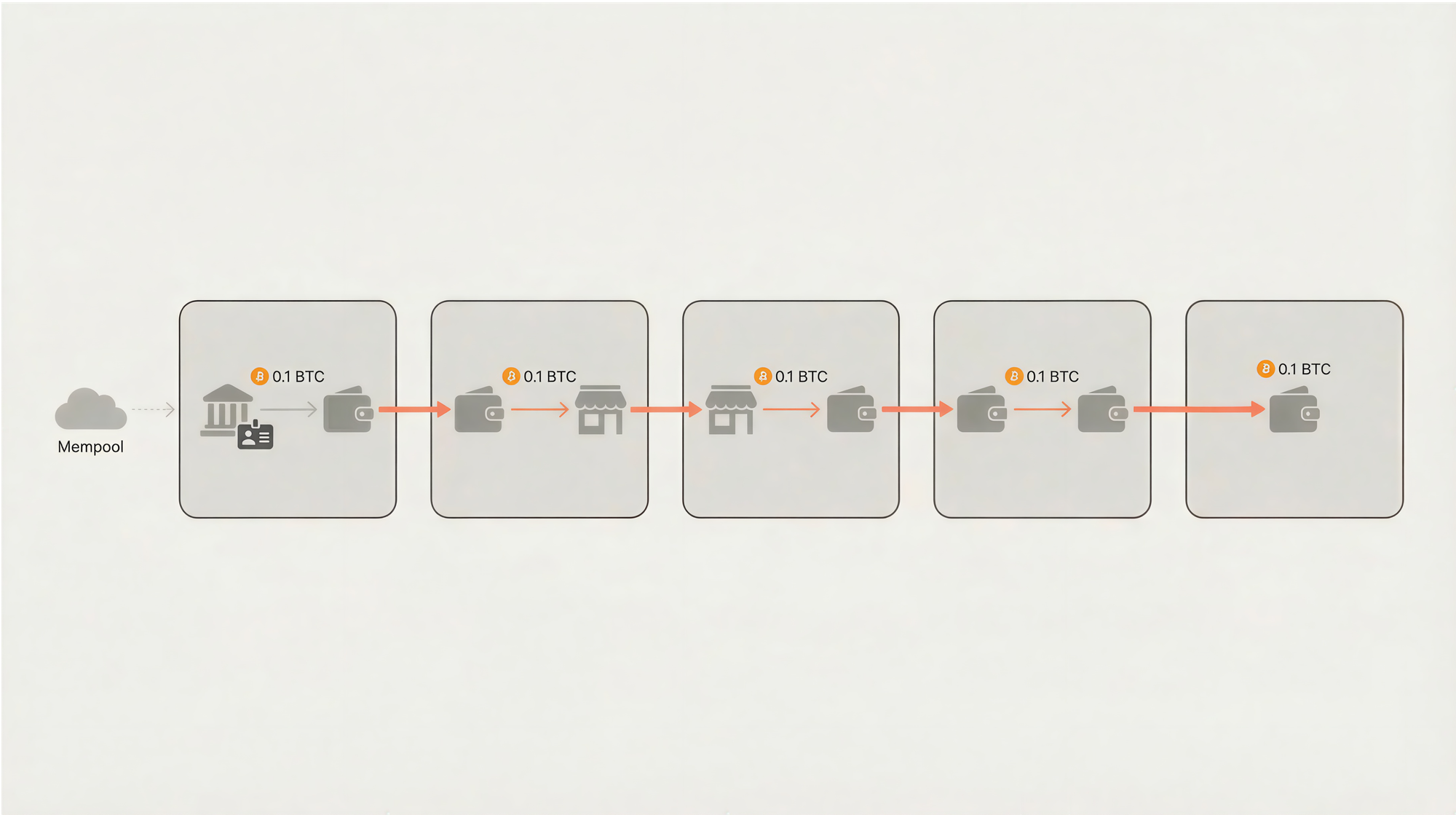
Yes, Bitcoin is traceable because every transaction is recorded on a public and immutable ledger called the blockchain. Bitcoin is pseudonymous rather than anonymous. Transactions tie to wallet addresses instead of real names. Investigators and blockchain analysis tools can still follow funds between addresses with precision.
Three properties drive this:
- Public ledger: Anyone can view the sender address, receiver address, amount, and timestamp of every transaction.
- Pseudonymous design: Addresses are not names. They can still be linked to identities through exchanges, IP data, and behavior.
- Permanent record: Once confirmed, a transaction cannot be deleted or altered.
Why Bitcoin Is Pseudonymous Not Anonymous
Bitcoin is pseudonymous because activity ties to a consistent identifier that can be linked to you. Anonymous means no identifier attaches to your actions at all. Pseudonymous means your actions attach to a stand-in identity. Your wallet address is that stand-in.
Think of a public library checkout system. The card number appears on every borrowed book. Anyone can see which card borrowed what. The moment someone connects your name to the card number, your entire reading history becomes visible. A Bitcoin address works the same way as a pen name for an author. Link the pen name to the person once and every prior work links too.
How Bitcoin Transactions Are Recorded
Every Bitcoin transaction broadcasts to the network and lands in a permanent public record. Your transaction first enters the mempool and waits for confirmation. Miners then include it in a block. From that point anyone with internet access can view it on a block explorer such as mempool.space.
Transaction Inputs and Outputs
Each transaction shows where funds come from and where they go. Inputs reference prior unspent outputs. Outputs assign coins to new addresses. This UTXO structure creates an unbroken chain of custody across the ledger. Analysts follow the chain hop by hop.
Wallet Addresses and Public Keys
A wallet address is the public identifier that sends and receives Bitcoin. The address contains no personal information on its own. It still accumulates a complete and visible history of everything it touches. Your Bitcoin wallet manages the private keys behind those addresses. The keys stay secret while the addresses stay public.
The Immutable Public Ledger
Blockchain records are permanent. No one can alter or delete a confirmed transaction. Something hard to trace today may become trivial to trace in a decade as tools improve. The ledger waits. That permanence is the core reason Bitcoin privacy demands planning rather than cleanup.
How Blockchain Analysis Tools Trace Bitcoin
Blockchain analysis firms turn raw ledger data into named entities and money trails. An entire industry exists to de-anonymize Bitcoin activity for exchanges and governments. Chainalysis explains its own attribution process in three stages. It clusters addresses first. It then identifies the owner and categorizes the entity. These firms attribute the bulk of Bitcoin flows to named services like exchanges.
Chainalysis and Elliptic
Chainalysis and Elliptic are the two largest blockchain analytics companies. They sell tracing software to law enforcement and to financial institutions. Their databases label millions of addresses with the real-world services behind them. When your coins touch a labeled address, the connection records.
Cluster Analysis and Heuristics
Cluster analysis groups addresses that belong to the same owner. The most common heuristic is co-spending. When a wallet pulls from three addresses to fund one payment, software infers all three share an owner. Change address detection extends the cluster further. One identified address can expose hundreds of others.
Pattern Recognition
Analytics firms study behavior across billions of transactions. Timing patterns and counterparty patterns narrow down ownership. Repeated peel chains suggest laundering. Consistent payout schedules suggest a mining pool or an exchange. Behavior identifies owners even when addresses rotate.
Can Law Enforcement Trace Bitcoin
Yes, law enforcement traces Bitcoin with dedicated units and commercial analytics tools. The FBI and IRS Criminal Investigation both run specialized crypto teams. The playbook is consistent. Investigators follow funds on the public ledger until the coins reach a regulated service. A subpoena to that exchange then converts an address into a name.
This is why Bitcoin is a poor tool for criminals. Cash leaves no ledger. Bitcoin leaves a permanent one. The real cases below show how often the permanent record wins.
What Makes Bitcoin Traceable in Practice
Bitcoin becomes traceable to a person at the points where addresses meet identity. The ledger alone shows pseudonyms. Three practical factors convert pseudonyms into names.
KYC Requirements at Exchanges
Regulated exchanges require identity verification before you trade. KYC rules link your legal identity and bank account to every address you deposit to or withdraw from. This is the single largest tracing vector. Exchanges share records with tax authorities and forensic firms on request.
The reporting is now formalized in the United States. Custodial exchanges file Form 1099-DA with the IRS for sales made in 2025 and later. Cost basis reporting begins for assets acquired in 2026 and later. The Travel Rule pushes similar data sharing between exchanges worldwide. Buy 0.5 BTC on a KYC exchange and withdraw it. That wallet now connects to your identity from the first block forward.
IP Addresses and Metadata
Network metadata adds a second tracing layer. Nodes can log the IP address that broadcasts a transaction. Public posts add more. Share a donation address on social media and you tie your public identity to every coin that flows through it.
Reused Addresses and Patterns
Address reuse is the most common self-inflicted privacy failure. One reused address concentrates your history in a single visible spot. Predictable behavior compounds the problem. Same amounts on the same schedule to the same counterparties. Analysts read those habits like a signature.
What can go wrong: You post one donation address and reuse it for savings. A single identification point now cascades across your entire transaction graph.
How to mitigate: Generate a new address for every receipt. Keep exchange coins, savings, and spending in separate wallets. Decide the identity question before the first transaction rather than after.
Ways to Enhance Bitcoin Privacy
Bitcoin privacy comes from habits rather than from any single product. The protocol gives you pseudonymity. Your practices decide whether it holds. A simple hygiene checklist covers most investors:
- Generate a fresh receiving address for every payment
- Keep separate wallets for separate purposes
- Never post an address you also use for savings
- Withdraw from exchanges to self-custody rather than leaving coins in one labeled cluster
- Review your UTXOs before consolidating them into one transaction
Using New Addresses
Fresh addresses are the highest-value privacy habit. Bitcoin.org recommends a new address for every payment you receive. Modern wallets do this by default. Taproot helps at the script level too. Its uniform spend format makes complex spends look like ordinary ones. It does not hide amounts or addresses. The transaction graph stays visible.
Hardware Wallets and Self Custody
Self-custody removes ongoing exchange visibility into your balances. A cold wallet keeps your keys offline and your future activity out of a custodian's database. Understand the limit. Coins withdrawn from a KYC exchange stay linked to your identity at the withdrawal point. The hardware wallet adds security going forward. It does not add retroactive privacy.
CoinJoin and Mixing Services
CoinJoin combines transactions from many users to obscure which input paid which output. Mixers pursue the same goal through a custodial pool. Both exist for legitimate privacy reasons and both attract illicit use. Mixing services occupy contested legal ground. Sanctions and prosecutions have targeted operators, and several mixer operators have been convicted in U.S. courts. Treatment varies by jurisdiction. Exchanges also flag mixed coins, which can delay or freeze deposits. Weigh those trade-offs before touching the category.
Is There an Anonymous Bitcoin Wallet
No wallet makes Bitcoin anonymous. Every wallet spends from the same public ledger. Marketing that promises an anonymous Bitcoin wallet is selling something the protocol cannot deliver. What a non-custodial wallet can do is remove exchange surveillance from your future activity. No account. No KYC file. No custodian watching your balance.
The on-chain record still exists forever. Coins that arrive from a KYC source carry that link with them. Privacy then depends on the habits above rather than on the wallet brand. Choose a wallet for security and key control. Build privacy through practice.
Real Cases Where Bitcoin Was Traced
Federal cases prove Bitcoin's traceability at billion-dollar scale. Three stand out.
Silk Road Takedown and the Individual X Seizure
Investigators traced Silk Road's Bitcoin flows and shut the darknet market down in 2013. Founder Ross Ulbricht was convicted in 2015 and sentenced to life. He served over 11 years before receiving a full presidential pardon in January 2025. The pardon changed his legal status. It did not change the traceability lesson.
The ledger kept working long after the site died. In November 2020 the DOJ seized about 69,370 BTC tied to Silk Road from a hacker known in court filings only as Individual X. Chain analysis found the dormant wallet seven years after the marketplace closed. A federal court cleared the government to liquidate the coins in a late 2024 ruling. The stash was then worth about $6.5 billion.
Colonial Pipeline Recovery
Colonial Pipeline paid a 75 BTC ransom to the DarkSide ransomware group in May 2021. The FBI traced the payment across the public ledger to a wallet it could access. Within a month the bureau recovered 63.7 of the 75 BTC. A ransom paid in Bitcoin left a trail that cash never would.
The Bitfinex Hack
A hacker moved 119,754 BTC out of the Bitfinex exchange in 2016. Years of laundering attempts failed to break the trail. Chain analysis led agents to Ilya Lichtenstein and Heather Morgan in 2022. Agents seized about 94,000 BTC at the arrest. Both pleaded guilty in 2023. Lichtenstein received five years in 2024 and Morgan received 18 months. Six years of obfuscation lost to a permanent ledger.
How Bitcoin Compares to Privacy Coins
Bitcoin trades default privacy for auditability and that trade supports its monetary role. Privacy coins like Monero hide the sender, receiver and amount by default. The cost is verification. Hidden amounts make supply audits harder and regulators respond with delistings.
| Feature | Bitcoin | Privacy Coins (Monero, Zcash) |
|---|---|---|
| Transaction visibility | Public | Hidden or optional |
| Address linkability | Traceable | Obfuscated |
| Supply auditability | Full | Reduced |
| Regulatory acceptance | High | Lower |
For most investors Bitcoin remains the superior monetary asset. Its track record runs since January 2009. The network settles billions of dollars in value every day. No privacy coin approaches that scale or liquidity. Active privacy habits on Bitcoin give most people sufficient protection without leaving the strongest network.
Does Bitcoin Mining Create Traceable Records
Yes, mining creates traceable records because every block reward starts with a public coinbase transaction. The coinbase transaction mints new Bitcoin to the winning miner or pool. Pool payouts then move on-chain to miner wallets like any other transfer. Anyone can watch them.
Mining still changes one thing about your coins. Mined Bitcoin arrives clean of prior transaction history. No previous owner. No exchange withdrawal link at origin. No cluster tying your coins to thousands of strangers. The record starts at the block reward and you control every decision after it.
Here is an operator detail most articles miss. Miners tend to point pool payouts at one address for months. That habit builds a public accumulation record anyone can total. Rotate payout addresses if accumulation privacy matters to you.
FAQs About Bitcoin Traceability
Can Bitcoin be traced to a person?
Yes, Bitcoin can be traced to a person once an address links to a real identity. KYC exchanges create most of those links. IP logs and public posts create the rest.
Can the FBI trace Bitcoin?
Yes, the FBI traces Bitcoin with dedicated crypto units and commercial analysis tools. The bureau recovered 63.7 of the 75 BTC ransom in the Colonial Pipeline case within a month. The public ledger makes Bitcoin easier to follow than cash.
Can the IRS see Bitcoin transactions?
Yes, the IRS sees Bitcoin activity through the public ledger and through exchange reporting. Custodial exchanges now file Form 1099-DA for sales made in 2025 and later. Cost basis reporting begins for assets acquired in 2026 and later.
Can Bitcoin transactions be traced if I use a VPN?
Yes, Bitcoin transactions stay traceable even with a VPN. The VPN hides your IP address when you broadcast a transaction. The blockchain record itself stays public and traceable through chain analysis.
Are Bitcoin ATM transactions traceable?
Yes, Bitcoin ATM transactions are traceable. Each purchase records on the blockchain like any other transaction. Most ATMs also require identity verification under current regulations.
Does converting Bitcoin to cash make it untraceable?
No, converting Bitcoin to cash does not erase the trail. The blockchain record stays permanent after the sale. Cash-out points like exchanges and ATMs also verify identity.
What Bitcoin Traceability Means for Miners and Investors
Traceability is a feature for legitimate participants rather than a flaw. The transparent ledger lets you verify the total supply. It lets you confirm settlement without trusting anyone. It protects investors from the hidden inflation that plagues opaque systems. The same transparency demands intentional privacy habits from day one.
Mining offers the cleanest acquisition path. Starting with mining means your coins begin with no prior history and no exchange cluster. Mined coins are not anonymous. Every pool payout is recorded on the public ledger, and your privacy from that point depends on your own practices.
Simple Mining operates 150+ MW of U.S.-based infrastructure with 9+ EH/s under management. The company is headquartered in Cedar Falls, Iowa. Clients own their machines and watch real-time hashrate and billing data on a dashboard built for verification. Precision billing charges only for time online and hashing. Machines purchased through Simple Mining include Year 1 Repair Coverage with free repair labor at one of the largest certified ASIC repair centers in North America. New clients can test the experience with a free 7-day trial on an Antminer S21+ (235 TH/s). The trial runs on the Ocean pool through DATUM with payouts you can verify on-chain.
The ledger never forgets. Plan like it.
Ready to mine your own Bitcoin? Explore Simple Mining hosting and start your free 7-day trial.