

What Is BIP-110? Bitcoin's Data-Limit Proposal and Why It Failed
By Josh Heine, Content Strategist at Simple Mining
Updated August 10, 2026Published July 9, 2026
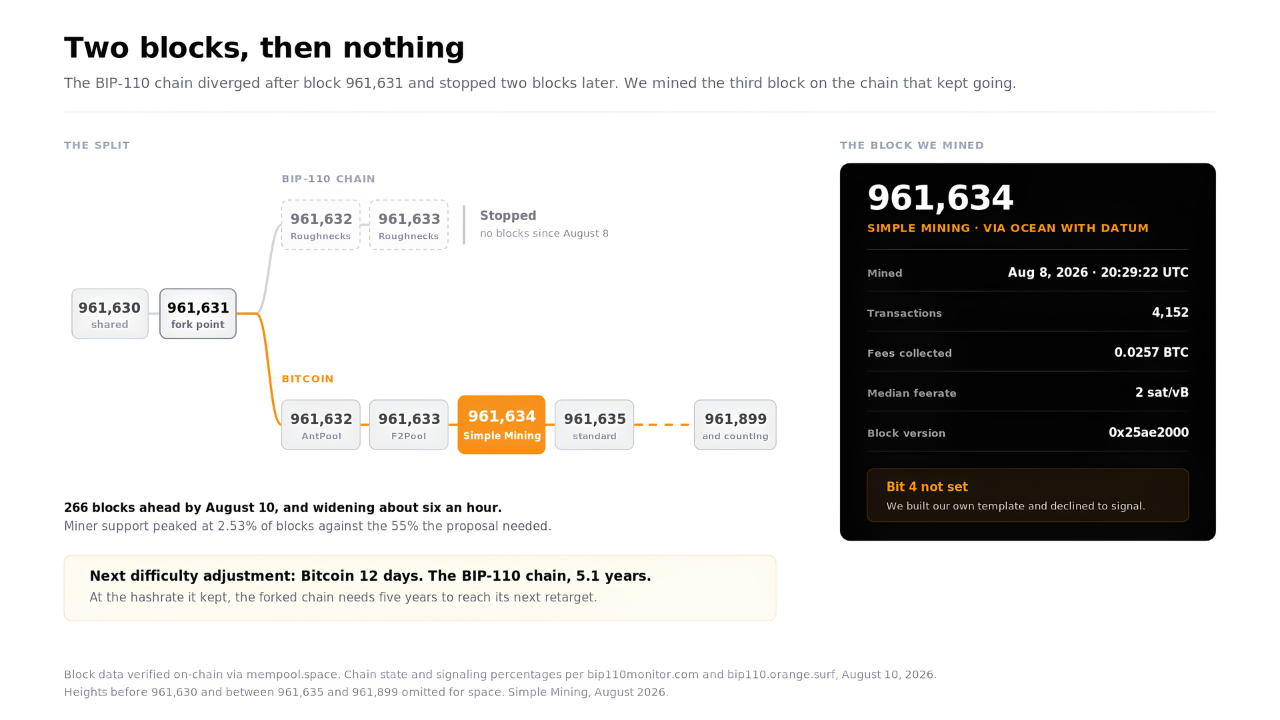
BIP-110 was a proposed Bitcoin soft fork that limited how much arbitrary data a transaction could carry. Supporters framed it as a defense of Bitcoin's role as sound money. Critics framed it as censorship with real chain split risk. It got its answer on August 8, 2026: miner support peaked at 2.53%, the chain enforcing it produced two blocks and stopped, and Bitcoin kept going without it. This guide covers what the proposal was, what the seven rules would have done, why it failed, and what the split revealed about who actually controls a block.
On this page · 14 sections
- What Is BIP-110?
- What Is a Bitcoin Improvement Proposal?
- Why Was BIP-110 Proposed?
- How Does BIP-110 Change Bitcoin's Data Limits?
- How Does BIP-110 Activate?
- What Happened to BIP-110 in August 2026
- Who Actually Controls a Block
- Bitcoin Knots and BIP-110
- The Bitcoin Fork Debate Around BIP-110
- Arguments For and Against BIP-110
- What Does BIP-110 Mean for Bitcoin Miners?
- How Should Miners Prepare for Bitcoin Protocol Changes?
- FAQs About BIP-110
- Blocks Settle the Debate
Key Takeaways
- BIP-110 (Reduced Data Temporary Softfork) was a proposed one-year Bitcoin soft fork that would have restricted arbitrary data in transactions.
- Seven rules would have capped most new outputs at 34 bytes, OP_RETURN at 83 bytes, and data pushes at 256 bytes.
- Miner support peaked at 2.53% of blocks in the final voluntary period against a 55% threshold, and every signaling block came from a single pool.
- The mandatory window opened at block 961,632 on August 8, 2026. The BIP-110 chain produced two blocks, stalled, and has not extended since. Signaling on the surviving chain is 0.00%.
- Miners needed no hardware changes. Pool policy decided which chain a miner's hashrate landed on, and DATUM miners on Ocean ended up on both sides of the split.
What Is BIP-110?
BIP-110 was a proposed temporary Bitcoin soft fork that would have restricted arbitrary non-financial data in transactions for about one year. The full specification lives in the Bitcoin BIPs repository. Here is the proposal at a glance:
- Full name: Reduced Data Temporary Softfork (RDTS), which first circulated as BIP-444
- Purpose: restrict non-financial data embedded in Bitcoin transactions
- Targets: Ordinals inscriptions, BRC-20 tokens, Runes, and oversized OP_RETURN payloads
- Mechanism: seven consensus rules capping output sizes and data fields
- Duration: the rules would have expired on their own about one year after activation
- Status: reached Complete status in the BIPs repository on June 25, 2026, entered mandatory signaling at block 961,632 on August 8, 2026, and failed. Its chain stalled after two blocks.
The proposal is authored under the pseudonym Dathon Ohm with developer Luke Dashjr credited for the original draft and advice. Authorship remains disputed. Greg Maxwell has alleged Ocean Mining wrote it and Dathon Ohm denies the claim.
What Is a Bitcoin Improvement Proposal?
A Bitcoin Improvement Proposal (BIP) is a formal design document that proposes a change to Bitcoin's protocol or its processes. BIPs receive sequential numbers, which is why this one is number 110.
BIPs fall into three broad types:
- Standards Track: changes to the network protocol or consensus rules
- Informational: guidelines or design discussion
- Process: changes to how decisions get made
A BIP number signals process compliance rather than endorsement. BIP editor Mark "Murch" Erhardt assigned BIP-110 its number while describing it as "a misguided and unusually careless softfork proposal." He published it anyway because it met the repository's criteria. No BIP activates without broad support across miners and the wider economy.
Why Was BIP-110 Proposed?
BIP-110 existed because a wave of data embedding that began in 2022 convinced some Bitcoiners that policy filters were no longer enough.
The Rise of Ordinals and Inscriptions
The "inscription" method appeared in 2022 and stores arbitrary data inside transaction witness fields. Ordinals popularized the technique in early 2023 and brought images and NFT-style assets onto the Bitcoin blockchain. Supporters of BIP-110 call this traffic spam. Users of these protocols call it valid paid block space.
Node Burden and the Fee Market
Proponents argue the economics are lopsided: a miner collects the fee once while every node stores the data forever. Critics respond that the block size limit already caps node costs and that the fee market prices out spam on its own.
From Policy Dispute to Consensus Proposal
The fight escalated after Bitcoin Core v30 removed the long-standing OP_RETURN relay limit in 2025. BIP-110 answered by proposing to move those limits into consensus, where no single software release could undo them.
How Does BIP-110 Change Bitcoin's Data Limits?
BIP-110 would have added seven consensus rules capping the size of data fields in new transactions. The common "83-byte" shorthand applies only to OP_RETURN outputs.
| Rule | Limit under BIP-110 |
|---|---|
| New output scriptPubKeys | 34 bytes maximum (OP_RETURN excepted) |
| OP_RETURN outputs | 83 bytes maximum |
| Data pushes and witness items | 256 bytes maximum |
| Taproot control blocks | 257 bytes maximum |
| Undefined witness versions | Spending becomes invalid |
| Taproot annex | Invalid |
| OP_SUCCESS and OP_IF/OP_NOTIF in Tapscripts | Invalid |
Grandfathering would have been permanent. UTXOs created before activation would have stayed exempt for the entire deployment with no deadline to move funds, and existing Ordinals and inscriptions would have remained untouched.
The soft fork would also have ended on its own. The rules were written to expire 52,416 blocks after activation, which works out to about one year. Expiry would have required no vote and no follow-up change.
How Does BIP-110 Activate?
BIP-110 was designed to activate through miner signaling or through a mandatory flag day. Both paths failed.
Miners signal readiness by setting version bit 4 in the blocks they produce. Early lock-in required 55% of blocks in a single 2,016-block difficulty period. That is 1,109 signaling blocks or about 110 per day across two weeks. Individual miners signal through whichever mining pool builds their block templates.
Node operators do not signal. They enforce. Running BIP-110 software such as Bitcoin Knots meant rejecting blocks that broke the rules once they applied. Bitcoin Core has not endorsed the proposal and an implementation submitted to Core has not been merged.
The deployment was a user activated soft fork (UASF). From block 961,632 through block 963,647, enforcing nodes reject any block that does not signal bit 4. Lock-in was scheduled no later than block 963,648, with activation at 965,664. That design is what produced the split rather than an activation: enforcing nodes rejected the first non-signaling block of the window, isolating themselves onto a chain almost no hashrate followed.
What Happened to BIP-110 in August 2026
BIP-110 failed. Miner support peaked at 2.53% of blocks against a 55% threshold, the chain enforcing it produced two blocks and stopped, and Bitcoin's main chain never paused.
Mandatory signaling opened at block 961,632 on August 8, 2026 at 19:35:55 UTC. AntPool mined the first block of the window without setting bit 4. Nodes running BIP-110 rejected it and followed a competing version of 961,632 mined by Roughnecks through Ocean, roughly 40 minutes later. That rejection was the split.
The BIP-110 chain produced exactly two blocks, 961,632 and 961,633, both by Roughnecks. It has not produced a block since. Roughnecks announced early on August 9 that it was stopping and advised anyone still mining that chain to stop as well. Analysts put roughly 0.15% of total hashrate on the branch at the split.
The Signaling Record
Signaling never exceeded 2.53% in any completed difficulty period.
| Period | Blocks signaling | Rate |
|---|---|---|
| 477 (mandatory window, as of Aug 10) | 0 of 266 | 0.00% |
| 476 (final voluntary period) | 51 of 2,016 | 2.53% |
| 475 | 26 of 2,016 | 1.29% |
| 474 | 20 of 2,016 | 0.99% |
| 473 | 9 of 2,016 | 0.45% |
| 472 | 16 of 2,016 | 0.79% |
| 471 | 7 of 2,016 | 0.35% |
Every signaling block in the final period came from Ocean. No other pool signaled once. The widely quoted "2.6%" was a rolling intra-period reading; the period closed at 2.53%.
Since the window opened, zero blocks on the surviving chain have set bit 4, including eight blocks tagged OCEAN. Foundry mined 61 post-window blocks and signaled on none of them. Its hashrate-weighted miner vote closed without a published result, and it never flipped.
What the Pools Did
Ocean had switched connected miners to signal by default on July 15 and supplied effectively all support. After the split, a Stratum configuration error routed some of its miners onto the BIP-110 chain for about 18 hours. Ocean restored its default endpoint to the non-BIP-110 chain and said it would distribute roughly 0.3 BTC in rebates, keeping both endpoints available for explicit selection. AntPool and F2Pool never signaled and mined 46 and 47 post-window blocks respectively.
What Did Not Happen
No reorganizations were reported on the main chain. No user fund losses have been confirmed. The fee market showed no stress, with blocks around the fork carrying median feerates of 0 to 3 sat/vB. Bitcoin traded above $65,000 through the window and spot ETFs took $853 million in inflows on August 9.
Who Actually Controls a Block
The split produced one genuinely useful demonstration, and Simple Mining is in it.
Block 961,634 came out of our Iowa facility at 20:29:22 UTC on August 8, 53 minutes after the window opened, mining through Ocean with DATUM. It carried 4,152 transactions and 0.026 BTC in fees, it did not set bit 4, and it extended the chain almost all hashrate was already on.
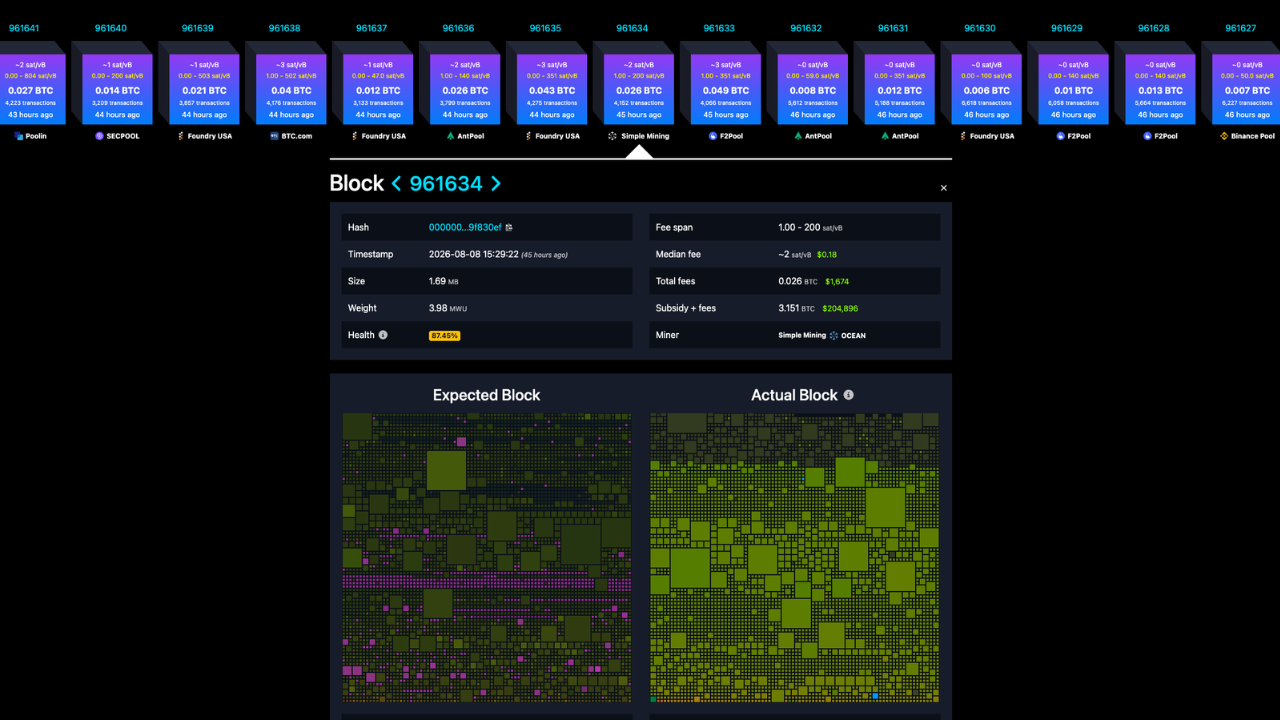
That looks contradictory: Ocean was signaling by default, and one of Ocean's own miners mined the fork's first block. Both are true. DATUM changes who builds the template. Under DATUM the miner's own Bitcoin node assembles the block, and the pool coordinates the reward split without creating the work. Because the header comes from the miner's node, the miner controls the version field, which is where bit 4 lives. Ocean's July default applied to pool-built templates and endpoint defaults, not to a miner running its own node.
That is why Ocean produced blocks on both chains that weekend. Roughnecks mined both blocks on the BIP-110 chain, and 961,634 on the main chain came through Simple Mining.
The evidence for this predates the window too. In the final voluntary period Ocean mined 69 blocks and only 51 of them signaled. Eighteen of those blocks came from miners already opting out before anyone had to choose a chain.
Bitcoin Knots and BIP-110
Bitcoin Knots is an alternative Bitcoin node implementation maintained by Luke Dashjr. It shipped the BIP-110 enforcement rules; Bitcoin Core never merged them. Running Knots with those rules meant rejecting any block that failed to signal during the mandatory window, which is exactly what produced the split.
Node counts stayed roughly flat through the event. Coin Dance showed Knots at 21.43% of reachable nodes on August 10 against Bitcoin Core at 78.46%, compared with roughly 22.65% in late June. Estimates of BIP-110-capable listening nodes specifically ranged far lower, from 2% to 8%, and the gap between those figures was disputed throughout. Enforcing that ruleset did not stop working when the fork stalled; those nodes simply follow a chain that stopped advancing unless their operators change software.
The Bitcoin Fork Debate Around BIP-110
BIP-110 is written as a soft fork, yet its activation method is the reason critics treat it as a fork threat.
Soft Fork vs Hard Fork Explained
A soft fork tightens the rules and old nodes still accept new blocks. A hard fork changes rules in a way old nodes reject, which can create a lasting chain split. BIP-110 qualifies as a soft fork because it only makes rules stricter.
Why Critics Dispute the Label
Critics point to three features. Mandatory signaling means enforcing nodes reject blocks from miners who never agreed to the change. Wallets using features the rules would have prohibited faced forward compatibility breakage even though nodes did not. And the 55% lock-in threshold replaces the traditional 95% standard for soft forks. Jameson Lopp's critical walkthrough argues these choices raise chain split risk well past prior soft forks.
Lessons From Previous Bitcoin Forks
SegWit activated in 2017 after the block size wars split the community for years. The UASF threat of that era (BIP 148) never triggered because SegWit locked in through miner signaling first. Critics cite that history to argue UASF safety is unproven. Supporters draw the opposite lesson and say the threat alone moved miners.
Arguments For and Against BIP-110
Both camps make claims worth weighing.
Why Supporters Backed BIP-110
- Anti-spam protection: limiting data keeps block space available for payments and holds fees down for monetary use
- Node accessibility: slower data growth keeps running a full node cheap
- Sound money focus: rejecting data storage as a supported use case keeps Bitcoin focused on its role as money
- Temporary by design: the rules would lapse on their own after about one year
- Split skepticism: supporters argue miners will not sacrifice block rewards over spam fees once the choice is real
Why Critics Opposed BIP-110
- Censorship precedent: consensus rules that filter transaction types set a precedent critics consider dangerous
- Innovation suppression: the control block limits would constrain BitVM and covenant research along with Miniscript edge cases
- Governance concern: some describe the campaign as a "hostile takeover" attempt by a small group
- Aggressive activation: a 55% threshold and mandatory signaling raise chain split risk
- Fund freezing edge cases: the specification itself concedes rare pre-signed Taproot transactions could freeze funds
- No replay protection: a split would leave transactions valid on both chains
Prominent names anchor the opposition. Adam Back argues the proposal breaks multiple things without stopping the embedding it targets and calls each flaw "fatal." Michael Saylor escalated from a single quote to a campaign across July, calling BIP-110 Bitcoin's "biggest self-inflicted risk," labeling it a "Bitcoin Iatrogenic Proposal," and publishing on X (Twitter) "110 Reasons BIP-110 Is a Bad Idea" on July 18. He sharpened the case on August 1, arguing that the 55% voluntary threshold had become mathematically unreachable for the period and that no major exchange, custodian, ETF platform, wallet, or payment network has been identified as enforcing the rules, which in his framing leaves more than 99% of Bitcoin's economic weight unadopted. Corporate treasuries, not just developers and node operators, are now active voices in protocol politics. Peter Todd embedded the full BIP text inside a compliant transaction to show determined data storage survives the rules. The specification concedes the rules raise the cost of data storage rather than eliminate it.
After the split both sides claimed vindication. Saylor wrote that Bitcoin "worked exactly as designed," noting the proposal was free to fork and the network free not to follow. Adam Back wrote "They forked off and found out." Luke Dashjr rejected the failure label, posting that "BIP110 is active on the Bitcoin network" and accusing pools and miners of attacking the network. On August 9, BIP editor Mark Erhardt formally recommended removing Dashjr as a BIP editor over his handling of the proposal; Dashjr rejected the allegations and the request remains open.
What Does BIP-110 Mean for Bitcoin Miners?
BIP-110 would have changed which transactions are valid, and that would have touched fee revenue and pool policy more than hardware.
Fee Revenue and Transaction Selection
Miners select the highest paying transactions waiting in the mempool. Ordinals and Runes activity pays real fees and has become a meaningful slice of miner revenue. That link helps explain thin miner interest in restricting the traffic. Fee swings feed straight into hashprice, so any rule that removes fee-paying demand matters to every operator.
Pool Positioning
Pools set the version bits in the blocks they build, which is what made pool choice the deciding factor in August. A pool's default endpoint determined which chain its miners' hashrate landed on, and Ocean's own misrouting cost about 18 hours of work before it was refunded. The exception is a template protocol like DATUM, where the miner's node builds the block and the miner sets the version field. Ask your pool what its default is, and ask whether you can override it.
Hardware Is Chain Agnostic
An ASIC computes SHA-256 for whichever chain its pool points it at. No firmware update or hardware change follows from BIP-110. Pool selection is where a miner's exposure to this debate lives.
How Should Miners Prepare for Bitcoin Protocol Changes?
Protocol fights are a permanent feature of Bitcoin, so preparation beats prediction.
- Stay informed: follow signaling monitors and developer communications when a proposal reaches an activation window
- Know your pool: confirm your pool's version bit policy, its default endpoint, and whether you can build your own templates
- Focus on fundamentals: uptime and efficiency drive mining profitability no matter which proposals activate
- Let operations absorb the noise: machines that keep hashing through protocol debates need no patch and no vote
Hosted mining customers need no direct action on BIP-110. Machines hash for whichever pool the owner selects and payouts continue. Simple Mining's free 7-day trial runs on an Antminer S21+ (235 TH/s) through the Ocean pool with DATUM, paid to a wallet you control.
FAQs About BIP-110
What would have happened to existing Ordinals if BIP-110 activated?
Existing Ordinals and inscriptions would have remained on the blockchain and stayed spendable. BIP-110 grandfathered every UTXO created before activation for the entire deployment, and the rules would have applied only to new outputs created after activation.
Is BIP-110 the same as increasing Bitcoin's block size?
No. BIP-110 would have restricted certain data types and left the block size unchanged. It was a data-limit proposal rather than a scaling proposal.
Could BIP-110 have been reversed after activation?
BIP-110 would not have needed reversal because it was written to expire on its own. The rules would have lapsed 52,416 blocks after activation, which works out to about one year. Extending the limits would require a new proposal and fresh consensus.
Is BIP-110 the same as the eCash fork?
No. BIP-110 was a proposed soft fork that would have tightened data rules on the existing Bitcoin chain, while eCash is a separate hard fork planned by Paul Sztorc at block 964,000 with a 1:1 airdrop, projecting to roughly August 21 to 25, 2026. BIP-110 failed on August 8 and had no effect on it.
Which mining pools support or oppose BIP-110?
No major pool ever signaled for BIP-110. Ocean supplied effectively all support after switching to signal by default on July 15, then restored its non-signaling default endpoint on August 9 after the fork stalled. AntPool mined the first non-signaling block of the mandatory window and F2Pool the second. Foundry USA ran a hashrate-weighted miner vote, published no result, and never signaled. Since the window opened, zero blocks on the surviving chain have signaled.
Did BIP-110 activate?
No. BIP-110 never locked in and never activated. Miner support peaked at 2.53% of blocks in the final voluntary difficulty period against a 55% threshold. When the mandatory signaling window opened at block 961,632 on August 8, 2026, enforcing nodes split onto a separate chain that produced two blocks and stopped.
How much hashrate supported BIP-110?
At its peak, 2.53% of blocks in a completed difficulty period, all from one pool. After the split, analysts estimated roughly 0.15% of total hashrate on the BIP-110 chain. Signaling on the surviving chain has been 0.00% since the window opened.
What happens to BIP-110 now?
Its chain has produced no blocks since August 8 and its only miner stopped. Lock-in on that chain would require more than 2,000 additional blocks at full network difficulty with no date-based timeout, and monitors put its next difficulty adjustment more than five years out at the hashrate it retained. Supporters have discussed a proof-of-work change as the next step, which would make it a separate coin rather than a Bitcoin soft fork.
Will there be more proposals like BIP-110?
More proposals are likely. The BIP-110 specification invited a longer-term successor once it expired. Some supporters favor a stricter follow-on idea known as The Cat, and Bitcoin's open process lets anyone submit the next one.
What happens to Bitcoin ETFs if there is a chain split?
Spot ETF holders would not receive forked coins. BlackRock's IBIT prospectus states the trust will permanently and irrevocably abandon any rights to forked or airdropped assets, and other issuers use similar language. Only holders who control their own private keys before a snapshot would have a claim to a split chain's coins.
Blocks Settle the Debate
Bitcoin settles its arguments in blocks rather than in posts. BIP-110 got its answer in three of them: 961,632, 961,633, and 961,634 out of our facility on the chain that kept going. Months of argument resolved in under an hour of block production, and the miners who knew their setup lost nothing either way. Simple Mining handles hosted Bitcoin mining so your machines keep running through the noise, and you can buy Bitcoin miners when you want to add hashrate.