

Bitcoin Mining Pools Explained: A Complete Beginner's Guide
By Josh Heine, Content Strategist at Simple Mining
Updated April 22, 2026Published October 17, 2025
Bitcoin mining alone is a lottery. One ASIC against the whole network finds a block once every few decades on average. A mining pool fixes that by combining the hashrate of many miners so blocks arrive often and rewards split across everyone who contributed. This guide covers what a pool is, how it works, the types you can join, and how to pick one as a beginner. The key takeaway: pools trade variance for steady payouts and make small-scale Bitcoin mining viable.
On this page · 10 sections
- What Is a Bitcoin Mining Pool?
- How Does a Bitcoin Mining Pool Work?
- Solo Mining vs Pool Mining: Why Pools Reduce Variance
- What Types of Bitcoin Mining Pools Exist?
- How Do Bitcoin Mining Pool Payouts Work?
- How Do You Choose a Bitcoin Mining Pool as a Beginner?
- How Do You Join a Bitcoin Mining Pool?
- How Long Until You Earn Bitcoin in a Pool?
- FAQs
- Start Mining with Simple Mining
Key Takeaways
- A Bitcoin mining pool combines many miners' hashrate to find blocks together and shares the reward in proportion to each contribution.
- Pool mining replaces solo mining's lottery with steady income at a small fee, which is why almost every modern operation mines into a pool.
- The main pool types are centralized (most common), decentralized (self-custody), and cloud/hashrate rental (risky and best avoided).
- Choose a pool on fees, minimum payout, server latency, reputation, uptime, and dashboard quality. Payout method matters but is a secondary filter.
- Joining a pool takes about 10 minutes: create a worker, paste the stratum URL into your miner's config, and watch for accepted shares on the pool's dashboard.
What Is a Bitcoin Mining Pool?
A Bitcoin mining pool is a group of miners who combine their hashrate to find blocks together and share the block reward in proportion to each miner's contribution.
Think of it like a lottery syndicate. One ticket a week gives slim odds. Ten thousand tickets together give the group regular wins. Each member takes a small share of every win instead of waiting years for one big payout.
Three terms show up in every pool discussion:
- Hashrate: how fast your miner performs SHA-256 calculations, measured in terahashes per second (TH/s)
- Shares: small proofs of work your miner submits to the pool to show it is contributing
- Block rewards: the 3.125 BTC plus transaction fees paid to whoever finds the next block
Pools exist because Bitcoin's network hashrate dwarfs any one miner. With the network running in the zettahash range (see live network data on our Bitcoin mining stats page), a single ASIC's odds of finding the next block round to near zero.
How Does a Bitcoin Mining Pool Work?
A mining pool hands each connected miner a slice of the same block search, tracks each miner's contribution through submitted shares, and splits the reward when any member of the pool finds a valid block.
How Shares Work
A share is proof that your miner attempted to solve a block at a lower difficulty than the full network. Shares have no value on the Bitcoin blockchain. They exist to measure how much work your machine is contributing to the pool. The more shares you submit, the larger your slice of the next payout. Pools accept or reject each share to confirm real work and filter out bad data (see LearnMeABitcoin's walkthrough of mining mechanics for the low-level view).
How the Pool Coordinates Work
The pool server builds a block template with pending Bitcoin transactions and hands each miner a different starting point in the search. Every connected miner runs the same SHA-256 algorithm across a different slice. This keeps miners from duplicating work and keeps the pool hashing at full speed. When any miner finds a hash that meets the full network difficulty, the pool broadcasts the winning block to the Bitcoin network and claims the reward.
How Rewards Reach Your Wallet
Once the pool wins a block, it calculates each miner's share of the total hashrate over the relevant window and sends Bitcoin to each payout address on file. Minimum thresholds apply at most pools (often 0.001 BTC to 0.01 BTC). Your payout lands once your running balance clears that threshold.
Solo Mining vs Pool Mining: Why Pools Reduce Variance
Solo mining means hashing against the full Bitcoin network with no one to split rewards. Pool mining means earning a smaller share of a much more frequent win. The math of solo mining on modern hardware is brutal.
A current-generation ASIC puts out several hundred TH/s. With the network in the zettahash range, that ASIC's odds of winning any given 10-minute block round to near zero. On average, a single ASIC would wait decades to find one block alone, and our solo mining odds calculator puts an exact probability and expected wait on whatever hashrate you run. A pool distributes that wait across thousands of miners and pays you a steady share of every win.
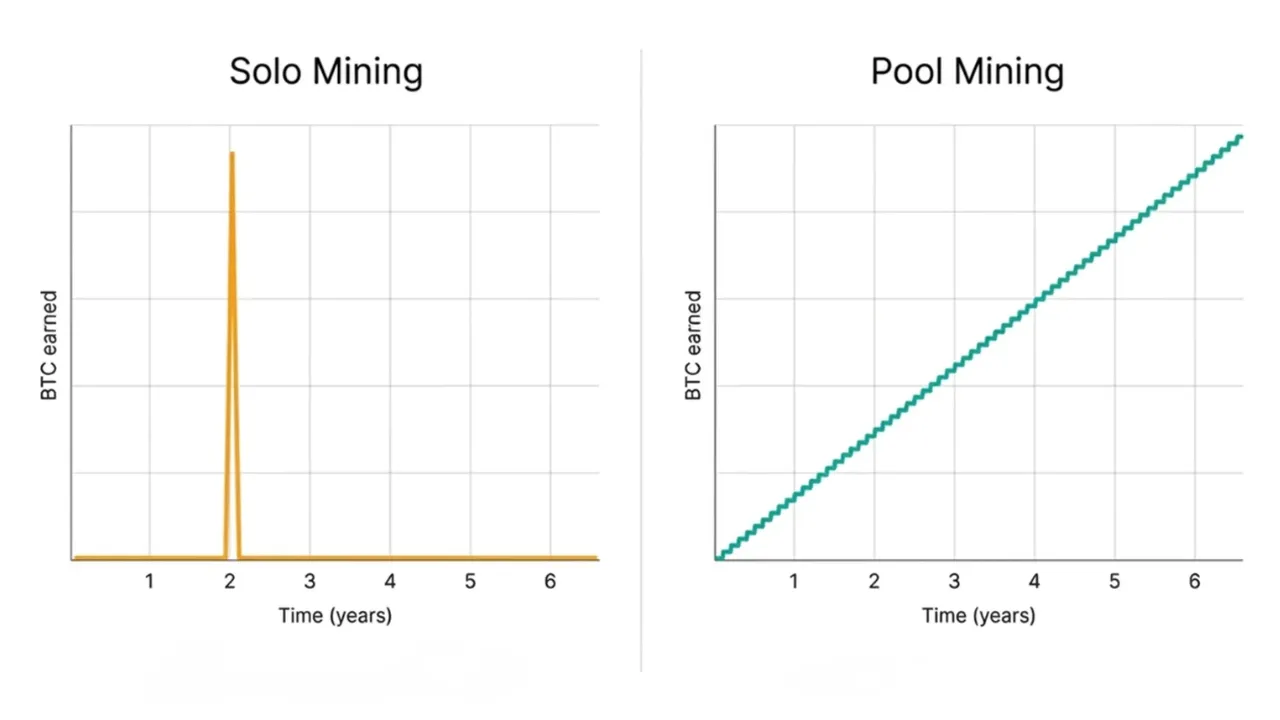
| Solo Mining | Pool Mining | |
|---|---|---|
| Payout pattern | Rare and large | Frequent and small |
| Time to first payout | Months to years | Days to weeks |
| Income variance | Very high | Low |
| Fees | None | 0% to 4% |
| Operational overhead | Higher (run your own node) | Lower (pool handles backend) |
| Best for | Rare, lucky events | Almost every modern miner |
Pool mining is the default for the entire industry today, from hobbyists with one ASIC to industrial farms with tens of thousands of machines.
What Types of Bitcoin Mining Pools Exist?
Three main approaches cover almost every option available today.
Traditional (Centralized) Pools
Traditional Bitcoin mining pools are all centralized. A single operator handles work assignment, share tracking, payouts, and infrastructure. This is the most common structure and the easiest on-ramp for beginners. Foundry USA, AntPool, ViaBTC, and F2Pool are all traditional centralized pools. The tradeoff is trust. You rely on the operator for honest accounting and on-time payouts.
Decentralized Pools
A handful of traditional pools control the majority of Bitcoin's network hashrate, and that concentration has raised concerns across the mining community. You can see how hashrate is currently split across pools on our live Bitcoin mining pool stats. Decentralized pools are the response. They route work through a peer-to-peer protocol instead of a central operator. Ocean, Public Pool, and P2Pool fit here. No single company holds custody of pending rewards. Setup takes more technical effort, and short-term variance runs higher than a large centralized pool. These pools appeal to miners who value censorship resistance, self-custody, and protocols like Stratum V2 that give miners control over block templates.
Cloud Mining (Hashrate Rental Services)
Cloud mining is not the same as joining a pool with your own hardware. It means renting hashrate from a provider who points it at a pool for you. The cloud mining space has a long record of scams and underperformance. If you want mining exposure without managing hardware yourself, hosted Bitcoin mining at a real facility is a sturdier path.
How Do Bitcoin Mining Pool Payouts Work?
Mining pools convert your submitted shares into Bitcoin using one of four main payout models: PPS, FPPS, PPLNS, and PPS+. Each one shifts risk and transaction-fee exposure between the operator and the miner in a different way. FPPS is the dominant choice today because it pays a steady amount that includes estimated transaction fees.
The short version: PPS-style models give predictable income at a higher fee. PPLNS gives variance at a lower fee that compounds over time.
For a deeper breakdown of PPS vs FPPS vs PPLNS, read our mining pool payouts guide.
How Do You Choose a Bitcoin Mining Pool as a Beginner?
A good beginner pool has low fees, a low minimum payout threshold, a server close to you, a clean reputation, a track record of uptime, and a dashboard you can read at a glance. Work through this checklist before you point any hashrate.
Pool Fees and Minimum Payout Thresholds
Fees range from 0% to 4% of earnings, with a 2% fee common at major FPPS pools. A higher fee is not always worse if the pool absorbs variance or pays on time through dry spells. Minimum payout thresholds affect how often Bitcoin lands in your wallet. Lower thresholds mean more frequent payouts and less time with your Bitcoin sitting in the pool's custody.
Server Latency and Geographic Reach
The closer your miner sits to a pool server, the fewer rejected shares you submit. Major pools run regional endpoints across multiple continents. Pick the one with the lowest ping from your location.
Reputation and Uptime Record
Check independent sources for the pool's block-find history and payout track record. Pools with clean dashboards and a multi-year operating history are safer than unknown operators with attractive fees.
Beginner-Friendly Dashboard
A good dashboard shows your hashrate, rejected shares, and pending balance at a glance. This matters when your miner acts up and you need to diagnose in minutes.
Payout Method
Pick a pool with at least one payout model that fits your risk tolerance. FPPS is a safe default for most beginners (see the payouts guide for the details).
Non-Custodial Support
Some pools (like Ocean) pay direct to a wallet address you control with no intermediary custody. This removes a layer of counterparty risk but requires a wallet you already manage.
Hosted clients at a provider like Simple Mining skip most of this work. The provider handles pool connections, uptime monitoring, and partner-discounted fees at pools like Luxor, NiceHash, and Ocean.
How Do You Join a Bitcoin Mining Pool?
Joining a pool takes about 10 minutes once your miner is on the network. The steps below work for any ASIC-based setup.
1. Create a Pool Account and Worker ID
Sign up on the pool's website. Add your Bitcoin payout address in the account settings. Create a worker ID to label this specific machine. A worker ID looks like username.worker01 and helps you track individual ASICs when you run more than one.
2. Open Your Miner's Web Dashboard
Find your miner's local IP on your router, then enter it in a browser. Log in with the default credentials from the manufacturer (change these the first time you log in). Navigate to the "Pool" or "Miner Configuration" page.
3. Enter the Stratum URL and Credentials
A stratum URL is the address your miner uses to talk to the pool. It looks like stratum+tcp://btc.pool.com:3333. Paste it into the URL field. Put username.worker01 in the worker field. Leave the password as x or whatever your pool suggests. Save and restart the miner.
4. Watch the Pool Dashboard for Your First Shares
Return to the pool's site and find your worker. Accepted shares should show up within a minute or two. A rejected share rate above 2% points to latency or configuration trouble. Hashrate on the pool dashboard reports a bit lower than your miner's local reading because of propagation delay between the submitted shares and the pool's calculation window.
How Long Until You Earn Bitcoin in a Pool?
Payout frequency depends on four variables. Your hashrate and the pool's minimum payout threshold matter most. Bitcoin's network hashrate and transaction fees in winning blocks fill in the rest. All four shift over time, so any specific day count is a moving target.
The direction is steady but gradual. A single current-generation ASIC on a major pool clears a typical 0.001 BTC minimum payout in a matter of days to weeks, not hours. Larger fleets hit the threshold sooner. For a live estimate on your specific hardware, run the numbers through our Bitcoin Mining Calculator.
Smaller miners on large pools see steady but small payouts. Larger miners see the same steady rate at higher dollar values. The pool smooths the underlying variance in both cases.
You will not see a full 3.125 BTC block reward land in your personal wallet. Instead, you receive a fractional share of every block your pool wins.
FAQs
What is the minimum hashrate needed to join a mining pool?
Most pools have no minimum hashrate requirement. A single ASIC at 100 TH/s or more can join any major pool and earn Bitcoin in proportion to its contribution. Some decentralized pools apply a soft minimum to keep share validation efficient.
Can I mine Bitcoin with just one ASIC miner in a pool?
Yes. One current-generation ASIC can run in a pool and earn steady Bitcoin. Your take-home depends on electricity cost and miner efficiency measured in joules per terahash.
What happens to my earnings if a mining pool shuts down?
Any balance below the minimum payout threshold at the time of closure is at risk. Reputable pools announce shutdowns in advance and pay out pending balances. Withdraw at or near the minimum threshold often to limit exposure to pool custody.
How do I switch my ASIC miner from one mining pool to another?
Update the stratum URL and worker credentials in your miner's configuration panel. The switch itself takes a few minutes. Some PPLNS pools delay your final payout until the reward window closes, so factor that in before moving mid-round.
Do hosted mining services choose the pool for me?
Most hosting providers let you point hashrate at any pool you prefer. Simple Mining clients keep full pool choice and get discounted fees at partner pools like Luxor, NiceHash, and Ocean.
Start Mining with Simple Mining
Pools turn mining from a solo gamble into a steady output. Simple Mining removes the pool-selection and uptime overhead on top of that.
Hosted clients get precision billing tied to actual hashing time and a 7-day free trial before any commitment. Pool flexibility includes discounted fees at Luxor, NiceHash, and Ocean. Every ASIC runs in our Cedar Falls facility with an on-site repair team and a fleet of 35,000+ machines under active management.
Schedule a call or start your free 7-day hosted Bitcoin mining trial to see what steady pool payouts look like on a fleet you actually own.