

What is a Satoshi? Bitcoin's Smallest Unit Explained
By Josh Heine, Content Strategist at Simple Mining
Updated April 24, 2026Published June 13, 2024
A satoshi is the smallest unit of Bitcoin, equal to 0.00000001 BTC. One Bitcoin holds 100 million satoshis, known as "sats" for short. The unit lets anyone hold a piece of the network without buying a whole coin. Miners earn their block rewards in sats and pools pay out in sats. Stackers stack in sats.
Key Takeaways
- One Bitcoin holds 100 million satoshis, the smallest unit on the Bitcoin network.
- Bitcoin's creator Satoshi Nakamoto inspired the name through a BitcoinTalk proposal adopted in early 2011.
- Sats make Bitcoin usable at any price and let anyone own a stake without a whole coin.
- Divisibility is not inflation and the 21 million supply cap stays intact.
- Mining and exchanges are the two paths to build a sat stack.
What Is a Satoshi
A satoshi is the smallest unit of Bitcoin at the protocol level. One sat equals 0.00000001 BTC, and it cannot be divided further on-chain. The Bitcoin network tracks every balance and every transaction in whole satoshis under the hood. Wallets display the same value as BTC for human convenience.
- Definition: one hundred millionth of a Bitcoin
- Abbreviation: "sats"
- Indivisibility: the minimum unit of account on the Bitcoin network
How Many Satoshis Are in One Bitcoin
One Bitcoin holds 100 million satoshis. Bitcoin's 21 million coin cap works out to 2.1 quadrillion sats across the entire supply. The large number is no accident. It gives the network room to price goods at tiny fractions of a coin even if the Bitcoin price runs into the millions per BTC.
Why Is It Called a Satoshi
The unit takes its name from Satoshi Nakamoto, the pseudonymous creator of Bitcoin. The community adopted the label as a tribute in late 2010 and early 2011.
Who Is Satoshi Nakamoto
Satoshi Nakamoto is the pen name of the person or group who built Bitcoin. In 2008 Nakamoto published the Bitcoin whitepaper, and in 2009 they mined the genesis block. By 2011 Nakamoto stepped back from the project and has not spoken in public since. Their true identity is still unknown. Their earliest coins have not moved.
The Meaning Behind the Satoshi Name
A BitcoinTalk user proposed the term in late 2010, first for 0.01 BTC and then for the smallest unit. Other contributors adopted it in early 2011 as a tribute to the designer who built divisibility into the protocol from day one. No whole coin was ever needed for small payments by design.
How Much Is a Satoshi Worth
A satoshi is worth the current Bitcoin price divided by 100 million. The rate moves with every tick of the market.
Current Satoshi to USD Value
To check a live sat-to-dollar rate, divide today's Bitcoin price by 100 million. At a Bitcoin price of $100,000, one sat is worth $0.001. Our USD to satoshi converter runs the math at the current price so you do not have to. For an operator view, a Bitcoin mining calculator models daily sat earnings at any price and hosting rate.
Will 1 Satoshi Ever Equal 1 Dollar
One satoshi equals one dollar when Bitcoin trades at $100 million per coin. That price sits far above today's level and above the combined value of the global gold supply. Treat the idea as a thought exercise on scarcity, not a forecast. The math shows how much room the unit leaves as Bitcoin grows into a larger monetary base.
How Satoshis Work
Bitcoin transactions run on satoshis at the protocol level. A wallet showing 0.01 BTC is showing 1 million sats under the hood. Fees and balances sit in sats before a wallet translates them into BTC for the display. On-chain transfers move whole sats between addresses. The Lightning Network extends the model with near-instant low-cost payments, making it practical to tip a few sats or pay for a song.
- On-chain transactions: how satoshis move on the Bitcoin blockchain
- Lightning Network: a second-layer protocol for instant satoshi payments
- Wallet displays: how users view balances in sats or BTC
Why Satoshis Matter
Satoshis keep Bitcoin usable at any price and let anyone own a stake in the network without needing a whole coin.
Bitcoin Divisibility vs Monetary Expansion
Divisibility is not inflation. The total supply of Bitcoin is capped at 21 million coins no matter how many sats circulate. Splitting one Bitcoin into 100 million sats works like splitting a dollar into cents. No new money appears in either case. Each sat draws its value from the fixed supply above it.
Making Bitcoin Accessible to Everyone
You do not need a whole Bitcoin to own Bitcoin. At a Bitcoin price of $100,000, a $10 purchase picks up about 10,000 sats. The phrase "stacking sats" describes building a position in small increments over time. That framing removed the psychological wall that kept new buyers out when the price crossed five figures. A stacker with discipline ends up with meaningful exposure even without a six-figure budget.
How to Buy and Earn Satoshis
Two paths lead to a stack of sats. You can buy fractional Bitcoin on an exchange or you can mine new sats through block rewards. Most serious holders use some mix of both over time.
Buying Satoshis on Crypto Exchanges
Any major exchange that lists Bitcoin sells sats by default. Drop $25 into an order and get a BTC quote. The wallet records the buy down to the sat. No separate "satoshi coin" exists since sats are not a different asset. They are Bitcoin at a finer resolution.
Earning Satoshis Through Bitcoin Mining
Bitcoin mining pays out in sats. After Bitcoin's 2024 halving, each block reward is 3.125 BTC plus transaction fees. Pools distribute that reward to miners in satoshi shares based on accepted work. Hosted Bitcoin mining gives buyers a turnkey way to earn sats without the heat and noise of home ASICs. At Simple Mining our clients watch the sat balance tick up in the dashboard every day a machine hashes on the network.
Satoshi vs Other Cryptocurrency Denominations
Every major cryptocurrency has its own smallest unit. Bitcoin's satoshi set the template, and several other chains borrowed the same 100 million split.
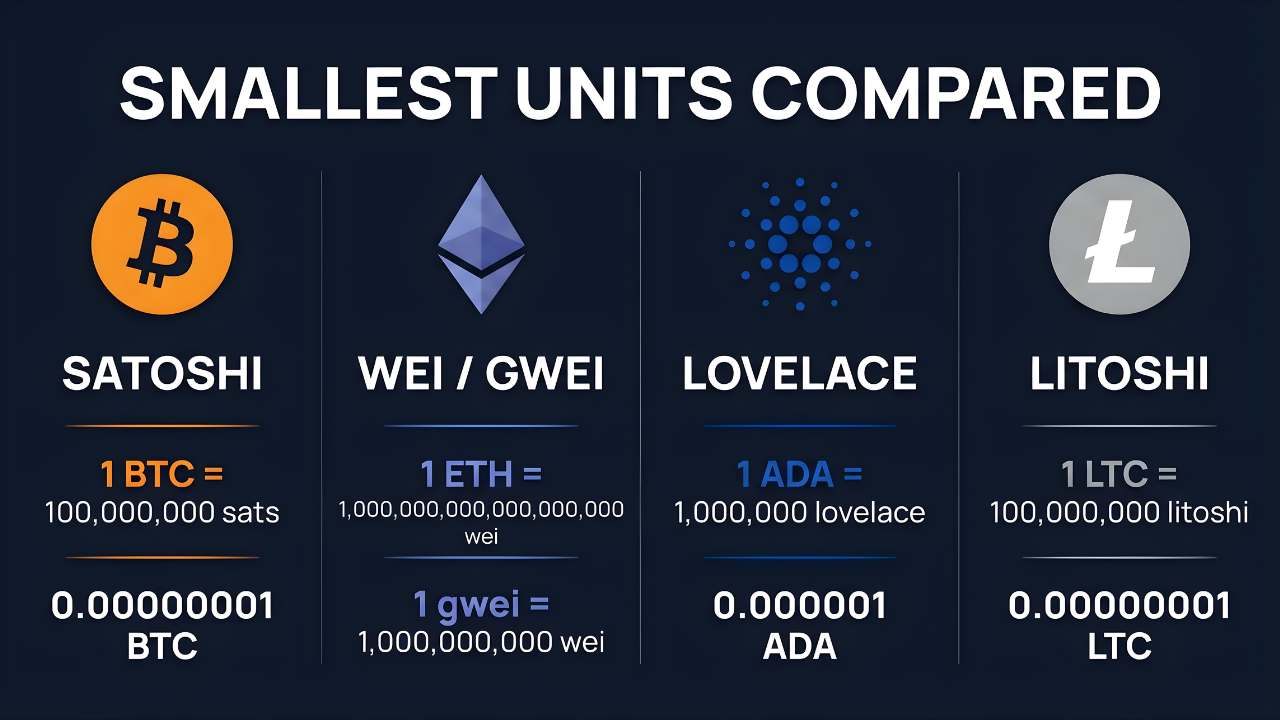
| Cryptocurrency | Smallest Unit | Units per Coin |
|---|---|---|
| Bitcoin | Satoshi | 100 million |
| Ethereum | Wei (gwei in practice) | 1 quintillion |
| Cardano | Lovelace | 1 million |
| Litecoin | Litoshi | 100 million |
Ethereum Gwei
Ethereum uses wei as its base unit, where 1 ETH holds 1 quintillion wei. Users work in gwei for most fees, where 1 gwei equals 1 billion wei. The stacked units fit Ethereum's variable fee model more than user convenience. Wei appears in smart contracts and developer tooling.
Cardano Lovelace
Cardano's smallest unit is the lovelace, named after the mathematician Ada Lovelace. One ADA holds 1 million lovelace. The finer split on Bitcoin reflects its higher per-unit value and its design as a store of value.
Litecoin Litoshi
Litecoin copies the Bitcoin model. One LTC holds 100 million litoshi, the same split as Bitcoin. The match is no coincidence since Litecoin forked from the Bitcoin codebase in 2011.
FAQs
How many satoshis does Satoshi Nakamoto own?
Estimates put Nakamoto's holdings near 1.1 million BTC across wallets mined in Bitcoin's early days. That works out to about 110 trillion sats. None of those coins have moved since 2010.
Can I send less than one satoshi?
No. The satoshi is the smallest indivisible unit on the Bitcoin blockchain. All on-chain transactions round to whole sats.
Where can I buy satoshi coins?
Any major exchange that lists Bitcoin sells sats by default. No separate "satoshi coin" exists. When you buy $50 of Bitcoin, you buy sats at the current rate.
Are satoshis the same as sats?
Yes. "Sats" is the short form used across the Bitcoin community. Both terms point to the same unit.
What is the smallest Bitcoin transaction possible?
On-chain, the smallest Bitcoin transaction is one satoshi. Network fees make tiny transfers impractical on the base layer. The Lightning Network handles sat-size payments with fees measured in fractions of a sat.
Start Stacking Sats Through Bitcoin Mining
Every block reward gets cut into sats before it lands in a miner's wallet. That is how new Bitcoin enters circulation today. Buying sats on an exchange builds a stack one transaction at a time. Mining builds a stack every 10 minutes whether the price runs up or down.
Simple Mining runs hosted mining from Iowa at all-in rates starting near $0.07 per kWh, with on-site repairs and precision billing that charges for machine-hashing time. To see sats land in a dashboard without wiring ASICs in your basement, schedule a call or browse our Bitcoin mining hardware.
Sats compound one block at a time.