

Bitcoin Halving Explained: Complete Guide
By Josh Heine, Content Strategist at Simple Mining
Updated June 23, 2026Published June 13, 2024
A Bitcoin halving is a protocol event that cuts the block reward in half every 210,000 blocks. This mechanism enforces a hard cap of 21 million coins. As of September 2026, over 20 million Bitcoin have been mined. Less than one million remain.
On this page · 11 sections
- What Is Bitcoin Halving
- How Bitcoin Halving Works
- Why Bitcoin Halving Matters
- Bitcoin Halving Dates and History
- How Bitcoin Halving Affects Price
- How Bitcoin Halving Affects Miners
- How Many Bitcoin Halvings Are Left
- What Happens After All Bitcoin Is Mined
- How to Prepare for the Next Bitcoin Halving
- Start Mining Bitcoin with Simple Mining
- FAQs About Bitcoin Halving
Key Takeaways
- A Bitcoin halving cuts the block reward in half every 210,000 blocks (about every four years), enforcing Bitcoin's fixed supply cap of 21 million coins.
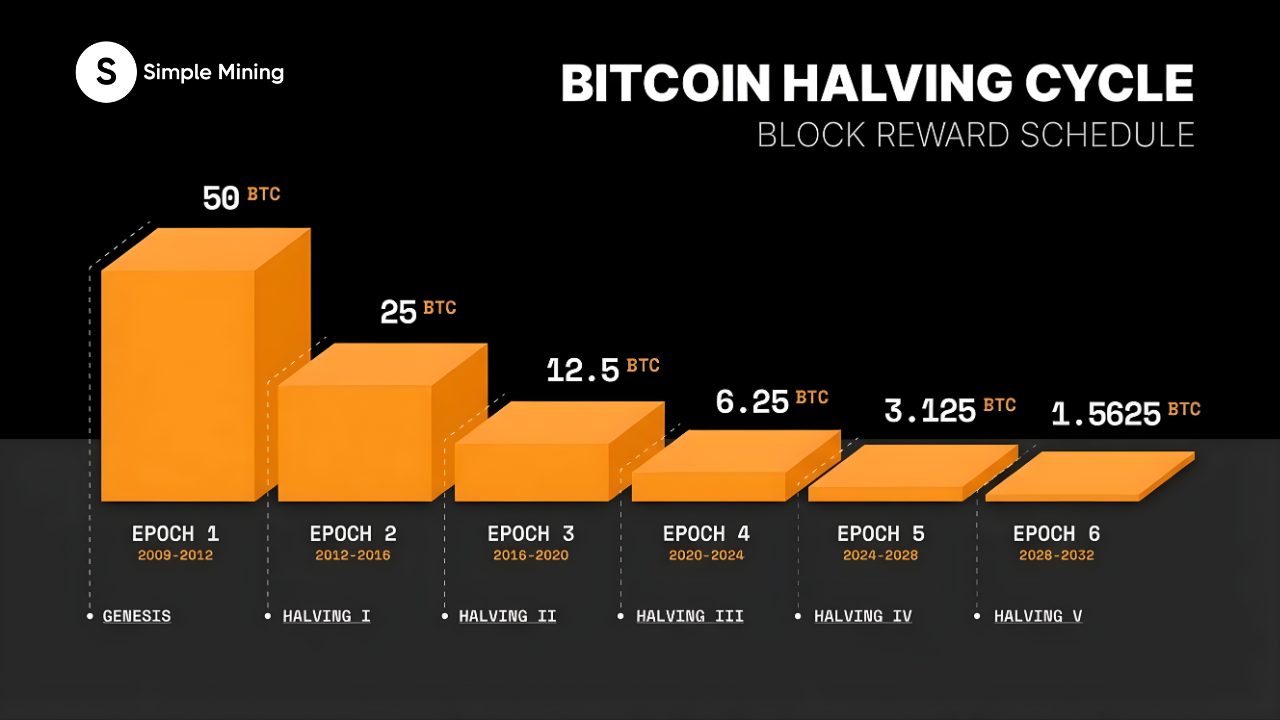
- Four halvings have occurred (2012, 2016, 2020, 2024), reducing the block reward from 50 BTC to the current 3.125 BTC.
- Halvings reduce the rate of new supply, which can create upward price pressure if demand holds steady. Price increases are not guaranteed.
- Miners face an immediate 50% revenue cut at each halving. Survival depends on electricity costs and hardware efficiency.
- The next halving is projected for April 2028. Roughly 29 halvings remain before all Bitcoin are mined around 2140
What Is Bitcoin Halving
A Bitcoin halving is a pre-programmed event that reduces the block reward by 50%. The block reward is the new Bitcoin that miners earn for adding a valid block of transactions to the blockchain.
This event triggers every 210,000 blocks. No person or organization can change it. The mechanism is written into Bitcoin's source code and will continue until all 21 million Bitcoin are mined (around the year 2140).
- Block reward: The new Bitcoin miners earn for each block added to the blockchain
- Halving trigger: Fires every 210,000 blocks (about every four years)
- Supply impact: Cuts the rate of new Bitcoin entering circulation by 50%
How Bitcoin Halving Works
Miners use specialized computers called ASICs to solve cryptographic puzzles. The first miner to find a valid solution earns the right to add the next block to the blockchain and collect the block reward.
When the network reaches a halving block, the protocol enforces a lower reward. There is no vote and no committee. The code executes on its own. One block pays the old reward. The very next block pays half as much.
Why Bitcoin Halving Matters
The halving enforces Bitcoin's fixed supply cap of 21 million coins by reducing new issuance on a predictable schedule. Central banks can print currency without a hard limit. Bitcoin cannot exceed 21 million coins.
As of September 2026, over 20 million Bitcoin circulate. Fewer than one million coins remain to be mined across the next 114 years. Bitcoin also offers something no fiat currency can: a transparent monetary policy. Anyone can verify when the next halving will occur and how many Bitcoin will ever exist.
Bitcoin Halving Dates and History
Four halvings have occurred since Bitcoin launched in 2009. Each event cut the block reward and drew increasing attention from investors and media.
| Halving | Approximate Date | Reward Before | Reward After |
|---|---|---|---|
| First | November 2012 | 50 BTC | 25 BTC |
| Second | July 2016 | 25 BTC | 12.5 BTC |
| Third | May 2020 | 12.5 BTC | 6.25 BTC |
| Fourth | April 2024 | 6.25 BTC | 3.125 BTC |
The first halving in 2012 proved the mechanism worked as designed. By 2016, traders and investors began anticipating the event. The 2020 halving drew institutional attention from public companies and financial firms. The April 2024 halving was the first to follow the approval of spot Bitcoin ETFs in the United States.
Bitcoin Halving Schedule and Future Dates
The next halving is projected for approximately April 2028. The block reward will drop to 1.5625 BTC. You can estimate future dates by tracking block production: the network produces about 144 blocks per day. The final Bitcoin is expected to be mined around 2140.
How Bitcoin Halving Affects Price
Halving reduces the rate of new supply entering the market. Before April 2024, miners produced about 900 new Bitcoin per day. After the halving, that number dropped to about 450.
Price increases are not guaranteed. Historical data shows correlation between halvings and subsequent bull markets, and supply mechanics are only one input in the broader case for Bitcoin as an investment. But correlation does not equal causation. Many factors influence Bitcoin's price. Bitcoin reached an all-time high above $126,000 in October 2025, about 18 months after the fourth halving. Whether that pattern repeats depends on conditions at the time of the next event.
How Bitcoin Halving Affects Miners
Miners experience an immediate 50% drop in Bitcoin-denominated revenue per block. A miner earning 6.25 BTC per block before April 2024 now earns 3.125 BTC for the same work. There is no phase-in period.
Profitability comes down to whether revenue covers electricity and operational costs. The difference between $0.07/kWh and $0.12/kWh can separate a profitable operation from an unprofitable one after a reward cut. Hashprice is the metric that reveals this dynamic. It measures expected daily revenue per terahash. When hashprice drops below a miner's breakeven cost, the operation loses money on every block.
Each halving also pressures miners to upgrade hardware. A current-gen ASIC running at 17 J/TH generates more profit per dollar of electricity than an older unit at 30 J/TH. After a halving, that efficiency gap becomes critical. This is why mining profitability depends as much on equipment selection as it does on Bitcoin's price.
How Many Bitcoin Halvings Are Left
Roughly 29 halvings remain before block rewards round to zero. The reward drops to 1.5625 BTC in 2028 and 0.78125 BTC in 2032. As of September 2026, more than 95% of all Bitcoin that will ever exist has been mined. The final Bitcoin is expected around 2140.
What Happens After All Bitcoin Is Mined
Once the block reward reaches zero, miners earn revenue from transaction fees alone. Every Bitcoin transaction includes a fee paid to the miner who processes it. This fee market already exists today. Transaction fees will represent a growing share of miner income with each halving.
How to Prepare for the Next Bitcoin Halving
The next halving is projected for April 2028. Miners and investors who plan ahead are better positioned to weather the revenue compression.
- Evaluate mining hardware: Check whether your equipment remains profitable at a 1.5625 BTC block reward.
- Understand hosting costs: The gap between institutional hosting rates and residential power widens after every halving.
- Plan for the cycle: Low-hashprice windows after halvings can present opportunities to acquire Bitcoin mining hardware at a discount.
- Model scenarios: Use a mining calculator to project profitability at different price levels before committing capital.
Start Mining Bitcoin with Simple Mining
Low-cost power and efficient hardware make the difference between surviving a halving and getting squeezed out.
Simple Mining provides hosted mining with all-in power rates from $0.065–$0.08/kWh. Average uptime sits at 95%. Miners purchased through Simple Mining include 12 months of repair coverage. You own the hardware. We handle the infrastructure.
Try 235 TH/s of hashrate free for 7 days with no obligation.
FAQs About Bitcoin Halving
Does Bitcoin halving guarantee a price increase?
No. Historical data shows price appreciation following past halvings, but correlation does not equal causation. Many factors influence Bitcoin's price. Future results are not guaranteed.
Can you buy half a Bitcoin?
Yes. Bitcoin is divisible into 100 million smaller units called satoshis. You can purchase any fraction of a Bitcoin regardless of halving events or the current price per coin.
What is the difference between Bitcoin halving and Bitcoin Cash halving?
Both use similar halving mechanisms inherited from Bitcoin's original code. They are separate blockchains with different block rewards and network hashrates. A Bitcoin Cash halving has no effect on the Bitcoin network.
How long does a Bitcoin halving take?
The halving happens in a single block. One block pays the old reward. The very next block pays half. There is no gradual transition or phase-in period.
Is Bitcoin halving good or bad for small miners?
Halving compresses margins for all miners. Smaller operations with higher electricity costs feel the squeeze more. Access to low-cost hosting and modern ASICs determines who stays profitable.