
What Can I Buy With Bitcoin? Who Accepts Bitcoin in 2026
By Josh Heine, Content Strategist at Simple Mining
Updated September 23, 2026Published September 29, 2024
What can I buy with Bitcoin? Electronics, phone bills, flights, hotels, burgers, gold, cars, and gift cards for almost everything else. Newegg takes it at checkout, AT&T takes it for your phone bill, and Steak 'n Shake takes it at all 393 of its US locations. The rest of the economy is reachable through gift cards and crypto-funded debit cards.
The first Bitcoin purchase on record was food. On May 22, 2010 a Florida programmer named Laszlo Hanyecz paid 10,000 BTC for two pizzas. That date is now Bitcoin Pizza Day. Sixteen years later the question is no longer whether Bitcoin buys anything. The question is where it works well and where it costs you more than it should.
On this page · 11 sections
- What Can You Buy With Bitcoin?
- Who Accepts Bitcoin? Companies and Stores That Take It
- How Merchants Accept Bitcoin
- Everyday Purchases: Groceries, Gas and Food
- How to Buy Gift Cards With Bitcoin
- Bitcoin Debit Cards
- How to Spend Bitcoin
- Do You Pay Taxes When You Spend Bitcoin?
- How to Convert Bitcoin to Cash
- FAQs About Buying With Bitcoin
- Why Bitcoin Spending Keeps Growing
Key Takeaways
- Bitcoin buys real goods at named US companies today, including Newegg, AT&T, Microsoft account credit, Ferrari dealers, JM Bullion, and Steak 'n Shake.
- Most acceptance runs through a processor such as BitPay or a Lightning checkout such as Square, so the merchant receives dollars and you lock a price for a short window.
- No national grocery chain takes Bitcoin at the register. Gift cards from Bitrefill and similar platforms cover groceries, gas, and food delivery.
- Spending Bitcoin is a taxable disposal in the US. Gain equals the value at payment minus your cost basis, tracked wallet by wallet.
- BTC Map counts 26,914 Bitcoin-accepting merchants worldwide as of its August 2026 report, and Square's Lightning rollout puts about four million US sellers within reach.
What Can You Buy With Bitcoin?
You can buy electronics, restaurant meals, flights, hotels, luxury cars, precious metals, domain names, VPN subscriptions, and Bitcoin mining hardware with Bitcoin, either at the merchant's own checkout or through a gift card funded with Bitcoin. Each later section names the companies and explains how each one accepts payment.
- Retail and electronics: computer parts, gaming hardware, and digital goods from Newegg and Microsoft, plus phone bills at AT&T.
- Restaurants and local shops: Steak 'n Shake nationwide, plus any Square seller who leaves Bitcoin acceptance switched on.
- Travel: flights on 600+ airlines through Alternative Airlines, and hotels, flights, and activities through Travala.
- Luxury and big-ticket items: Ferrari dealers, watches at Jomashop, and gold and silver at JM Bullion and APMEX.
- Gift cards for everything else: Walmart, Target, Kroger, Uber, DoorDash, Starbucks, and hundreds more through Bitrefill, Gyft, and eGifter.
- Bitcoin mining hardware: ASIC miners from Simple Mining's inventory of Bitcoin miners, paid in Bitcoin through a crypto payment processor.
Who Accepts Bitcoin? Companies and Stores That Take It
Newegg, Microsoft, AT&T, Steak 'n Shake, Ferrari dealers, JM Bullion, and every Square seller with Bitcoin switched on accept Bitcoin in the United States today. Most of them accept it through a payment processor that converts your coins to dollars before the merchant sees the sale. That detail matters for refunds and price locks.
Merchant details below were checked in September 2026.
Retail and electronics
Newegg accepts Bitcoin at checkout through BitPay and has done so since 2014. Choose BitPay as the payment method and pay from the QR code. Computer parts, laptops, and gaming gear are all in scope.
Microsoft accepts Bitcoin through BitPay, but only as a way to add money to a Microsoft account balance. That balance then buys games, apps, and other digital goods in the Microsoft Store and Xbox store. The option is US only, it does not cover hardware, and funds added this way cannot be refunded. It dates to December 2014.
AT&T lets signed-in customers pay their bill through BitPay. Bill payment is the whole scope; you cannot buy a phone with Bitcoin. AT&T has offered the option since May 2019.
Namecheap accepts Bitcoin through BitPay for domains and hosting.
Restaurants and local shops
Steak 'n Shake accepts Bitcoin over the Lightning Network at all 393 US locations. The rollout began May 16, 2025 through the processor Speed and covers kiosks, counters, and drive-throughs. Scan the Lightning invoice with any Lightning wallet and the payment settles in seconds.
Square sellers are the largest pool of potential Bitcoin acceptance in the country. Block launched Lightning payments for eligible US sellers in November 2025 and switched them to on by default in March 2026. Sellers pay zero processing fee through 2026 and a 1% flat fee after that. New York sellers are excluded.
About four million businesses run Square. Treat that as eligibility rather than a merchant count. Any seller can switch it off, so look for the Bitcoin option on the screen before you order.
Payment platforms
PayPal Checkout with Crypto lets US customers with a PayPal Balance account sell Bitcoin held inside PayPal to pay for select online purchases. The merchant receives dollars and PayPal takes a spread on the conversion rather than a listed fee. Venmo users can hold and transfer Bitcoin, but Venmo is not part of this checkout feature.
PayPal Pay with Crypto is a separate product for merchants that launched in 2025. It lets a US merchant accept 100+ cryptocurrencies from outside wallets such as Coinbase and MetaMask. The merchant is paid in dollars. New York merchants are excluded.
Shopify stores accept Bitcoin when the owner activates one of Shopify's crypto payment methods: BitPay, Crypto.com, OpenNode, Strike, IBEX Pay, Solana Pay, DePay, Lunu, or Bit2Me. Shopify does not publish how many stores use them, so treat each store's checkout as the source of truth.
Travel
Travala is a crypto-native booking site for hotels, flights, and activities that accepts Bitcoin plus more than 100 other coins. Alternative Airlines sells tickets on 600+ airlines and accepts Bitcoin at checkout through XMoney, Crypto.com, CoinGate, and Binance Pay. The airline itself never touches Bitcoin; the agency converts it.
Luxury and big-ticket items
Ferrari dealers in the US accept Bitcoin, Ether, and USDC through BitPay under a program that started in October 2023. Jomashop accepts Bitcoin through BitPay for Rolex, Patek Philippe, and other luxury watches. JM Bullion accepts Bitcoin at checkout for orders up to $2,000,000 and gives Bitcoin buyers a 3% discount versus card and PayPal prices. APMEX accepts Bitcoin for precious metals through BitPay.
Real estate is possible but not standardized. A small number of title and escrow companies will close a purchase funded with Bitcoin by converting to dollars before settlement.
Simple Mining accepts Bitcoin for miner purchases and hosting invoices through a crypto payment processor. The steps for how to buy mining hardware are the same whichever way you pay.
How Merchants Accept Bitcoin
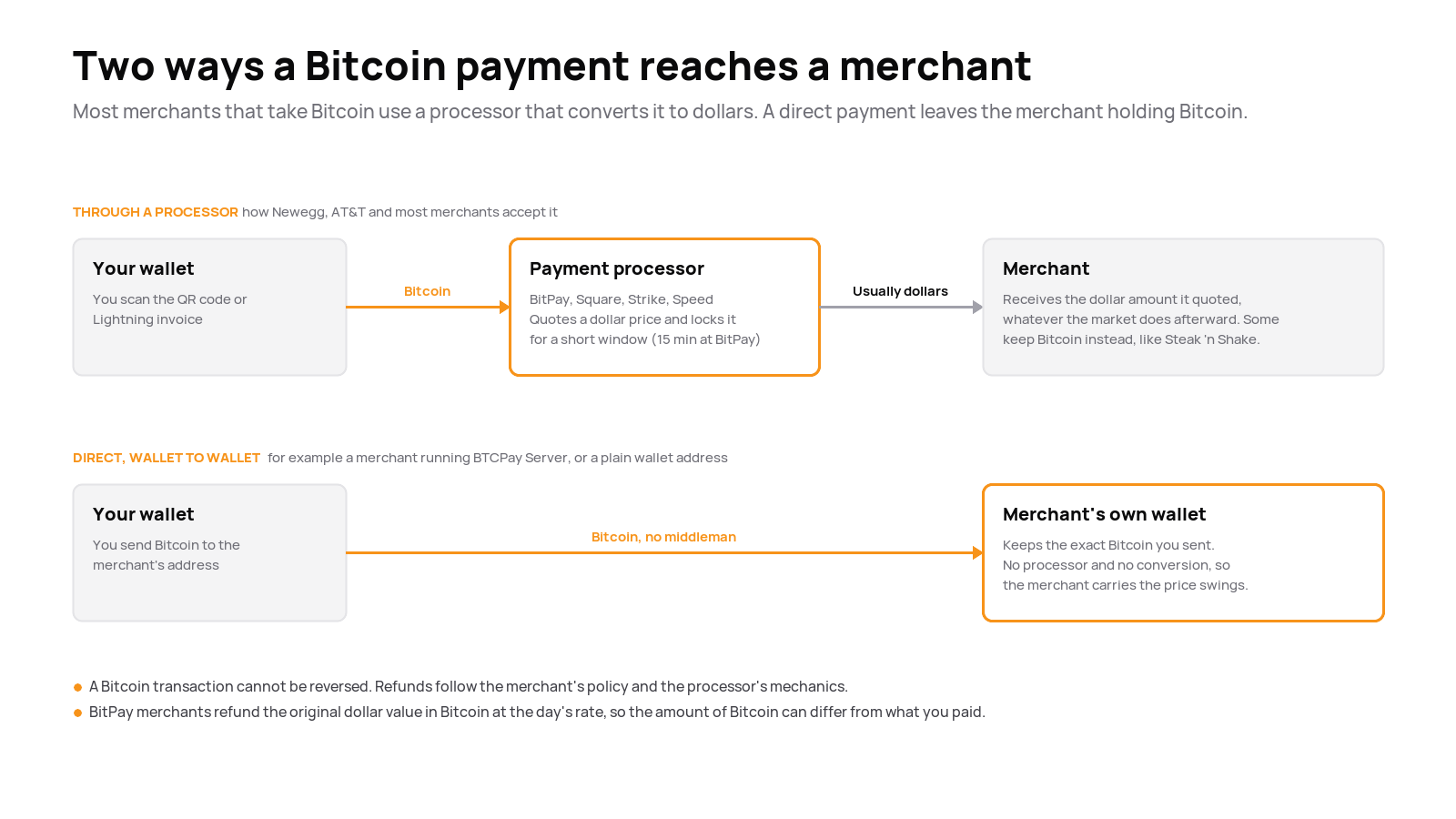
Merchants accept Bitcoin through four main routes: a licensed processor like BitPay that converts to dollars, self-hosted software like BTCPay Server where the merchant keeps the coins, a Lightning checkout like Square or Speed, or a wallet platform like PayPal that settles in fiat. Knowing which one a merchant uses tells you who holds the Bitcoin and how a refund works.
BitPay is a licensed US processor. It invoices you in dollars, converts your Bitcoin, and pays the merchant in fiat. Its merchant directory advertises 250+ companies and stores. That count mixes direct-checkout merchants with gift card brands, so read each listing's label.
BTCPay Server is free, open-source software a merchant runs on its own server. There is no processor, no fee, and no conversion. The merchant keeps the Bitcoin.
Lightning checkouts such as Square, Strike, OpenNode, and Speed generate an invoice that settles in seconds for fractions of a cent. Square lets the seller receive the payment as Bitcoin or as dollars. PayPal sits between the models: the buyer spends crypto and the merchant receives dollars.
Processor checkouts lock a dollar price for a short payment window: fifteen minutes at BitPay and five at Square. A price swing inside that window does not change what you owe. A direct wallet-to-wallet payment has no lock. The merchant receives whatever amount of Bitcoin you send.
Everyday Purchases: Groceries, Gas and Food
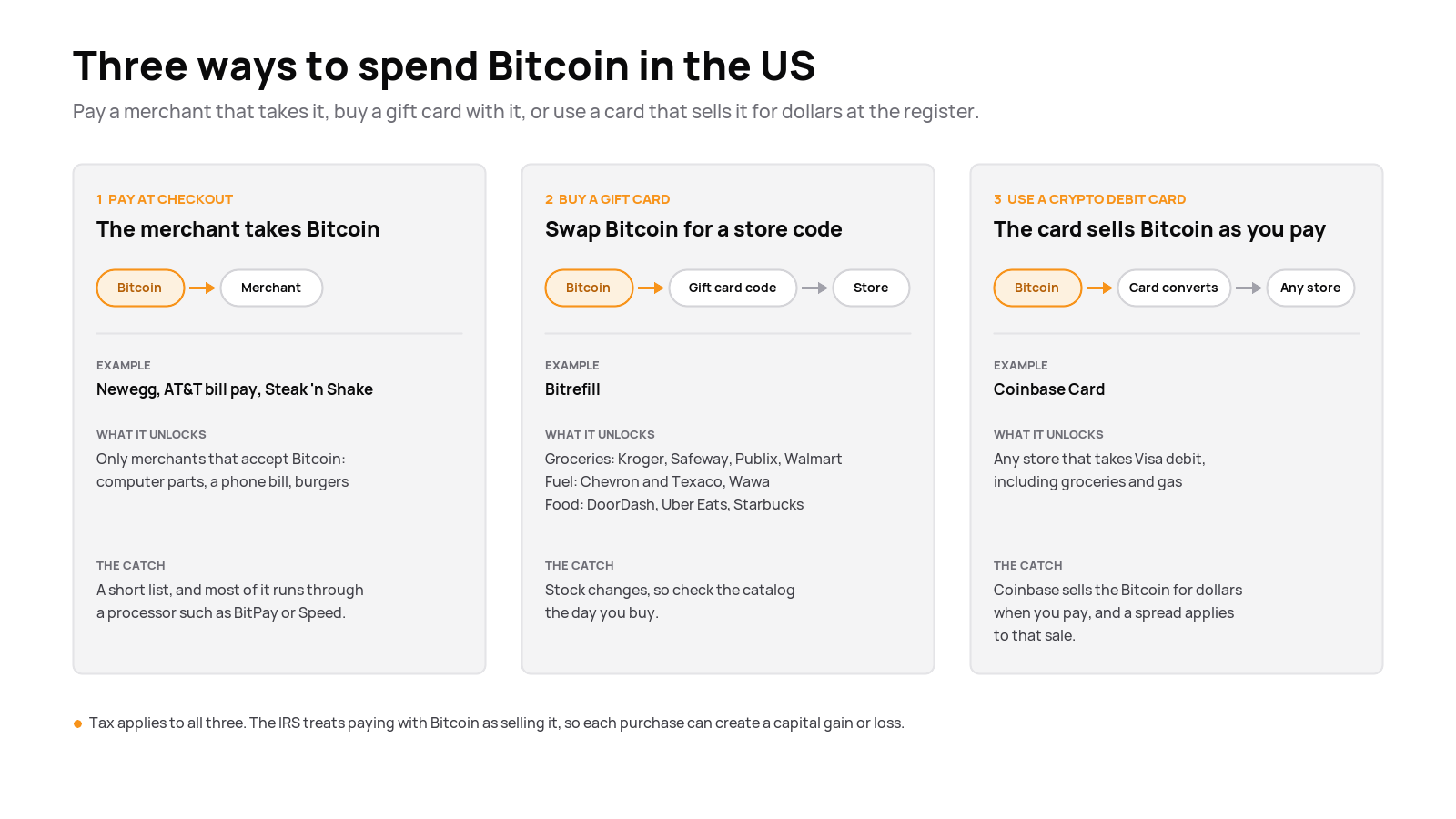
No national US grocery chain accepts Bitcoin at the register in 2026, and gas stations and most restaurant chains are the same. Gift cards are the practical path. Bitrefill's US catalog covers Kroger, Albertsons, Safeway, Publix, Walmart, Target, and Instacart for groceries; Chevron/Texaco and Wawa for fuel; and Uber, Uber Eats, DoorDash, Starbucks, and Chipotle for getting around and eating out.
Availability shifts, so check the catalog the day you need it. Individual brands sell out from time to time.
A crypto debit card is the other route. It converts Bitcoin to dollars at the point of sale, so it works at any register. The trade-off is that every swipe is a taxable disposal.
How to Buy Gift Cards With Bitcoin
You buy gift cards with Bitcoin by picking a brand and amount on a platform such as Bitrefill, Gyft, or eGifter, paying the Bitcoin or Lightning invoice, and redeeming the emailed code at the retailer. Fold also sells gift cards, but you pay in dollars and earn Bitcoin back.
Bitrefill has the widest selection and accepts Bitcoin, Lightning, USDC, and USDT. It sells gift cards, eSIMs, and phone top-ups and delivers by email in minutes.
Gyft sells hundreds of US gift cards for Bitcoin with no added fee for paying in Bitcoin.
eGifter processes Bitcoin and Bitcoin Cash through BitPay across 300+ brands and charges no fee on crypto payments.
Fold sells gift cards you pay for in dollars, not Bitcoin, and pays Bitcoin rewards, or sats back, on each purchase. It has grown into a broader rewards platform with a prepaid Visa debit card and a Visa credit card.
Bitcoin Debit Cards
A Bitcoin debit card converts your Bitcoin to dollars at the moment you pay, so it works anywhere Visa or Mastercard is accepted. Of the three US cards below, only Coinbase Card does this. The Crypto.com and Fold cards spend dollars and pay rewards in crypto. The BitPay Card is gone; that Mastercard program ended in June 2023 and has no successor.
| Card | Type and network | Rewards and tiers | What to know |
|---|---|---|---|
| Coinbase Card | Visa prepaid debit | Rotating menu of crypto rewards you select and can switch at any time; no annual fee | Funded from your Coinbase balance. A conversion spread applies when you spend non-USDC assets; check the Cardholder Agreement for the current schedule. |
| Crypto.com Visa Signature | Visa credit | Level Up tiers: Basic (free, 1.5% back), Plus ($4.99 per month or $500 CRO stake, 3.5%), Pro (4.5%), Private (up to 6%); rewards paid in BTC or CRO | A credit card: purchases are charged in dollars, not paid with Bitcoin. Issued by Comenity Capital Bank. Qualifying tiers get 100% rebates on Netflix and Spotify. A Crypto.com Prepaid Visa Card is still offered for people who prefer prepaid. |
| Fold Card | Visa prepaid debit; Visa credit | Bitcoin rewards on purchases, with higher rates for Fold+ subscribers | Neither card spends Bitcoin. The debit card draws from a USD balance, and moving Bitcoin into that balance is a sale. Credit card issued by Celtic Bank under a Visa license. Bitcoin custody by BitGo. Fold is a financial services platform, not a bank. |
Every card purchase that draws on Bitcoin rather than a dollar balance is a sale of that Bitcoin for tax purposes.
How to Spend Bitcoin
Spending Bitcoin takes four steps: get a Bitcoin wallet, fund it, pay by scanning the merchant's QR code or Lightning invoice, and wait for confirmation. The first two steps are quick. The last two are where mistakes cost money.
- Get a Bitcoin wallet. A wallet is software or hardware that holds your private keys, and a Bitcoin wallet can be a phone app, a desktop program, or a hardware device. For spending you want a mobile wallet with Lightning support, and the hot wallet vs cold wallet trade-off explains why you keep only spending money in it.
- Fund it. Buy on an exchange and withdraw to your wallet, or receive Bitcoin from someone else. If you have never done it, learning how to buy Bitcoin takes one account, one purchase, and one withdrawal.
- Pay by scanning the QR code or Lightning invoice. The merchant's checkout shows a QR code that encodes the address and the exact amount. Scan it with your wallet rather than typing anything. An on-chain invoice from a processor like BitPay locks the dollar price for a set window of about fifteen minutes. A Lightning invoice from Square or Speed settles in seconds. Check the amount on your screen against the merchant's screen before you confirm, because a Bitcoin payment cannot be reversed.
- Wait for confirmation. An on-chain payment enters the mempool and waits for a miner to include it in a block. Most processors accept a payment after one confirmation, which averages ten minutes. Some release digital goods as soon as the transaction appears. You choose the fee, and Bitcoin transaction fees rise when blocks are full. Pay too little and the payment can sit for hours, which is why Lightning wins for small purchases.
Do You Pay Taxes When You Spend Bitcoin?
Yes. In the United States spending Bitcoin is a disposal of property under IRS Notice 2014-21, and your gain or loss equals the dollar value of the purchase minus the cost basis of the Bitcoin you spent. Since January 1, 2025 that basis is tracked wallet by wallet rather than across all your holdings. The units you spend from a given wallet determine the gain. Rates and holding periods for Bitcoin capital gains tax are the same whether you sell or spend.
Tax rules in this section reflect IRS guidance as of September 2026.
Custodial brokers such as exchanges and processors like BitPay report your disposals to the IRS on Form 1099-DA. A payment from a self-custody wallet or over Lightning generates no 1099-DA, but the disposal is still taxable and you still report it on Form 8949.
No de minimis exemption for purchases exists in current law. H.R. 10357 (the Digital Asset Tax Certainty Act) cleared the House Ways and Means Committee 38 to 5 on September 16, 2026 and is not law. Even if enacted as written it would exempt only network and transaction fees of $10 or less, not the purchase itself.
This article is not tax or investment advice. Talk to a tax professional before you spend appreciated Bitcoin.
How to Convert Bitcoin to Cash
You convert Bitcoin to cash by selling on an exchange and withdrawing dollars to your bank, by selling at a Bitcoin ATM, or by trading peer to peer on a platform like Bisq. The exchange route is cheapest and the ATM route is fastest.
Exchanges such as Coinbase, Kraken, and Gemini sell Bitcoin for dollars with fees in the low single digits and settle to a linked bank account in one to three business days. Every sale reaches the IRS on Form 1099-DA.
Most Bitcoin ATMs only sell Bitcoin, but two-way machines also buy it back for cash on the spot, and the convenience is expensive. FinCEN puts kiosk fees at roughly 7% to 20%, depending on the operator. Limits and caps now vary by state.
North Carolina's Virtual Currency Kiosk Consumer Protection Act is one example. Signed in July 2026 and effective January 1, 2027, it requires operators to be licensed money transmitters, caps total fees including the spread at 12%, limits new customers to $2,000 a day, holds a new customer's first-week transactions for 48 hours, and refunds new customers whose fraud report is filed within 30 days and confirmed by the state. Indiana, Tennessee, and Minnesota banned kiosks outright in 2026. Read the fee disclosure on the screen before you insert cash.
Bisq is open-source desktop software that matches buyers and sellers over Tor with no identity check. It takes longer than an exchange, and the question of whether Bitcoin is traceable still matters because the on-chain record exists whether or not a company collected your name.
FAQs About Buying With Bitcoin
Is it better to spend Bitcoin or hold it?
It depends on your goals and your cost basis. If you spend, choose the specific units with the highest cost basis in the wallet you pay from. A higher basis means a smaller taxable gain. Older coins are not the answer by default; they often carry the lowest basis of all. Units held more than one year qualify for long-term capital gains rates, so document which units you spend before the transaction.
Can I get a refund on a Bitcoin purchase?
Yes, but the refund follows the merchant's policy and the processor's mechanics rather than the blockchain. A Bitcoin transaction cannot be reversed. BitPay merchants refund the original dollar value of the invoice in Bitcoin at the market rate on the day you claim it. The amount of Bitcoin you receive can differ from what you paid. Other merchants refund to a card, to store credit, or in dollars.
What happens if Bitcoin's price changes after I pay?
Nothing changes for either side when you pay through a processor. BitPay, PayPal, and Square quote a dollar price and lock it for a payment window, and the merchant receives that dollar amount no matter what the market does afterward. A direct wallet-to-wallet payment has no lock, so the merchant holds whatever Bitcoin arrived.
Do any grocery stores accept Bitcoin?
No national US grocery chain accepts Bitcoin at the register in 2026. The practical route is a gift card funded with Bitcoin from Bitrefill for Kroger, Albertsons, Safeway, Publix, Walmart, or Target, or a crypto debit card that converts to dollars at the point of sale.
Are there discounts for paying with Bitcoin?
A few merchants pass their card savings to Bitcoin buyers. JM Bullion gives a 3% discount on Bitcoin orders versus card and PayPal prices, just under the 4% it gives for checks, ACH, and wires. Most merchants charge the same price across payment methods.
Does Amazon accept Bitcoin?
No. Amazon does not accept Bitcoin or any other cryptocurrency directly. The workaround is an Amazon.com gift card bought with Bitcoin, which gift card platforms stock off and on, so check availability before you plan a purchase around it.
Why Bitcoin Spending Keeps Growing
BTC Map counted 26,914 Bitcoin-accepting merchants worldwide in its August 2026 report, and the United States was the most active country for new listings that month. Two things drove the recent growth in the US.
Steak 'n Shake proved a 393-store chain could switch on Bitcoin across every location and cut card processing costs in half. Then Square did the same for a whole point-of-sale network, and the coffee shop down the street became a Bitcoin merchant without deciding to be one. You can search for both on the BTC Map merchant map.
The common thread is the Lightning Network. Lightning moves Bitcoin off the main chain into payment channels, so a burger costs a fraction of a cent in fees and settles before the receipt prints. That removes the two objections merchants raised for a decade: slow confirmations and volatile fees.
Every merchant that accepts Bitcoin is a reason to hold it, and every holder then asks how to get more. Some buy on an exchange. Others mine it. Deciding whether to mine or buy Bitcoin comes down to the math on both paths, and for people who want the coins without running hardware at home, Bitcoin hosting in Iowa keeps a miner powered, cooled, and online for a bundled hosting service fee of $0.065 to $0.08 per kWh.