

How Is Bitcoin Taxed? Capital Gains, Rates, and Reporting in 2026
By Josh Heine, Content Strategist at Simple Mining
Updated September 9, 2026Published December 30, 2024
The IRS treats Bitcoin as property. Selling it, trading it, or spending it produces a capital gain or loss. The rate depends on your income and how long you held. These are the tax year 2026 figures, for the return you file in early 2027. Two rules surprise most first-time filers: swapping Bitcoin for another digital asset is taxable, and spending Bitcoin on anything is a disposition.
On this page · 13 sections
- What Are Bitcoin Capital Gains?
- How the IRS Classifies Bitcoin as Property
- What Triggers a Bitcoin Taxable Event?
- Short-Term vs. Long-Term Bitcoin Capital Gains
- Bitcoin Capital Gains Tax Rates for 2026
- How to Calculate Your Bitcoin Capital Gains
- How Mined Bitcoin Is Taxed
- How to Report Bitcoin Capital Gains to the IRS
- Does the IRS Know If You Sell Bitcoin?
- How to Legally Reduce Bitcoin Capital Gains Tax
- Common Bitcoin Tax Mistakes
- FAQs About Bitcoin Taxes
- Set Your Cost Basis From the First Payout
Key Takeaways
- Bitcoin is property under IRS Notice 2014-21, so every sale, trade, or purchase with it is a taxable event. Buying and holding is not.
- Short-term gains (held one year or less) use ordinary income rates from 10% to 37% in 2026. Long-term gains (held more than one year) use 0%, 15%, or 20%.
- High earners owe an extra 3.8% Net Investment Income Tax, which pushes the federal top rate to 23.8% long-term and 40.8% short-term.
- Mined Bitcoin is taxed twice: as ordinary income at fair market value on receipt, then as a capital gain or loss on the appreciation when sold.
- Brokers now file Form 1099-DA with the IRS. For 2026 dispositions the form adds cost basis for units bought through that broker on or after January 1, 2026.
What Are Bitcoin Capital Gains?
A Bitcoin capital gain is the amount you realize on a sale or exchange minus your adjusted basis. Basis is everything you spent to acquire the Bitcoin in US dollars, including exchange fees and other acquisition costs. A loss is the same math running the other direction. The gain or loss is "realized" the moment you dispose of the coins, not when the price moves.
Losses are useful. They first offset gains of the same character and then gains of the other character. Up to $3,000 of remaining losses per year offsets ordinary income ($1,500 if married filing separately). Anything beyond that carries forward with no expiration and keeps its short-term or long-term character. One exception: losses on Bitcoin held for personal use are not deductible at all.
How the IRS Classifies Bitcoin as Property
The IRS has classified Bitcoin as property rather than currency since Notice 2014-21 on March 25, 2014. Property treatment is the reason capital gains rules apply to Bitcoin the way they apply to stock or real estate. Rev. Rul. 2019-24 extended the framework to hard forks and airdrops. Rev. Rul. 2023-14 confirmed staking rewards are income on receipt.
Since 2021 the statutory term is "digital asset," defined at IRC §6045(g)(3)(D). The CFTC calls Bitcoin a commodity for market regulation, but that label has no bearing on your tax return. Market-structure law and tax law run on separate tracks, which is why the CLARITY Act left capital gains treatment untouched.
What Triggers a Bitcoin Taxable Event?
A taxable event is any disposal of Bitcoin: a sale for dollars, a trade into another digital asset, or a purchase of goods or services. Receiving Bitcoin as payment is also taxable, but as ordinary income rather than a capital gain.
Selling Bitcoin for Fiat Currency
Selling Bitcoin for US dollars or any other currency is the classic taxable event. Your gain or loss is the sale proceeds minus your adjusted basis in the coins sold, and the exchange's timestamped price is your record.
Trading Bitcoin for Another Digital Asset
A crypto-to-crypto trade is a taxable disposition of the Bitcoin you give up. Your gain equals the fair market value of what you receive minus your basis in the Bitcoin. Like-kind exchange treatment under §1031 has covered real property only since January 1, 2018. IRS memo ILM 202124008 concluded that pre-2018 crypto swaps did not qualify either. No swap defers the tax.
Spending Bitcoin on Goods or Services
Buying anything with Bitcoin is treated as selling the Bitcoin and then buying the item. There is no dollar floor, so a coffee purchase is a reportable disposition.
No de minimis exemption exists in current law. The proposed Lummis bill from July 2025 would exclude gains under $300 per transaction, capped at $5,000 per year and limited to purchases. The proposed H.R. 9178 from June 2026 is narrower still and covers only network fees of $10 or less. Neither has passed either chamber, so treat every purchase as taxable until one does.
Receiving Bitcoin as Income
Bitcoin received as wages, contractor payments, or mining rewards is ordinary income at its fair market value on the date of receipt. That value becomes your basis in the coins. Wages paid in Bitcoin go on a W-2 with normal withholding, and contractor payments are self-employment income.
Transferring Bitcoin Between Your Own Wallets
Moving Bitcoin between wallets or accounts you own is not a taxable event. Your basis and holding period carry over with the coins. One catch arrived on January 1, 2025. Basis must now be tracked per wallet, so record the acquisition date and basis of every lot you move. Your records are what prove a withdrawal was a transfer rather than a sale.
Short-Term vs. Long-Term Bitcoin Capital Gains
Short-term means you held the Bitcoin for one year or less. Long-term means you held it for more than one year. The holding period starts the day after you acquire the coins and ends on the day you dispose of them. Bitcoin bought and sold one year apart to the day is short-term.
Do not think in months; the boundary is where the rate jumps. For mined Bitcoin the clock starts the day after the reward hits your wallet. A payout received December 15, 2025 and sold December 15, 2026 is short-term by one day.
Bitcoin Capital Gains Tax Rates for 2026
Short-term Bitcoin gains are taxed at ordinary income rates from 10% to 37% in 2026, and long-term gains are taxed at 0%, 15%, or 20% based on taxable income. Every threshold below comes from Rev. Proc. 2025-32 released on October 9, 2025.
Short-Term Capital Gains Tax Brackets
Short-term gains stack on top of your other ordinary income and fill these brackets:
| Rate | Single | Married filing jointly | Married filing separately | Head of household |
|---|---|---|---|---|
| 10% | $0 to $12,400 | $0 to $24,800 | $0 to $12,400 | $0 to $17,700 |
| 12% | $12,401 to $50,400 | $24,801 to $100,800 | $12,401 to $50,400 | $17,701 to $67,450 |
| 22% | $50,401 to $105,700 | $100,801 to $211,400 | $50,401 to $105,700 | $67,451 to $105,700 |
| 24% | $105,701 to $201,775 | $211,401 to $403,550 | $105,701 to $201,775 | $105,701 to $201,750 |
| 32% | $201,776 to $256,225 | $403,551 to $512,450 | $201,776 to $256,225 | $201,751 to $256,200 |
| 35% | $256,226 to $640,600 | $512,451 to $768,700 | $256,226 to $384,350 | $256,201 to $640,600 |
| 37% | over $640,600 | over $768,700 | over $384,350 | over $640,600 |
Long-Term Capital Gains Tax Brackets
Long-term rates apply to taxable income including the gain:
| Filing status | 0% up to | 15% up to | 20% above |
|---|---|---|---|
| Single | $49,450 | $545,500 | $545,500 |
| Married filing jointly | $98,900 | $613,700 | $613,700 |
| Married filing separately | $49,450 | $306,850 | $306,850 |
| Head of household | $66,200 | $579,600 | $579,600 |
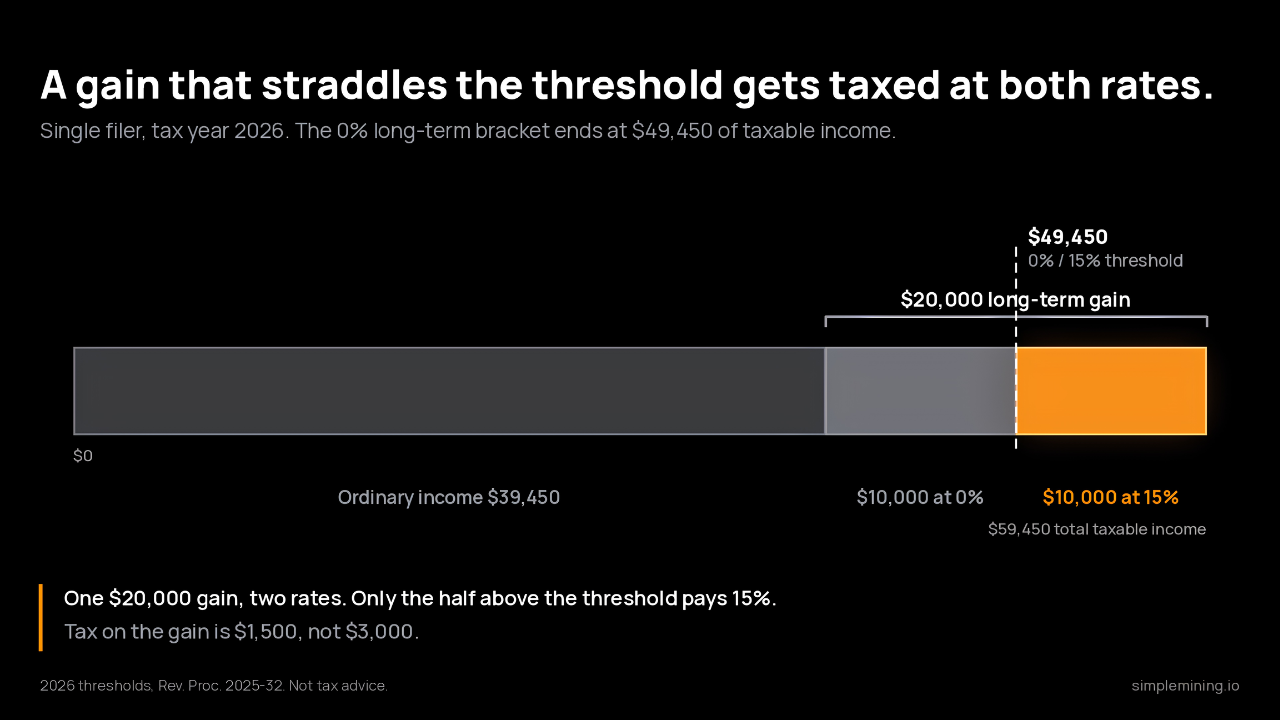
Two details most guides skip. The 0% and 15% bands stack on top of your ordinary income. A gain that straddles $49,450 is taxed in part at 0% and in part at 15% rather than all at one rate. And these thresholds are taxable income after deductions. The 2026 standard deduction is $16,100 for a single filer, so a single filer with no other deductions can show $65,550 of gross income and still pay 0% on a long-term Bitcoin gain.
The Net Investment Income Tax
A 3.8% Net Investment Income Tax applies on top of capital gains rates for higher earners. It hits the lesser of your net investment income or your modified adjusted gross income above $200,000 for single and head of household filers, $250,000 married filing jointly, or $125,000 married filing separately. The thresholds sit in IRC §1411, are not indexed for inflation, and have not moved since 2013. You compute it on Form 8960 and carry it to Schedule 2 line 12.
The practical result: the federal top rate on long-term Bitcoin gains is 23.8% and on short-term gains 40.8%. Mining income reported on Schedule C as an active business sits outside the NIIT in most cases. Income from mining in which you do not materially participate can fall inside it.
How to Calculate Your Bitcoin Capital Gains
The formula is amount realized minus adjusted basis, computed lot by lot and wallet by wallet. Four steps get you there.
1. Determine Your Cost Basis
Cost basis is what you paid for the lot in US dollars, including fees and acquisition costs. For mined coins it is the fair market value on the date of receipt. Basis tracking has been wallet-by-wallet since January 1, 2025 under Treas. Reg. §1.1012-1(j) and Rev. Proc. 2024-28. The old universal method that pooled every wallet into one ledger ended December 31, 2024.
Within each wallet the default ordering is FIFO: the earliest coins acquired are the ones deemed sold. You can instead choose which cost basis method you identify at the time of sale, and the identification must happen no later than the sale itself. LIFO is not an IRS method; it is a specific identification pattern your software labels for you. Notice 2025-7 and Notice 2026-20 let you keep that identification in your own books through December 31, 2026 while brokers build the tooling. The rule is about timing and scope, not about repeating one method every year.
One hard consequence: a lot with no documentation is treated as zero basis. That is not "harder to track." It means the full sale proceeds become taxable gain.
2. Identify the Fair Market Value at Disposal
Fair market value is the US dollar value at the date and time of the transaction. Use the exchange's recorded price for exchange trades and a consistent index price at the ledger timestamp for on-chain payments.
3. Calculate the Gain or Loss
Subtract adjusted basis from the amount realized. Selling fees reduce the amount realized and acquisition fees increase basis, so fees cut the gain from both sides.
4. Apply the Holding Period and Rate
Check whether the lot was held more than one year. Long-term lots use the 0%, 15%, or 20% table. Short-term lots stack onto your ordinary income and use the bracket table. Then test the NIIT threshold, because the 3.8% rides on top of either rate.
How Mined Bitcoin Is Taxed
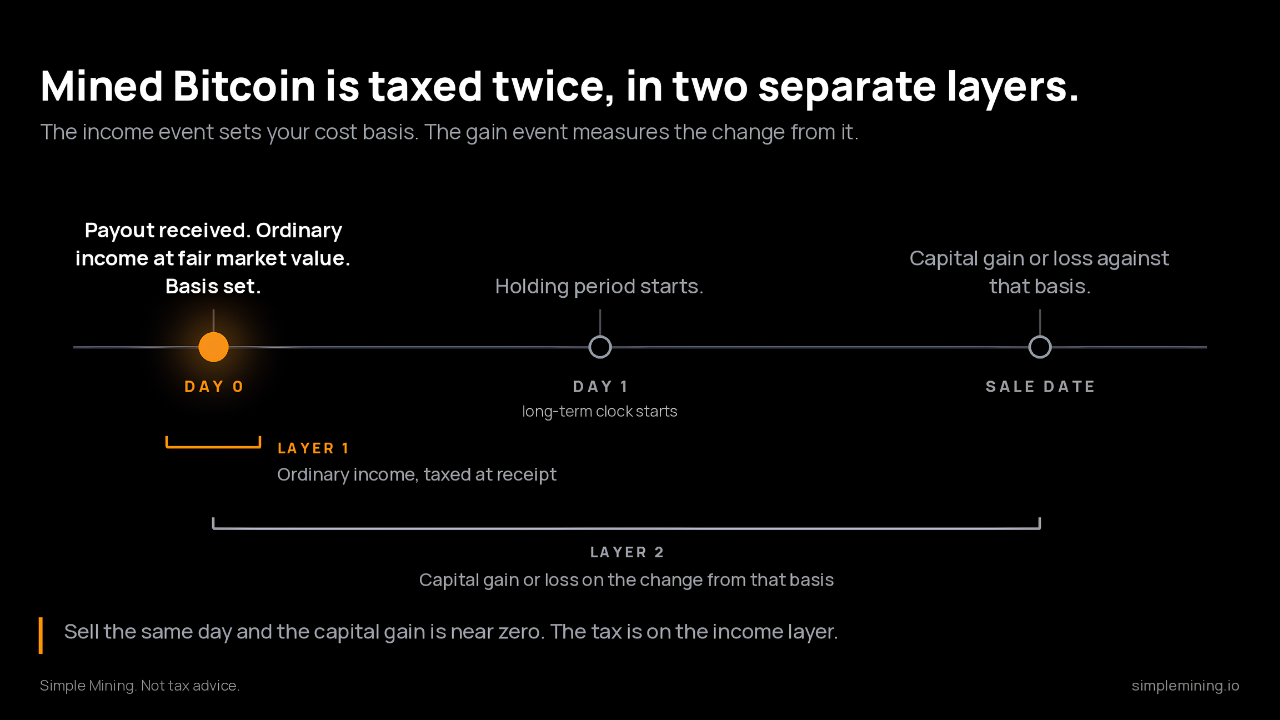
Mined Bitcoin is taxed in two layers: as ordinary income at fair market value on the day you receive it, then as a capital gain or loss on the change in value when you dispose of it. The income figure from layer one becomes your cost basis for layer two.
Mining Rewards as Ordinary Income
Every payout is gross income at its US dollar value on receipt, whether the hardware sits in your garage or in a data center. What varies is where the income lands. A hobby miner reports rewards on Schedule 1 line 8z and deducts nothing against them; the OBBBA made that expense suspension permanent. A miner running a trade or business files Schedule C, deducts hosting fees, pool fees, and depreciation, and owes self-employment tax of 15.3% on 92.35% of net profit up to the $184,500 wage base for 2026. Using a hosting provider does not by itself make your mining a business; the test is regularity, continuity, and profit motive.
The recordkeeping burden scales with payout frequency, because your payout model sets how often income lands and each payout is its own income event. Daily payouts mean 365 dated lots a year per machine. Clients running machines in Bitcoin miner hosting get dashboard logs of payout timestamps and uptime, which is the raw material a preparer needs to price each lot. The export you want is the same either way: date, time, amount, and US dollar value per payout.
Deductions are a separate question from the income itself. For business miners the equipment write-off is a separate lever from the tax on the coins, and it carries material participation rules that decide whether losses can offset other income. Get the income layer right first; the write-off math only works on top of clean payout records.
Capital Gains When You Sell Mined Bitcoin
When you sell mined coins, your gain or loss is the sale price minus the fair market value at receipt. A miner who sells rewards the day they arrive has near-zero capital gain, because basis equals the sale price. This is the core difference when you weigh mined Bitcoin against purchased Bitcoin on tax treatment: purchased coins have one taxable event, mined coins have two, and mining lets you set the basis and start the clock with every payout your Bitcoin miners produce.
Now the mismatch that catches holders. Rewards are taxed as ordinary income at the receipt price even if you never sell. If the price then falls, the decline is only a capital loss. Capital losses offset just $3,000 of ordinary income per year. A miner who received $50,000 of rewards and watched them drop to $30,000 still owes income tax on $50,000 this year, so reserve dollars for tax at receipt rather than at sale.
How to Report Bitcoin Capital Gains to the IRS
Capital gains go on Form 8949 and flow to Schedule D, while mining and other Bitcoin income goes on Schedule 1 or Schedule C. Form 8949 lists each disposition with dates, proceeds, basis, and gain or loss. Business mining adds Schedule SE, and the NIIT rides on Form 8960.
Every Form 1040 opens with the digital asset question: did you receive, sell, exchange, or otherwise dispose of a digital asset this year? If your only activity was buying Bitcoin with dollars and holding it, the correct answer is No. Moving coins between your own wallets is also a No. Any sale, trade, spend, or reward received is a Yes whether or not a form arrived.
What Form 1099-DA Shows the IRS
Form 1099-DA is the broker information return for digital assets, and 2026 is the year it grows teeth. Custodial brokers reported gross proceeds only for 2025 dispositions, on forms taxpayers received in early 2026. For 2026 dispositions brokers must also report cost basis on covered units. Covered means coins bought through that same broker on or after January 1, 2026 and held in its custody since; those forms arrive in early 2027. Coins bought before 2026 or transferred in from your own wallet show proceeds with no basis, and you supply the basis from your records.
That gap is the trap. A proceeds-only Form 1099-DA looks like 100% gain to IRS matching software unless your return shows the basis. File the disposition with documented basis on Form 8949 and the mismatch never becomes a notice. One more wrinkle: spot Bitcoin ETFs are grantor trusts that report on Form 1099-B like any security, and the wash sale rule does apply to those shares.
Estimated Tax Payments for 2026 Gains
Nothing is withheld from a Bitcoin sale or a mining payout, so large 2026 gains often require estimated payments. The quarterly due dates for 2026 income are April 15, June 15, and September 15, 2026, and January 15, 2027. You avoid the underpayment penalty by paying in 90% of your 2026 tax or 100% of your 2025 tax through the year, whichever is smaller (110% of the 2025 figure if your 2025 AGI topped $150,000, or $75,000 if married filing separately). The January 15, 2027 payment is the last chance to cover a 2026 gain before the return itself.
Does the IRS Know If You Sell Bitcoin?
Yes. Bitcoin's ledger is public, and since 2025 custodial brokers report every disposition to the IRS on Form 1099-DA with no dollar threshold. Between chain analytics and broker files, the IRS sees on-chain activity and exchange reporting on most flows that touch a US exchange. Digital assets remain a stated IRS compliance priority.
One rule that is not in effect: the $10,000 business cash-reporting requirement. The 2021 infrastructure law added digital assets to the Form 8300 rule at IRC §6050I, but Announcement 2024-4 suspended it until Treasury issues regulations. None have been issued as of September 2026. Businesses receiving large Bitcoin payments should keep payer records now, but no Form 8300 filing is required yet.
How to Legally Reduce Bitcoin Capital Gains Tax
Four levers lower the bill without bending any rule: harvest losses, hold past one year, use a retirement wrapper, and donate appreciated coins.
Harvesting first. You can sell underwater coins to offset the gain on winners. The wash sale rule in §1091 does not reach Bitcoin you hold outright, because the statute still reads "stock or securities." The OBBBA contains no digital asset wash sale provision. A House draft circulated in June 2026 would extend the rule to digital assets, and it is written to reach back to its introduction date. It is proposed rather than law, but the safest harvest in late 2026 waits out the rebuy.
Holding is the boring lever that works. Crossing the one-year line moves a gain from your ordinary bracket to the 0%, 15%, or 20% table. For a top-bracket filer that is 37% down to 20% before the NIIT.
A retirement wrapper removes the annual tax event: gains inside a Bitcoin Roth IRA compound without capital gains tax.
Donation is the strongest lever for coins with large gains, because donating appreciated Bitcoin held over a year skips the gain and deducts fair market value. Three limits keep it honest.
A deduction over $5,000 requires a qualified appraisal per CCA 202302012, and the exchange price does not count. Fair market value gifts are capped at 30% of AGI with a five-year carryforward. And starting in 2026 itemized charitable deductions shrink by 0.5% of AGI, with the benefit capped at 35 cents per dollar for top-bracket filers. Skip the appraisal and the whole deduction dies.
What about moving? Most states tax capital gains as ordinary income starting from federal AGI, and no state has a Bitcoin-specific rate. Nine states levy no personal income tax at all.
Missouri now exempts capital gains outright under HB 594 for tax years from January 1, 2025. Washington is the trap: it has no income tax but charges a standalone 7% excise on long-term gains above an annual deduction, rising to 9.9% above $1,000,000. A move only works if it is real and predates the sale under the new state's residency rules, because high-tax states audit that timeline.
Common Bitcoin Tax Mistakes
The same six errors generate most of the notices and lost deductions.
- Assuming a small-purchase exemption exists. There is no de minimis rule. The $300 figure is a proposed bill, not law.
- Pooling basis across wallets. The universal method ended December 31, 2024. Basis is per wallet now, with FIFO as the default inside each one.
- Answering Yes on a buy-and-hold year. If you only bought Bitcoin with dollars and held it, the Form 1040 digital asset answer is No.
- Treating the 1099-DA proceeds figure as the gain. Proceeds minus your documented basis is the gain. A form with no basis is not a bill.
- Deducting hobby mining costs. Electricity and hosting fees are deductible on Schedule C for a business, and nowhere for a hobby.
- Expecting to write off lost keys. Lost access is not a closed transaction, so there is no deduction to take.
FAQs About Bitcoin Taxes
What are Bitcoin capital gains?
Bitcoin capital gains are the profit realized when you dispose of Bitcoin for more than your adjusted basis. Basis is your full acquisition cost in US dollars including fees. Selling below basis produces a capital loss instead.
How is Bitcoin taxed?
Bitcoin is taxed as property. Disposals produce capital gains taxed at 0% to 20% long-term or 10% to 37% short-term for 2026, and Bitcoin received as payment or mining rewards is ordinary income at its value on receipt.
Do you have to pay taxes on Bitcoin if you don't sell?
No tax is due on Bitcoin that only rises in price while you hold it. Buying with dollars and holding is not a taxable event, and the Form 1040 digital asset answer for a pure buy-and-hold year is No. Rewards and payments you receive are taxable even if you never sell them.
What is the Bitcoin tax rate?
There is no separate Bitcoin rate. For 2026, long-term gains are taxed at 0%, 15%, or 20% by income, short-term gains at ordinary rates from 10% to 37%, and higher earners add the 3.8% Net Investment Income Tax.
Is trading Bitcoin for another crypto taxable?
Yes. A crypto-to-crypto trade is a disposition of the Bitcoin you give up, with gain or loss measured against the fair market value of what you receive. Like-kind deferral has not applied to digital assets since 2018.
How is mined Bitcoin taxed?
Mined Bitcoin is taxed twice. Rewards are ordinary income at fair market value on the day of receipt, and that value becomes the cost basis for a capital gain or loss when the coins are later sold.
What is Form 1099-DA?
Form 1099-DA is the broker information return for digital asset sales. Brokers reported gross proceeds for 2025 dispositions. For 2026 they add cost basis for coins bought through the same broker on or after January 1, 2026.
Does the IRS know if I sell Bitcoin?
Yes. Custodial brokers report every disposition on Form 1099-DA with no minimum, and the public ledger makes on-chain flows traceable. Report each sale with documented basis and the broker file confirms your return instead of contradicting it.
Set Your Cost Basis From the First Payout
Purchased Bitcoin hands you one taxable event and a basis someone else's price set. Mining hands you two events, and that is the point: every payout sets a fresh cost basis and starts a fresh holding-period clock you control. The tax work is recordkeeping, and clean per-payout logs turn it into a spreadsheet export. That is what professional Bitcoin mining hosting is built to produce, with a bundled service fee of $0.065 to $0.08 per kWh tiered by total load, 95%+ average uptime, and payout logs your CPA can price lot by lot.
This article is educational and is not tax advice. Talk to a CPA about wallet-by-wallet basis allocation, theft losses, and entity questions before you file.