

How to Reduce Taxable Income in 2026: 12 Strategies for High Earners
By Josh Heine, Content Strategist at Simple Mining
Published August 26, 2026
Reducing taxable income means claiming every deduction and adjustment the tax code allows before the IRS calculates what you owe. The 2026 tax year raises the stakes for high earners: a new floor on charitable deductions, a cap on the value of itemized deductions, and a reset alternative minimum tax all take effect this year. The twelve strategies below run from payroll deferrals any employee can set up to depreciable assets that produce income while they shelter it. The biggest levers belong to people who own businesses or income-producing assets rather than to those who depend on a paycheck alone.
Key Takeaways
- The 2026 employee 401(k) limit is $24,500, and self-employed readers can reach $72,000 through a solo 401(k) or SEP-IRA.
- New for 2026: itemizers deduct only charitable gifts above 0.5% of AGI, and top-bracket taxpayers keep at most 35 cents of value per deducted dollar.
- The alternative minimum tax reaches lower in 2026, with exemption phase-outs starting at $500,000 for single filers and $1,000,000 for joint filers.
- Qualified opportunity zone deferrals hit a dead zone in 2026, and new money gains five years of deferral by waiting until January 2027.
- Income-producing equipment such as hosted Bitcoin mining hardware can be deducted at 100% in year one when the activity qualifies as a real business.
This article is for educational purposes only and is not tax, legal, or financial advice. Simple Mining is not a tax advisor or a financial advisor. Consult a qualified CPA before acting on any strategy here.
What Is Taxable Income?
Taxable income is your gross income minus allowable deductions and adjustments, and it is the number the IRS uses to calculate your tax bill. Every strategy in this article works by shrinking that number. The math flows in three steps:
- Gross income: wages, investment gains, business revenue, and other earnings.
- Adjustments: above-the-line deductions that reduce gross income before anything else applies.
- Taxable income: the final figure your tax brackets apply to.
Lowering the final figure cuts tax at your highest marginal rate first, which is why deductions grow more valuable as income climbs.
Tax Deductions vs. Tax Credits
A tax deduction reduces the income you are taxed on, while a tax credit reduces your tax bill dollar for dollar. The strategies in this article focus on deductions because deductions scale with your bracket. A $10,000 deduction saves $3,700 for someone in the 37% bracket and $2,400 for someone in the 24% bracket. Credits are valuable but work through a different door.
| Factor | Tax Deduction | Tax Credit |
|---|---|---|
| How it works | Reduces taxable income | Reduces tax owed dollar for dollar |
| Value depends on | Your marginal tax bracket | A fixed or income-based amount |
| Example | Retirement contributions | Child Tax Credit |
12 Legal Ways to Lower Your Taxable Income
The twelve strategies below reduce taxable income through retirement accounts, health savings, loss harvesting, charitable giving, business deductions, and asset ownership. Eligibility varies by strategy, so each entry names who can use it.
1. Maximize Your 401(k) Contributions
Pre-tax 401(k) contributions come straight out of each paycheck and reduce your taxable wages for the year. The 2026 employee deferral limit is $24,500, with an $8,000 catch-up at age 50 and an $11,250 catch-up at ages 60 to 63. Deferrals cut income tax withholding but not FICA taxes, so the payroll tax bill stays the same.
Employer matches do not count toward your $24,500 deferral limit. They do count toward the overall $72,000 defined contribution limit for 2026. One change lands this year under SECURE 2.0: employees whose prior-year wages passed a threshold of about $145,000 to $150,000 must make catch-up contributions as Roth rather than pre-tax.
Eligibility: any W-2 employee whose employer offers a plan.
2. Contribute to a Traditional IRA
Traditional IRA contributions can be deductible up to $7,500 for 2026, plus a $1,100 catch-up at age 50. The catch for this audience: when a workplace plan covers you, the deduction phases out between $81,000 and $91,000 of income for single filers and between $129,000 and $149,000 for joint filers where the contributor is covered. Above those ranges the deduction disappears, so for much of this readership the strategy is unavailable rather than small.
Roth contributions do not reduce current-year taxable income, and the difference between a Roth and a traditional IRA decides which account earns your $7,500.
Eligibility: anyone with earned income can contribute, but the deduction favors those without workplace plan coverage.
3. Fund a Health Savings Account
An HSA carries a triple tax advantage: contributions are deductible or pre-tax, growth is untaxed, and qualified medical withdrawals come out untaxed. The 2026 limits are $4,400 for self-only coverage and $8,750 for family coverage, plus a $1,000 catch-up at age 55. Eligibility requires a high-deductible health plan with a minimum deductible of $1,700 for self-only coverage or $3,400 for family coverage.
Unused funds roll over year after year and the account travels with you between employers. You can open one on your own when your plan qualifies, even if your employer offers no HSA.
Eligibility: anyone enrolled in a qualifying high-deductible health plan.
4. Open a SEP-IRA or Solo 401(k)
Self-employment income unlocks contribution room close to ten times an IRA. A SEP-IRA accepts the lesser of 25% of compensation or $72,000 for 2026. A solo 401(k) reaches the same $72,000 through a $24,500 employee deferral plus an employer contribution, and catch-ups push the ceiling to $80,000 at age 50 and $83,250 at ages 60 to 63.
At moderate income the solo 401(k) wins, because the deferral applies from the first dollar of profit while the SEP formula needs high compensation to reach the cap.
Eligibility: self-employed individuals and owners with self-employment income.
5. Harvest Investment Losses
Tax-loss harvesting means selling an investment below your cost basis to lock in a loss that offsets your gains. Losses cancel capital gains dollar for dollar first. Up to $3,000 of any leftover loss then offsets ordinary income each year ($1,500 on a separate married return). The remainder carries forward with no expiration date.
The wash sale rule blocks a stock loss when you buy the position back too soon around the sale. Crypto you hold in your own accounts sits outside that rule for now, because the IRS treats it as property rather than a security. A Bitcoin loss can be harvested without waiting to rebuy.
Spot Bitcoin ETF shares are securities and the rule applies to them in full. Treat the crypto exemption as current law rather than a permanent feature. The mechanics of harvesting losses to offset your gains run deeper, from cost basis choices to what miners do with mined coins.
Eligibility: anyone with taxable investment accounts.
6. Make Strategic Charitable Donations
Charitable giving works harder in 2026, because itemizers now deduct only the gifts that exceed 0.5% of adjusted gross income. That new floor makes bunching more valuable: combine several years of planned gifts into one year, clear the floor once, and push past the $32,200 joint standard deduction in that year. Two more changes arrive with it. Taxpayers in the 37% bracket keep at most 35 cents of value per deducted dollar, and non-itemizers gain a permanent deduction of $1,000 ($2,000 for joint filers) for cash gifts to public charities.
- Cash gifts: deductible up to 60% of AGI, above the new 0.5% floor.
- Appreciated Bitcoin: deducts at fair market value when held more than one year, capped at 30% of AGI for appreciated property.
- Donor-advised funds: deduct in the year you contribute and grant to charities later. Gifts to a donor-advised fund do not qualify for the non-itemizer deduction.
Donating appreciated Bitcoin beats donating cash when the position carries a large gain. Bitcoin held more than one year deducts at fair market value when donated, and the built-in gain never gets taxed. Coins held one year or less deduct at cost basis only, so how capital gains are taxed by holding period determines which lots to give first.
Eligibility: itemizers benefit most, while non-itemizers now get the small above-the-line deduction.
7. Invest in Real Estate for Depreciation
Rental property owners deduct depreciation as a non-cash expense that shelters rental income on paper while the property produces cash. The deduction applies to the building and improvements, never to the land.
Real estate professional status lets qualifying owners use rental losses against other income, and the bar is high. It requires more than 750 hours per year in real property trades, more than half of your total working hours in those trades, and material participation in the rentals themselves. A full-time W-2 employee has almost no path to qualify, so treat the status as a tool for full-time real estate operators.
Eligibility: property owners, with the loss benefits reserved for full-time real estate operators.
8. Claim the Home Office Deduction
The home office deduction requires a space used on a regular and exclusive basis for business. It is available to self-employed individuals and business owners, and it is not available to W-2 employees.
Two methods exist. The simplified method allows $5 per square foot up to 300 square feet, for a maximum of $1,500. The actual expense method deducts the business share of real housing costs and takes more records to defend.
Eligibility: self-employed individuals and business owners only.
9. Use Qualified Opportunity Zone Funds
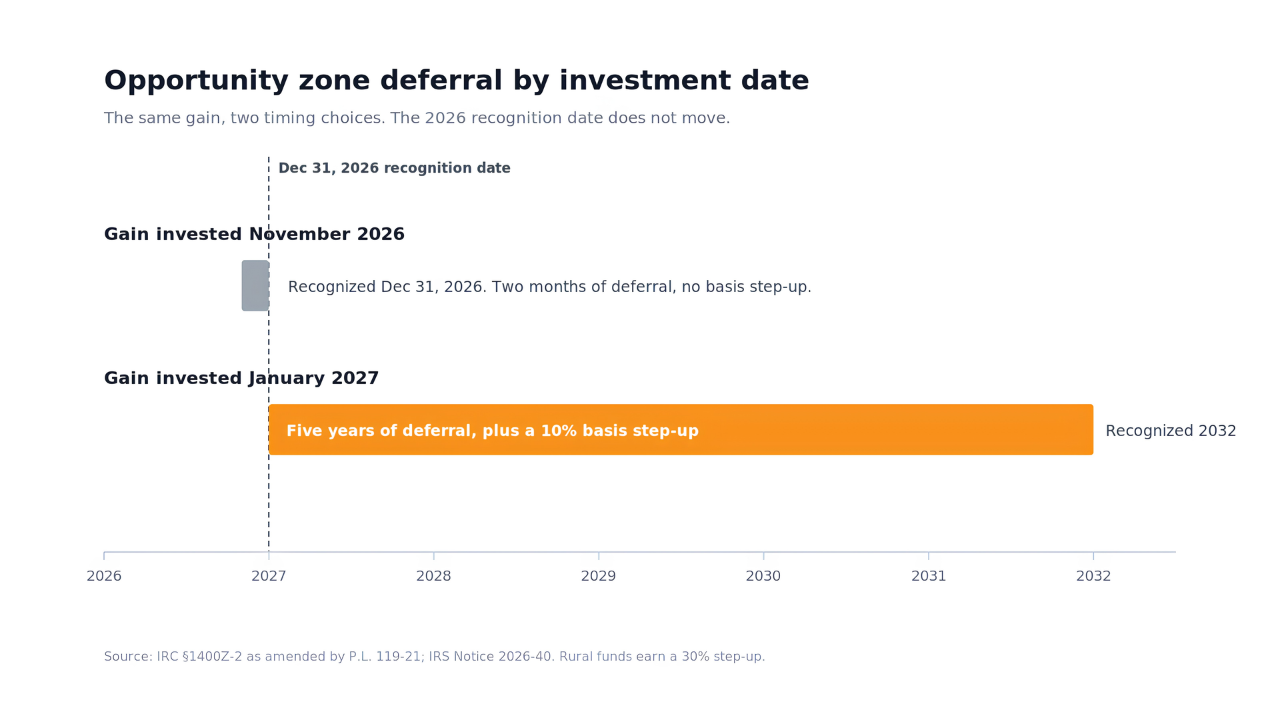
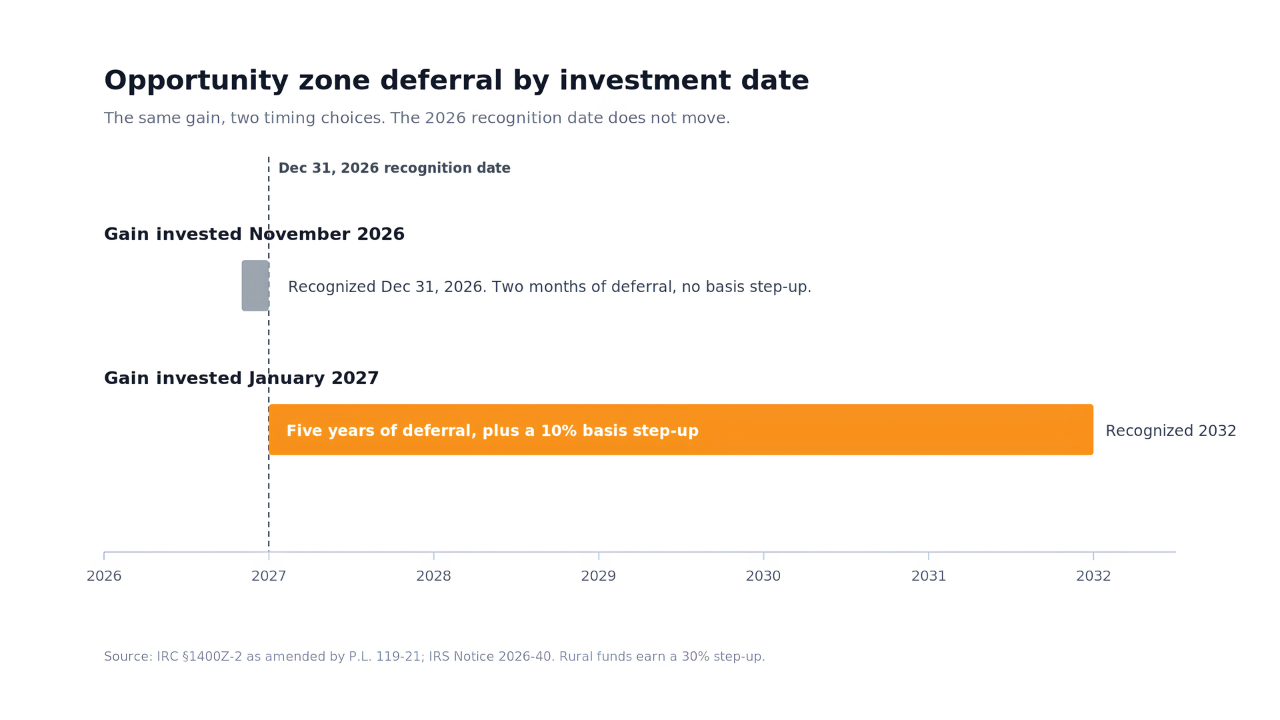
Qualified opportunity zone funds hit a dead zone in 2026, and most articles will not tell you that. Any capital gain invested in a fund on or before December 31, 2026 must be recognized on your 2026 return no matter when you invested it. New money placed in a fund today buys months of deferral, not years.
The rebuilt program starts January 1, 2027. Investments made on or after that date earn a rolling five-year deferral from the investment date plus a 10% basis step-up, and rural funds earn a 30% step-up. The honest play for new gains: wait until January 2027 and trade a few months of patience for five years of deferral.
Eligibility: investors with large realized capital gains, and this year the timing matters more than the vehicle.
10. Defer Income to Lower Tax Years
Income deferral works for self-employed readers who control their own billing. A cash-method business can invoice in January instead of December and push the income into next year. Asset sales can wait for a lower-income year on the same logic.
W-2 employees face a wall called constructive receipt. Income made available to you without restriction counts as received, so a bonus that is payable now cannot move to January by leaving the check uncashed. Formal bonus deferral requires an employer plan with strict election rules, and a botched election carries a penalty.
Eligibility: self-employed readers and business owners, while W-2 bonuses need a formal employer plan.
11. Take the Qualified Business Income Deduction
The qualified business income deduction cuts 20% off pass-through business income, and Congress made it permanent. It applies to income from sole proprietorships, partnerships, S corporations, and other pass-through structures. For a high earner with business income it is often the single largest recurring deduction available.
Specified service trades such as law, medicine, and consulting phase out of the deduction at higher incomes. Owners of other business types keep it at any income level, subject to wage and property limits a CPA can model.
Eligibility: owners of pass-through businesses.
12. Invest in Income-Generating Depreciable Assets
Some assets pay twice: once through the income they produce and again through the depreciation deduction on their purchase price. Rental property, leased equipment, and specialized computing hardware all fit the pattern. The strategy appeals to readers who have maxed every retirement account and still face a large bill, because it converts capital into a deduction and a revenue stream at the same time.
The deduction can be large. Qualifying business equipment can be deducted at 100% of its cost in the first year, so a six-figure purchase can produce a six-figure deduction while the asset starts earning.
Bitcoin mining hardware is one example of the class. ASIC miners produce Bitcoin through most hours of the year, with normal pauses for maintenance and curtailment. The machines can be hosted at a professional facility, so the deduction does not require becoming a data center operator.
One warning before the appeal runs ahead of the rules. The deduction on income-generating equipment is a larger and more technical lever than anything else on this list. How much of it you can use against W-2 wages depends on which election you take and on whether the IRS treats the activity as active or passive. The deduction also requires a real trade or business with documented participation, not a hobby and not a passive holding you never touch. Read how bonus depreciation works on mining hardware before you commit capital, because the setup decisions come before the purchase.
Eligibility: buyers prepared to run the activity as a documented business.
Why High Earners Need Advanced Tax Strategies
High earners need advanced strategies because standard deductions and basic retirement contributions make a small dent at the top of the bracket ladder. The 37% bracket begins at $640,600 for single filers and $768,700 for joint filers in 2026, and every marginal dollar above those lines loses more than a third of itself to federal tax before state tax applies.
- Bracket creep: raises, bonuses, and windfalls push marginal dollars into higher rates even when your lifestyle feels the same.
- Phase-outs: the traditional IRA deduction, Roth eligibility, and several credits shrink or vanish as income climbs, which removes the easy levers first.
The state and local tax deduction is the largest single deduction change of 2026 for a W-2 earner in a high-tax state. The cap sits at $40,400 for the year ($20,200 on a separate married return), up from the old $10,000 limit that stood from 2018 through 2024. The cap phases down at 30 cents per dollar of modified adjusted gross income above $505,000 and bottoms out at a $10,000 floor, so the highest earners keep the least of it. The higher cap is temporary and reverts to $10,000 in 2030. Business owners in states with a pass-through entity tax election can deduct state tax at the entity level outside the cap, a route W-2 earners do not have.
The net investment income tax adds a 3.8% surcharge once modified adjusted gross income passes $200,000 for single filers, $250,000 for joint filers, or $125,000 on a separate married return, and those thresholds are fixed by statute with no inflation adjustment. The tax applies to interest, dividends, capital gains, rents, royalties, and income from passive businesses. It stacks on top of capital gains rates, which lifts the top federal rate on long-term gains to 23.8%. Harvested losses do double work here, because a loss that offsets a gain also removes that gain from net investment income. A deferred opportunity zone gain recognized on December 31, 2026 counts as investment income too, so the surcharge belongs in the estimated payment math for anyone facing that date.
The alternative minimum tax earns its own paragraph in 2026. The exemption phase-out now begins at $500,000 for single filers and $1,000,000 for joint filers, and the phase-out rate doubles from 25% to 50%. Inside that band each extra dollar of income erases 50 cents of exemption, which pushes effective marginal rates into the low 40s. Exposure stays limited below the $500,000 single threshold, so most readers under that line see little change. Above it, income timing and large deductions carry AMT consequences they did not carry in 2025.
Tax Reduction Mistakes to Avoid
The most expensive tax reduction mistakes are misclassified expenses, missed deadlines, and weak documentation. Each one turns a legitimate strategy into an audit flag or a lost deduction.
- Misclassifying personal expenses as business deductions. The IRS scrutinizes home office and vehicle claims, so document business use before you claim it.
- Missing contribution deadlines. 401(k) deferrals must land by December 31. IRA and HSA contributions can wait until the April filing deadline, and a SEP-IRA can wait until your extended filing deadline.
- Ignoring the wash sale rule on securities. Buying a stock or ETF back too soon after a loss sale erases the harvested loss.
- Over-contributing to retirement accounts. Excess contributions draw a penalty each year until you remove them.
- Skipping charitable paperwork. Cash gifts above a modest threshold need written acknowledgment from the charity, and large non-cash gifts need appraisals.
FAQs About Reducing Taxable Income
What is the most overlooked tax deduction for high earners?
The HSA is an easy one to underuse. You can open one on your own with qualifying high-deductible coverage even when your employer offers no HSA, and the funds never expire.
How much does a tax deduction save you?
A deduction saves money at your marginal tax rate. A $10,000 deduction saves $3,700 in the 37% bracket and $2,400 in the 24% bracket, so the same deduction grows more valuable as income rises.
Can you reduce taxable income after December 31?
Yes, within limits that differ by account. Traditional IRA and HSA contributions count for the prior year until the April filing deadline with no extensions allowed. A SEP-IRA stays open until your filing deadline including extensions, which can reach October for a sole proprietor on extension. 401(k) employee deferrals close on December 31.
What is the difference between marginal and effective tax rate?
Your marginal rate is the percentage paid on your last dollar of income. Your effective rate is the average percentage paid across all income after deductions and credits, and it sits below your marginal rate under a progressive bracket system.
What changed for high earners in 2026?
Itemizers now deduct only the charitable gifts that exceed 0.5% of AGI, and taxpayers in the 37% bracket keep at most 35 cents of value per deducted dollar. The alternative minimum tax also reaches lower, with exemption phase-outs starting at $500,000 for single filers and $1,000,000 for joint filers at a doubled 50% rate.
Build Wealth While Lowering Your Tax Bill
The best tax strategies do double duty: they cut this year's bill while building assets that keep paying. Retirement accounts compound behind a tax shield. Charitable plans move wealth on your terms. Equipment you own produces Bitcoin and depreciates for tax purposes, and hosted Bitcoin mining from $0.065/kWh removes the racking, power, and maintenance burden from that path. The Bitcoin mining equipment we sell runs in those same facilities. Bring your full picture to a CPA before year end, because the strategies above work best in combination and several carry December deadlines.
This article is for educational purposes only and is not tax, legal, or financial advice. Simple Mining is not a tax advisor or a financial advisor. Consult a qualified CPA before acting on any strategy here.