

Can You Buy Bitcoin in a Roth IRA? Rules, Custodians, and How It Works
By Josh Heine, Content Strategist at Simple Mining
Published August 12, 2026
Yes, you can buy Bitcoin in a Roth IRA. The account has to sit with a custodian that supports digital assets, which today means a self-directed IRA custodian or Fidelity's crypto IRA. The appeal is structural: gains compound inside the account and come out untaxed once a distribution qualifies. The trap most guides skip is mining income, which the IRS taxes even inside the wrapper. This guide covers the eligibility rules, the custodians, the costs, and that trap.
On this page · 12 sections
- Can You Buy Bitcoin in a Roth IRA?
- What Is a Self-Directed IRA for Bitcoin?
- How Bitcoin in a Roth IRA Works
- Tax Benefits of Holding Bitcoin in a Roth IRA
- Bitcoin Roth IRA Rules and Contribution Limits
- What to Look for in a Bitcoin IRA Custodian
- Bitcoin IRA Fees and Costs to Expect
- Risks and Drawbacks of Bitcoin in a Roth IRA
- Bitcoin IRA vs. Bitcoin ETF in a Roth IRA
- What Happens If Your IRA Mines Bitcoin?
- FAQs About Bitcoin in a Roth IRA
- Is a Bitcoin Roth IRA Right for Your Retirement Strategy?
Key Takeaways
- Yes: you can hold Bitcoin in a Roth IRA through a self-directed custodian or through Fidelity's crypto IRA, while most other brokerages limit retirement accounts to spot Bitcoin ETFs.
- The contribution limit is $7,500 for tax year 2026 and $8,600 with the age-50 catch-up, with income phase-outs starting at $153,000 for single filers (IRS Notice 2025-67).
- Trades inside the account are not taxable events; the growth becomes tax-free only on a qualified distribution after five years and age 59½ or an exception.
- A qualified custodian must hold the assets and you cannot hold your own private keys; McNulty v. Commissioner (2021) shows the IRS treats personal control as a distribution.
- Mining income inside an IRA is taxed as unrelated business income at trust rates that reach 37%, while buying and holding Bitcoin is not.
Can You Buy Bitcoin in a Roth IRA?
Yes, you can buy Bitcoin in a Roth IRA. The account must be held with a custodian that supports digital assets, which most brokerage Roth IRAs are not. IRS Notice 2014-21 treats crypto as property, and property that is not a prohibited collectible under IRC 408(m) can be held in an IRA.
Fidelity offers a crypto IRA that holds Bitcoin directly, available as a Roth, Traditional, or Rollover account. Most other mainstream brokerages still limit retirement accounts to spot Bitcoin ETFs, which is why self-directed IRA custodians exist. The rest of this guide walks both routes.
What Is a Self-Directed IRA for Bitcoin?
A self-directed IRA is a Roth or traditional IRA held at a custodian that permits alternative assets, Bitcoin included. Three terms carry the whole concept:
- Self-directed IRA: a retirement account that can hold investments beyond stocks, bonds, and funds.
- Custodian: the financial institution that holds and administers the assets for the account.
- Alternative assets: Bitcoin, real estate, precious metals, and private equity all qualify.
The self-directed label means broader investment options, not self-custody of assets. The custodian still holds everything the account owns, and the risks section below explains why that rule has teeth.
How Bitcoin in a Roth IRA Works
The process runs through four steps: open, fund, purchase, and monitor. Each step keeps the custodian between you and the asset, and that separation preserves the tax treatment.
1. Open a Self-Directed IRA with a Qualified Custodian
Pick a custodian that supports digital assets and open the account. The application resembles any IRA setup: identity verification, a beneficiary designation, and the account agreement. Some custodians pair the IRA with a trading account at a partner exchange titled to the IRA.
2. Fund Your Account or Roll Over Existing Retirement Funds
Funding comes from new cash contributions, a rollover from a 401(k), or a transfer from another IRA. Annual limits apply to new contributions and not to rollovers. Contributions must arrive as cash under IRC 408(a)(1). Bitcoin you bought through the steps to buy Bitcoin on a regulated exchange stays outside the wrapper; the account buys its own coins with the cash you send it.
3. Purchase Bitcoin Through Your Custodian
Orders run through the custodian's platform rather than a personal exchange login. Pricing arrives as a per-trade fee or a spread, and both belong in your cost math before you fund.
4. Store and Monitor Your Bitcoin Holdings
Someone other than you holds the keys, either the custodian directly or a partner exchange the account trades through. A dashboard shows balances, cost basis, and account value. What you never receive is the private key, and that is by design under IRC 408(a).
Tax Benefits of Holding Bitcoin in a Roth IRA
A Roth IRA removes the annual tax friction from a volatile asset: trades inside the account are not taxable events, and qualified withdrawals come out untaxed. Both halves carry conditions worth reading before you celebrate.
How Gains Are Treated Inside the Account
Bitcoin appreciation compounds inside the account with no annual tax bill. The growth becomes tax-free only on a qualified distribution, meaning the account has been open five years and the holder is 59½ or meets an exception. Compare that with how Bitcoin capital gains are taxed in an ordinary account, where every sale settles with the IRS.
Why Trades Inside a Roth Are Not Taxable Events
Selling or swapping Bitcoin inside the account triggers nothing on your tax return, because the account itself is the exempt owner for tax purposes. The flip side is that losses inside the account do no work: crypto tax loss harvesting in a taxable account has no Roth equivalent. The tax-free outcome still depends on a qualified distribution at the end.
Tax-Free Qualified Withdrawals in Retirement
Qualified distributions after age 59½ with a five-year holding period are completely tax-free. The exceptions that substitute for the age test are disability, a qualified first-time home purchase, and death under IRS Pub 590-B. Miss the conditions on earnings and income tax plus a 10% penalty can apply.
Bitcoin Roth IRA Rules and Contribution Limits
The rules that govern any Roth IRA govern this one; holding Bitcoin changes nothing about the wrapper itself. Contribution caps, income phase-outs, and the prohibited transaction rules all apply in full.
Annual Contribution Limits for Roth IRAs
The IRA contribution limit for tax year 2026 is $7,500 under IRS Notice 2025-67. Savers age 50 and over add a $1,100 catch-up for tax year 2026, which brings their total to $8,600. The cap applies across all your traditional and Roth IRAs combined and cannot exceed your taxable compensation for the year.
Income Eligibility Requirements
Roth contributions phase out with modified adjusted gross income. For tax year 2026 the range runs from $153,000 to $168,000 for single filers and heads of household, per IRS Notice 2025-67. Joint filers phase out between $242,000 and $252,000 for tax year 2026. Above the top of your range you cannot contribute to a Roth directly.
Prohibited Transactions to Avoid
IRC 4975 bars self-dealing between you and your IRA. The classic violations:
- Using IRA-owned Bitcoin to buy personal goods
- Lending money between yourself and your IRA
- Selling personal property to your IRA
A prohibited transaction can disqualify the entire IRA retroactively to January 1 of that year, which makes the full account value a deemed distribution. One version of this we field from hosting clients: no, you cannot sell miners you already own to your new self-directed IRA. That is personal property sold to your IRA, which is the third bullet.
What to Look for in a Bitcoin IRA Custodian
Judge a Bitcoin IRA custodian on security, fees, supported assets, regulation, and support quality. The checklist:
- Security: cold storage, documented key management, and independent audits.
- Fee transparency: every setup, custody, and trading charge disclosed before you fund.
- Insurance: some custodians carry commercial insurance, and coverage varies by provider. Crypto held in an IRA is not FDIC or SIPC insured.
- Supported assets: confirm the coins you want are on the platform.
- Track record: years in operation, a state trust charter or equivalent oversight, and public reviews.
Popular Self-Directed IRA Providers for Bitcoin
Providers fall into three lanes rather than one ranked list. Crypto-first IRA platforms build the account around digital assets. Broad SDIRA custodians add crypto beside real estate and private equity, often through a partner exchange. Fidelity runs a third lane as a mainstream brokerage whose crypto IRA trades Bitcoin, Ethereum, Litecoin, and Solana, though it is unavailable in California and Oregon.
Bitcoin IRA Fees and Costs to Expect
Expect three fee layers on a dedicated crypto IRA: setup, annual administration, and per-trade charges. Fidelity's crypto IRA charges no setup or maintenance fee and takes 1% per trade, while dedicated SDIRA custodians typically charge a setup fee, an annual fee, and a per-trade percentage.
| Fee type | What it covers | Example |
|---|---|---|
| Setup | One-time account opening | $50 at Directed IRA; $0 at Fidelity |
| Annual administration | Custody, reporting, and account maintenance | $295 at Directed IRA; $0 at Fidelity |
| Trading | Each buy or sell | 0.50% at Directed IRA; 1% at Fidelity |
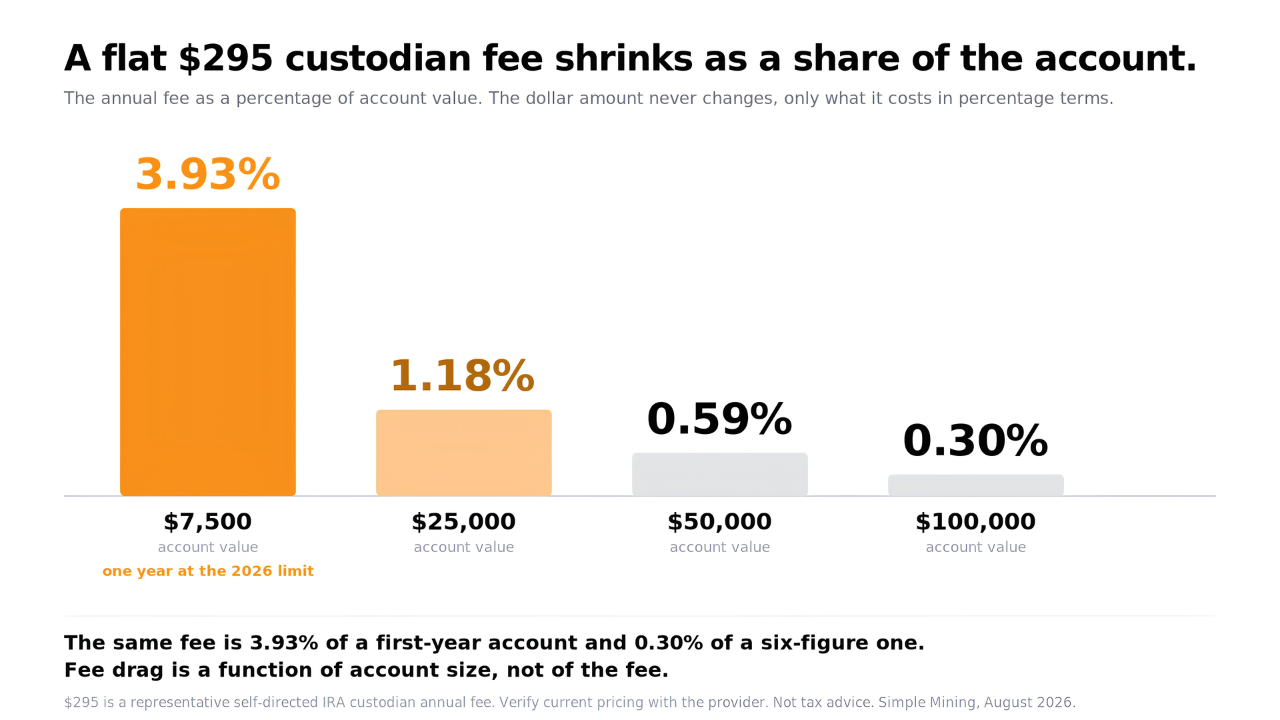
Run the math on a small account before you commit. A $295 annual fee against a first-year contribution of $7,500 for tax year 2026 is a 3.9% drag before a single trade clears. The percentage shrinks as the account grows, which is why fee structure matters most in the early years.
Risks and Drawbacks of Bitcoin in a Roth IRA
The main drawbacks are price volatility, fee drag, a thin custodian market, and the loss of self-custody. None of them is hidden; all of them belong in the decision.
Bitcoin Price Volatility
Bitcoin's drawdowns test a retirement timeline. An investor five years from distributions faces different math than one thirty years out, because the account cannot deduct losses along the way. Volatility rewards the wrapper on the way up and offers no consolation prize on the way down.
Higher Fees Than Traditional IRAs
A plain index-fund IRA at a discount broker costs close to zero. Every fee layer above that is drag your Bitcoin position must out-earn. The fee table above shows where the layers sit.
Limited Custodian Options
Fewer providers support crypto than support stocks, which limits competition on fees and features. The market is widening as mainstream brokerages enter it.
No Self-Custody Allowed
IRA assets must sit with a qualified trustee or custodian under IRC 408(a). The Tax Court showed the consequence in McNulty v. Commissioner, 157 T.C. No. 10 (2021): a taxpayer took personal possession of IRA assets and the court treated the value as a taxable distribution. The IRS has not ruled on private keys as a specific question, but holding your own keys invites the same treatment. Losing self-custody is the price of the tax deal.
Bitcoin IRA vs. Bitcoin ETF in a Roth IRA
A self-directed account owns the coin itself, while a spot ETF inside a standard brokerage Roth owns shares of a fund that holds Bitcoin. Both live inside the same tax wrapper; the difference is what you hold and what you pay to hold it.
| Factor | Direct Bitcoin | Spot Bitcoin ETF |
|---|---|---|
| Ownership | Actual Bitcoin titled to the IRA | Shares of a fund holding Bitcoin |
| Custodian required | SDIRA custodian, or a brokerage offering direct crypto IRAs | Standard brokerage |
| Fees | Setup, annual, and trading fees at most providers | Fund expense ratio plus commission |
| Complexity | More setup steps | As simple as buying a stock |
| Self-custody | Not possible | Not possible |
Spot ETFs trade in any brokerage account including IRAs, so access is not a point of difference between the products. What differs is form: coin versus fund share, and withdrawal in kind versus cash. Watch daily net flows across the US spot Bitcoin ETFs to see how much capital moves through the fund wrapper.
What Happens If Your IRA Mines Bitcoin?
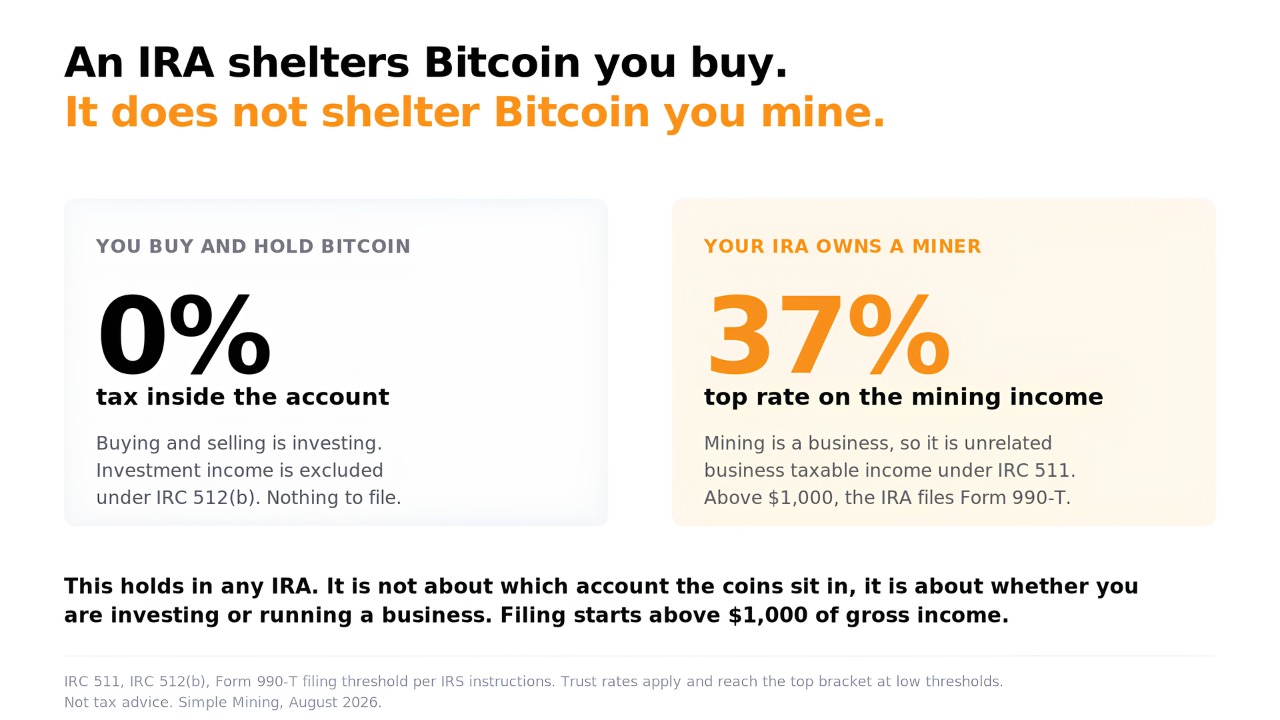
Mining income inside an IRA is unrelated business taxable income under IRC 511, because the IRS treats mining as a trade or business rather than passive investment income. Buying and selling Bitcoin in an IRA does not trigger UBIT. Mining it does. That distinction is the misunderstanding we correct most on tax questions: investors assume the wrapper covers everything inside it.
An IRA with more than $1,000 of gross UBTI must file Form 990-T. Trust tax rates apply to that income, and they compress fast: the top 37% bracket starts at just $16,000 of taxable income for tax year 2026. A hosted machine earning a few thousand dollars a year clears the $1,000 filing threshold on its own, well before it reaches the top rate.
Some tax professionals use a C-corporation blocker between the IRA and the mining activity. The corporation pays the 21% corporate rate on mining profit and its dividends to the IRA are exempt investment income under IRC 512(b)(1). The 21% is the price of the structure, not a loophole around tax. Operating that entity yourself raises self-dealing questions under IRC 4975. The deductions miners prize also live elsewhere: bonus depreciation on mining hardware held in a trade or business shelters a taxable operation rather than an IRA.
This structure requires a CPA, not an article. If mining inside a retirement account tempts you, put the numbers in front of a tax professional before any money moves.
FAQs About Bitcoin in a Roth IRA
Can I transfer Bitcoin I already own into a Roth IRA?
No. IRA contributions must arrive as cash under IRC 408(a)(1), so the IRS does not accept Bitcoin you already hold. You would sell the coins, contribute the proceeds within the annual limit, and repurchase through the account. Selling your own Bitcoin to fund the contribution is itself a taxable disposal.
What happens to my Bitcoin IRA if the custodian goes bankrupt?
Assets held in trust are generally kept separate from a custodian's own corporate assets, but the protection depends on the custodian's charter and structure rather than on any federal insurance. Some custodians carry commercial insurance, and coverage varies by provider. Crypto held in an IRA is not FDIC or SIPC insured. Confirm segregation and insurance terms in writing before you fund an account.
Can I hold multiple cryptocurrencies in one self-directed IRA?
Yes. Most crypto IRA custodians support several digital assets in one account. Fidelity's crypto IRA trades Bitcoin, Ethereum, Litecoin, and Solana, while some SDIRA platforms list dozens of coins.
How do I report a Bitcoin Roth IRA on my taxes?
Your custodian reports the account's fair market value each year on Form 5498. You do not report individual trades or gains inside the account. The exception is business income: an IRA with more than $1,000 of gross UBTI from mining or a similar activity must file Form 990-T.
Can I take early withdrawals from a Bitcoin Roth IRA?
You can withdraw your original contributions at any time without tax or penalty. Earnings withdrawn before age 59½ face income tax plus a 10% penalty unless an exception applies. IRS Pub 590-B lists the exceptions.
Is a Bitcoin Roth IRA Right for Your Retirement Strategy?
The wrapper suits investors with long runways and buy-and-hold conviction: decades of compounding with no tax friction and a tax-free exit once the distribution qualifies. It suits nobody who wants to hold their own keys, trade on margin, or run a business inside the account. Weigh the fee drag against your time horizon and the value you place on the tax treatment.
Accumulating Bitcoin through mining is a different decision, and the taxable side is the simpler home for it. Business deductions work in your favor there, and hosted Bitcoin mining at $0.065/kWh removes the racking, power, and maintenance burden from the equation. Talk with our team about what a hosted fleet produces, then bring the retirement question to your CPA.
This article is educational content, not financial, tax, or legal advice. Simple Mining is not an IRA custodian, a tax advisor, or a financial advisor. Consult a CPA or licensed advisor before moving retirement money.