

What Is a Bitcoin ETF? How It Works vs Owning Bitcoin
By Josh Heine, Content Strategist at Simple Mining
Published September 23, 2026
A Bitcoin ETF is an exchange-traded fund that holds Bitcoin or Bitcoin futures contracts and issues shares that trade on a stock exchange, so an investor can track Bitcoin's price through an ordinary brokerage account without buying coins, running a wallet, or securing private keys. The fund owns the asset and you own shares in the fund. That one distinction drives every cost, tax, and control difference below.
On this page · 13 sections
- What Is a Bitcoin ETF?
- How Do Bitcoin ETFs Work?
- Spot Bitcoin ETFs vs Bitcoin Futures ETFs
- When Were Bitcoin ETFs Approved?
- List of US Spot Bitcoin ETFs
- Bitcoin ETF vs Owning Bitcoin
- Bitcoin ETF Pros and Cons
- Bitcoin ETF Fees Explained
- How Are Bitcoin ETFs Taxed?
- How to Buy a Bitcoin ETF
- Alternatives to a Bitcoin ETF
- Bitcoin ETF FAQs
- Is a Bitcoin ETF Right for You?
Key Takeaways
- Twelve US spot Bitcoin ETFs trade today, with sponsor fees from 0.14% to 1.50%.
- Spot funds are 1933 Act grantor trusts rather than 1940 Act funds, so mutual-fund-style protections do not apply.
- The sponsor fee is paid by selling Bitcoin out of the trust, so each share represents a little less Bitcoin every year.
- ETF shares fall under the wash sale rule and arrive with a Form 1099-B. Bitcoin in your own wallet does not, under current law.
- Shares trade on weekdays only. Bitcoin trades around the clock, and only the holder of the keys can spend or move it.
What Is a Bitcoin ETF?
A Bitcoin ETF is a fund listed on a US stock exchange whose shares rise and fall with the price of Bitcoin. ETF stands for exchange-traded fund. Each fund carries a ticker symbol such as IBIT or FBTC, and you trade its shares the same way you trade a stock. Each share is a fractional claim on whatever the fund holds.
Two kinds exist. A spot Bitcoin ETF holds Bitcoin itself with a custodian. A Bitcoin futures ETF holds futures contracts that reference Bitcoin's price. Twelve spot funds trade in the United States alongside a handful of futures and options-based funds. Unless a section says otherwise, this article means the spot kind.
Three terms recur. Net asset value (NAV) is the value of the fund's holdings divided by shares outstanding. The sponsor fee is the annual charge the issuer takes for running the fund. An authorized participant is a large trading firm allowed to create and redeem shares with the fund itself.
How Do Bitcoin ETFs Work?
A spot Bitcoin ETF works by holding Bitcoin with a custodian and issuing shares in large blocks to authorized participants, who then sell those shares on the exchange. When demand pushes the share price above NAV, an authorized participant buys Bitcoin, delivers it or the cash equivalent to the trust, and receives new shares to sell. When the share price sinks below NAV the process runs in reverse. That arbitrage loop keeps the share price close to the value of the Bitcoin behind it.
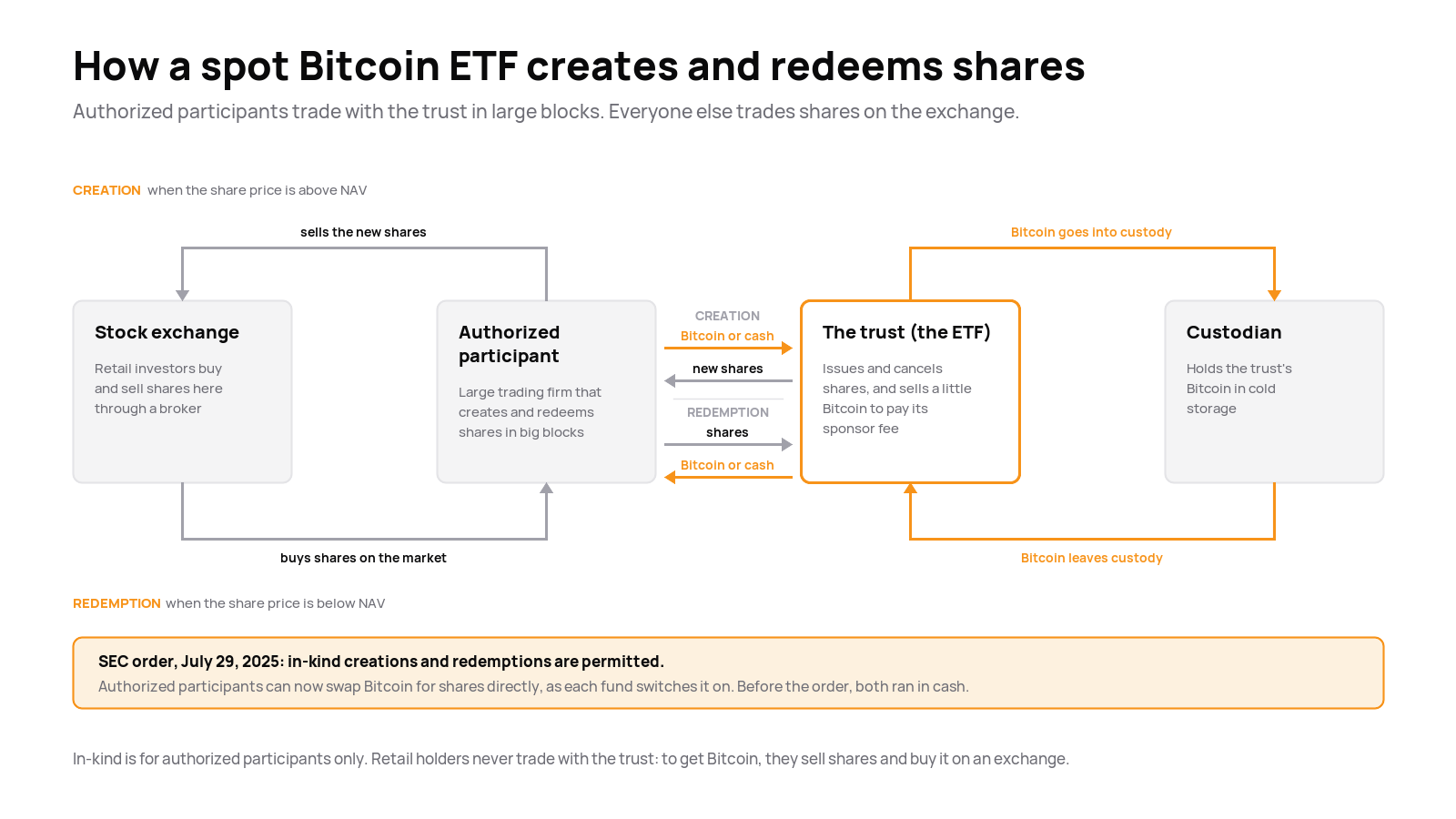
Redemption used to be cash only. The SEC changed that on July 29, 2025 with an order permitting in-kind creations and redemptions for spot Bitcoin and ether products. In-kind means an authorized participant can hand Bitcoin to the trust for shares or hand shares back for Bitcoin. That right belongs to authorized participants alone, and a retail holder still cannot turn shares into coins.
The sponsor fee is collected in Bitcoin. The trust accrues the fee each day and sells enough Bitcoin each month to pay it. The share count stays the same while the Bitcoin behind it shrinks, so a share of a 0.25% fund represents about 0.25% less Bitcoin after one year. Over a decade that erosion compounds.
Net creations minus net redemptions show up as daily Bitcoin ETF flows. Through the September 22, 2026 session the twelve funds had absorbed $56.8B in cumulative net flow since January 11, 2024 and held $110.8B in total net assets. Flows measure demand arriving through brokerage accounts, and a single session says little on its own.
Spot Bitcoin ETFs vs Bitcoin Futures ETFs
A spot Bitcoin ETF holds Bitcoin, while a Bitcoin futures ETF holds CME futures contracts that reference Bitcoin's price. The two look alike on a brokerage screen and part ways over time.
Spot Bitcoin ETFs
Spot funds are grantor trusts registered under the Securities Act of 1933 and listed under the Exchange Act of 1934. The trust owns Bitcoin and a custodian holds the keys in cold storage. The share price follows a Bitcoin reference rate less fees. There is no roll and no derivative exposure, so the drag on returns is the sponsor fee plus the bid-ask spread.
Bitcoin Futures ETFs
The ProShares Bitcoin Strategy ETF (BITO) was the first US Bitcoin ETF of any kind. It is a 1940 Act fund that holds front-month CME Bitcoin futures and rolls them every month. When the next contract costs more than the expiring one the roll sells low and buys high, a state traders call contango. That roll cost sits on top of a 0.95% expense ratio, which is why BITO trails Bitcoin over long holding periods. BITO pays distributions each month from futures gains and interest rather than from Bitcoin.
| Feature | Spot Bitcoin ETF | Bitcoin futures ETF (BITO) |
|---|---|---|
| Underlying asset | Bitcoin held by a custodian | CME Bitcoin futures contracts |
| Legal structure | 1933 Act grantor trust | 1940 Act registered fund |
| Expense ratio range | 0.14% to 1.50% | 0.95% |
| Roll costs | None | Yes, every month |
| Tracking | Follows spot less the sponsor fee | Drifts from spot as contracts roll |
| Distributions | None | Monthly |
When Were Bitcoin ETFs Approved?
The SEC approved the first US spot Bitcoin ETFs on January 10, 2024, and ten of them began trading the next day. Bitcoin futures ETFs came more than two years earlier, and every milestone since has widened what the funds can do.
- October 19, 2021. BITO lists on NYSE Arca as the first US Bitcoin futures ETF.
- January 10, 2024. The SEC approves exchange listing for eleven spot Bitcoin ETPs in one order.
- January 11, 2024. Ten spot funds begin trading, including GBTC after its conversion from an over-the-counter trust.
- July 31, 2024. Grayscale spins 10% of GBTC's Bitcoin into the lower-fee Grayscale Bitcoin Mini Trust (BTC).
- November 19, 2024. Options on IBIT begin trading after SEC approval on September 20, 2024. The contracts settle in ETF shares, not in Bitcoin.
- July 29, 2025. The SEC permits in-kind creations and redemptions for authorized participants.
- April 8, 2026. Morgan Stanley lists MSBT at a 0.14% sponsor fee, the lowest of the twelve spot funds.
- August 2026. Hashdex liquidates DEFI, the first US spot Bitcoin ETF to close.
List of US Spot Bitcoin ETFs
Twelve spot Bitcoin ETFs trade in the United States. The count moved twice in 2026: Morgan Stanley's MSBT listed on April 8, 2026 and Hashdex's DEFI stopped trading on August 17, 2026 ahead of its liquidation. Sponsor fees below are as listed on each issuer's page or SEC filing in September 2026 and can change.
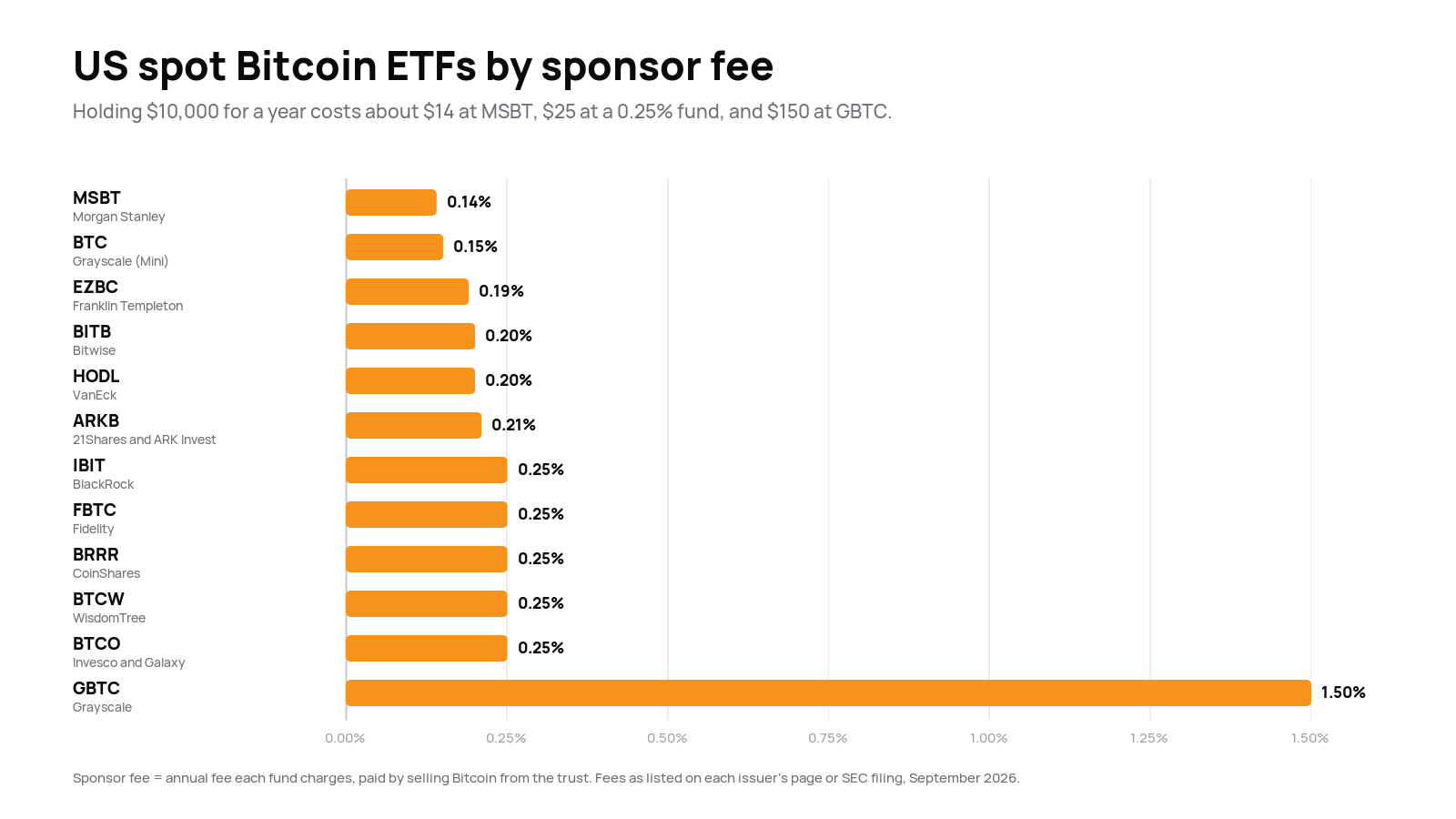
| Ticker | Fund | Issuer | Sponsor fee | Bitcoin custodian(s) |
|---|---|---|---|---|
| MSBT | Morgan Stanley Bitcoin Trust | Morgan Stanley Investment Management | 0.14% | Coinbase Custody, BNY |
| BTC | Grayscale Bitcoin Mini Trust ETF | Grayscale | 0.15% | Coinbase Custody |
| EZBC | Franklin Bitcoin ETF | Franklin Templeton | 0.19% | Coinbase Custody |
| BITB | Bitwise Bitcoin ETF | Bitwise | 0.20% | Coinbase Custody |
| HODL | VanEck Bitcoin ETF | VanEck | 0.20% | Gemini Trust, Coinbase Custody |
| ARKB | ARK 21Shares Bitcoin ETF | 21Shares and ARK Invest | 0.21% | Coinbase Custody, Anchorage Digital Bank, BitGo |
| IBIT | iShares Bitcoin Trust ETF | BlackRock | 0.25% | Coinbase Custody, Anchorage Digital Bank |
| FBTC | Fidelity Wise Origin Bitcoin Fund | Fidelity | 0.25% | Fidelity Digital Asset Services |
| BRRR | CoinShares Bitcoin ETF | CoinShares | 0.25% | Coinbase Custody, BitGo |
| BTCW | WisdomTree Bitcoin Fund | WisdomTree | 0.25% | Coinbase Custody |
| BTCO | Invesco Galaxy Bitcoin ETF | Invesco and Galaxy | 0.25% | Coinbase Custody |
| GBTC | Grayscale Bitcoin Trust ETF | Grayscale | 1.50% | Coinbase Custody |
Coinbase Custody holds Bitcoin for eleven of the twelve funds, and FBTC is the only one outside Coinbase because Fidelity custodies its own coins. Several issuers name a second custodian on paper, though BlackRock's filings state it has no plans to move IBIT's Bitcoin to Anchorage. That concentration is a counterparty risk most ETF buyers never price in.
Bitcoin ETF vs Owning Bitcoin
The difference between a Bitcoin ETF and owning Bitcoin comes down to who holds the keys. An ETF gives you price exposure inside a system you already use. Direct ownership gives you the asset itself and every job that comes with it.
Custody and Control
With an ETF the fund's custodian holds the Bitcoin and your broker holds your shares, so you never touch a private key and never control one. With direct ownership you hold the keys in a non-custodial wallet, and for long-term storage most holders move coins to a cold wallet kept offline. Control means you can move funds at 3 a.m. on a Sunday, and it means a lost seed phrase is a lost balance.
Costs
An ETF charges a sponsor fee between 0.14% and 1.50% a year for as long as you hold it. Direct ownership has no management fee but carries costs the ETF does not: exchange trading fees and spread at purchase, a network fee on every on-chain transfer, exchange withdrawal fees, and the one-time price of a hardware wallet.
Taxes and Reporting
Both routes produce capital gains when you sell. Your broker reports ETF share sales on Form 1099-B with cost basis. US crypto exchanges now report Bitcoin sales on Form 1099-DA, while sales from your own wallet remain self-reported on Form 8949. The wash sale rule reaches ETF shares and not self-held Bitcoin, which the tax section below explains.
Trading Hours
ETF shares trade on weekdays. Exchange sessions run from 4:00 a.m. to 8:00 p.m. Eastern, and many brokers route overnight weekday orders for large funds such as IBIT through alternative trading systems. The SEC has approved 22- to 23-hour weekday sessions for NYSE Arca, Nasdaq, and 24X National Exchange, and NYSE Arca's published launch target is December 6, 2026. None of that reaches a Saturday or a market holiday, while Bitcoin trades every hour of every day.
Forks and On-Chain Use
An ETF share cannot be sent or spent on the Bitcoin network. If the network splits in a contested Bitcoin fork, the sponsor decides which chain the trust follows and may abandon any forked coins rather than distribute them. A holder of keys makes that call alone. For anyone who wants Bitcoin as money rather than as a ticker, that difference matters every day.
| Factor | Bitcoin ETF | Owning Bitcoin |
|---|---|---|
| Custody | The fund's custodian | You hold the keys |
| Ongoing costs | Sponsor fee of 0.14% to 1.50% | No management fee; per-transaction and one-time costs |
| Tax reporting | Form 1099-B | Form 1099-DA from US brokers, self-reported for self-custody sales |
| Wash sale rule | Applies | Does not apply under current law |
| Trading hours | Weekdays, with extended and overnight sessions at many brokers, no weekends or holidays | Around the clock |
| On-chain use | None | Send, spend, or hold through a fork |
Bitcoin ETF Pros and Cons
A Bitcoin ETF trades convenience and familiar paperwork for fees and a loss of control. The lists below spell out that trade.
Pros
- Buy it in the brokerage or IRA you already have
- No wallet, seed phrase, or exchange account to manage
- Standard Form 1099-B reporting
- Registered prospectus disclosure under the Securities Act of 1933 and exchange listing rules against manipulation
- SIPC covers the shares against broker failure up to $500,000
Cons
- A recurring sponsor fee that reduces the Bitcoin behind each share every year
- You own a claim on Bitcoin, not Bitcoin
- Custodian concentration at Coinbase across eleven of twelve funds
- Not a 1940 Act fund, so mutual-fund-style protections do not apply
- SIPC does not cover Bitcoin's price or a loss at the fund's custodian
- No trading on weekends or holidays while Bitcoin moves
Bitcoin ETF Fees Explained
The sponsor fee is the only recurring fee a spot Bitcoin ETF charges, and it ranges from 0.14% to 1.50% a year. The issuer accrues it against the trust's assets each day and collects it by selling Bitcoin, so the fee never appears on your statement as a line item. You see it instead as a share that tracks Bitcoin a little less each year. On a $50,000 position a 0.25% fee costs about $125 in the first year.
Four other costs sit outside the sponsor fee. The bid-ask spread is the gap between the buy and sell price when you trade, and it widens for thin funds and in fast markets. A premium or discount to NAV is the gap between the share price and the Bitcoin behind it, which arbitrage keeps small but not zero. Tracking difference is the gap between the fund's return and Bitcoin's return over a period, and it comes from the fee plus small cash balances. Broker commissions are zero at most US brokers today.
How Are Bitcoin ETFs Taxed?
A spot Bitcoin ETF is taxed as a grantor trust, which means the IRS treats you as owning your share of the trust's Bitcoin. Selling shares is a sale of that Bitcoin for tax purposes. Gains on shares held more than one year are long-term, and gains on shares held one year or less are short-term ordinary income. The trust's Bitcoin sales to pay the sponsor fee are also taxable events passed through to you, so expect a small gain or loss on your annual tax statement even in a year you never sell.
For the 2026 tax year the long-term rates are 0%, 15%, and 20%. Under Rev. Proc. 2025-32 the 0% rate covers taxable income up to $49,450 for single filers and $98,900 for married couples filing jointly, the 15% rate runs to $545,500 and $613,700, and the 20% rate applies above those lines. Short-term gains face ordinary rates up to 37%. The 3.8% Net Investment Income Tax applies above $200,000 of modified adjusted gross income for single filers and $250,000 for joint filers. Bitcoin is not a collectible, so the 28% collectibles rate does not apply to either the ETF or the coin.
The rules for crypto capital gains tax on coins you hold yourself use the same rate schedule. The rule that differs is the wash sale rule under Section 1091, which disallows a loss on securities repurchased within 30 days. ETF shares are securities and Bitcoin in your own wallet is property under current law, so crypto tax-loss harvesting without a 30-day wait remains available for direct holders. Several bills would close that gap. The furthest along is H.R. 10357, the Digital Asset Tax Certainty Act, which the House Ways and Means Committee advanced 38-5 on September 16, 2026 and which still needs full House and Senate votes. Earlier proposals include Senator Lummis's S. 2207, the PARITY Act (H.R. 8899), and the Applying Existing Tax Anti-Abuse Rules to Digital Assets Act. None is law as of September 2026.
Form 1099-DA reporting for exchange-held Bitcoin began with 2025 sales and adds cost basis for coins bought in 2026 or later.
This article is educational and is not tax or investment advice, so consult a tax professional before you act on any of it.
How to Buy a Bitcoin ETF
Buying a Bitcoin ETF takes four steps and works the same as buying any listed stock.
- Open a brokerage account. Any US broker that trades ETFs will do, including the one that holds your IRA.
- Pick the fund. Compare sponsor fee, custodian, and trading volume across the twelve spot funds above.
- Place the order. Search the ticker and choose a limit order, which caps the price you pay. Market orders fill at whatever price is available.
- Check the position. Confirm the fill price against NAV on the issuer's page, and note the purchase date, since shares held more than one year qualify for long-term capital gains rates.
Alternatives to a Bitcoin ETF
An ETF is one of three common ways to get Bitcoin exposure, and each fits a different investor.
Buying Bitcoin Directly
Direct ownership means buying coins on an exchange and moving them to a wallet you control. It has no recurring fee, trades every hour, and hands you the custody job, which starts with learning how to buy Bitcoin on an exchange and withdrawing the coins to your own wallet.
Bitcoin Treasury Company Stocks
Some public companies hold large Bitcoin balances and trade as a leveraged proxy for the coin. Their shares can move more than Bitcoin in both directions because the market prices the company, its debt, and its ability to raise capital on top of the coins. Valuing Bitcoin treasury companies comes down to the premium the market pays over the coins they hold. These are operating businesses with equity risk rather than a substitute for the asset.
Bitcoin Mining
Mining produces Bitcoin rather than buying it. You buy a Bitcoin miner outright or on a payment plan, and the machine earns a share of block rewards for as long as it runs. Hosted mining places that machine in a data center under a bundled hosting service fee, which at Simple Mining runs $0.065 to $0.08 per kWh. The economics depend on the machine's efficiency, the hosting rate, and network difficulty, and all three move. The tax treatment differs too, because mined coins are ordinary income when received and the hardware qualifies for bonus depreciation on mining hardware in the year it goes into service.
Bitcoin ETF FAQs
Can I convert Bitcoin ETF shares to actual Bitcoin?
Not as a retail holder. Authorized participants can redeem shares for Bitcoin in kind since the SEC's July 2025 order, while a retail investor sells the shares and buys Bitcoin on an exchange.
Can I hold a Bitcoin ETF in an IRA or 401(k)?
Any brokerage IRA that trades ETFs can hold one, including a Roth, where holding Bitcoin in a Roth IRA through an ETF follows the same contribution and withdrawal rules as any other Roth asset. A 401(k) can hold one only if the plan menu includes one or offers a brokerage window, and the Department of Labor's March 2026 proposed rule on alternative assets is not final.
What happens if a Bitcoin ETF closes?
The sponsor sets a last trading day, delists the shares, sells the trust's Bitcoin, and pays each holder cash equal to NAV on the distribution date. Hashdex followed that sequence with DEFI in 2026: it announced on August 3, shares traded for the last time on August 17, and cash went out on August 24. The payout is a taxable sale whether or not you wanted one.
Why doesn't a Bitcoin ETF track Bitcoin's price exactly?
The sponsor fee is paid by selling Bitcoin from the trust, so each share follows a little less Bitcoin every year. Shares also trade at a small premium or discount to NAV during the day, and futures funds drift further because of monthly roll costs.
Do Bitcoin ETFs pay dividends?
Spot Bitcoin ETFs pay no distributions. Futures funds such as BITO and covered-call funds such as BITA pay monthly, and those payouts come from futures rolls or sold options rather than from Bitcoin itself.
Is a Bitcoin ETF Right for You?
Choosing a Bitcoin ETF is a decision about the vehicle, not about Bitcoin. If you want Bitcoin inside a retirement account or alongside stocks with one tax form, the ETF is the cleanest path and the fee is the price of that convenience. If you want money that no custodian can freeze and no sponsor can abandon in a fork, buy coins and learn the wallet. If you want exposure that produces coins each month through hardware you own, mining is the third door.
Whether a machine outproduces a spot purchase depends on Bitcoin's price, network difficulty, and power cost, which is the core of mining versus buying Bitcoin. None of this settles whether Bitcoin is a good investment in the first place, which is a separate decision from the vehicle.
Simple Mining hosts client machines across 150+ MW and 9+ EH/s at eleven sites in Iowa from its headquarters in Cedar Falls, with 95%+ average uptime. Investors who want to see hosted mining before buying hardware can take a 7-day free trial on an Antminer S21+ at 235 TH/s, then decide whether Bitcoin miner hosting fits alongside or instead of an ETF position.