

What is Ocean Mining Pool and How Does It Work?
By Josh Heine, Content Strategist at Simple Mining
Published February 18, 2026
Ocean is a decentralized Bitcoin mining pool that sends payouts straight to your wallet and lets you choose which transactions go into the blocks you help build. Launched in 2023 with backing from Jack Dorsey, the pool gives miners transparency and autonomy that traditional pools don't offer.
This guide covers how Ocean works, how it compares to major pools, and how to get your miner connected step by step.
On this page · 10 sections
- What is Ocean Mining Pool
- Why Miners Choose Ocean Over Other Pools
- How Ocean Mining Pool Works
- Ocean Mining Pool Fees Compared
- How to Get Started with Ocean Mining Pool
- How to Use the Ocean Mining Pool Dashboard
- Who Uses Ocean Mining Pool
- Ocean Mining Pool Pros and Cons
- FAQs
- Start Mining Bitcoin with the Right Pool and Support
Key Takeaways
- Ocean is a non-custodial Bitcoin mining pool that sends block rewards straight to your wallet. The pool never holds your funds.
- DATUM (Decentralized Alternative Templates for Universal Mining) lets miners build their own block templates and choose which transactions to include.
- Fees are 2% standard, and 1% for miners using DATUM. The bigger difference vs traditional pools is non-custodial payout design and template sovereignty, not just the fee.
- BOLT12 Lightning payouts can provide smaller, more frequent payouts, but they require a BOLT12-supporting Lightning node (e.g., Alby Hub, Core Lightning) and a signed message to prove address ownership.
- No account, no KYC, and no minimum hashrate required. You connect with a Bitcoin address and start hashing.
What is Ocean Mining Pool
Ocean is a decentralized Bitcoin mining pool that launched in 2023 with backing from Jack Dorsey. The pool runs at ocean.xyz and takes a different approach than traditional pools. Miners receive payouts direct to their personal wallets. They can also control which transactions go into the blocks they help build.
Luke Dashjr, a longtime Bitcoin Core developer, co-founded Ocean with a clear goal. He wanted to give miners back the autonomy that eroded as mining pools grew more centralized over the years.
Here's what makes Ocean different from most pools:
- Non-custodial payouts: Your Bitcoin goes straight from the block reward to your wallet. The pool never holds your funds.
- Decentralized block templates: You choose which transactions to include in blocks rather than accepting whatever the pool operator decides.
- No account required: You connect with a Bitcoin address. No signup. No KYC. No personal information.
Why Miners Choose Ocean Over Other Pools
The main reasons miners switch to Ocean come down to control, transparency, and cost.
Non-Custodial Payouts Direct to Your Wallet
Most mining pools hold your earnings in a pool-controlled account until you withdraw them. Ocean works the opposite way. When the pool finds a block, your share of the reward goes from the coinbase transaction to your Bitcoin address.
What does "non-custodial" mean in practice? The pool never takes possession of your Bitcoin. There's no balance sitting on their servers. No withdrawal process. No counterparty risk if the pool runs into problems.
Decentralized Block Templates with DATUM
DATUM stands for Decentralized Alternative Templates for Universal Mining. It's a system that lets individual miners build their own block templates instead of accepting the pool's default.
Why does this matter? Traditional pools decide which transactions go into every block their miners work on. With DATUM, that power shifts back to individual miners. For anyone who cares about Bitcoin's censorship resistance, this is a meaningful feature.
Competitive Fees
Ocean’s standard fee is 2%, discounted to 1% for miners using DATUM to build their own block templates. The difference is transparency. There are no complex reward calculations or hidden costs. You know what you're paying.
Lightning Network Payouts with BOLT12
Ocean supports BOLT12 Lightning payouts. The Lightning Network is a layer built on top of Bitcoin that allows for fast and cheap transactions.
This option works well for smaller operations that want frequent payouts without waiting to accumulate enough for an on-chain transaction.
How Ocean Mining Pool Works
When you connect your miner to Ocean, the pool tracks your work and distributes rewards based on your contribution. The mechanics differ from what you might be used to with other pools.
The TIDES Payout System
TIDES stands for Transparent Index of Distinct Extended Shares. It's Ocean's method for calculating how much each miner earns.
TIDES track work in a rolling window equivalent to the last 8 blocks (defined as 8× network difficulty). This smooths out the variance that smaller miners experience. Ocean emphasizes on-chain transparency: payouts are often paid directly in the coinbase transaction, enabling coinbase-level auditing. The dashboard also surfaces the share window signals used for TIDES accounting.
Block Template Construction
Most pools hand you a pre-built block template. You do the work. They decide what goes in the block. Ocean flips this with DATUM.
Does this complicate things? For most miners the default template works fine. But the option exists if you want granular control over transaction selection.
Share Calculation and Reward Distribution
"Shares" are how pools measure your work. Think of each share as a lottery ticket. Every valid hash you submit counts as a share even if it doesn't find a block.
When Ocean finds a block, the reward gets split based on shares submitted during the TIDES window. More shares means a larger cut of the block reward.
Ocean Mining Pool Fees Compared
Here's how Ocean stacks up against other major pools:
| Pool | Fee | Payout Type | Minimum Payout |
|---|---|---|---|
| Ocean | ~2% | Non-custodial | Flexible (Lightning available) |
| Foundry USA | ~2% | Custodial | Set threshold |
| F2Pool | 2.5% | Custodial | 0.005 BTC |
| Antpool | 2.5% | Custodial | 0.001 BTC |
Fee Structure vs Major Pools
Ocean's fees are in line with Foundry USA and a bit lower than F2Pool and Antpool. The real difference is the payout model, not the percentage.
Minimum Payout Thresholds
A payout threshold is the minimum amount you earn before the pool sends payment. If you're below threshold, your earnings accumulate until you hit the minimum.
Ocean offers flexibility here. Lightning payouts can be small. On-chain payouts typically trigger when unpaid balance reaches ~0.01048576 BTC (time-sensitive and subject to change).
On-Chain vs Lightning Payouts
On-chain payouts are standard Bitcoin transactions. They work better for larger amounts since the transaction fee is fixed regardless of how much you send.
Lightning payouts are faster and cheaper. That makes them practical for smaller and more frequent payments. You choose based on your hashrate and preference.
How to Get Started with Ocean Mining Pool
Getting set up takes about 10 minutes. No account creation required.
1. Create a Bitcoin Wallet Address
You need a wallet where you control the private keys. Hardware wallets like Trezor, Ledger, or Blockstream Jade work well. Software wallets like Sparrow or BlueWallet are also solid options.
Don't use an exchange address. Your payouts go to this wallet, so you want full control.
2. Configure Your ASIC Miner Settings
Access your miner's web interface by typing its IP address into a browser. Navigate to the pool configuration page.
Enter Ocean's pool URL and put your Bitcoin wallet address in the user/worker field. You can add a worker name after your address (like YourBTCAddress.worker1) to track individual machines.
3. Connect to Ocean Stratum Servers
Your miner connects to the pool using the stratum protocol. Configure both a primary and backup server URL from Ocean's documentation.
Choose the server closest to your physical location for the best latency. Having a backup keeps your miner working if the primary server goes down.
4. Verify Your Connection on the Dashboard
Go to ocean.xyz and enter your Bitcoin address. Your stats appear without any login.
After your miner begins submitting accepted work, your dashboard should populate for that address. If nothing appears after 30 minutes, double-check your configuration for typos.
How to Use the Ocean Mining Pool Dashboard
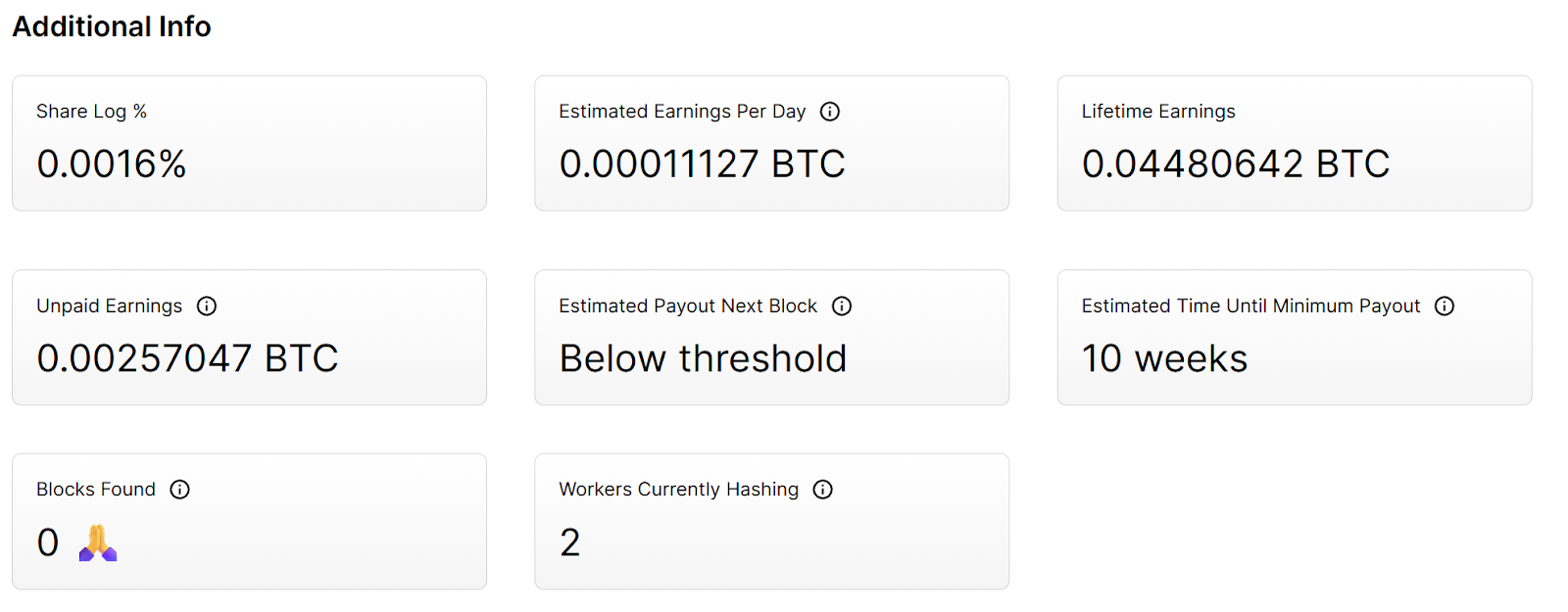
The Ocean dashboard is your monitoring hub. No login required. Paste your Bitcoin wallet address into the search bar at ocean.xyz and your stats load based on your address alone.
From there you can track reported hashrate vs effective hashrate, monitor individual machines by worker name, and check your payout queue. Estimated earnings fluctuate with network difficulty and pool luck, so treat them as a moving target rather than a guarantee.
We wrote a full walkthrough on reading hashrate graphs, interpreting "below threshold" status, and avoiding common dashboard misreads. Read our complete guide.
Who Uses Ocean Mining Pool
Ocean attracts a specific type of miner. Here's who tends to use it:
- Decentralization advocates: Miners who want to support Bitcoin's distributed nature.
- Privacy-focused operators: Those who prefer no-KYC and no-account setups.
- Experienced miners: People comfortable with technical configuration.
- Hosted miners: Those using hosting providers who allow pool selection.
If you're using a hosting provider, ask whether you can specify Ocean as your pool. Many providers offer pool flexibility while handling infrastructure and repairs.
Ocean Mining Pool Pros and Cons
Every pool has tradeoffs. Here's an honest look at Ocean.
Advantages of Mining with Ocean
- Non-custodial payouts: You maintain direct ownership of your Bitcoin.
- Decentralized templates: You support Bitcoin's censorship resistance.
- No account required: Privacy-preserving setup with no personal data.
- Lightning payouts: Faster access to earnings for smaller operations.
- Transparent operations: Everything is verifiable on-chain.
Potential Drawbacks to Consider
- Smaller pool size: Less total hashrate means more variance in payout frequency.
- Technical setup: Requires more configuration than plug-and-play pools.
- Newer pool: Shorter track record than established pools like Foundry or F2Pool.
The variance issue matters most for smaller operations. With less total hashrate, Ocean finds blocks less often than larger pools. You can compare Ocean's network share against the largest pools on our Bitcoin mining pool stats page. When they do find a block your share is proportional, but the timing is less predictable.
FAQs
Can hosted miners use Ocean mining pool?
Yes. If your hosting provider allows pool selection you can request Ocean and provide your own wallet address. Providers like Simple Mining offer this flexibility while handling infrastructure, repairs, and monitoring.
What happens to pending Ocean payouts if the pool goes offline?
Ocean uses non-custodial payouts. Your earned Bitcoin from found blocks goes to your wallet. Once a block is confirmed your share is yours regardless of what happens to the pool.
Is there a minimum hashrate required to mine on Ocean?
Ocean has no minimum hashrate requirement. Any ASIC can connect. Smaller operations take longer to accumulate payouts above the minimum threshold. Lightning payouts help by allowing smaller and more frequent payments.
Does Ocean mining pool support miners outside the United States?
Ocean is available worldwide. Miners in any jurisdiction can connect. Local regulations and compliance requirements vary by jurisdiction.
How do I troubleshoot connection issues with Ocean?
Start by checking your stratum URL and wallet address for typos. Then check Ocean's status page for ongoing issues. If the primary server is unresponsive try the backup server.
Start Mining Bitcoin with the Right Pool and Support
Choosing a pool is one piece of a larger puzzle. Pool selection, hardware efficiency, electricity costs, and operational support all factor into long-term profitability.
For miners who want Ocean's decentralization benefits without managing physical infrastructure, hosted mining offers a middle path. The hosting provider handles the data center, repairs, and monitoring. You maintain control over pool selection and wallet addresses.
Simple Mining offers hosted mining with pool flexibility, 12 months of repair coverage, and precision billing based on actual uptime. Whether you choose Ocean or another pool, the infrastructure stays the same.