

What Does Hashrate Mean for Bitcoin?
By Josh Heine, Content Strategist at Simple Mining
Updated June 23, 2026Published June 8, 2026
Bitcoin hashrate is the speed at which miners make guesses to win the next block. It measures computing power in hashes per second. The number matters because it sets both network security and your odds of earning Bitcoin. A higher network hashrate makes Bitcoin harder to attack. A higher machine hashrate gives you more chances to win.
On this page · 13 sections
- What Is Hashrate
- How Bitcoin Mining Hashrate Works
- Bitcoin Hashrate Units
- Why Hashrate Matters for Miners and Investors
- Your Miner Hashrate vs Total Network Hashrate
- How Hashrate and Mining Difficulty Are Connected
- What Is a Good Hashrate for Bitcoin Mining
- How Much Hashrate You Need to Mine 1 Bitcoin
- Factors That Affect Your Mining Hashrate
- How to Calculate Bitcoin Mining Profitability
- How to Monitor Your Hashrate in Real Time
- FAQs
- Start Mining Bitcoin with Confidence
Key Takeaways
- Hashrate counts the hash guesses a machine or network makes each second.
- Network hashrate secures Bitcoin and makes a 51% attack too expensive to attempt.
- Your machine hashrate sets your share of rewards, not a guaranteed payout.
- Difficulty rises and falls with hashrate to hold block time near 10 minutes.
- Efficiency in joules per terahash matters more than raw hashrate for profit.
What Is Hashrate
Hashrate is the number of hash calculations a mining machine or network performs each second. Mining is a guessing game. Each machine generates hashes and checks them against a target the network sets.
A few terms make this clear:
- Hash: a fixed-length output from a one-way math function. The same input gives the same output every time.
- SHA-256: the cryptographic hash function Bitcoin uses to turn block data into a 64-character result.
- Hashrate: the count of those outputs a miner produces per second.
You cannot reverse a hash to find its input. So miners guess inputs at high speed and test each result. The faster the guessing, the higher the hashrate.
How Bitcoin Mining Hashrate Works
Bitcoin mining works by generating random hashes until one falls below the network's target. The first miner to find a valid hash wins the block and its reward. This contest is Bitcoin's Proof of Work consensus, and hashrate is the work being measured.
The cycle runs in three steps:
- The miner builds a block and changes a small number called the nonce.
- It runs the block through SHA-256 to produce a hash.
- If the hash beats the target, the miner wins. If not, it changes the nonce and tries again.
Machines repeat this billions of times per second. That brute-force loop is the heart of how Bitcoin mining works.
Bitcoin Hashrate Units
Hashrate is measured in hashes per second (H/s) and scaled up with metric prefixes. The numbers grow so large that miners and analysts speak in trillions and quintillions.
| Unit | Name | Hashes per Second |
|---|---|---|
| kH/s | Kilohash | Thousands |
| MH/s | Megahash | Millions |
| GH/s | Gigahash | Billions |
| TH/s | Terahash | Trillions |
| PH/s | Petahash | Quadrillions |
| EH/s | Exahash | Quintillions |
Terahashes per Second
Terahashes per second (TH/s) is the standard spec for one modern ASIC miner. Current SHA-256 units deliver about 200 to 500 TH/s each.
Petahashes per Second
Petahashes per second (PH/s) measures a full rack or a small farm or a mining pool's combined output. One PH/s equals 1,000 TH/s.
Exahashes per Second
Exahashes per second (EH/s) measures the entire Bitcoin network. The network runs at over 900 EH/s, and you can track the current figure on our live Bitcoin network stats. To see how that total is distributed among mining pools, check our live Bitcoin mining pool stats.
Why Hashrate Matters for Miners and Investors
Hashrate matters because it shapes network security and mining profit and signals Bitcoin's health. Each angle speaks to a different reader.
Network Security and Decentralization
A high network hashrate protects Bitcoin by making attacks too expensive to attempt. An attacker would need more than half of all hashrate to launch a 51% attack and rewrite recent blocks. At hundreds of EH/s that hardware and power bill runs into the billions. The cost is the defense.
Mining Competition and Profitability
More hashrate on your machine means more guesses and a larger share of rewards. Your profit still depends on what others bring to the network. When total hashrate climbs faster than the Bitcoin price your revenue per terahash falls.
Bitcoin Network Health
A rising network hashrate signals that miners are investing in Bitcoin for the long term. Miners commit capital and power when they expect future value. Falling hashrate often points to price drops or rising energy costs that push older machines offline. Over long cycles, Bitcoin's price and its hashrate tend to climb and fall together.
Your Miner Hashrate vs Total Network Hashrate
Your miner hashrate is your contribution while total network hashrate sets your odds of winning a block. Think of it as a lottery. Your hashrate is the number of tickets you hold. Total network hashrate is the number of tickets sold. More tickets raise your chance, but a bigger pool of buyers shrinks each ticket's edge.
How Hashrate and Mining Difficulty Are Connected
Bitcoin raises difficulty when hashrate rises and lowers it when hashrate falls to hold block time near 10 minutes. Two terms drive this:
- Difficulty: how hard the network makes the target that a winning hash must beat.
- Difficulty adjustment: the reset that happens every 2,016 blocks, or about every two weeks.
When more machines join blocks arrive faster and the next adjustment makes the target harder. The system self-corrects no matter how much power joins. You can watch live difficulty on mempool.space. And because difficulty only ratchets higher over time, staying efficient is what decides whether Bitcoin mining is still profitable.
What Is a Good Hashrate for Bitcoin Mining
A good hashrate is the one that earns at your power rate, not the highest number on the box. Efficiency decides this. A miner is rated in joules per terahash (J/TH), and lower is better.
A unit at 15 J/TH produces more Bitcoin per dollar of power than one at 25 J/TH. Modern ASICs run in the hundreds of TH/s, so compare efficiency before speed. That same efficiency math drives the payback numbers in our mining rig cost and ROI guide.
How Much Hashrate You Need to Mine 1 Bitcoin
There is no fixed hashrate that mines one Bitcoin because output depends on difficulty and your network share and plain luck. The network produces about 450 BTC each day across about 144 blocks at 3.125 BTC per block. Your Bitcoin per day equals your share of total hashrate applied to that output.
More hashrate improves your odds, but it never guarantees a timeframe. At current conditions one top-tier ASIC still needs about nine years to reach a full coin, which is why how long it takes to mine 1 Bitcoin comes down to fleet size more than any single spec. Most miners join a mining pool to smooth payouts rather than mine solo. To put real numbers on your odds, run them through our Bitcoin mining calculator.
Factors That Affect Your Mining Hashrate
Your real hashrate depends on the operating conditions around the machine, not the spec sheet alone. Five factors move the number.
Uptime and Operational Environment
Downtime means zero hashrate, so uptime is the first lever. A machine offline for repair earns nothing while difficulty keeps climbing. Professional sites hold 95%+ uptime with on-site technicians. On our bench a unit that drops 10% below its rated TH/s most often has a failing hashboard or a fan throttling on heat.
Cooling and Ambient Temperature
Heat is the enemy of rated hashrate. When intake air runs hot, a miner throttles its chips and output falls. Cool rooms and clean airflow hold full speed.
Power Supply Stability
Unstable or weak power drags hashrate down before it trips an error. A loose connector or sagging voltage makes chips miss cycles. We check power seating at intake because the symptom hides as lost speed.
Hardware Model and Efficiency
Newer ASIC models post higher hashrate at lower power. A current-gen unit can double the Bitcoin per watt of a three-year-old machine. The model you run sets your ceiling.
Firmware and Pool Configuration
Old firmware and bad pool settings shave effective hashrate. A misrouted worker or a high-latency pool raises rejected shares, which the network does not count. Keep firmware current and your pool close.
How to Calculate Bitcoin Mining Profitability
You calculate mining profitability by weighing revenue against cost. Revenue comes from your hashrate and the current hashprice. Cost comes from power and pool fees and hosting.
The inputs you need:
- Hashrate in TH/s
- Power draw in watts
- Electricity rate in dollars per kWh
- Pool fee percentage
- Bitcoin price and network difficulty
Market conditions move these numbers every day, so treat any output as a snapshot. Plug them into our Bitcoin mining profit calculator and rerun it when hashprice or difficulty shifts.
How to Monitor Your Hashrate in Real Time
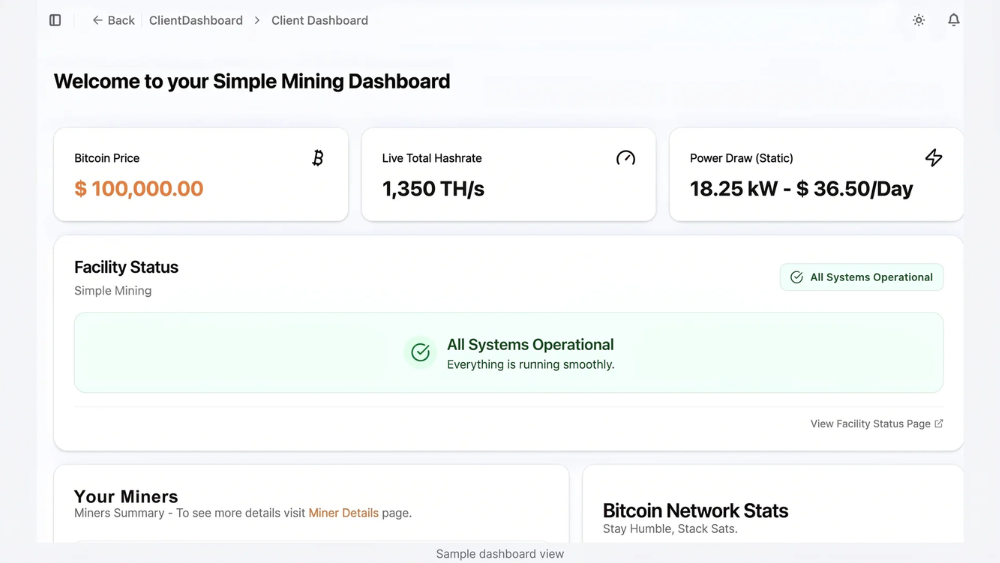
Monitor your hashrate by comparing reported output against the machine's rated spec on a live dashboard. A gap between the two is your earliest warning of trouble.
Track these four signals:
- Reported hashrate against rated hashrate
- Accepted shares
- Rejected shares
- Chip and board temperature
Pool dashboards and your host's dashboard should agree within a small margin. A widening gap points to heat or hardware or a network fault.
FAQs
What happens when all 21 million Bitcoin are mined?
Miners earn transaction fees instead of new block rewards once the last Bitcoin is mined near the year 2140. Hashrate stays important because it still secures the network and confirms transactions. Fee revenue replaces the block subsidy over time.
Can I mine Bitcoin with a regular computer?
No, a regular computer cannot mine Bitcoin in any practical sense. Bitcoin mining needs purpose-built ASIC hardware that runs the SHA-256 algorithm at hundreds of trillions of hashes per second. A laptop or GPU produces a tiny fraction of that and earns nothing against the network.
Does higher hashrate always mean more Bitcoin?
Not always. Your earnings track your share of total network hashrate alongside your power cost and the network difficulty. A faster machine that burns too much power can earn less Bitcoin per dollar than an efficient one.
Why does the Bitcoin network hashrate keep increasing?
The network hashrate keeps rising because more miners join and newer ASICs deliver more hashes per watt. Rising hashrate reflects growing investment in Bitcoin mining. It also tracks Bitcoin's price over long cycles since higher prices fund more hardware.
How often does Bitcoin mining difficulty adjust?
Bitcoin difficulty adjusts every 2,016 blocks or about every two weeks. The protocol resets difficulty to hold the average block time near 10 minutes. When hashrate climbs the next adjustment raises difficulty.
Start Mining Bitcoin with Confidence
Hashrate is the heartbeat of Bitcoin, and reading it well turns a confusing metric into a clear decision. You now know what the number means for security and for your share of rewards. Put it to work without the noise and heat of a home setup.
Simple Mining hosts your machine at an industrial site with 95% uptime and on-site repair. You watch live hashrate on the dashboard and keep direct pool-to-wallet payouts. Start with a free 7-day trial of 235 TH/s, or compare options in our hosting provider guide.