

Bitcoin Mining Rig Costs and ROI: Key Insights for Investors
By Josh Heine, Content Strategist at Simple Mining
Updated October 12, 2026Published November 28, 2025
A bitcoin mining rig converts electricity into Bitcoin. The economics work when your cost to produce one bitcoin falls below the market price. For investors seeking exposure beyond spot purchases or ETFs, mining may offer a potential path to acquire BTC at a discount under favorable market conditions while generating possible tax advantages unavailable through other methods. The catch: you must understand both the upfront hardware costs and the ongoing operational expenses that determine your return. No outcome is guaranteed, and profitability depends on volatile market conditions.
Key Takeaways
- A Bitcoin mining rig is an ASIC machine that converts electricity into BTC through proof-of-work computation
- Current hardware costs approximately $4,250 to $15,000 with efficiency ranging from 9.5 to 17 W/TH
- ROI depends on hashprice dynamics: mining may outperform when Bitcoin price grows faster than network hashrate, but no guarantees exist
- 100% bonus depreciation may create tax advantages unavailable through spot BTC or ETF purchases (consult a tax professional)
- Buying hardware during miner capitulation (low hashprice) may maximize potential upside from both hardware appreciation and mining profits
What Is a Bitcoin Mining Rig?
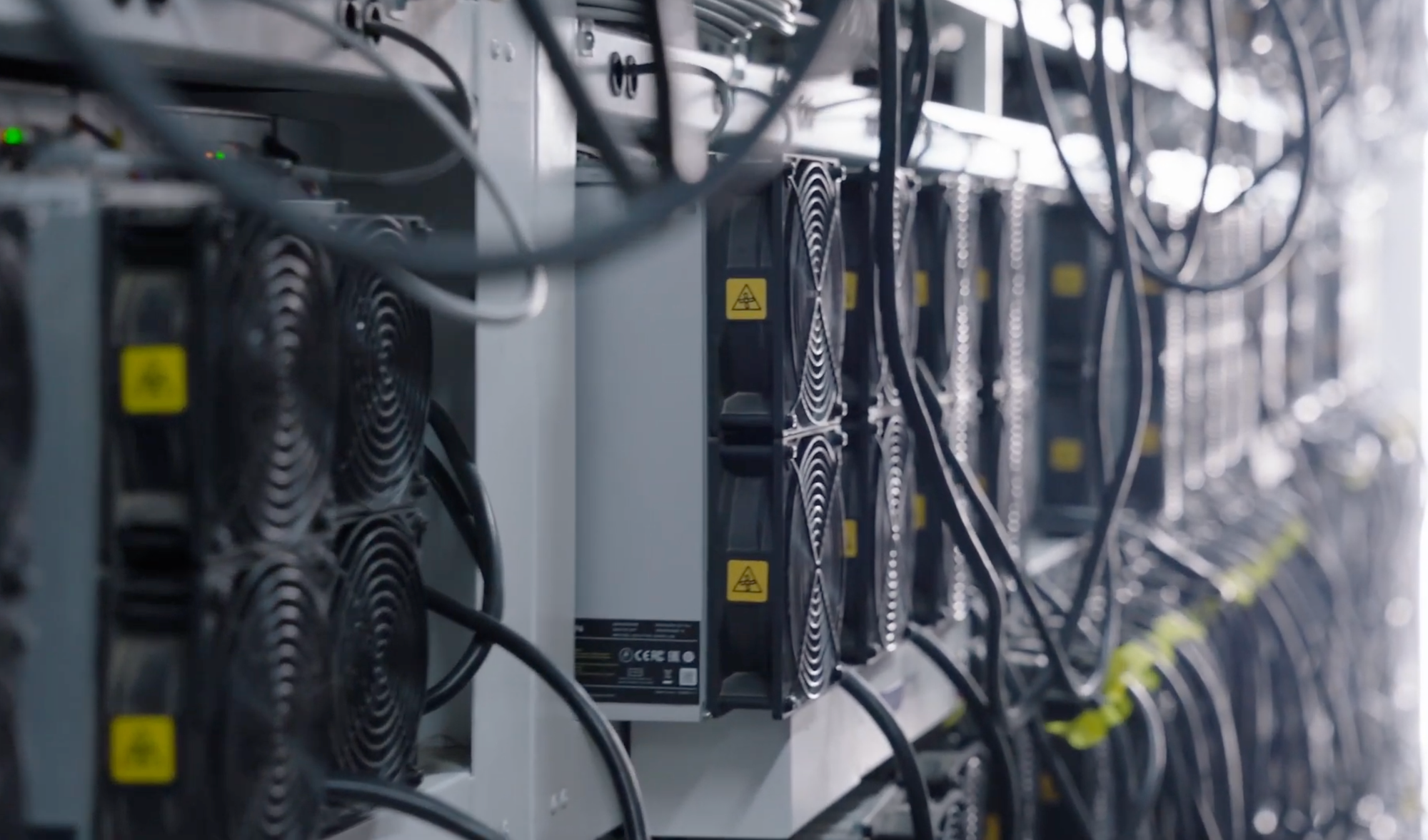
A bitcoin mining rig is a specialized computer built to solve cryptographic puzzles on the Bitcoin network. Think of it as a machine that guesses lottery numbers billions of times per second. The network rewards successful guesses with newly minted bitcoin.
Modern rigs use Application-Specific Integrated Circuits (ASICs). These chips perform one task: executing the SHA-256 hash algorithm that secures Bitcoin's proof-of-work consensus. Unlike general-purpose computers, ASICs cannot browse the web or run spreadsheets. They mine bitcoin and nothing else.
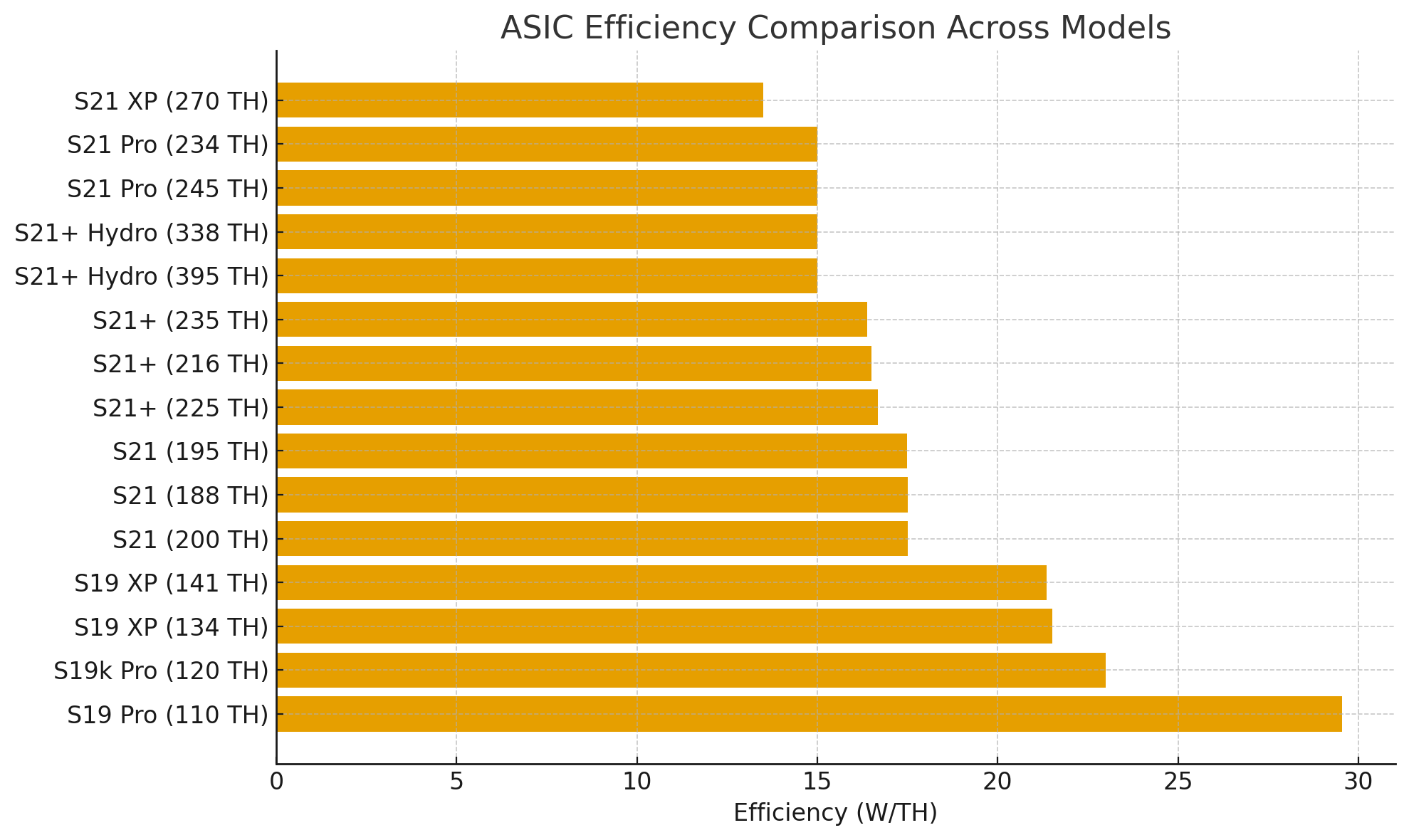
The key metric for any bitcoin mining rig is efficiency, measured in Watts per Terahash (W/TH). Lower numbers mean the machine produces more hashes for each watt consumed. A 13.5 W/TH machine costs less to run than a 21 W/TH machine producing the same output.
How Bitcoin Mining Rig Costs Break Down
Mining economics split into two categories: capital expenditure (CAPEX) for hardware and operational expenditure (OPEX) for electricity and hosting.
Step 1: Hardware Purchase (CAPEX)
Current-generation ASICs range from approximately $4,250 to $15,000, depending on model and market conditions. The Antminer S21 XP at 270 TH/s and 13.5 J/TH efficiency costs around $4,250 when in stock (check current prices). The flagship S23 Hydro (563 TH/s, 9.5 J/TH) costs $15,000. Older models like the S19 series trade for less but consume more power per hash.
Step 2: Hosting or Infrastructure
Running miners at home requires 220V electrical circuits and industrial cooling. Most investors choose hosted mining instead. Professional facilities typically charge $0.065 to $0.08 per kWh all-in. This covers electricity, cooling, security, and basic maintenance. In the examples below, we use $0.08/kWh as a base case for all-in hosting and note where cheaper power would improve the numbers.
Step 3: Ongoing Operational Costs
Electricity represents 70% to 90% of operational expenses. A 3,645W miner running 24/7 consumes about 2,624 kWh monthly. At $0.08/kWh, that costs $210 per month. Pool fees add another 0.5% to 2% of mined revenue.
Step 4: Calculate Daily Revenue
Revenue depends on hashprice (the dollar value earned per terahash per day). As an example, a 270 TH/s Antminer S21-class rig can generate roughly $11 per day in gross mining revenue at typical market conditions. At a $0.08/kWh all-in power rate, this typically translates to low single-digit dollars per day in estimated net profit. Both figures fluctuate constantly with Bitcoin price, network difficulty, transaction fees, and rig uptime.
Step 5: Determine Payback Period
Divide total CAPEX by monthly net profit. For illustration, a roughly $4,250 Antminer S21 XP (270 TH/s) running at a $0.07/kWh all-in power rate might produce about $133 per month in estimated net profit, resulting in a simple payback period of about 32 months.
Actual results vary significantly with Bitcoin price, network difficulty, uptime, and fees. Rising prices can shorten the payback window dramatically; market downturns extend it. Readers should always verify the latest numbers using a current mining profitability calculator (for example, Simple Mining, WhatToMine, or ASIC Miner Value) before making purchase decisions.
Why Investors Care About Bitcoin Mining Rig ROI
Mining creates optionality that spot purchases cannot replicate. When Bitcoin price rises, your mining output maintains constant BTC production while operational costs remain fixed in dollars, assuming stable electricity costs and uptime. As a hypothetical example: a $7/day cost that produces $15/day in BTC becomes attractive when price doubles. The miner still costs $7/day but now produces $30/day in BTC value. Past performance does not guarantee future results.
This asymmetry matters. Hashrate growth requires physical infrastructure: warehouses, transformers, shipping containers of ASICs. Building takes 6 to 12 months. Price can move in minutes. During the 2021 bull run, hashprice saw significant increases while many miners waited on equipment deliveries.
What Can Go Wrong
Network difficulty adjustments erode profitability when hashrate grows faster than price. The April 2024 halving cut block rewards from 6.25 to 3.125 BTC. Some machines that were profitable before the halving became marginal or unprofitable. Older ASICs with poor efficiency face the highest risk. Under today's hashprice, many S19-class machines are at or below break-even even with competitive power, while modern S21-class rigs still show positive margins at $0.08/kWh. That's why efficiency and hardware generation matter as much as headline hashrate.
How to Mitigate
Choose high-efficiency machines (sub-16 W/TH) that survive difficulty increases. Use hosting providers that offer pause periods, letting you power down without penalty when mining turns unprofitable. Lock in low electricity rates before demand spikes.
Why Efficiency Gains Are Slowing Down
A common fear is that a miner bought today will be obsolete in a year or two. That concern made sense in the early days of ASICs, when each new generation could cut power consumption per terahash by 50% or more. Those “giant step” improvements are much harder to achieve now.
Modern rigs like the S21-class sit in the low to mid-teens W/TH. Future generations may still improve efficiency, but the gains are more likely to be incremental. Think roughly 10–20% better, not a 2–3x overnight step-change. Physics, chip design limits, and manufacturing costs all put a natural ceiling on how much more efficiency can be squeezed out.
For someone mining at an all-in power rate around $0.08/kWh, that matters. If you start with a top-tier efficiency machine today, a future model that is modestly more efficient does not automatically turn your hardware into dead weight. Your rig may slide down the competitiveness ladder over time, but it is not instantly pushed off the map the way older, very inefficient models were when ASICs were new.
This does not remove hardware risk, because ASICs are still depreciating assets, but it does mean that buyers of current-generation, high-efficiency rigs are protected by diminishing returns on efficiency. In practice, power price, uptime, and hashprice often matter as much as squeezing out the last few joules per terahash.
Decision Framework: When to Buy a Bitcoin Mining Rig
This framework is educational and not financial or tax advice. Investors should consult qualified professionals before making decisions.
Timing matters more than most investors realize. The price of ASICs correlates with Bitcoin price. Hypothetically, based on past cycles, an $11,000 machine purchased at cycle tops could drop to low hundreds at the bottom. Buy during miner capitulation and your hardware may appreciate alongside your mined bitcoin.
If hashprice sits near all-time lows: This signals miner distress. Weak operators exit. Hardware prices drop. This may represent an opportunity to deploy capital for potential upside.
If Bitcoin price exceeds your 4-year target growth rate for hashrate: Mining may potentially outperform dollar-cost averaging in scenarios where price grows faster than hashrate, based on historical data, but no guarantees exist. Historical data shows hashrate has grown significantly per halving epoch, often 200% to 500%. If you expect price to exceed that growth rate, mining may offer leverage.
If you need tax advantages: Mining hardware qualifies for 100% bonus depreciation under current U.S. tax law (as of 2026; consult a tax professional). A $150,000 hardware purchase may generate significant immediate tax savings for eligible taxpayers. Spot BTC and ETFs offer no equivalent benefit.
If you want bitcoin accumulation: Hosted mining generates daily bitcoin, allowing accumulation of BTC. However, the USD value is subject to price volatility.
Comparing Alternatives: Mining vs. Spot vs. ETF
These are estimates. Actual costs and benefits vary based on market conditions.
| Method | Upfront Cost | Ongoing Cost | Tax Treatment | BTC Acquisition Cost |
|---|---|---|---|---|
| Bitcoin Mining Rig | $4,250-$15,000 per unit | $0.065-$0.08/kWh | 100% bonus depreciation | Below market when profitable |
| Spot Purchase | Market price | Exchange fees (0.1%-1.5%) | Capital gains only | Market price |
| Bitcoin ETF | Market price + expense ratio | 0.2%-1.5% annual fee | Capital gains only | Market price + fees |
Mining may win when you believe hashprice will expand (price outpaces hashrate). Spot wins for simplicity and liquidity. ETFs suit retirement accounts where custody complexity matters, and the per-fund net flow data for all twelve US spot Bitcoin ETFs is worth a look before picking one, since roughly half of weekly flow volatility tracks hedge funds adding CME futures shorts rather than directional buying. Shares of a Bitcoin treasury company add corporate leverage on top of that same exposure.The honest assessment: mining involves more variables. Hardware selection, hosting quality, and timing all affect returns. Some investors prefer the certainty of market price over the complexity of operational margins.
The Simple Mining Angle
Simple Mining operates 40,000+ ASICs across facilities in Iowa with a 60% renewable energy mix. The operation exists to remove friction between investors and profitable mining.
On-Site Repairs: Machines go back online in days to weeks versus potentially longer with external services. Downtime destroys returns. Fast repairs protect them.
Precision Billing: Clients pay for actual power consumption, providing fair and precise billing.
7-Day Trial: Test a miner before committing capital. Verify performance against projections. No penalty for walking away.
Pause Periods: Suspend machines during unprofitable conditions without breaking your hosting contract. This feature transforms fixed costs into variable costs during market stress.
Transparent Operations: Real-time dashboards show hashrate, uptime, and earnings.
12 Months of Repair Coverage: Hardware purchased through Simple Mining includes free repair labor, unlimited fan replacements, and a $500 annual parts allowance for the first year.
FAQs
How much does a Bitcoin mining rig cost in 2026?
As of October 2026, current-generation ASIC miners generally cost between about $4,250 and $15,000 when listed in stock. Prices for hardware typically fluctuate based on the current price of Bitcoin and the network's hashprice. High-efficiency models, such as the Antminer S21 series, represent the upper end of this price range but offer the best protection against rising network difficulty.
What is the typical ROI for a Bitcoin mining rig?
ROI is highly variable and depends on four main factors: your electricity rate, hardware efficiency, Bitcoin price, and network difficulty. Based on October 2026 mining-revenue conditions, a high-efficiency rig with an all-in hosting rate of $0.07/kWh might see a simple payback period in the neighborhood of two to three years, though price increases can significantly compress this timeline.
Why is hardware efficiency (W/TH) so important?
Efficiency determines your ongoing operational cost. A lower Watts per Terahash (W/TH) rating means the machine produces more Bitcoin for every dollar spent on electricity. In a competitive market, rigs with poor efficiency (such as older S19 models) are the first to become unprofitable when the Bitcoin price drops or network difficulty rises.
Is hosted mining better than mining at home?
For most investors, hosted mining is the preferred choice. Home setups require specialized 220V electrical work, industrial-grade cooling, and noise mitigation for machines that exceed 75 decibels. Professional hosting facilities provide industrial power rates (typically $0.065 to $0.08 per kWh), 24/7 monitoring, and on-site repair services that are difficult to replicate at home.
What are the tax advantages of buying a mining rig?
Under current U.S. tax law (as of 2025/2026), Bitcoin mining hardware may qualify for 100% bonus depreciation. This potentially allows eligible taxpayers to deduct the full cost of the hardware in the year of purchase, creating an immediate tax benefit that is not available when buying spot Bitcoin or ETFs. You should always consult a qualified tax professional regarding your specific situation.
Can I pause my mining rig if it becomes unprofitable?
This depends on your hosting provider. Some providers, like Simple Mining, offer pause periods that allow you to suspend operations during market downturns without breaking your contract. This feature is a critical risk-management tool, as it transforms your electricity cost from a fixed monthly expense into a variable one.
Conclusion
A bitcoin mining rig turns electricity into hard money. The math works when your all-in production cost falls below market price, but profitability is not guaranteed and depends on market conditions. Success requires efficient hardware, cheap power, and the patience to buy when others capitulate.
Ready to model the numbers for your situation? Book a consultation to get an expert assessment of how mining fits your portfolio and tax picture.