

Bitcoin Price vs Hashrate: Why the Gap Drives Mining Profitability
By Josh Heine, Content Strategist at Simple Mining
Updated April 1, 2026Published November 15, 2024
Bitcoin price can double in three months. Hashrate cannot. That mismatch is not a flaw. It is the profit engine for every Bitcoin miner who understands it.
The relationship between Bitcoin price and network hashrate determines who earns money and who burns cash. Price moves at the speed of sentiment. Hashrate responds at the speed of construction, shipping, and rack-and-stack.
Understanding how these two forces interact (and why they never move in lockstep) separates profitable mining operations from expensive hobbies. You can check the current spread on the Luxor Hashrate Index at any time.
On this page · 8 sections
Key Takeaways
- Bitcoin price moves at market speed while hashrate responds at infrastructure speed, and the lag between them creates the primary profit window for miners.
- When price leads hashrate, miners earn outsized returns per terahash. When hashrate outpaces price, margins compress and less efficient machines get forced offline.
- The difficulty adjustment recalibrates every 2,016 blocks (~2 weeks), translating hashrate changes into direct revenue impact for every miner on the network.
- Hashprice (revenue per TH/s per day) captures the price-hashrate relationship in a single number. Track it against your breakeven to know your real-time profitability.
- Operational flexibility (pause-friendly hosting, precision billing, efficient hardware) separates miners who survive gap compression from those who exit at a loss.
Does Hashrate Follow Bitcoin Price?
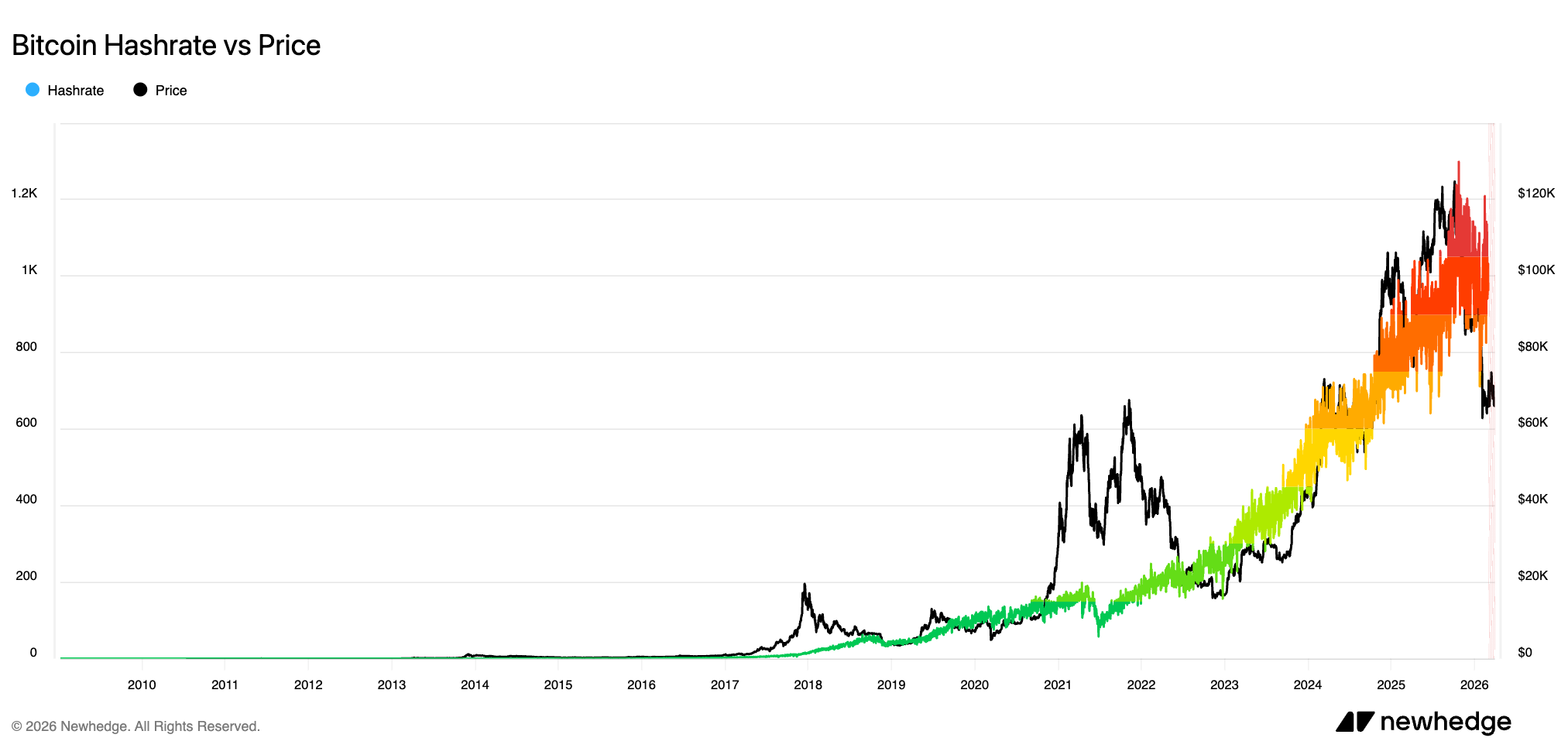
Hashrate follows Bitcoin price, but with a lag measured in weeks to months. Deploying new mining hardware takes physical infrastructure that cannot move at the speed of a market order.
When Bitcoin's price rises, mining becomes more profitable per unit of hashrate. More operators plug in machines. New investors order ASICs. Facilities expand capacity. But ordering a container of miners, shipping it, wiring the infrastructure, and bringing machines online takes 3 to 12 months depending on scale.
The reverse holds too. When price drops, miners do not unplug on day one. Operations with sunk capital in hardware and facility leases run machines until the math forces a shutdown. This creates a trailing effect where hashrate stays elevated even after price retreats.
Why the Lag Exists
Three physical constraints create the delay:
- Hardware lead times. ASIC manufacturers have production queues. A surge in orders does not produce immediate deliveries.
- Infrastructure buildout. Electrical capacity, cooling systems, and physical space require months of construction before a single miner can hash.
- Operational inertia. Miners with low electricity costs and efficient hardware can operate through drawdowns that force higher-cost competitors offline.
This lag is the reason price and hashrate never move in perfect lockstep. And that gap is where profit lives.
What Is the Price-Hashrate Gap?
The price-hashrate gap is the window between a Bitcoin price move and the hashrate response. It represents the most favorable (or unfavorable) period for miner profitability.
When price rises 30% in a quarter but hashrate only grows 5%, every existing miner earns more per terahash. Revenue jumps while costs stay flat. The gap widens in the miner's favor.
When hashrate grows 20% but price is flat, the opposite happens. More machines compete for the same block rewards. Each miner's share of revenue shrinks. Margins compress.
| Scenario | Price Trend | Hashrate Trend | Gap Direction | Miner Impact |
|---|---|---|---|---|
| Bull breakaway | Rising fast | Lagging | Widens (favorable) | Revenue per TH/s increases |
| Hashrate squeeze | Flat or falling | Rising | Narrows (unfavorable) | Margins compress |
| Bear capitulation | Falling | Declining (delayed) | Widens then corrects | Weak miners exit, survivors benefit |
| Equilibrium | Stable | Stable | Neutral | Profitability depends on cost basis |
This pattern repeats across every halving cycle. Post-halving periods compress hashprice as the block subsidy drops. Less efficient machines hit breakeven or worse. But miners running high-efficiency hardware at low power rates remain profitable through the squeeze. This played out after the 2020 halving and again after the 2024 halving.
How Does the Difficulty Adjustment Affect Mining Profitability?
Bitcoin's difficulty adjustment recalibrates every 2,016 blocks (about two weeks) to keep block times near 10 minutes. It compresses or expands miner margins based on how much hashrate joins or leaves the network.
When hashrate rises between adjustments, blocks get found faster than 10 minutes. The next adjustment increases difficulty. Each miner now needs more computation to earn the same reward. Revenue per terahash drops.
When hashrate falls (miners unplug during bear markets or energy price spikes), blocks slow down. The next adjustment decreases difficulty. Remaining miners get a larger share of block rewards.
You can track the current epoch and estimated next adjustment on the Newhedge Difficulty Estimator.
Operator reality: We watch block intervals on our monitoring dashboards. When average block times drop below 9 minutes and 30 seconds, we know an upward difficulty adjustment is coming. That is the signal to check client machines for efficiency and confirm every unit runs at peak performance before the next epoch starts.
What Happens When Hashrate Outpaces Price?
When hashrate grows faster than Bitcoin's price, hashprice drops, margins shrink, and less efficient miners get pushed toward breakeven or shutdown.
This is the most dangerous environment for mining operations. Revenue per terahash falls while costs (electricity, hosting, maintenance) stay constant or rise. The math turns negative for older hardware first.
Consider two machines at the same $0.08/kWh power rate. An older ASIC running at 18+ J/TH has a breakeven hashprice near the mid-to-high $30s per PH/s per day. A current-generation machine at 10–13 J/TH breaks even in the low-to-mid $20s (or lower for latest hydro-cooled models). Same facility, same electricity rate, but the efficiency gap creates a $10–20+/PH/s buffer before the newer machine hits breakeven. The same spread decides how many dollars of electricity go into each mined Bitcoin, which our tracker publishes model by model alongside a break-even $/kWh.
What can go wrong: A miner ignores the hashrate squeeze because Bitcoin's price "feels" high. Revenue erosion from difficulty increases eats through margins without any obvious warning. By the time the monthly electricity bill arrives, the damage is done.
Mitigation: Track your breakeven hashprice. If market hashprice approaches your number, you need a plan: pause your machines, upgrade hardware, or negotiate a lower power rate.
How Do Miners Profit from the Gap?
Miners profit from the gap by being online and hashing before the network catches up. The ideal position is running efficient hardware at low electricity costs when price leads and difficulty has not yet adjusted upward.
This is the miner's arbitrage. During the 12 to 20 months following a halving, price tends to lead hashrate. Miners plugged in during this window earn outsized returns in BTC terms. Hashprice spikes with price while difficulty takes weeks or months to reflect new capacity coming online.
The practical implication: time your deployment, not just your purchase. Buying hardware during a low-hashprice window (when weak miners capitulate and equipment prices drop) and having it hashing before the next price breakout is the playbook.
Operator Checklist: Reading the Gap
Use this framework to assess the current gap and your position within it:
- Check hashprice vs your breakeven. Use a mining profitability calculator with your actual power rate and hardware specs.
- Monitor block intervals. Sub-9.5-minute averages signal an upcoming difficulty increase.
- Compare 30-day price change vs 30-day hashrate change. If price growth exceeds hashrate growth, the gap favors miners. If hashrate leads, margins are compressing. Check the net flow trend across the US spot Bitcoin ETFs over the same window, since a sustained run of inflows tells you whether the price side of the gap has real demand behind it.
- Review your fleet's J/TH efficiency. Machines above 20 J/TH at $0.065–$0.08/kWh are vulnerable in compressed environments. Sub-15 J/TH machines have the widest survival margin.
- Confirm your hosting flexibility. If your host charges during downtime or lacks pause options, a hashprice crash forces you to eat losses instead of preserving capital.
What Is Hashprice and Why Does It Matter?
Hashprice measures the dollar revenue a miner earns per terahash per day. It is the single best metric for evaluating whether your operation is profitable right now.
The formula: (Block Reward × Bitcoin Price × 144 blocks/day) ÷ Network Hashrate in TH/s. Four variables drive it: block subsidy, transaction fees, network difficulty, and Bitcoin price.
Hashprice captures the price-hashrate relationship in a single number. When the gap favors miners (price up, hashrate lagging), hashprice rises. When hashrate outpaces price, hashprice falls.
The key habit: check your breakeven hashprice, then compare it to current market hashprice. If market hashprice sits above your breakeven, you are profitable. If it drops below, every hour your machine runs costs you money.
Precision billing matters here. When margins are thin, every fraction of a cent counts. Billing based on nameplate power rather than wall draw (which runs roughly 5.5% higher) provides a built-in buffer. Paying for actual hashing time only (rather than a flat monthly rate) means you stop spending the moment your machine stops earning.
FAQs
Is Bitcoin mining still profitable when hashrate hits all-time highs?
Yes, but profitability depends on hardware efficiency and electricity cost. High hashrate alone does not kill profitability. It compresses margins. Miners running high-efficiency equipment at under $0.08/kWh remain profitable even at record hashrate levels. Less efficient operations face breakeven or losses.
What is a good hashprice for profitable mining?
A "good" hashprice depends on your cost basis. Calculate your breakeven by dividing your total daily operating cost by your total hashrate. If market hashprice exceeds that number, you are profitable. Most hosted operations with efficient hardware (10–15 J/TH) and $0.065–$0.08/kWh power break even in the low-to-mid $20s per PH/s per day (or lower for latest hydro-cooled models).
How often does Bitcoin mining difficulty change?
Bitcoin's difficulty adjusts every 2,016 blocks, which takes roughly two weeks. If the network finds blocks faster than 10 minutes on average, difficulty increases. If blocks take longer, difficulty decreases. This automatic mechanism keeps Bitcoin's block production and issuance schedule on track regardless of how many miners join or leave.
Mine Smarter by Reading the Gap
The gap between Bitcoin price and hashrate is not a bug. It is the signal. Miners who read it correctly position themselves on the right side of the margin equation. Those who ignore it learn the lesson on their electricity bill.
Simple Mining gives investors the infrastructure to act on the gap: precision billing that tracks actual hashing time, pause-friendly hosting for when hashprice compresses, on-site ASIC repairs that maximize uptime during favorable windows, and $0.065–$0.08/kWh all-in power at U.S. facilities. Schedule a call to see the current economics for your fleet.