

What is Bitcoin Difficulty Adjustment?
By Josh Heine, Content Strategist at Simple Mining
Updated April 21, 2026Published July 18, 2024
Bitcoin difficulty adjustment is the protocol rule that keeps new blocks arriving about every 10 minutes. Every 2,016 blocks (close to two weeks) the network retargets mining difficulty based on how fast the last epoch was mined. Faster blocks push difficulty up. Slower blocks pull it down. Supply stays on schedule no matter how much hashrate joins or leaves.
On this page · 11 sections
- What Is Bitcoin Difficulty Adjustment in Mining
- Why Bitcoin Uses a Difficulty Adjustment
- How Bitcoin Difficulty Adjustment Works
- How Often Does Bitcoin Difficulty Adjust?
- The Math Behind Bitcoin Difficulty Adjustment
- How Difficulty Adjustment Affects Bitcoin Miners
- How Difficulty Adjustment Protects the Bitcoin Network
- Limits on How Much Bitcoin Difficulty Can Change
- How to Factor Difficulty Into Your Mining Profitability
- FAQs
- What Difficulty Adjustment Means for Your Mining Strategy
Key Takeaways
- Bitcoin difficulty adjustment retargets every 2,016 blocks to hold the average block time near 10 minutes
- The protocol reads block timestamps from the last epoch and scales difficulty by the ratio of actual to expected time
- Each retarget is capped at a 4x increase or 4x decrease in a single epoch
- Rising difficulty compresses revenue per terahash, so efficient hardware and low-cost power stay profitable longer
- The mechanism protects Bitcoin's fixed issuance and raises the cost of attacking the network in step with hashrate growth
What Is Bitcoin Difficulty Adjustment in Mining
Bitcoin difficulty adjustment is the built-in retargeting rule that every 2,016 blocks raises or lowers how hard it is to mine a block, holding the average block time near 10 minutes.
- Difficulty adjustment: the protocol retargets how hard it is to produce a valid block
- Trigger: total network hashrate shifted during the last 2,016 blocks
- Purpose: hold block production near the 10-minute target and keep Bitcoin's issuance on schedule
Think of it as a thermostat for block time. More miners competing pushes blocks faster, so difficulty climbs until blocks cool back to the 10-minute rhythm. Fewer miners slow blocks, so difficulty eases until the tempo returns.
Three terms anchor this mechanism. Proof-of-work is the cryptographic puzzle miners race to solve. Hashrate is the combined guessing speed of every miner on the network. Block time is how long it takes to land a valid answer.
Why Bitcoin Uses a Difficulty Adjustment
Bitcoin uses difficulty adjustment to protect a predictable supply schedule and a stable block cadence regardless of how hashrate changes.
Satoshi designed Bitcoin around a fixed issuance curve that halts at 21 million coins around the year 2140. If blocks could arrive whenever hashrate willed it, coins would be issued on an unpredictable schedule and the network's security assumptions would fray. Tying difficulty to elapsed time fixes this.
Stable block times matter for three reasons. They let full nodes propagate blocks before the next one arrives. They make transaction confirmations predictable. They raise the cost of reorganization attacks because any attacker faces the same moving target as honest miners.
How Bitcoin Difficulty Adjustment Works
Every full node runs the same retarget math at the same block height. No human intervention. No governance vote. The rule sits in the Bitcoin Core source code and executes on schedule.
1. The Network Measures Block Time Over 2,016 Blocks
At the end of each epoch (a 2,016-block window) the protocol reads the timestamp in each block header. Those timestamps tell the network how much time elapsed from the first block of the epoch to the last. In an ideal epoch 2,016 blocks at 10 minutes each takes 20,160 minutes (exactly 14 days).
2. Bitcoin Compares Actual Time to the 10-Minute Target
The protocol divides the actual elapsed time by 20,160 minutes. If the last epoch took 18,000 minutes, blocks came in about 11% fast. If it took 22,000 minutes, blocks came in about 9% slow.
3. The Protocol Calculates a New Difficulty Target
Bitcoin scales the difficulty target by that same ratio. Blocks 11% fast push difficulty up close to 11%. Blocks 9% slow pull difficulty down close to 9%. The ratio is proportional within the protocol's caps (more on those below).
4. Miners Begin Working Against the Adjusted Difficulty
The change takes effect with the very next block. No gradual rollout. Every miner on the planet is hunting the new target at the same height, so global consensus stays intact.
How Often Does Bitcoin Difficulty Adjust?
Bitcoin difficulty adjusts every 2,016 blocks, which lands near every two weeks when the network runs at the 10-minute target.
Why 2,016? It's the count of 10-minute blocks in 14 days. The window is long enough to smooth noise from single-block luck and short enough to keep the network responsive to real shifts in hashrate.
A shorter window would swing difficulty on random clustering of fast blocks. A longer window would leave miners working against stale conditions for weeks. Two weeks splits the difference.
You can watch the next retarget on the Newhedge difficulty estimator. Both show a countdown to the next epoch boundary and a live projection based on current block pace.
The Math Behind Bitcoin Difficulty Adjustment
The new target equals the old target multiplied by (actual time for the last 2,016 blocks / 20,160 minutes), with the ratio capped at 4x in either direction.
| Scenario | Block Time | Adjustment |
|---|---|---|
| Hashrate grows | Faster than 10 minutes | Difficulty rises |
| Hashrate falls | Slower than 10 minutes | Difficulty drops |
| Hashrate flat | Near 10 minutes | Small change |
The difficulty target is a 256-bit number. Valid block hashes must land below it. Lower target = fewer valid hashes = harder block. Higher target = more valid hashes = easier block.
Miners cannot force a winning hash. All they can do is add hashrate (more guesses per second). The target decides the odds on each guess. That's why adding machines raises difficulty but never short-circuits issuance: more guesses just trigger a higher difficulty at the next retarget.
How Difficulty Adjustment Affects Bitcoin Miners
Difficulty sets the share of block rewards each unit of hashrate earns. Higher difficulty means less Bitcoin per terahash. Lower difficulty means more.
Mining Profitability and Revenue Swings
When difficulty climbs each terahash captures a smaller slice of block rewards each day. When difficulty falls each terahash captures a larger slice. This is why operators track hashprice (expected revenue per TH per day) rather than Bitcoin price alone. Hashprice combines Bitcoin price with network difficulty and transaction fees.
The Simple Mining Bitcoin Mining Calculator models these variables side by side. Before adding machines, run scenarios at different difficulty paths to stress-test margins.
Hardware Efficiency and J/TH
Efficiency matters more as difficulty rises. ASIC efficiency is measured in joules per terahash (J/TH). A machine at 15 J/TH produces the same hashrate as one at 21 J/TH for about 29% less power. When difficulty compresses revenue per TH that electricity gap decides who stays online.
Each new generation of ASICs closes the J/TH gap further. That's the long-game reason hardware cycles don't slow: every difficulty increase raises the price of inefficiency.
Competition Among Miners on the Network
Difficulty creates a self-balancing market. High margins attract new hashrate. New hashrate raises difficulty. Rising difficulty compresses margins until the marginal miner breaks even. Weak operators shut down. Hashrate drops. Difficulty eases. The cycle resets.
No single miner or fleet can dominate for long. The protocol rebalances the field at every epoch.
How Difficulty Adjustment Protects the Bitcoin Network
Difficulty adjustment raises the cost of attacking Bitcoin in step with the network's hashrate, making 51% attacks expensive and issuance enforceable.
- Attack cost scales with hashrate: any attacker who adds machines to mount an attack triggers the next difficulty increase and raises their own ongoing cost
- Decentralization holds: no single operator can run blocks faster than the network because faster blocks just retarget difficulty up
- Issuance stays on track: the supply schedule holds regardless of fluctuations in global mining power
The mechanism also disarms a subtler attack: flooding the network with cheap blocks. Cheap blocks can't exist for long because the next retarget prices them back in.
Limits on How Much Bitcoin Difficulty Can Change
Bitcoin caps each epoch's difficulty change at a 4x increase or a 4x decrease, no matter how extreme the last 2,016 blocks were.
The cap matters for two reasons. It blocks runaway swings if a large share of hashrate goes offline in one event. It limits the damage from timestamp manipulation, since an attacker forging block times can at most push difficulty a factor of four.
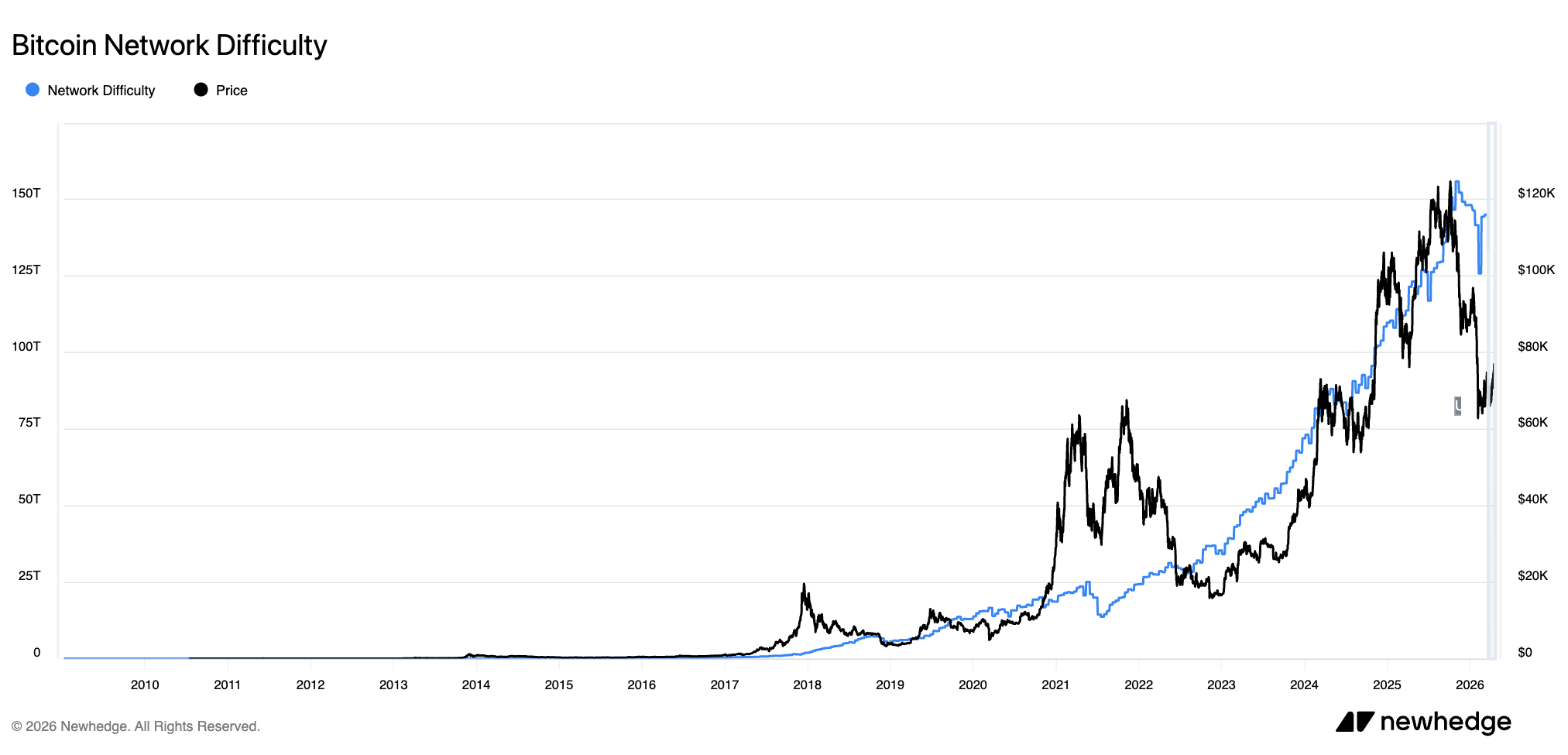
In practice, most retargets land in single-digit percentages. The 4x limits are rare. The largest drops in Bitcoin's history followed the 2021 reshuffle of China-based hashrate, when network hashrate collapsed and difficulty dropped hard over several consecutive epochs.
How to Factor Difficulty Into Your Mining Profitability
Build difficulty growth into every projection. Difficulty trends up over long horizons and flat projections tend to overstate future revenue.
- Monitor the trend: watch whether difficulty is rising or falling across the last five or six epochs
- Run scenarios: model baseline and downside difficulty paths against your machine's J/TH
- Weight efficiency: a lower J/TH miner leaves more room to absorb difficulty growth without going underwater on power
Operator reality: over Bitcoin's full history difficulty has climbed through bull and bear cycles. Sharp drops show up during disruption events (mining bans, grid failures, major hardware transitions). Assuming flat difficulty is the fastest way to overestimate return.
FAQs
How do I track upcoming Bitcoin difficulty adjustments?
Blockchain explorers and the Luxor Hashrate Index show a countdown to the next retarget and a live projection of the percentage change. The Newhedge difficulty estimator offers a similar view. Both update as new blocks land.
Can Bitcoin difficulty decrease?
Yes. Difficulty drops when the past 2,016 blocks took longer than 20,160 minutes to mine. This happens when miners leave the network or when a hashrate drop outpaces new machines coming online.
What happens if a large number of miners leave the Bitcoin network?
Block times stretch past 10 minutes until the next retarget, when difficulty drops to restore the target tempo. The 4x cap limits how far it can fall in one epoch. Severe hashrate drops often resolve over several consecutive down-adjustments.
How does the Bitcoin halving relate to difficulty adjustment?
Halvings cut the block subsidy in half, squeezing revenue per terahash. Weaker operators shut down after a halving. The resulting hashrate drop triggers a downward difficulty adjustment that restores margin for miners who stay online.
What Difficulty Adjustment Means for Your Mining Strategy
Your strategy can't control difficulty. It can control three levers: operating cost per terahash, fleet efficiency, and pause flexibility.
First, operating cost per terahash. At $0.07 to $0.08 per kWh on nameplate power, current-generation ASICs hold margin through most difficulty regimes. Second, fleet age. Machines two generations behind frontier efficiency are the first to go offline in a squeeze. Third, operational flexibility. The option to pause during hostile conditions preserves capital for the next cycle.
Simple Mining's hosting covers all three. All-in power at $0.07 to $0.08 per kWh. Precision billing that charges for actual hashing time. A pause period for hard market conditions. Twelve months of free repairs and on-site technicians keep uptime high through difficulty cycles.
The metronome keeps time whether you're ready or not.
Start your free 7-day trial and test 100 TH/s on the Client Dashboard with no commitment.