

What Is Proof of Work and How Does It Secure Blockchain
By Josh Heine, Content Strategist at Simple Mining
Updated June 22, 2026Published June 18, 2024
Proof of Work is the consensus mechanism that secures Bitcoin by requiring miners to expend real computational energy to validate transactions and create new blocks. It is the reason Bitcoin cannot be counterfeited, double-spent, or controlled by a single entity. This guide covers how PoW works, why it makes blockchain secure, how it compares to Proof of Stake, and what the path looks like for anyone considering Bitcoin mining.
On this page · 12 sections
- What Is Proof of Work
- How the Proof of Work System Works
- How Proof of Work Secures the Blockchain
- Why Blockchain Needs Proof of Work
- Where Proof of Work Came From
- Proof of Work vs Proof of Stake
- Advantages and Disadvantages of PoW
- Proof of Work Coins and Cryptocurrencies
- Bitcoin Mining and the Proof of Work Process
- How to Participate in PoW Crypto Mining
- FAQs About Proof of Work
- Why Proof of Work Still Powers Bitcoin
Key Takeaways
- Proof of Work is the consensus mechanism that secures Bitcoin by requiring miners to expend real computational energy to validate transactions and produce new blocks.
- PoW makes fraud economically irrational. Attacking Bitcoin would cost billions in hardware and electricity with no guarantee of profit.
- PoW and PoS solve the same problem through different methods. PoW has 17+ years of unbroken security.
- Bitcoin mining requires ASICs, affordable electricity, and (for consistent payouts) a mining pool.
- Hosted mining makes participation accessible. You own the hardware while a professional facility handles power, cooling, repairs, and optimization.
What Is Proof of Work
Proof of Work (PoW) is a decentralized consensus mechanism that requires computers to solve complex mathematical puzzles to validate transactions and produce new blocks on a blockchain. The "work" is the computational effort needed to find a valid solution. The "proof" is the solution itself, which other network participants verify in a fraction of a second.
Think of it like a global lottery where the ticket price is electricity and computing power. The first miner to solve the puzzle earns the right to add the next block of transactions to the chain and collect a reward.
This energy-intensive process secures blockchains like Bitcoin by making fraud computationally expensive. No one can fake the work. No one can shortcut the math.
A few key terms clarify how PoW functions:
- Consensus mechanism: A method for all participants to agree on the state of the blockchain without a central authority like a bank.
- Mining: The process of using specialized hardware to solve cryptographic puzzles and validate transactions.
- Hash: A fixed-length alphanumeric code generated from transaction data. Change one character in the input and the entire hash changes.
How the Proof of Work System Works
The PoW process follows three steps that keep the network secure and synchronized across thousands of computers worldwide.
Mining
Miners compete to solve a cryptographic puzzle by guessing a number called a "nonce." When combined with the block's transaction data, the correct nonce produces a hash that falls below a target threshold set by the network. A modern ASIC miner performs over 200 trillion guesses per second (200 TH/s). The entire network still takes about 10 minutes on average to find the right answer.
Verification
Once a miner finds a valid solution, they broadcast it to the network. Other nodes verify the answer almost instantly, even though finding it required enormous computational effort. This asymmetry is intentional. Solving the puzzle is hard. Checking the answer is easy. That design choice is what makes PoW resistant to manipulation.
Rewards
The winning miner receives newly minted cryptocurrency (the "block subsidy") plus any transaction fees in that block. As of March 2026, the Bitcoin block reward is 3.125 BTC. This amount halves roughly every four years through an event called the halving. The incentive structure motivates honest participation because cheating costs more in electricity and hardware than any potential gain.
How Proof of Work Secures the Blockchain
PoW secures the blockchain by making fraud so expensive that honest participation is the only rational choice. Security does not come from trust in any institution. It comes from economic incentives and computational barriers that make attacking the network irrational.
Preventing Double-Spending
Double-spending is the attempt to use the same coins twice. PoW prevents it by requiring an attacker to re-mine not just one block but every subsequent block faster than the rest of the network combined. Re-mining blocks would require more computing power than exists in most countries. Every new block added to the chain makes older transactions more secure.
Making Attacks Economically Impractical
A "51% attack" would require controlling more than half the network's total mining power. The electricity costs alone would exceed any potential profit. Honest mining is more profitable than attacking.
Creating Immutable Records
Each block contains a cryptographic hash of the previous block. This creates a chain where any tampering becomes detectable. Change one transaction from five years ago and every block since would need to be re-mined. No central authority is needed to verify history because the math does that work.
Why Blockchain Needs Proof of Work
PoW solves the problem of creating digital scarcity and trustless agreement among strangers without any central authority. Before Bitcoin, digital scarcity did not exist. Any digital file could be copied without limit. Every previous attempt at digital money required a trusted third party to prevent copies.
PoW creates scarcity by requiring real-world resources (electricity and hardware) to produce new coins and validate transactions. This allows people across the globe to agree on a single transaction history without trusting each other or any intermediary. The energy expenditure is not a flaw. It is the feature that makes trustless consensus possible.
Where Proof of Work Came From
The concept predates Bitcoin by over a decade. Cynthia Dwork and Moni Naor proposed it in 1993 as a way to combat spam emails. The idea: require computers to perform a small amount of work before sending a message. Legitimate users would not notice. Spammers sending millions of emails would face prohibitive costs.
Adam Back built on the idea with Hashcash in 1997. Satoshi Nakamoto then adapted it for Bitcoin in 2008. The innovation was not PoW itself. It was applying PoW to solve the double-spend problem in a peer-to-peer network without any trusted third party.
Proof of Work vs Proof of Stake
Proof of Work and Proof of Stake (PoS) are the two dominant consensus mechanisms. They solve the same problem (achieving agreement without a central authority) through different approaches.
| Feature | Proof of Work | Proof of Stake |
|---|---|---|
| Validator selection | Computing power (mining) | Amount of cryptocurrency staked |
| Hardware requirements | Specialized ASICs | Standard computers |
| Energy consumption | High | Low |
| Security model | Cost of computation | Cost of locked capital |
| Track record | 15+ years (Bitcoin) | Newer, less battle-tested |
In PoW, miners are selected based on who solves the puzzle first. More computing power means more chances. In PoS, validators are chosen based on how much cryptocurrency they have staked as collateral. No puzzle-solving is required.
PoW requires specialized, power-hungry hardware like ASICs and consumes significant electricity. A single Antminer S21 XP uses about 3,600 watts (roughly the same as three space heaters). PoS validators lock up capital instead of running intensive computations.
PoW has been battle-tested for over 17 years with Bitcoin. No successful attack has compromised the protocol. PoS is newer with different attack vectors. Both make cheating expensive, but through different mechanisms: computational cost versus locked capital at risk of "slashing" (forfeiture).
Advantages and Disadvantages of PoW
- Proven security: Bitcoin's PoW has operated since 2009 without a successful protocol attack.
- Decentralization: Anyone with the right hardware can participate. No gatekeepers.
- Trustless operation: Transactions are validated without banks or governments.
- Real-world anchor: Energy expenditure ties digital scarcity to physical resources.
The trade-offs:
- Energy consumption: Mining requires significant electricity. Impact depends on energy sources.
- Scalability limits: Bitcoin processes about 7 transactions per second, which is why Lightning Network payment channels move everyday payments off the base layer.
- Hardware barriers: Competitive mining requires expensive ASICs.
- Concentration risk: Mining consolidates where electricity is cheapest.
Proof of Work Coins and Cryptocurrencies
Bitcoin is the original and largest PoW cryptocurrency, using the SHA-256 hashing algorithm. It accounts for the vast majority of all PoW mining activity and has the highest network hashrate by far. Litecoin uses the Scrypt algorithm with faster 2.5-minute block times. Dogecoin also uses Scrypt and can be "merge-mined" alongside Litecoin (miners secure both networks with the same hardware). Bitcoin Cash forked from Bitcoin in 2017, maintaining SHA-256 but using larger block sizes. Ethereum used PoW until September 2022, when it transitioned to Proof of Stake.
Bitcoin Mining and the Proof of Work Process
Bitcoin mining turns the theory of PoW into practice through specialized hardware, measurable metrics, and professional infrastructure.
Hash rate measures a miner's computational power in hashes per second. Individual machines are measured in TH/s (trillions). The total network is measured in EH/s (quintillions). A higher hash rate means more chances to find a valid block and earn rewards.
Application-Specific Integrated Circuits (ASICs) are machines built for one purpose: mining a specific algorithm. A current-generation Antminer S21 XP delivers around 270 TH/s at roughly 13.5 joules per terahash. That efficiency metric (J/TH) determines whether a miner is profitable at a given electricity rate. A cheaper machine running at 30 J/TH often loses money at $0.07–$0.08/kWh, while a more efficient unit at 13.5 J/TH generates positive cash flow.
Because mining is competitive, most miners join mining pools to combine hashrate. When the pool mines a block, the reward is split proportionally. A single mid-tier S21 XP would take about 20 years to reach one Bitcoin at current difficulty, as our breakdown of how long it takes to mine 1 Bitcoin shows. Pools smooth that variance into regular payouts.
Professional hosting facilities provide the power, cooling, and on-site repair infrastructure that keeps large fleets running at 95%+ uptime. Facilities in regions with renewable-heavy grids and low natural disaster risk offer both cost and reliability advantages over home setups.
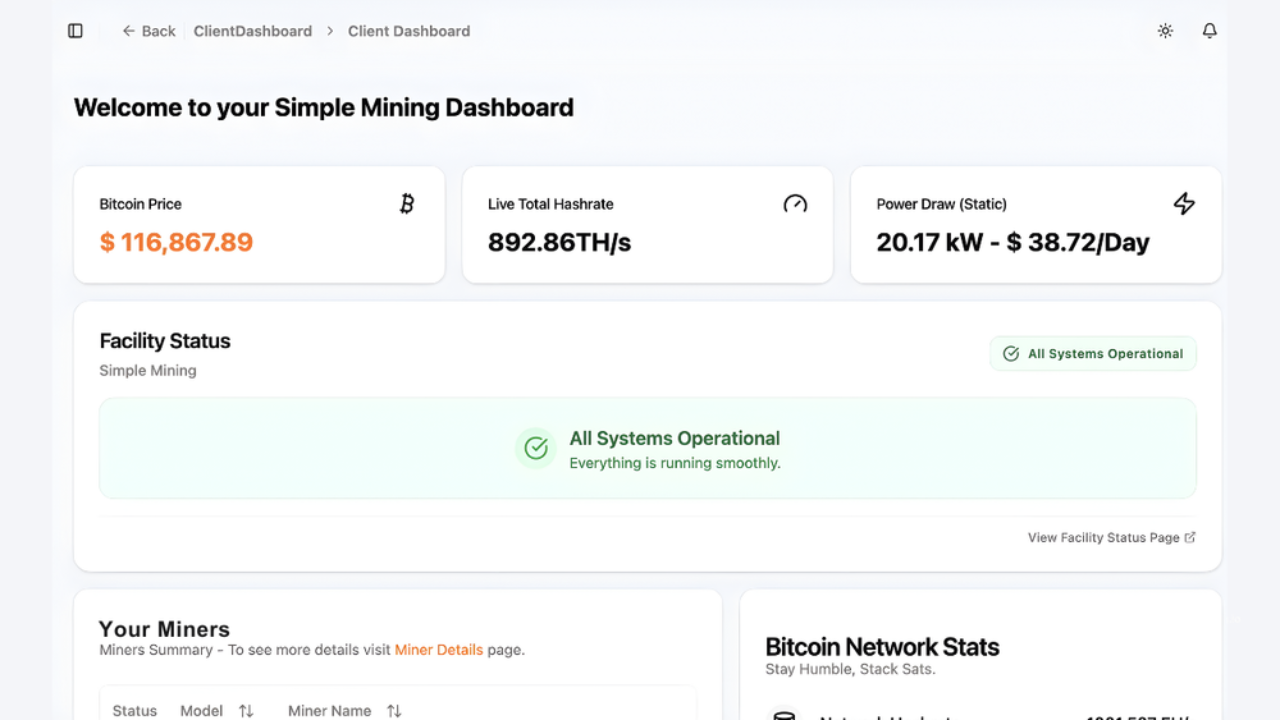
The Simple Mining dashboard provides a real-time "command center" view of your operation, tracking live hashrate and facility status to ensure your machines are running with maximum uptime.
How to Participate in PoW Crypto Mining
- Research mining hardware. Compare ASICs by hash rate, power consumption, and efficiency (J/TH).
- Calculate profitability. Use a Bitcoin mining calculator to check whether your cost to mine one Bitcoin falls below market price.
- Choose a setup. Home mining means managing power, cooling, and 75-decibel noise. Hosted mining removes those burdens while providing lower electricity rates, on-site repairs, and precision billing (you pay for actual hashing time, not idle time).
- Select a mining pool. Look for transparent fees and a payout method that fits (FPPS, PPLNS, etc.).
- Monitor performance. Track hash rate, uptime, and earnings through a dashboard to catch issues early.
Hosted mining lets you own the hardware while a professional facility handles operations and optimization. You get equipment ownership (with associated depreciation benefits) without the infrastructure headaches. Good hosting providers offer precision billing (you pay for hashing time, not idle time), on-site repairs, and the ability to pause machines during unprofitable market conditions.
FAQs About Proof of Work
What is a 51% attack and how does Proof of Work prevent it?
A 51% attack occurs when a single entity controls more than half the network's total hashrate. This could allow double-spending or transaction blocking. PoW prevents it by making the cost prohibitive on large networks. Acquiring 51% of Bitcoin's hashrate would cost billions in hardware plus ongoing electricity that dwarfs any potential profit.
Is Proof of Work mining bad for the environment?
PoW mining consumes significant electricity, but impact depends on energy sources. Many operations run on renewable energy, stranded natural gas, or excess grid capacity during off-peak hours. The conversation is more nuanced than the headlines suggest.
Can you mine Bitcoin without owning mining hardware?
Yes, through hosted mining services. You purchase and own the physical ASIC, but a professional facility handles setup, power, cooling, and maintenance. This provides equipment ownership with depreciation benefits and no operational complexity.
How long does it take to mine one Bitcoin using Proof of Work?
At June 2026 conditions, a mid-tier S21 XP (270 TH/s) takes about 20 years to reach one Bitcoin, a top-tier machine about 9, and an older unit close to 38. This is why most miners join pools, which combine hashrate and distribute proportional payouts. See how long it takes to mine 1 Bitcoin for the full breakdown.
Why Proof of Work Still Powers Bitcoin
Proof of Work remains the most battle-tested approach for securing a decentralized monetary network. Its 17+ year track record and uncompromised security are why it continues to power Bitcoin. The energy is not waste. It is the cost of trustless consensus. Every kilowatt-hour spent mining is a kilowatt-hour an attacker would need to match.
For those interested in participating, professional mining services make hardware ownership accessible without the operational burden of running equipment yourself.
Explore Bitcoin Mining with Simple Mining to learn how hosted mining works.