

Best Bitcoin Mining Pools for 2026: 11 Pools Compared
By Josh Heine, Content Strategist at Simple Mining
Published May 6, 2026
Bitcoin mining pools combine hashrate from many miners to find blocks more often and share rewards based on each miner's contribution. As of May 2026, ten pools control over 95% of network hashrate while Stratum V2 adoption reshapes how blocks get built. The right pool depends on the size of your operation and your appetite for payout variance. This guide ranks the top Bitcoin mining pools and shows how to match one to your setup.
On this page · 10 sections
- What Is a Bitcoin Mining Pool?
- Best Bitcoin Mining Pools Compared
- Pool Payout Methods Explained
- How to Choose a Bitcoin Mining Pool
- How Pool Fees Affect Profitability
- How BTC Pool Mining Works
- Hosted Mining at Simple Mining
- How to Start Mining with a Bitcoin Pool
- FAQs about Best Bitcoin Mining Pools
- Find the Right Mining Pool and Start Hashing
Key Takeaways
- Foundry USA leads with around 30% of network hashrate as of May 2026, followed by AntPool, ViaBTC, F2Pool, and SpiderPool.
- Payout method matters more than fee. FPPS smooths variance for predictable income, PPLNS rewards consistent miners with lower fees and higher swings, and TIDES delivers non-custodial payouts straight to miner addresses.
- Match the pool to your scale. Home miners want low payout thresholds and FPPS, mid-size farms want tooling and reliability, and large operations spread hashrate across two or three pools to reduce single-operator risk.
- Reliability dwarfs fee differences. A 4% uptime gap costs roughly four times more than a 1% fee gap on the same fleet at $0.07/kWh.
- Hosted miners get optionality. Simple Mining clients mine to any pool they choose with discounted fees available through Luxor, NiceHash, and Ocean partnerships.
What Is a Bitcoin Mining Pool?
A Bitcoin mining pool is a group of miners who combine hashrate to find blocks more often and share the rewards. Solo mining a single ASIC against current network difficulty could take decades to find one block. Pools turn that lottery into predictable income by paying out small amounts based on the work each miner contributes. For a deeper walkthrough of how pool mining works under the hood, see our beginner's guide to Bitcoin mining pools.
Best Bitcoin Mining Pools Compared
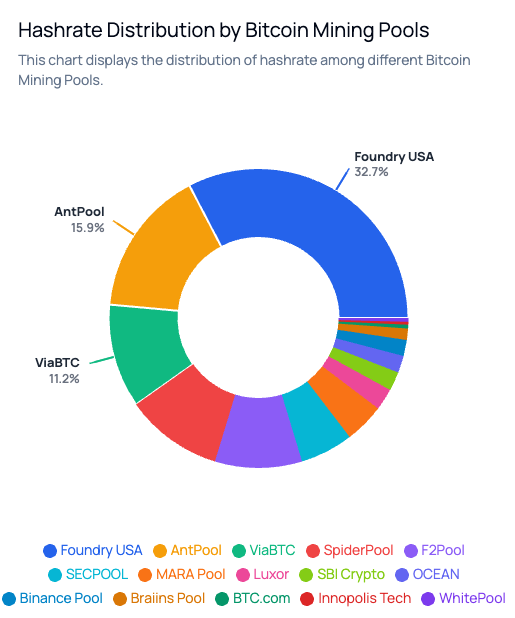
The largest Bitcoin mining pools by hashrate share in 2026 are Foundry USA, AntPool, ViaBTC, F2Pool, and SpiderPool. Each pool targets a different operator profile. The table below compares the eleven pools that matter most for miners deciding where to point hashrate. For live network share data, our live Bitcoin mining pool stats track current pool distribution.
Hashrate shares and fees change. Verify the latest figures at mempool.space or Hashrate Index before committing capital.
| Pool | Best For | Payout Method | Fee | Network Share |
|---|---|---|---|---|
| Foundry USA | Large-scale US-based operations | FPPS | Tiered (private) | ~30% |
| AntPool | Bitmain hardware users | FPPS / PPLNS | 2.5% / 0% | ~18% |
| ViaBTC | Payout flexibility | PPS+ / PPLNS / SOLO | 4% / 2% | ~13% |
| F2Pool | Mature operators | FPPS / PPLNS | 4% / 2% | ~10% |
| SpiderPool | Mid-size operations | FPPS | 4% | ~9% |
| MARA Pool | Public mining companies | FPPS | Private | ~6% |
| Luxor | North American professionals | FPPS | ~2% (custom tiers) | ~3% |
| Braiins Pool | Stratum V2 adopters | FPPS / PPLNS | 2.5% / 0% | <2% |
| Binance Pool | Exchange-integrated miners | FPPS | 0.5% | ~2% |
| Ocean | Decentralization-focused | TIDES | 2% (1% with DATUM) | <1% |
| NiceHash | Marketplace flexibility | PPS+ | ~2% | Marketplace |
Foundry USA
Foundry USA is the largest Bitcoin mining pool in 2026 with around 30% of network hashrate. It is based in the United States and backed by Digital Currency Group. Foundry pays daily FPPS rewards and supports identity verification and address whitelisting. Tiered API permissions and SOC 2 Type 2 accreditation round out its institutional posture. Pricing depends on quarterly group hashrate and is not posted as a flat percentage. The pool sees heavy use among public mining companies and hosted fleets in North America. Best for large-scale operations that want US-based infrastructure and accept identity verification as a condition of access.
AntPool
AntPool is the second-largest pool in 2026 with around 18% of network hashrate. Bitmain operates AntPool and bundles it tightly with its ASIC product line. Miners can pick FPPS at 2.5% or PPLNS at 0% as the public fee structure. The pool supports merge-mining for several altcoins alongside Bitcoin. AntPool has a strong presence across China and international markets and serves miners who already run Antminer hardware. Best for operators using Bitmain equipment who want a default pool with hardware-aligned firmware and broad geographic coverage.
ViaBTC
ViaBTC controls around 13% of network hashrate and offers the widest range of payout modes among major pools. Miners can choose PPS+ at 4% or PPLNS at 2% or solo mining inside a managed pool environment. The pool is independent of Bitmain and has strong adoption across Russia and Central Asia. Daily payouts and a clean dashboard make it accessible for international miners. Multi-coin support sits alongside Bitcoin for operators who run mixed fleets. Best for miners who want to choose their own variance profile rather than accept a single default payout method.
F2Pool
F2Pool is one of the oldest pools in operation and holds around 10% of network hashrate. It runs FPPS at 4% and PPLNS at 2% with a long track record of consistent payouts. F2Pool pioneered merge-mining and supports several proof-of-work coins beyond Bitcoin. Servers are distributed across global regions which keeps latency low for international operators. The dashboard is approachable for first-time miners while offering API depth for larger fleets. Best for mature operators who want a tested pool with public fees and broad regional support.
SpiderPool
SpiderPool has grown to around 9% of network hashrate through aggressive expansion and stable infrastructure. The pool runs FPPS at a standard 4% fee and competes on uptime and large-fleet support. Its rise reflects miner demand for alternatives outside the dominant US and Bitmain-aligned options. The platform supports standard Stratum mining and is accessible to operators in most regions. SpiderPool publishes less in English than other major pools which can slow new account onboarding for some miners. Best for mid-size operations that want a fast-growing pool with FPPS payouts and infrastructure built for scale.
MARA Pool
MARA Pool is the private mining pool operated by Marathon Digital Holdings (NASDAQ: MARA). It controls around 6% of network hashrate but is not open to outside miners. The pool exists to internalize block production and payout mechanics for Marathon's own fleet. Vertical integration of this kind reflects how large public miners now treat the pool layer as part of operations rather than a third-party service. Outside operators cannot route hashrate to MARA Pool. Best understood as a structural feature of the network rather than an option for retail or hosted miners.
Luxor
Luxor is a US-based pool that integrates firmware and hashrate derivatives alongside FPPS payouts at a standard 2% fee. It controls around 3% of network hashrate and targets North American professional miners. The pool offers fixed and upfront pool payouts that let miners lock in revenue before hashrate is delivered. SOC 2 Type 2 certification and real-time reporting set it apart from pure-play pools. Custom firmware called LuxOS extends its reach into the firmware layer. Custom rate tiers are available for institutional volume. Best for North American operations that want institutional-grade reporting and access to financial products.
Braiins Pool
Braiins Pool was the original Bitcoin mining pool and launched in November 2010 as Slush Pool. It runs FPPS at 2.5% and PPLNS at 0% for Braiins OS firmware users with a smaller share of network hashrate than the top names. Braiins built and runs Stratum V2 which lets individual miners construct their own block templates rather than rely on the pool. That capability matters for operators who care about transaction censorship resistance and decentralized block construction. The dashboard exposes deep monitoring data and supports custom payout schedules. Best for operators who value tooling and transparency and want the option to build blocks on the miner side.
Binance Pool
Binance Pool sits at around 2% of network hashrate and connects mining to the Binance exchange ecosystem. It runs FPPS at 0.5% which is one of the lowest public fees among major pools. Miners benefit from seamless conversion between mined Bitcoin and other assets within the Binance platform. The pool requires KYC and ties accounts to Binance exchange identity. Regional availability depends on whether Binance operates in a miner's jurisdiction. Best for miners already inside the Binance ecosystem who want low fees and integrated trading.
Ocean
Ocean is a non-custodial pool that uses the TIDES payout system and pays miners through coinbase transactions. The pool carries less than 1% of network hashrate but appeals to miners who prioritize decentralization. Payouts go to miner-owned addresses with no withdrawal step or balance held by the pool. Ocean supports the DATUM protocol which lets miners construct their own block templates. Pool fees are 2% with a 1% rate available to miners running DATUM. Best for operators who want non-custodial payouts and a pool aligned with decentralized block construction. We cover Ocean's mechanics and trade-offs in detail in our Ocean mining pool guide.
NiceHash
NiceHash is a hashrate marketplace that lets miners sell hashrate to buyers who direct it to their chosen pools. It is best understood as a layer that sits between miners and traditional pools. Buyers pay in Bitcoin and miners receive payouts in BTC at marketplace prices. NiceHash uses PPS+ at around 2% and supports both ASIC and GPU hashrate. The platform appeals to miners who want flexible payouts and to small operators who prefer marketplace dynamics over fixed pool fees. Best for miners who value liquidity and want to sell hashrate as a commodity rather than commit to a single pool.
Pool Payout Methods Explained
Bitcoin pools pay miners using a few common methods that trade variance for fee economics. The summary below covers the main models. For tax treatment and detailed math on each method, see our guide to Bitcoin mining pool payouts.
FPPS
Full Pay Per Share. The pool pays a fixed rate per share for both block subsidy and an estimated transaction fee component. Lowest variance and highest predictability for miners.
PPS+
Pay Per Share Plus. The pool pays a fixed PPS rate for the block subsidy and distributes transaction fees through a PPLNS-style window. Higher variance than FPPS with the chance of capturing fee upside.
PPLNS
Pay Per Last N Shares. Miners earn from a rolling window of recent shares when a block is found. Lowest fees among major models with the highest day-to-day variance.
TIDES
Transparent Index of Distinct Extended Shares. Ocean's auditable rolling window covers roughly the last eight blocks of network difficulty. Payouts go to miners through coinbase transactions with no pool-held balance.
SOLO
Solo mining within a pool's infrastructure. The pool routes work but pays out the full block reward only if a miner finds a block. High variance and high reward, used by hobbyists and very large operators. Before selecting SOLO at any pool, check your realistic solo block chances at the hashrate you actually run.
How to Choose a Bitcoin Mining Pool
The right pool depends on operation size and your appetite for payout variance against goals like predictability or decentralization. Different miners weight these factors at different scales. The framework below maps fleet size to pool fit.
Home Miners Running Few ASICs
Home miners with one to three ASICs should pick low minimum payout thresholds and FPPS or PPS+ payout methods. Predictable income matters more than chasing the lowest fee at this scale. Pools like F2Pool and Foundry USA publish straightforward fee structures that work for small fleets. Braiins Pool fits the same profile with the added option of Stratum V2. Avoid pools with high payout thresholds that leave balances trapped during low hashrate weeks. Consider running with a smaller pool to support Bitcoin's broader decentralization.
Small Mining Farms
Operations running three to fifty ASICs need to balance fees against tooling and reliability. Uptime and stable payout schedules matter more than chasing the cheapest pool fee. API access becomes useful at this size for monitoring worker health and routing across pools. Look for pools that publish their fee structures and that support encrypted Stratum connections. ViaBTC and F2Pool both serve this segment well. Luxor adds enterprise reporting features that scale further if a fleet grows.
Large Scale Mining Operations
Industrial operations with fifty or more ASICs negotiate custom fee structures and demand dedicated account management. Spread hashrate across two or three pools to reduce single-operator risk. Foundry USA and Luxor offer the deepest institutional features for North American operators. Pool reputation and hashrate stability matter more than headline fee differences once a fleet reaches enterprise scale. Most large operations also run their own Bitcoin nodes to verify blocks rather than trust the pool's reporting.
How Pool Fees Affect Profitability
Pool fees range from 0% to 4% across major pools. The cheapest pool is rarely the most profitable once reliability and payout method get factored in. Three fee categories matter when comparing pools.
The pool fee is the explicit percentage taken from mined rewards. Most major pools charge between 0% and 4% depending on the payout method.
Transaction fee handling sits on top of the pool fee. FPPS pools include an estimated transaction fee component in payouts. PPLNS and TIDES pools share actual fees during the rewards window which can pay more during high-fee periods.
Withdrawal mechanics show up as either minimum payout thresholds or as gas costs at payout time. Pools with high thresholds can trap small balances. Pools with daily auto-payouts pay a small effective spread through transaction fees on each batch.
Consider a miner running 200 TH at $0.07/kWh. A 1% pool fee difference on $50 per day equals about $182 per year. A 4% uptime difference between two pools costs about $730 per year on the same setup. Reliability dwarfs fee differences in most real-world setups. A miner with 100 TH should optimize for predictable income. A miner with 100 PH can negotiate fee tiers and benefit from variance smoothing across higher block counts.
How BTC Pool Mining Works
Pool mining follows a four-step pattern of connect, submit shares, find a block, and receive payouts. A miner connects to a pool by configuring its ASIC with the pool's stratum URL and a Bitcoin payout address. The miner submits partial proof-of-work called shares which prove the hardware is doing real work. When the pool finds a valid block at network difficulty, it claims the block reward and any transaction fees. The pool then distributes earnings according to its payout method. The full mechanics of share submission and reward distribution are covered in our beginner's guide to Bitcoin mining pools.
Hosted Mining at Simple Mining
Hosted mining customers can route hashrate to any pool while Simple Mining offers discounted pool fees with three partners. Pool selection looks different inside a hosted environment.
Hosted miners often have less reason to chase the lowest pool fee because the provider already handles power and operations. The pool layer becomes a question of payout method and risk tolerance rather than infrastructure choice.
Simple Mining clients mine to any pool they choose. Hosted customers receive discounted fees through partnerships with three pools:
- Luxor
- NiceHash
- Ocean
Pool flexibility comes packaged with the rest of the Bitcoin mining hosting offering:
- Year 1 Repair Coverage with free repair labor
- Precision billing on actual hashing time
- 7-day free trial
- Mining Recovery Credits
Operators who want managed pool selection get our recommendation based on fleet size and payout preference. Operators who prefer to manage their own pool relationship route hashrate to whichever pool fits their thesis.
How to Start Mining with a Bitcoin Pool
Pool mining starts with four practical steps from pool research through performance monitoring. Each step takes minutes once the hardware is in place.
- Research pools. Compare fees and payout methods. Check minimum thresholds using the comparison above. Match the pool to your fleet size and risk tolerance.
- Set up hardware. Buy a Bitcoin miner from a reputable source or host one with a turnkey provider. Verify firmware is current before pointing hashrate.
- Configure the connection. Enter the pool's stratum URL and your Bitcoin payout address into your miner's settings. Most pools provide setup guides for major ASIC models.
- Monitor performance. Track hashrate and payouts through the pool dashboard. Watch for stale shares and rejected work which signal latency or configuration problems.
FAQs about Best Bitcoin Mining Pools
How often do Bitcoin mining pools pay out?
Most major Bitcoin mining pools pay out daily once a miner reaches the minimum payout threshold. FPPS and PPS+ pools tend to pay on a fixed schedule while PPLNS pools pay when blocks are found within the rolling share window. Smaller miners can wait days or weeks to reach payout thresholds at low hashrate levels.
Can I switch Bitcoin mining pools without losing earnings?
Yes. Updating your miner's stratum URL and worker name moves hashrate to a new pool without losing unpaid balances at the old pool. Withdraw the old balance once it reaches the minimum payout threshold.
What is the minimum hashrate required to join a Bitcoin mining pool?
Most major pools have no minimum hashrate to join and accept connections from a single ASIC. Pools with high payout thresholds can trap small balances for a long time at low hashrate. Pick a pool with a reasonable threshold relative to your expected daily earnings.
Do Bitcoin hosting providers choose mining pools for customers?
It depends on the provider. Some providers select pools to optimize operations while others let customers point hashrate wherever they want. Simple Mining clients mine to any pool they choose with discounted fees available through partnerships with Luxor and NiceHash and Ocean.
How does pool luck affect Bitcoin mining rewards?
Pool luck measures how many shares it takes to find a block compared to the statistical expectation. Lucky pools find blocks faster than average and unlucky pools find them slower. FPPS and PPS+ payout methods absorb luck variance for miners while PPLNS exposes miners to it.
Find the Right Mining Pool and Start Hashing
The right pool matches operation size and the variance you can absorb. It also reflects the values you want your hashrate to support. Hardware quality and uptime discipline matter as much as which pool gets your work.
Simple Mining handles the operational layer so pool choice becomes a strategy decision rather than an infrastructure burden. Start with our 7-day free trial and see what 100 TH/s of hosted hashrate looks like before you commit capital.