

Bitcoin Mining Profit Calculator: How to Calculate Mining Profit (Step-by-Step)
By Josh Heine, Content Strategist at Simple Mining
Updated September 22, 2026Published February 24, 2026
A Bitcoin mining profit calculator turns your hardware specs and electricity rate into a clear earnings estimate. It is the first tool any serious investor uses before buying an ASIC or evaluating a hosting contract. This guide covers how to use a BTC mining calculator, what each input means, and the real-world factors that separate a calculator estimate from actual profit.
On this page · 12 sections
- What Is a Bitcoin Mining Profit Calculator
- How to Use a BTC Mining Calculator
- Bitcoin Mining Calculator Inputs
- What Bitcoin Mining Calculators Assume
- What Factors Affect Bitcoin Miner Profitability
- Is Bitcoin Mining Still Profitable
- How Long Does It Take to Mine 1 Bitcoin
- How Much Bitcoin Can You Mine per Day
- What Bitcoin Mining Calculators Miss
- How to Compare Bitcoin Miner Profitability
- FAQs
- Start Calculating Your Mining Profit
Key Takeaways
- A Bitcoin mining profit calculator estimates earnings based on hashrate, power consumption, electricity cost, pool fees, and BTC price.
- Calculator projections are optimistic because they assume constant difficulty, stable prices, 100% uptime, and no maintenance costs.
- Electricity cost is the single biggest profitability lever. A $0.02/kWh difference can transform a marginal operation into a profitable one.
- Real-world costs that calculators miss, including hosting, repairs, downtime, and hardware depreciation, reduce actual profit below projected numbers.
- Compare miners by efficiency (J/TH) rather than raw hashrate. Run every option through a calculator with your actual power rate before buying.
What Is a Bitcoin Mining Profit Calculator
A Bitcoin mining profit calculator estimates your net earnings by subtracting daily electricity and operational costs from daily revenue. Revenue depends on your hashrate, the current network difficulty, and the BTC price. You enter a few numbers and the tool returns projected profits in both BTC and USD.
Prospective miners use these calculators to validate ROI before committing capital to equipment. Existing miners use them to track shifting market conditions and optimize operations.
The output includes daily, monthly, and annual projections. These are estimates, not guarantees. Real results shift based on variables outside your control. Treat the output as a starting point for analysis, not a promise.
How to Use a BTC Mining Calculator
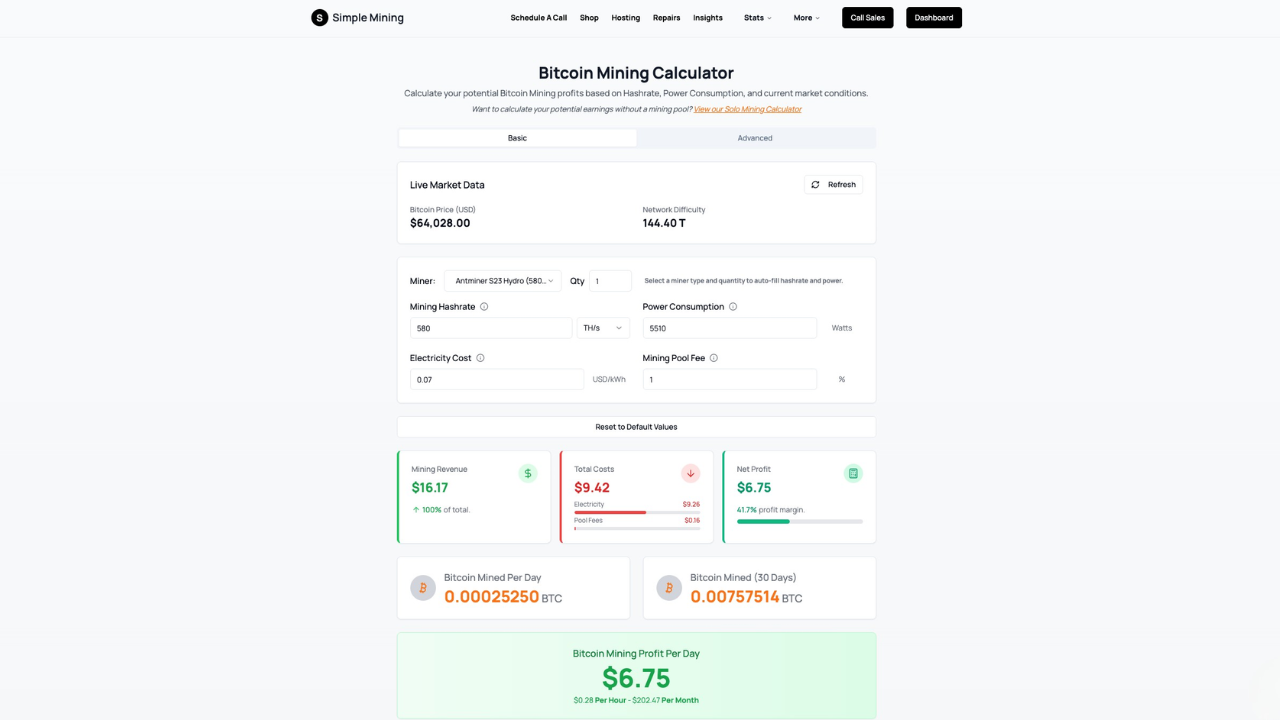
Enter your hashrate, power consumption, electricity cost, and pool fee to generate daily, monthly, and annual profit estimates. The entire process takes about two minutes.
1. Enter Your Hashrate
Hashrate is the computing power of your mining hardware. It is measured in terahashes per second (TH/s). Find this spec in your miner's documentation or on the manufacturer's product page. This input drives the entire calculation because higher hashrate captures a larger share of network rewards.
2. Input Power Consumption
Power consumption is how much energy your miner draws. It is measured in watts (W). This value appears alongside hashrate in manufacturer specs. Accuracy matters here because power draw determines your electricity bill.
One thing most newcomers miss: wall draw often exceeds the listed nameplate wattage by 3–6%. Some billing methods charge for nameplate power and some charge for wall draw. That difference changes your real cost.
3. Set Your Electricity Cost
Enter your rate in dollars per kilowatt-hour ($/kWh). Check your utility bill for this number. Electricity varies by location. Residential rates in many U.S. markets run $0.16–$0.20/kWh. Professional hosting facilities access industrial rates of $0.065–$0.08/kWh.
This single input can make or break a mining operation. A $0.02/kWh difference transforms a 5% profit margin into a 28% margin on the same machine.
4. Adjust Pool Fees
Mining pools combine hashrate from many miners to increase the odds of earning rewards. Pools charge a small fee for this service. The standard range is 1–3% of earnings. Most calculators include a default value you can adjust to match your pool, and our live stats page shows how hashrate is split across the major pools right now.
5. Review Your Profit Estimate
The calculator displays gross revenue (total earnings before costs) and net profit (what remains after expenses). You see projections for daily, monthly, and yearly timeframes. Compare the net profit figure against your total investment to gauge payback timeline.
Bitcoin Mining Calculator Inputs
Six inputs drive every Bitcoin mining profitability calculation. Each one affects your estimate in a different way.
| Input | Definition | Where to Find It |
|---|---|---|
| Hashrate | Computing power in TH/s | Miner specifications |
| Power consumption | Energy draw in watts | Miner specifications |
| Electricity cost | Price per kWh | Utility bill or hosting contract |
| Network difficulty | How hard it is to find a block | Auto-populated or blockchain explorer |
| Pool fees | Percentage of earnings | Pool website |
| BTC price | Current market value | Auto-populated or manual entry |
Hashrate and Hash Power
Hashrate measures how many calculations your miner performs per second. Units scale from gigahashes (GH/s) to terahashes (TH/s) to petahashes (PH/s) to exahashes (EH/s). A higher hashrate increases your chance of earning block rewards. It also increases power consumption.
Power Consumption in Watts
Your miner's power draw drives operating costs. Efficiency is expressed in Joules per terahash (J/TH). A lower J/TH number means a more efficient machine. An ASIC rated at 13.5 J/TH uses far less electricity per unit of hashrate than one rated at 25 J/TH.
When evaluating hardware, look at efficiency before raw hashrate. A machine with 200 TH/s at 15 J/TH can be more profitable than a 270 TH/s machine at 21 J/TH, depending on your power rate.
Electricity Cost per kWh
Electricity is the largest ongoing expense in any mining operation. It represents 75–85% of total operating costs. Residential rates in the U.S. average $0.16–$0.20/kWh. Professional hosting providers negotiate industrial rates of $0.065–$0.08/kWh. This gap is the primary reason most serious miners use hosted infrastructure rather than mining at home.
Mining Pool Fees
Solo mining is impractical for most individuals because the odds of a single ASIC finding a block are microscopic. Pools let miners combine their hashrate and share rewards in proportion to their contribution minus a service fee. Most pools charge between 1% and 3%.
Network Difficulty
Network difficulty measures how hard it is to find a valid block hash. Bitcoin's protocol adjusts this number every 2,016 blocks (about two weeks) to keep the average block time at 10 minutes. Most calculators pull the current difficulty and hold it constant. In practice, difficulty has trended upward for years as more hashrate joins the network. A rising difficulty means your same machine earns less BTC over time, even if nothing else changes.
Current Bitcoin Price
The market price of Bitcoin impacts the USD value of your mining profits. BTC is volatile. A calculation that shows strong profit at $100,000 per BTC might show a loss at $60,000. That is why smart miners track hashprice, the revenue a terahash earns per day, rather than BTC price alone.
What Bitcoin Mining Calculators Assume
Most calculators assume constant difficulty, a stable BTC price, 100% uptime, and zero maintenance costs. These assumptions bias every estimate higher than reality.
- Constant difficulty. Calculators use today's network difficulty. This metric adjusts every 2,016 blocks (about two weeks) based on total network hashrate. If more miners join, difficulty rises and your share of rewards shrinks.
- Stable BTC price. Calculations freeze the current BTC price. They ignore the volatility that can swing daily revenue by 10% or more in a single week.
- 100% uptime. Projections assume your miner runs 24/7 without interruption. No facility achieves 100%. Well-run facilities land in the 95 to 98% range and track every minute.
- No hidden costs. Basic calculators exclude hosting fees, cooling costs, maintenance, and repairs. These line items add up fast.
Operator reality: We see new investors build spreadsheets around calculator projections and forget to discount for downtime, repairs, or the next difficulty adjustment. The calculator is a compass, not a GPS. Use it to set direction, then layer in real operating costs.
What Factors Affect Bitcoin Miner Profitability
Five dynamic variables shift real-world results away from any calculator estimate. Understanding them separates informed operators from surprised ones.
Bitcoin Price Volatility
A 20% price drop means a 20% drop in dollar revenue, even if you mine the same amount of BTC. Price is outside your control. What you can control is your cost basis. Miners with low operating costs survive drawdowns that force high-cost operators offline.
Network Hashrate and Competition
Network hashrate is the total computing power of all miners combined. As more machines plug in, competition increases and your share of rewards shrinks. When hashrate grows faster than price, margins compress. When price outpaces hashrate, miners benefit from what's called the price-hashrate breakaway.
Mining Difficulty Adjustments
The Bitcoin network adjusts difficulty every 2,016 blocks to maintain the target 10-minute block time. If network hashrate increases, difficulty rises. Earning the same rewards with the same equipment gets harder over time.
Block Rewards and Halving Cycles
The block reward is the fixed amount of new Bitcoin awarded for each new block. This reward halves about every four years. The April 2024 halving reduced the reward from 6.25 BTC to 3.125 BTC per block. The next halving is expected around 2028. Update your calculator inputs after every halving.
Transaction Fees
Miners also earn transaction fees from the transactions included in their blocks. Fees vary with network activity. During high-demand periods, fees can represent a meaningful share of total revenue. This variable grows more important each halving cycle as the block subsidy continues to shrink.
Is Bitcoin Mining Still Profitable
Yes, but profitability depends on three things: electricity cost, hardware efficiency, and operational discipline.
Profitable setups include:
- All-in electricity at $0.08/kWh or below
- Current-generation hardware with sub-20 J/TH efficiency
- Professional hosting with high uptime, on-site repairs, and transparent billing
Challenging setups include:
- Residential power above $0.16/kWh
- Older ASICs with efficiency above 25 J/TH
- DIY operations without repair resources or uptime monitoring
For most investors, the question isn't "is mining profitable?" It's "can I build or access the right infrastructure?" The real cost of mining comes down to inputs you can influence: power rate, machine efficiency, and uptime.
How Long Does It Take to Mine 1 Bitcoin
A single ASIC cannot mine 1 full BTC in any short timeframe. At September 2026 conditions, a mid-tier S21 XP (270 TH/s) takes about 21 years to reach a full coin, a top-tier S23 Hydro about 10 years, and only a farm of a thousand-plus machines gets there in days. Our full breakdown of how long it takes to mine 1 Bitcoin by hardware tier runs the numbers for both solo and pool setups.
Most miners join a pool and earn fractional satoshis daily rather than wait on a whole coin. The daily accumulation rate depends on your hashrate, difficulty, and pool payout structure.
How Much Bitcoin Can You Mine per Day
Daily Bitcoin earnings depend on your hashrate, current network difficulty, and the block reward plus transaction fees.
A rough formula:
Daily BTC = (Your Hashrate ÷ Network Hashrate) × Blocks per Day × Block Reward
With about 144 blocks mined daily and a 3.125 BTC reward per block, the network produces around 450 BTC per day. Your share equals your percentage of total hashrate applied to that daily output.
The best way to get a personalized estimate is to use a Bitcoin mining calculator with your specific inputs.
What Bitcoin Mining Calculators Miss
Standard calculators skip real-world costs that reduce actual profit. Understanding these gaps is critical for setting honest expectations.
Hosting and Colocation Costs
Professional hosting adds a monthly fee on top of electricity. That fee covers infrastructure, security, monitoring, and management. The trade-off is access to industrial power rates, expert maintenance, and facilities designed for maximum uptime. For most miners, hosted operations produce better net returns than running machines at home.
Maintenance and Repair Expenses
ASIC miners run 24/7 in demanding thermal conditions. Hashboards fail. Fans wear out. Power supplies degrade. Unexpected component failures create repair costs and idle days with zero revenue. Most board failures show up in months 6–12 of operation, right when manufacturer warranty processes get slow.
On-site repair capability is a real differentiator. Shipping a machine to an overseas repair center can cost weeks of downtime. Facilities with an on-site certified ASIC repair bench turn repairs around in days, not months.
Downtime and Uptime Variability
Calculators assume 100% uptime. No operation achieves that. Hardware fails. Networks go down. Firmware updates require restarts. Well-run facilities hold 95%+ uptime and use precision billing so clients pay for actual hashing time only.
Every percentage point of downtime costs real money. On a machine earning $10/day, 2% downtime means $73 in lost revenue per year. Scale that across 50 or 100 machines and the gap between calculator projections and real earnings becomes clear.
Hardware Depreciation
Mining hardware loses value as newer, more efficient models release. A machine purchased today will be less competitive in two to three years. Serious profitability planning accounts for depreciation as a real cost of doing business. Some miners offset this through resale on a marketplace or strategic upgrades to newer hardware.
How to Compare Bitcoin Miner Profitability
Efficiency measured in Joules per Terahash (J/TH) is the best single metric for comparing ASIC miners side by side.
Key comparison factors:
- Efficiency (J/TH): Lower is better. A 13.5 J/TH machine costs far less to operate than a 25 J/TH machine at the same hashrate.
- Upfront cost: Purchase price affects your break-even timeline. A cheaper machine with lower efficiency can have a longer payback period than an expensive, efficient one.
- Expected lifespan: Durability determines total earnings potential over the machine's operational life.
- Resale value: Some models hold value better than others. Factor this into total ROI.
Run each candidate through a Bitcoin mining profitability calculator with your actual electricity rate. The machine with the best net profit per dollar invested wins, not the one with the highest hashrate on paper.
FAQs
What hashrate do I need to mine Bitcoin profitably?
There is no fixed hashrate threshold. Profitability depends on your electricity cost and hardware efficiency. A small operation with $0.07/kWh power can be profitable while a larger one paying $0.18/kWh struggles. Use a Bitcoin mining profitability calculator with your actual costs to find your break-even point.
How often should I recalculate my mining profitability?
Recalculate after any major BTC price move, after each difficulty adjustment (about every two weeks), or if your electricity rate changes. Many operators review projections monthly to stay current.
What is a good profit margin for Bitcoin mining?
A healthy margin covers all costs: electricity, hosting, maintenance, and hardware depreciation. It also leaves room for BTC price drops. Professional operations target margins that stay positive even during extended drawdowns. Margins vary based on power costs and equipment generation.
How does the Bitcoin halving affect mining profit calculations?
Each halving cuts the block reward in half. This reduces mining revenue unless BTC price rises enough to compensate. The April 2024 halving dropped the reward from 6.25 BTC to 3.125 BTC per block. Update your calculator inputs after every halving to reflect the lower reward.
Can I mine Bitcoin profitably with residential electricity?
It is difficult. Residential rates run $0.16–$0.20/kWh in most U.S. markets. Professional hosting facilities access rates of $0.065–$0.08/kWh. That difference makes a huge impact on margins. Many miners choose hosted mining to access lower power costs and on-site repair coverage.
Start Calculating Your Mining Profit
The best calculator is the one you use before you spend money.
Plug in your hashrate, power consumption, and electricity cost to see projected daily, monthly, and annual returns. Then layer in the real-world costs this guide covers: hosting, repairs, downtime, and depreciation. The gap between the two numbers is your margin of safety.
Try Simple Mining's Bitcoin Mining Calculator | Start Your Free 7-Day Trial