

Bitcoin Mining Cost in 2026: Production Cost Per BTC
By Josh Heine, Content Strategist at Simple Mining
Updated October 20, 2026Published December 1, 2025
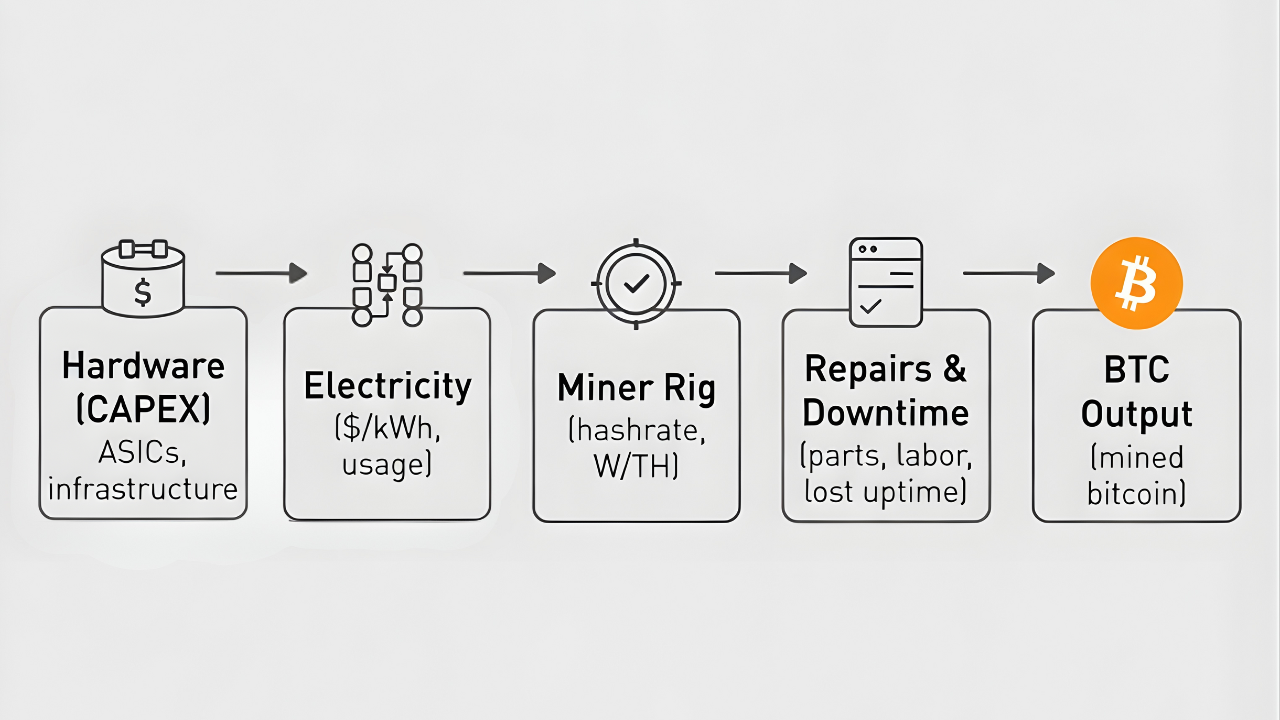
Bitcoin mining cost determines whether you acquire Bitcoin at an effective discount or pay full market price. Most analyses focus on network-wide electricity consumption. That approach misses the point for individual investors. Your cost structure depends on three variables: cheap power, efficient hardware, and minimal downtime. Manage these inputs well and you produce Bitcoin well below the prevailing market price. Manage them poorly and your margin thins to almost nothing, which is where a meaningful share of the network sits in mid-2026.
On this page · 10 sections
- What It Costs to Produce One Bitcoin in 2026
- What Is Bitcoin Mining Cost
- How the 2024 Halving Reset Production Cost
- Bitcoin Mining Cost Breakdown: CAPEX vs OPEX
- Mining Cost Risks: What Can Go Wrong
- How to Calculate Your Bitcoin Mining Cost
- Mining vs Buying Bitcoin: Cost Comparison
- How Simple Mining Lowers Your Cost Per Bitcoin
- FAQs
- Know Your Cost Per Bitcoin Before You Buy
Key Takeaways
- Bitcoin mining cost splits into CAPEX (hardware) and OPEX (electricity and pool fees). Electricity represents roughly 75-85% of ongoing expenses.
- Industrial hosting rates around $0.065-$0.08/kWh may create profitable margins in favorable conditions. Residential rates of $0.16 to $0.20/kWh make mining uneconomical for most operators.
- Hardware efficiency (measured in J/TH) determines your electricity cost per hash. S21-class machines run roughly 35-55% more efficient than S19 models, and the S23 Hydro at 9.5 J/TH is roughly 65% more efficient than an S19j Pro.
- Downtime from repairs destroys returns. On-site repair capability and Year 1 Repair Coverage convert unpredictable expenses into predictable costs.
- At $0.07/kWh, production cost runs near $35,519 per BTC on an Antminer S23 Hydro and about $50,469 on an Antminer S21 XP as of October 2026, with older air-cooled units costing more. Hardware efficiency, not hosting rate, drives most of that spread. These figures are the power cost to produce one Bitcoin, before hardware. Published industry averages run higher because they also count hardware depreciation and overhead.
- Tax benefits matter. Subject to eligibility and current U.S. tax law, 100% bonus depreciation on mining hardware can offset taxable income in the year of purchase. Consult a professional.
What It Costs to Produce One Bitcoin in 2026
At an industrial rate of $0.07/kWh, producing one Bitcoin costs near $35,519 on a hydro-cooled S23 and about $50,469 on an air-cooled S21 XP as of October 2026, and the spread comes almost entirely from hardware efficiency. Older air-cooled units cost more and sit closer to Bitcoin's market price, so the margin runs much thinner. Residential power at $0.16 to $0.20/kWh runs far past $80,000.
Use our cost to mine a Bitcoin tool to model your specific cost per BTC against current network conditions, or work out how long it takes to mine one Bitcoin at different hashrates.
What Is Bitcoin Mining Cost
Bitcoin mining cost is the total expense required to produce one Bitcoin. Think of it like manufacturing. Your factory (the ASIC) consumes raw material (electricity) to create a product (Bitcoin). The goal is simple: keep production cost below the selling price.
Mining differs from buying spot Bitcoin in one critical way. When you buy on an exchange, your cost equals the market price. When you mine, your cost equals your electricity bill plus overhead. This creates a potential arbitrage opportunity. Miners who optimize their input costs acquire Bitcoin at an effective discount to spot. At $0.07/kWh and October 2026 hashprice that discount is roughly 57% on the newest hydro hardware, 38% on a mid-range S21 XP, and about 20% on an older air-cooled S21. Same power rate, same network, three very different outcomes.
Here is a live example. At a hashprice near $37.02 per PH per day and $0.07/kWh power, an Antminer S21 XP (270 TH/s, 13.5 J/TH) earns about $10.00 per day against $6.12 of power and $0.10 in pool fees, for about $3.78 profit. Run the same math on an air-cooled S21 at 17.5 J/TH and you get $7.40 of revenue against $5.88 of power cost, a margin near 20%. Identical power rate. Efficiency is the whole difference.
How the 2024 Halving Reset Production Cost
Every Bitcoin mining cost figure published before April 2024 is obsolete, and the reason is arithmetic rather than markets.
The block subsidy halves roughly every four years. In April 2024 it dropped from 6.25 BTC to 3.125 BTC. Miners kept burning the same electricity to win the same blocks, but each block paid half as much. Holding every other input constant, that single event roughly doubled the electricity cost per Bitcoin produced overnight.
Difficulty did not fall to compensate. Network hashrate runs near 1,028.78 EH/s as of October 2026, which means each machine's share of the total keeps shrinking while the reward stays at 3.125 BTC. Difficulty now sits near 140.58 T. Both trends push production cost up, independently of price.
That is why efficiency stopped being a preference and became the deciding variable. Before the halving, a machine at 25 J/TH could survive on cheap industrial power. After it, the same machine produces Bitcoin above market price at any rate a hosting facility can offer. The next halving, expected in 2028, will do this again.
Bitcoin Mining Cost Breakdown: CAPEX vs OPEX
Bitcoin mining cost splits into two categories: capital expenditure (CAPEX) and operational expenditure (OPEX). Each category contains multiple line items that compound over time.
CAPEX: The Upfront Investment
ASIC hardware represents your largest upfront expense. As of October 2026, in-stock Antminer hardware includes an air-cooled Antminer S21 XP (270 TH/s, 13.5 J/TH) around $4,250 and a hydro-cooled Antminer S21j XP Hydro (495 TH/s) around $9,500, with the S23 Hydro at $15,000. Hydro units cost more per unit and far less per Bitcoin produced. For full specs and recommendations, read how to choose an ASIC miner or shop Bitcoin mining hardware directly.
Efficiency matters more than raw hashrate. S21-class machines operate between 13.5 and 17.5 J/TH, while S19-class models fall between 21 and 31 J/TH. The Antminer S23 Hydro, released in May 2026 at 563 TH/s and 9.5 J/TH, currently sets the floor. At $0.08/kWh that gap decides everything: the S23 Hydro runs a 50% operating margin while an air-cooled S21 at 17.5 J/TH runs about 9% on identical power. Buy the most efficient machine your budget allows.
OPEX: The Ongoing Burn
Electricity dominates operational costs. It represents roughly 75-85% of your monthly expenses. Industrial hosting facilities charge hosting fees around $0.065 to $0.08 per kWh. Residential rates often run $0.16 to $0.20 per kWh. The delta between these rates is a primary driver of profitability.
Consider a concrete example. An S21 XP draws roughly 3,645 watts at full load. Running 24/7 at $0.08/kWh costs about $210 per month. At $0.16/kWh that same machine costs around $420 per month. The roughly $210 monthly difference compounds to about $2,520 per year.
Pool fees add another 1-4% to your cost structure. Most miners join pools to smooth out revenue variance. FPPS (Full Pay Per Share) is the most common payout method, with public fees typically between 2% and 4%. Discounted pool fees through hosting partnerships can lower this further. Compare options across the best Bitcoin mining pools, or read up on pool payout structures and how they affect your bottom line.
Bitcoin mining cost breakdown by category, October 2026
| Cost Type | Component | Typical 2026 Range |
|---|---|---|
| CAPEX | ASIC hardware (current-gen) | about $4,250-$15,000 per unit |
| CAPEX | PDUs, cabling, cooling | $200-$500 per unit |
| OPEX | Industrial hosting fee | $0.065-$0.08 per kWh |
| OPEX | Residential electricity | $0.16-$0.20 per kWh |
| OPEX | Pool fees | 1-4% of revenue |
| OPEX | Repairs (uncovered) | $200-$800 per machine over lifetime |
Mining Cost Risks: What Can Go Wrong
The bitcoin mining cost equation determines your breakeven point. If your all-in cost to produce one Bitcoin exceeds the market price, you lose money. If your cost falls below market price, you accumulate Bitcoin at an effective discount. For a deeper look, find out whether Bitcoin mining is still profitable in 2026.
As of October 2026, industrial production cost at $0.07/kWh runs near $35,519 per BTC on an S23 Hydro and about $50,469 on an S21 XP, with older air-cooled units higher. With Bitcoin near $82,000, efficient fleets clear margins of about 45% to 57% while older units stay thinner. Both are technically profitable. Only one survives a further price decline, and that is the entire point of the cost equation.
What Can Go Wrong
Hardware failure destroys returns faster than any other variable. A dead miner produces zero revenue while depreciating in value. Control board failures, fan replacements, and power supply issues are common. Repair costs reach hundreds or thousands of dollars over a machine's life. External repair centers may take 4-12 weeks. That downtime hemorrhages potential revenue. Vertical integration with in-house ASIC repair services keeps repairs on site instead of in a shipping queue.
How to Mitigate
Choose a hosting provider with on-site repairs. Vertical integration between hosting and repair operations minimizes downtime. Some providers include Year 1 Repair Coverage with free repair labor in their Bitcoin miner hosting for hardware purchased through them, subject to program terms. This coverage converts an unpredictable expense into a more predictable cost.
What moves your production cost, and in which direction
| Factor | Direction | Why it moves cost |
|---|---|---|
| Hardware efficiency (J/TH) | Largest lever | At $0.07/kWh, an S23 Hydro produces near $35,519 per BTC while an S21 XP produces near $50,469 |
| Electricity rate ($/kWh) | Direct and linear | Each cent per kWh moves production cost by roughly $7,200 per BTC on a current-generation machine |
| Network difficulty | Rises over time | Now near 140.58 T at 1,028.78 EH/s. Higher difficulty means a smaller share of each block for the same hashrate |
| Block subsidy | Halves every 4 years | Cut to 3.125 BTC in April 2024, which doubled electricity per coin. Next halving expected 2028 |
| Uptime | Compounds | A machine offline earns nothing while depreciating. Every point of downtime raises cost per coin |
| Bitcoin price | No effect on cost | Price sets whether your production cost is profitable, not what it is |
How to Calculate Your Bitcoin Mining Cost
Use this framework to evaluate whether mining makes sense for your situation. These are simplified models for illustration purposes. BTC price, difficulty, fees, and uptime can change and materially affect results.
Step 1: Calculate Your All-In Cost Per kWh
Add your base electricity rate plus any hosting fees, cooling overhead, and management expenses. If this number exceeds $0.10/kWh, your margin shrinks fast.
Step 2: Model Your Daily Profit
Daily Revenue = (Your Hashrate / Network Hashrate) × Daily Block Rewards × Bitcoin Price
Daily Cost = Machine Wattage × 24 hours × Your $/kWh
Daily Profit = Daily Revenue - Daily Cost
These formulas are simplified. Plug your numbers into the Bitcoin mining calculator to model live network conditions.
Step 3: Calculate Payback Period
Payback Period = Machine Cost / Daily Profit
Payback stretches when hashprice is depressed and compresses sharply when it recovers, which is why entry timing matters as much as hardware choice. Buying hardware into a soft market is how operators end up with the shortest paybacks on the other side. This is not financial advice and actual outcomes vary.
Step 4: Stress Test Against Difficulty Increases
Network difficulty adjusts every two weeks. Model your profitability at 25% and 50% higher difficulty levels. If you go underwater in either scenario, reconsider your hardware choice.
Step 5: Factor in Tax Advantages
Subject to current U.S. tax rules and individual eligibility, mining hardware qualifies for 100% bonus depreciation, allowing a $10,000 purchase to potentially offset $10,000 of taxable income. For the full breakdown, learn how bonus depreciation applies to Bitcoin miners. This is not tax advice; consult a qualified professional.
Mining vs Buying Bitcoin: Cost Comparison
Mining and buying spot Bitcoin serve different purposes. Neither strategy dominates in all market conditions.
Buying Spot:
- Immediate exposure to Bitcoin price
- Zero operational complexity
- Cost equals market price
- Subject to KYC requirements on regulated exchanges
Mining:
- Produces Bitcoin below market price when electricity is cheap
- Operational complexity requires hosting or infrastructure
- Hardware depreciates over time
- Non-KYC Bitcoin flows direct from pool to wallet
Mining tends to outperform spot when Bitcoin price rises faster than network hashrate. The reverse is also true. Track this dynamic via hashprice. When hashprice climbs alongside spot price, miners' effective purchasing power holds steady or improves. Review this mining vs buying analysis for additional context.
Spot buying outperforms during extended bear markets. Hardware depreciates while Bitcoin trades sideways. The opportunity cost of locked capital hurts miners more than holders.
How Simple Mining Lowers Your Cost Per Bitcoin
Simple Mining structures operations to help minimize your all-in bitcoin mining cost. The focus is on reducing friction from the variables you control.
Hosting fees: Subject to contract terms, hosting fees start around $0.065/kWh for enterprise clients and $0.08/kWh for starter tiers. Precision billing charges each miner at its nameplate power rather than its wall draw, and only for the time it is online and hashing. Most miners draw a few percent more at the wall than their rating, so the effective rate sits below the headline rate, and repairs, maintenance and curtailment are not billed.
Uptime: On-site repairs at one of the largest ASIC repair centers in North America minimize downtime. Year 1 Repair Coverage with free repair labor on hardware purchased through Simple Mining, subject to program terms, helps eliminate surprise costs.
Flexibility: A 7-day free trial lets you test economics before committing capital, subject to availability. Pause periods let you stop mining for your own account once a month when margins turn thin, and hosting service fees don't accrue while a pause is active. Protection Plan program fees still apply during a pause.
Transparency: A client dashboard tracks hashrate, revenue, and costs in real time. You see every variable that affects your returns.
Simple Mining's Iowa data centers operate on roughly 60% renewable power. This matters for ESG-conscious investors and may future-proof operations against carbon regulations.
FAQs
What is the average cost to mine 1 Bitcoin in 2026?
At $0.07/kWh, industrial production cost ranges from roughly $35,519 to $50,469 per BTC as of October 2026 on current hydro and S21 XP hardware, with older air-cooled units higher. Hardware efficiency drives most of that spread. With Bitcoin near $82,000, the efficient end clears a stronger margin and older units clear less.
Is Bitcoin mining profitable in 2026?
Mining profitability depends on your electricity cost and hardware efficiency. Industrial hosting at $0.065-$0.08/kWh with modern S21-class miners is profitable when Bitcoin trades above production costs. Residential rates of $0.16 to $0.20/kWh make mining uneconomical for most operators. Calculate your specific breakeven point before investing.
What electricity rate do I need for profitable mining?
Industrial hosting at $0.065 to $0.08/kWh keeps production cost below market price on current-generation hardware as of October 2026. Residential rates of $0.16 to $0.20/kWh do not. Each cent per kWh moves production cost by roughly $7,200 per BTC on an S21 XP, and the gap between $0.08 and $0.16 compounds to about $2,520 per year on a single machine running continuously.
How long does it take to break even on mining hardware?
Payback period equals machine cost divided by daily profit. At October 2026 conditions, current hardware on hosted power pays back in roughly three to three and a half years, from about 38 months on an S21 XP to about 43 months on an S23 Hydro. That window widens when hashprice is depressed and narrows sharply when it recovers, so entry timing matters as much as hardware choice. Actual outcomes vary with Bitcoin price, network difficulty, and operational efficiency.
What are the tax benefits of Bitcoin mining?
Subject to current U.S. tax rules and individual eligibility, mining hardware qualifies for 100% bonus depreciation. This allows a $10,000 hardware purchase to potentially offset $10,000 of taxable income in the year of purchase. Consult a qualified tax professional for guidance.
Should I mine Bitcoin or buy it directly?
Mining produces Bitcoin below market price when electricity is cheap and conditions are favorable. Buying spot provides immediate exposure with zero operational complexity. Mining requires infrastructure and hardware that depreciates over time. Your choice depends on electricity access, technical capability, and market conditions.
Know Your Cost Per Bitcoin Before You Buy
Bitcoin mining cost is a function of inputs you can influence. Cheap power, efficient hardware, and fast repairs create potential margin. Expensive power, outdated machines, and extended downtime destroy it. Calculate your numbers before you plug in.
This article is for educational purposes only and does not constitute financial, investment, or tax advice. Consult qualified professionals before making decisions.
Ready to see the math for yourself? Start a 7-day free trial and test your mining economics with zero commitment.