
What Is Fiat Currency (Fiat Money)? Definition and Examples
By Josh Heine, Content Strategist at Simple Mining
Published November 23, 2026
Fiat currency is money a government issues that no commodity backs, such as the US dollar, the euro, or the Japanese yen. It holds value because a government declares it legal tender and people accept it as payment. This explainer covers what gives fiat money its value, how it differs from commodity money, how new money gets created, what it means for purchasing power, and how Bitcoin compares.
On this page · 13 sections
- What Is Fiat Currency?
- What Gives Fiat Currency Its Value?
- Is the US Dollar a Fiat Currency?
- Examples of Fiat Currency
- Fiat Money vs. Commodity Money
- How Is Fiat Money Created?
- Why Did the US Leave the Gold Standard?
- How Does Fiat Money Affect Purchasing Power?
- Advantages and Disadvantages of Fiat Money
- What Happens When a Fiat Currency Fails?
- Is Bitcoin Fiat Money?
- FAQs About Fiat Currency
- Earn Bitcoin With Hardware You Own
Key Takeaways
- Fiat currency, also called fiat money, can't be redeemed for gold, silver, or any other commodity.
- Its value rests on legal tender laws and on people accepting it in trade.
- Federal Reserve notes have not been redeemable in gold since 1934, and foreign governments lost the right to swap dollars for gold in 1971.
- Based on BLS consumer prices, it takes about $8.27 in October 2026 to buy what $1 bought in August 1971.
- Bitcoin is not fiat money: no government issues it, and its code stops new issuance at 21 million.
What Is Fiat Currency?
Fiat currency, also called fiat money, is money a government issues that is not backed by or convertible into a commodity such as gold. Its value comes from the government declaring it legal tender, an accepted form of payment. Merriam-Webster defines fiat money as money "not convertible into coin or specie of equivalent value."
Most fiat currencies share four traits:
- No commodity backing: You can't trade the notes in for gold, silver, or any other commodity.
- Legal tender: US law makes US coins and currency legal tender for all debts, public charges, taxes, and dues.
- Issued under a central bank: A central bank such as the Federal Reserve or the European Central Bank issues the notes.
- Value depends on use and acceptance: It works as money because people use it as a medium of exchange, a unit of account, and a store of value.
The US dollar, the euro, the Japanese yen, and the British pound are all fiat currencies.
What Gives Fiat Currency Its Value?
Fiat currency gets its value from law and from use: a government declares it legal tender, and people accept it in trade. The St. Louis Fed puts it this way: the value of fiat money comes from being declared legal tender by the government of the issuing country. Nothing physical stands behind it, so its worth depends on that status and on acceptance.
Legal tender has limits. US coins and currency are legal tender for all debts, public charges, taxes, and dues. Even so, no federal statute requires a business to accept cash, according to the Bureau of Engraving and Printing. Private businesses can set their own rules on cash unless a state law says otherwise.
Acceptance does the everyday work. Money serves as a medium of exchange, a unit of account, and a store of value. A dollar does those jobs because sellers take it, prices are set in it, and savers hold it.
The central bank manages the supply. The Federal Reserve aims for 2% inflation over the longer run, measured by the price index for personal consumption expenditures. The Fed judges that rate most consistent with its mandate for maximum employment and price stability.
The Fed also holds collateral against the notes it issues. Federal Reserve Banks must hold collateral equal in value to the notes they put into circulation, most of it Treasury, federal agency, and government-sponsored enterprise securities. Collateral is not convertibility. You still can't redeem a Federal Reserve note for gold, silver, or any other commodity.
Is the US Dollar a Fiat Currency?
Yes. The US dollar is a fiat currency because Federal Reserve notes are not redeemable in gold, silver, or any other commodity. According to the Federal Reserve, the notes have not been redeemable in gold since January 30, 1934, or in silver since the 1960s.
The Bureau of Engraving and Printing is the sole producer of US paper currency. The US Mint is the sole manufacturer of circulating coins.
Foreign governments kept a link to gold for decades longer. They could exchange dollars for gold until President Nixon closed the gold window on August 15, 1971, the event known as the Nixon shock.
The type of currency now in use in the United States is Federal Reserve notes and coins, and since 1933 the law has made both legal tender for all purposes.
Examples of Fiat Currency
The world's major currencies are fiat currencies, including the US dollar, the euro, the Japanese yen, the British pound, and the Canadian dollar. The St. Louis Fed said in 2014 that no country backed its currency with gold.
| Currency | Central bank |
|---|---|
| US dollar | Federal Reserve |
| Euro | European Central Bank |
| Japanese yen | Bank of Japan |
| British pound | Bank of England |
| Canadian dollar | Bank of Canada |
Each currency in the table has a central bank that issues its notes. In the United States, the Federal Reserve issues the notes and the Bureau of Engraving and Printing prints them.
Fiat Money vs. Commodity Money
Commodity money has value of its own, while fiat money does not. Gold and silver coins are commodity money: they work in trade, and the metal also has its own value and other uses. Fiat money has no practical value of its own and does not represent a commodity held anywhere else.
| Type | What gives it value | Example | Can you redeem it for a commodity? |
|---|---|---|---|
| Commodity money | The material it's made of | Gold and silver coins | It is the commodity |
| Representative money | The commodity held in reserve | A paper certificate redeemable for gold in a bank vault | Yes, for the gold it stands for |
| Fiat money | Legal tender status and acceptance | Today's US dollar | No |
Commodity money is a physical thing with value of its own, the same idea behind hard assets. Representative money sits in the middle. The paper is a receipt for metal held somewhere else.
According to the St. Louis Fed, representative money led to fiat money, the type modern economies use today. Fiat money drops the last link: the paper stands for no commodity at all.
How Is Fiat Money Created?
Most new fiat money is created by commercial banks when they make loans, not by a printing press. A 2014 bulletin from the Bank of England describes the process in those terms.
The central bank steers the total. In normal times it does this by setting interest rates. It can also add money by buying assets, a step known as quantitative easing.
Printing notes is a separate step. In the United States, the Bureau of Engraving and Printing prints paper currency and the US Mint makes coins. Bank lending and reserves fit together under fractional reserve banking, which covers the full mechanism.
Why Did the US Leave the Gold Standard?
The US left the gold standard in two steps: in 1933 for transactions at home and in 1971 for foreign governments. During the Great Depression, people hoarded gold instead of depositing it in banks. That created an international gold shortage.
The Gold Reserve Act of January 1934 moved monetary gold to the Treasury at $35 an ounce. That rate cut the dollar's gold value to 59% of the $20.67 an ounce set in 1900.
Abroad, the Bretton Woods system kept the dollar convertible to gold at $35 an ounce. When the gold window closed on August 15, 1971, the international monetary system in effect turned into a fiat one, according to Federal Reserve History.
The St. Louis Fed lists three drawbacks of a gold standard:
- No promise of stability: A gold standard does not ensure financial or economic stability.
- Costly to mine: Mining gold is costly and damages the environment.
- Supply not fixed: The supply of gold is not fixed.
How Does Fiat Money Affect Purchasing Power?
Fiat money loses purchasing power when prices rise, because each unit buys less. Based on the BLS consumer price index (CPI-U), it takes about $8.27 in October 2026 to buy what $1 bought in August 1971. Put the other way, a 1971 dollar buys about 12 cents' worth as of October 2026.
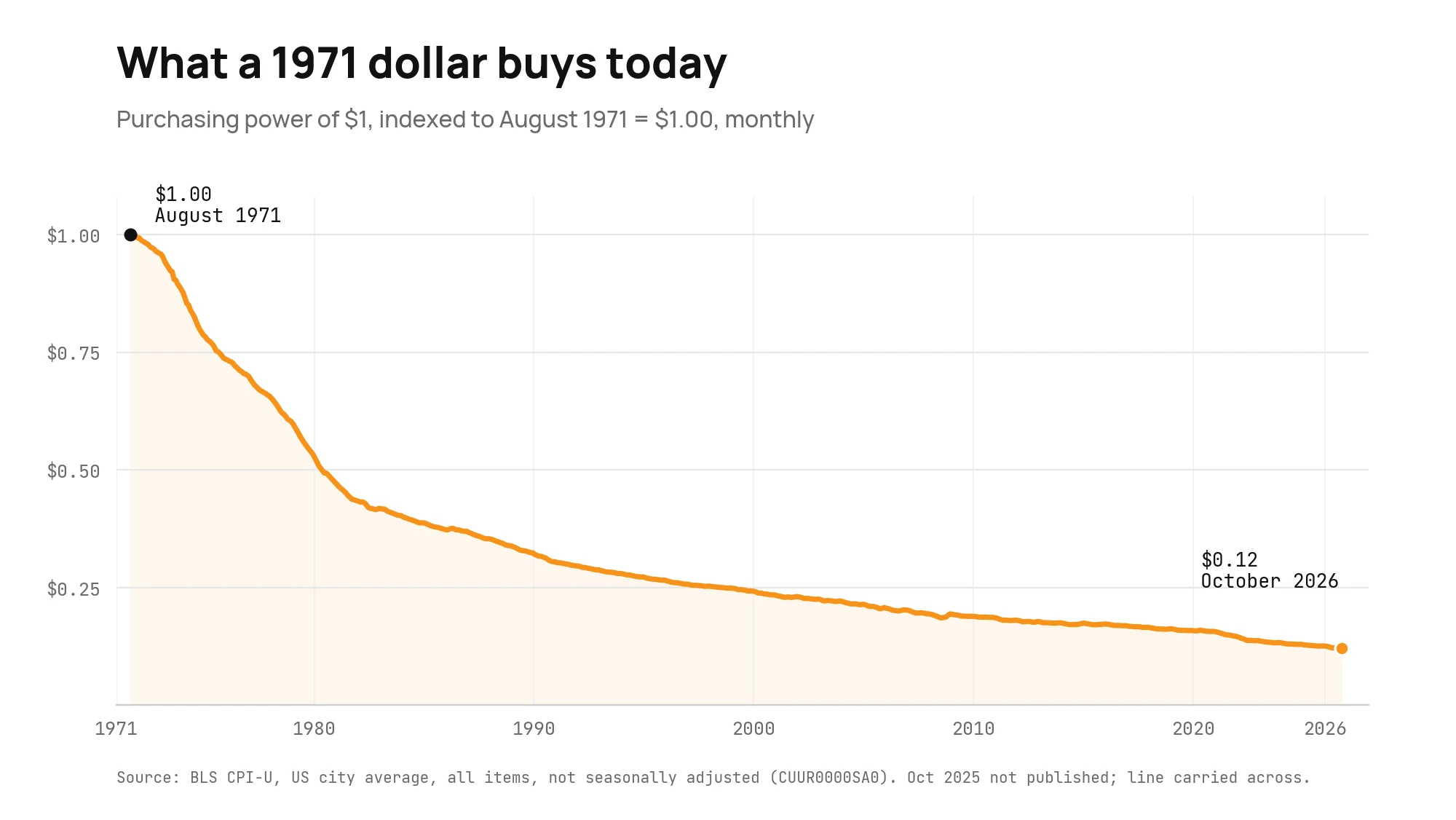
The same index shows prices about doubled from January 2000 to October 2026.
Some inflation is by design. The Federal Reserve aims for 2% inflation over the longer run, a little steady inflation each year rather than none.
Some investors argue that fiat currencies lose value over long periods and move savings into scarce assets as a result. That argument is known as the debasement trade. The figures in this section describe the past and are not a forecast.
Advantages and Disadvantages of Fiat Money
Fiat money gives a central bank room to respond to a downturn, at the cost of lost purchasing power over time and a value that rests on the issuer.
Advantages of fiat money:
- Room to respond: In a downturn, a central bank can change interest rates and buy assets.
- Not tied to gold mining: The money supply doesn't depend on how much gold gets mined, and gold is costly to mine with a supply that is not fixed.
- Easy to use: It works well as a medium of exchange and a unit of account.
Disadvantages of fiat money:
- No commodity limit: No gold or silver caps how much money banks and the central bank can create.
- Lost purchasing power: Prices rise over time, so each dollar buys less.
- Rests on the issuer: Its value depends on the issuing government and on people accepting it.
- Hyperinflation in extreme cases: Prices can spiral until people abandon the currency.
The same feature sits on both lists. The flexibility that lets a central bank respond to a downturn is also what lets the money supply grow without a commodity limit.
What Happens When a Fiat Currency Fails?
When a fiat currency fails, hyperinflation sets in: prices rise more than 50% a month, and people abandon the currency. The 50% line comes from economist Phillip Cagan's 1956 definition.
In November 1923 in Berlin, a loaf of bread cost 428 billion marks. In late 2008, Zimbabweans abandoned the Zimbabwe dollar in transactions. In February 2009, the authorities set up a multicurrency system, and the US dollar became the principal currency.
Is Bitcoin Fiat Money?
No. Bitcoin is not fiat money: no government issues it, and the US has not declared it legal tender. For US tax purposes, the IRS treats digital assets, including Bitcoin, as property, not currency.
Bitcoin's supply follows its code, not a central bank. New coins are created at a decreasing and predictable rate. The number created each year halves over time until issuance stops at 21 million. Each of those cuts is known as the Bitcoin halving.
New coins enter circulation through Bitcoin mining. The Bitcoin white paper describes a "peer-to-peer version of electronic cash" that sends payments "without going through a financial institution."
Supporters compare Bitcoin to gold because its supply stops at 21 million. That is their comparison, and Bitcoin vs. gold covers where the two match and where they differ.
The mining side of Bitcoin runs on physical hardware. A Bitcoin miner is a machine you can own, and it works under the same fixed issuance schedule. You can buy Bitcoin miners from Simple Mining and keep them running through Bitcoin miner hosting in Iowa, where the machines sit in a data center and stay yours.
FAQs About Fiat Currency
Why is it called fiat currency?
It's called fiat currency because "fiat" is Latin for "let it be done." The name fits money that exists because a government says so, not because it can be swapped for gold.
Why do most nations use fiat money today?
Most nations use fiat money because a gold link limits how a central bank can manage money. Without it, the money supply does not depend on how much gold gets mined, and the central bank steers it through interest rates and asset purchases. The St. Louis Fed also lists the drawbacks of gold: it does not ensure stability, it is costly to mine, and its supply is not fixed.
What can change the value of fiat money?
Three things change the value of fiat money: inflation, how much money gets created, and trust. Rising prices cut what each unit buys, and the Fed aims for 2% inflation over the longer run. Commercial banks create most new money through loans, while the central bank steers the total. The value also rests on people trusting the issuer and accepting the currency as payment.
Earn Bitcoin With Hardware You Own
A Bitcoin miner turns electricity and hardware into new Bitcoin under Bitcoin's fixed issuance schedule. Simple Mining clients buy and own their machines, pick their own pool, and keep custody of their Bitcoin. The machines run in Simple Mining's Iowa data centers. Clients pay a hosting fee in dollars, billed each month, so fiat money covers the running cost while the machine mines Bitcoin. To see a hosted miner at work, apply for a 7-day free trial on an Antminer S21+ at 235 TH/s.