
Hyperinflation: Causes and Examples From Weimar to Zimbabwe
By Josh Heine, Content Strategist at Simple Mining
Published October 27, 2026
Hyperinflation is inflation so fast that prices rise more than 50% in a single month, the line economists have used since 1956. Weimar Germany in 1923, Hungary in 1946, and Zimbabwe in 2008 all blew far past it. Each case shares one thread: a government created money to pay bills it couldn't fund through taxes or borrowing.
On this page · 12 sections
- What Is Hyperinflation?
- Hyperinflation vs. Inflation vs. Stagflation
- What Causes Hyperinflation?
- How Does Hyperinflation Affect Daily Life?
- Famous Hyperinflation Examples From Weimar to Zimbabwe
- What Was the Worst Hyperinflation in History?
- How Does Hyperinflation End?
- Which Countries Face Hyperinflation Today?
- Could the US Experience Hyperinflation?
- Can Hyperinflation Happen to Bitcoin?
- FAQs About Hyperinflation
- Earn Bitcoin From a Supply No One Can Print
Key Takeaways
- Hyperinflation means prices rising more than 50% a month, a pace that compounds to almost 13,000% a year.
- It starts when a government creates money to cover spending it can't fund through taxes or borrowing.
- Hungary holds the record: in July 1946, prices doubled every 15 hours.
- It ends when the government stops paying its bills with new money, through currency reform, budget discipline, dollarization, or a mix of the three.
- Bitcoin's supply can't inflate this way because its issuance is set in code, though a fixed supply doesn't mean a stable price.
What Is Hyperinflation?
Hyperinflation is runaway, accelerating inflation that destroys a currency's purchasing power. The standard definition draws the line at prices rising more than 50% in a single month. The threshold comes from Phillip Cagan's 1956 study "The Monetary Dynamics of Hyperinflation," published in a book edited by Milton Friedman. Under Cagan's rule, a hyperinflation begins in the month prices first rise more than 50% and ends in the month before the monthly rate drops below 50% and stays there for at least a year. Compounded over 12 months, 50% a month adds up to almost 13,000% a year.
Hyperinflation can occur when a government pays its bills with new money while the economy produces fewer goods. Two features mark it:
- Price surge: Prices rise more than 50% a month, and the pace speeds up instead of settling.
- Flight from the currency: People spend cash the moment they get it or swap it for foreign money, goods, or gold.
Hyperinflation vs. Inflation vs. Stagflation
Inflation is a general rise in prices, while hyperinflation is inflation so fast that the currency itself breaks down. Stagflation is high inflation alongside weak growth and high unemployment.
| Feature | Inflation | Hyperinflation | Stagflation |
|---|---|---|---|
| Speed of price rises | A few percent a year; the US peak in 2022 was 9.1% over 12 months | More than 50% a month by Cagan's definition | Elevated, while growth stalls |
| Typical cause | Demand outrunning supply, money growth, or supply shocks | Governments creating money to cover deficits | Supply shocks that raise costs while output weakens |
| Effect on daily life | Savings and wages lose buying power over years | Prices change within hours and savings vanish | Prices climb while jobs get harder to find |
| Does the currency survive? | Yes | Often replaced (Rentenmark, forint, boliviano) or abandoned for foreign money (Zimbabwe) | Yes |
What Causes Hyperinflation?
Hyperinflation starts when a government creates money to cover spending it can't fund through taxes or borrowing, most often after war, collapsed production, or lost access to credit.
Money Printing and Debt Monetization
Debt monetization is central bank funding of the government that brings a permanent increase in the money the central bank issues, which the IMF compares to printing money. The dollar has had no gold convertibility for anyone since the Nixon shock of 1971. When new money chases the same amount of goods, each unit buys less, the same arithmetic that sits behind the debate over whether UBI would cause inflation.
Collapsed Production
Printing does the most damage when there are fewer goods to buy. Hungary's industrial production in May 1945 was about 30% of its prewar level.
War, Reparations, and Lost Credit
War drains budgets and cuts off normal borrowing. Germany owed 132 billion gold marks in reparations under the London Schedule of Payments of May 5, 1921. Bolivia shows the same pattern without a war: when foreign capital dried up in 1982, the government turned to domestic credit instead of raising taxes or cutting spending.
Loss of Confidence in the Currency
The velocity of money is how often one unit of currency is spent on goods and services produced in the country during a given period. Once people expect higher prices, they spend money the moment they get it, which pushes velocity up and drives prices higher still.
Together, these forces feed a spiral in four steps:
- The government prints money to pay its bills.
- Prices outrun wages: New money reaches some people before others, a pattern known as the Cantillon effect.
- People spend cash before it loses value.
- The currency is abandoned: People switch to foreign money, gold, or barter wherever they can.
How Does Hyperinflation Affect Daily Life?
Hyperinflation wipes out savings, leaves wages behind prices, and pushes people to spend or swap their money within hours.
Savings and Wages Fall Behind
The German Historical Museum says the German hyperinflation destroyed the savings of countless families. The Deutsche Bundesbank notes that by 1923, wages in many parts of Germany were paid every day. Even so, the German Historical Museum says wages and salaries could not keep up with prices, and real wages fell to about 40% of their prewar level.
In November 1923 in Berlin, a loaf of bread cost 428 billion marks. In Hungary in 1946, ten pengős in your pocket at dawn were worth five by late evening.
People Flee to Dollars, Gold, and Stablecoins
Greeks under occupation fled the drachma for gold, and British gold sovereigns took the place of paper money. That flight to gold still frames the debate over Bitcoin vs. gold as an inflation hedge. Zimbabweans abandoned their own currency in late 2008 for de facto dollarization, the use of a foreign currency in place of the local one.
Stablecoins are a newer refuge: crypto tokens built to track a currency such as the dollar. Chainalysis's 2024 Latin America report found stablecoins made up 61.8% of Argentina's crypto transaction volume, as Argentines searched for ways to protect their savings. It also said Venezuelans appear to be drawn to crypto to combat the falling bolívar.
Famous Hyperinflation Examples From Weimar to Zimbabwe
Famous hyperinflation examples include Weimar Germany, occupied Greece, postwar Hungary, Nationalist China, Bolivia, Yugoslavia, and Zimbabwe. The years and peaks below come from the Hanke-Krus World Hyperinflations table.
| Country | Years | Main trigger | Peak month | Prices doubled every | How it ended |
|---|---|---|---|---|---|
| Germany | Aug 1922 to Dec 1923 | Reparations and Reichsbank funding of the Ruhr resistance | Oct 1923 | 3.70 days | Rentenmark, Nov 1923 |
| Greece | May 1941 to Dec 1945 | Occupation costs paid with new money | Oct 1944 | 4.27 days | New drachma Nov 1944; stabilization effort from 1946 |
| Hungary | Aug 1945 to Jul 1946 | War destruction and reparations | Jul 1946 | 15 hours | Forint, Aug 1, 1946 |
| China | Oct 1947 to mid-May 1949 | Civil war deficits | Apr 1949 | 5.34 days | Nationalist defeat in 1949 |
| Bolivia | Apr 1984 to Sep 1985 | Lost foreign credit | Feb 1985 | 20.3 days | Decree 21060, Aug 1985 |
| Yugoslavia | Apr 1992 to Jan 1994 | Breakup, war, and deficits covered by printing | Jan 1994 | 1.41 days | New dinar pegged to the Deutsche mark, Jan 1994 |
| Zimbabwe | Mar 2007 to mid-Nov 2008 | Farm output collapse and central bank money creation | Mid-Nov 2008 | 24.7 hours | Foreign currencies, 2009 |
Weimar Germany
Weimar Germany's hyperinflation ran from August 1922 to December 1923 and peaked in October 1923 at 29,500% a month. It turned extreme in 1923, after Germany defaulted on a reparations payment in January and France and Belgium occupied the Ruhr. A 1923 photo by Georg Pahl in Germany's Federal Archives shows a room being wallpapered with worthless banknotes.
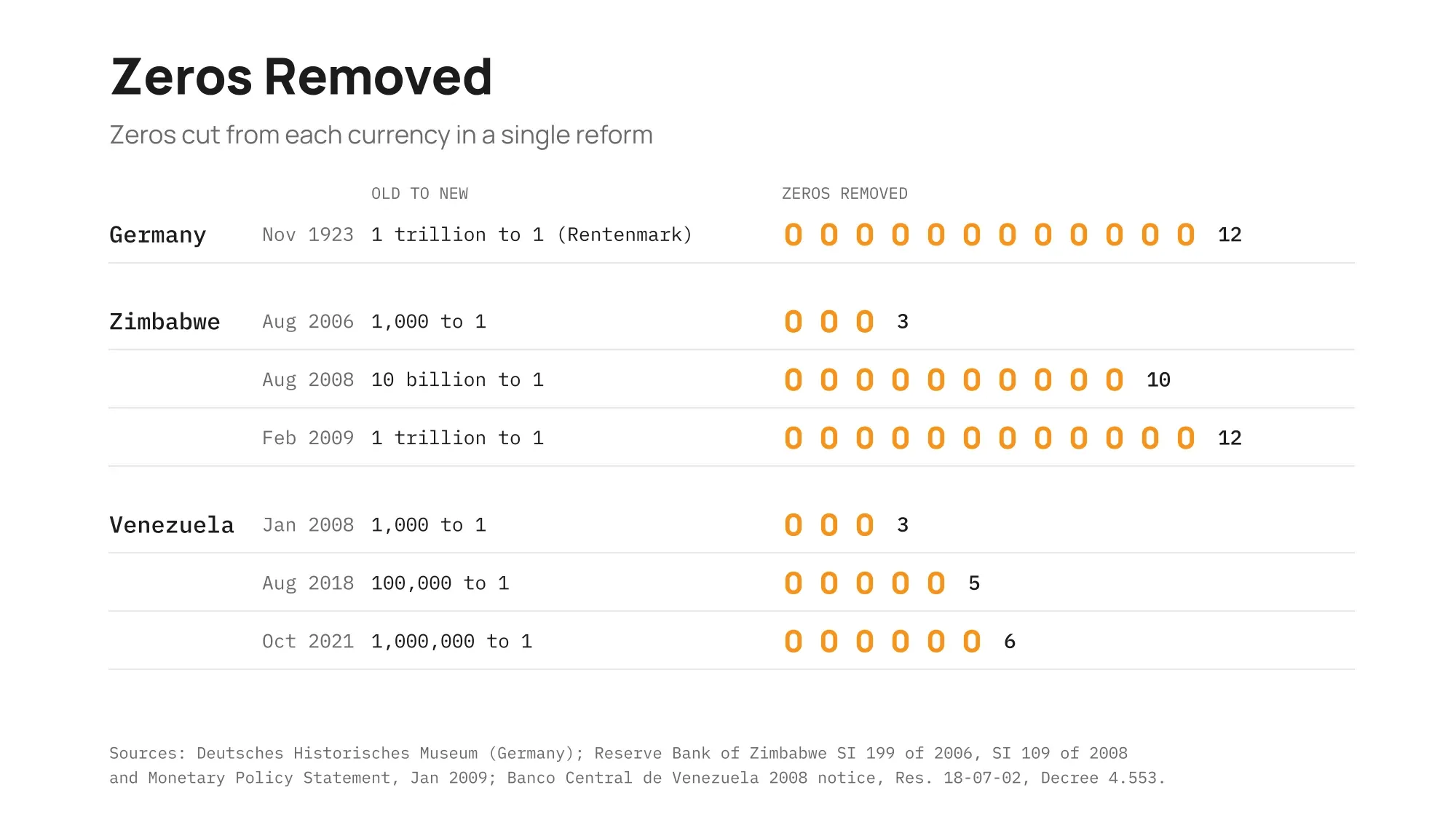
The Rentenmark arrived on November 15, 1923, at 1 Rentenmark to 1 trillion paper marks. As TFTC's history of central bank hyperinflation in Weimar Germany puts it, the hyperinflation ended only when the central bank was forced to stop issuing new money to fund government deficits.
Zimbabwe
The Zimbabwe hyperinflation ran from March 2007 to mid-November 2008. Farm output fell after the Fast Track Land Reform Program began in 2000, though weather also played a part. The Reserve Bank of Zimbabwe ran spending programs on the government's behalf and paid for them in part by creating money.
Hanke and Krus estimate the mid-November 2008 peak at 79.6 billion percent a month, based on implied exchange rates. The last official annual figure was 231 million percent, for July 2008. In January 2009, the Reserve Bank announced a 100 trillion Zimbabwe dollar note.
The January 29, 2009 budget allowed foreign currencies. An IMF paper on Zimbabwe's dollarization dates official recognition of the Zimbabwe dollar's demise to February 2009, and the US dollar became the principal currency. On April 5, 2024, Zimbabwe launched Zimbabwe Gold, known as ZiG and anchored by a basket of foreign currency and precious metals.
What Was the Worst Hyperinflation in History?
The worst hyperinflation in history hit Hungary in 1945 and 1946. In the peak month of July 1946, prices rose 41.9 quadrillion percent. That works out to about 207% a day, with prices doubling every 15 hours. On July 10, 1946, prices almost doubled within 11 hours, according to the Magyar Nemzeti Bank's history of the forint.
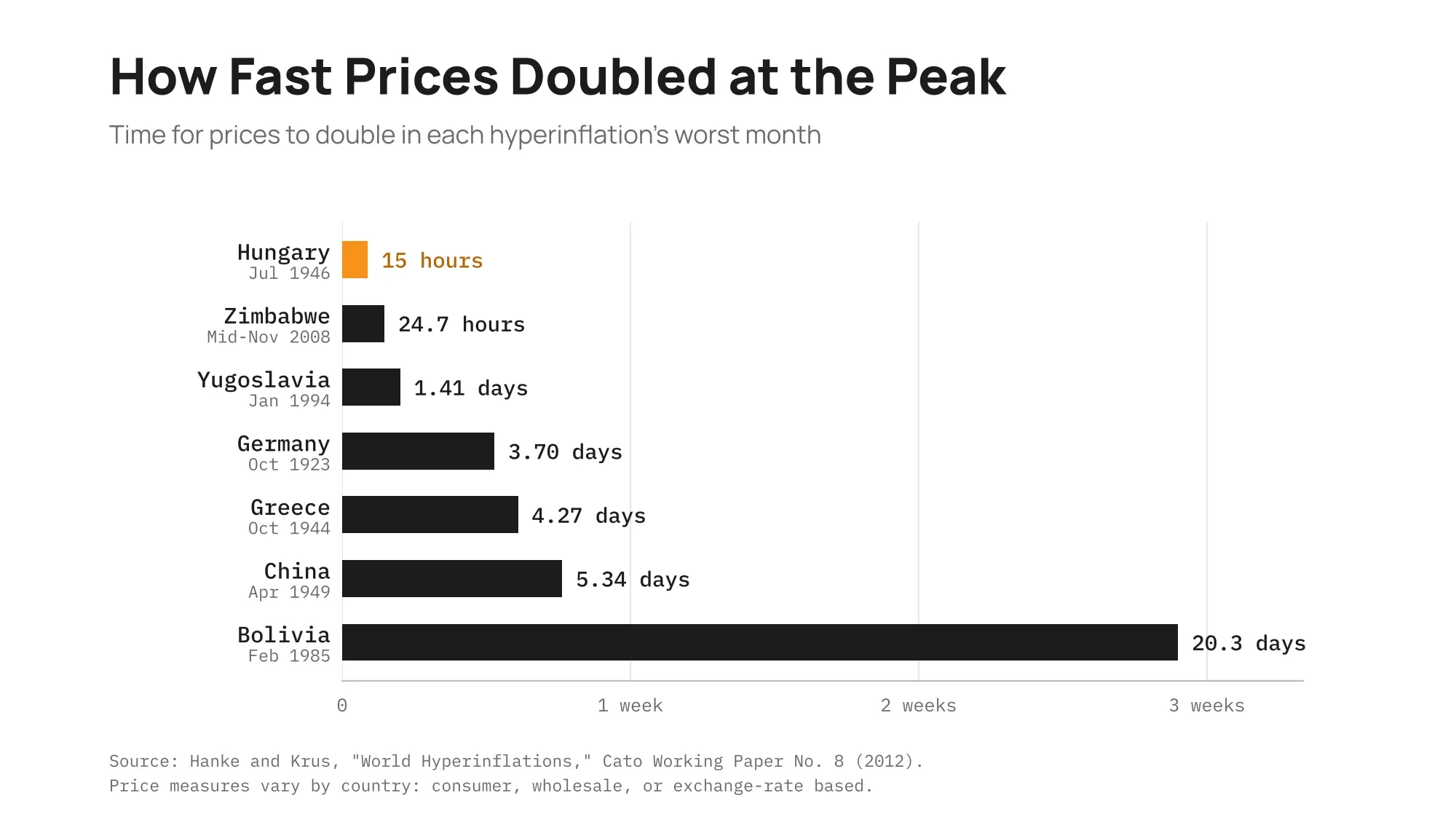
On January 1, 1946, Hungary introduced the tax pengő and tied its value to the retail price index. It sped inflation up instead of stopping it. When the forint arrived on August 1, 1946, one forint replaced 400 octillion ordinary pengős. That's a 4 followed by 29 zeros. Zimbabwe and Yugoslavia rank second and third in the Hanke-Krus table.
How Does Hyperinflation End?
Hyperinflation ends when the government stops paying its bills with new money, most often through some mix of three fixes.
- Currency reform: A new currency replaces the old one, as the Rentenmark and the forint did. Greece shows that a new currency alone isn't enough, since its first postwar drachma failed before the 1946 stabilization effort.
- Fiscal and monetary discipline: The government stops covering deficits with new money. Bolivia's Decree 21060 cut the deficit at once, and the hyperinflation ended within days.
- Dollarization: A stable foreign currency takes over. Zimbabwe moved to foreign currencies led by the US dollar in 2009, and Yugoslavia fixed its new dinar 1:1 to the Deutsche mark.
Which Countries Face Hyperinflation Today?
The clearest current answer comes from accounting, not Cagan's 50% monthly line: for periods ending June 30, 2026, PwC's June 2026 review of hyperinflationary economies counts nine under IAS 29:
- Argentina
- Haiti
- Iran
- Lebanon
- Malawi
- South Sudan
- Sudan
- Turkey
- Venezuela
The IAS 29 accounting standard, which covers companies operating in a hyperinflationary currency, sets no absolute rate; one of its indicators is cumulative inflation over three years that approaches or exceeds 100%. Burundi and Sierra Leone dropped off the list for periods ending on or after June 30, 2026. The accounting firms split on Zimbabwe: PwC says reliable information is lacking, while EY and BDO include it. These lists are judgments by accounting firms, not an official ranking. IAS 29 is also a far lower bar than 50% a month.
Venezuela's hyperinflation began in November 2017, when monthly inflation crossed 50%. Oil made up more than 90% of the country's exports, so the 2014 oil price crash cut deep into government revenue. The government had already adopted currency and price controls, and after the crash it printed money to cover the deficit.
Could the US Experience Hyperinflation?
Recent US inflation isn't close to hyperinflation: the peak was 9.1% over the 12 months ended June 2022, far from 50% in a single month. Congress sets the Federal Reserve's goals, but the Fed's decisions on how to reach them don't need approval from the President or anyone else in the executive or legislative branches. The dollar also made up 56.70% of global foreign exchange reserves in the second quarter of 2026, according to the IMF.
The risks worth watching are debt and a loss of confidence, the mechanism behind every case above. Large federal deficits keep the debate over a US debt crisis alive. A separate and more gradual concern is dollar debasement, a slow loss of purchasing power rather than a Weimar-style collapse.
Can Hyperinflation Happen to Bitcoin?
Bitcoin can't hyperinflate through its supply, because its issuance schedule is set in code and caps the total at 21 million coins. The block subsidy is the new Bitcoin a miner earns for each block. It started at 50 BTC and halves every 210,000 blocks, about every four years. Since the Bitcoin halving on April 20, 2024, the subsidy has been 3.125 BTC per block.
Bitcoin has no central issuer. New coins enter only through the first transaction in each block, which the block's miner creates. Full nodes reject any block that breaks the 21 million limit.
A fixed supply is not a stable price. Bitcoin's price in dollars or in a local currency can swing a long way in a short time.
FAQs About Hyperinflation
Does hyperinflation wipe out debt?
Yes, for debts fixed in the failing currency. In Germany, borrowers repaid loans in devalued marks under the rule that "a mark is a mark." A revaluation law of July 16, 1925 later set mortgages at 25% of their original gold-mark amount as a general rule, and long-standing holders of old government bonds were due to get back about 12.5% of face value.
What is the difference between hyperinflation and devaluation?
A devaluation is a deliberate cut in a currency's official exchange rate under a fixed-rate system, while hyperinflation is a collapse in what the currency buys at home. The IMF calls a market-driven fall under a floating rate a depreciation instead. One can trigger the other, since a weaker currency raises import prices and runaway prices drag the exchange rate down.
Earn Bitcoin From a Supply No One Can Print
Bitcoin's new coins come only from mining, on a schedule set in code. No government or central bank can add to that schedule.
With our ASIC miner hosting service, you own the hardware and pick your own pool. Rewards go to a wallet you control, and Simple Mining never takes custody. Hosted machines run at 95% average uptime, and mining revenue moves with Bitcoin's price, network difficulty, and hashprice.
You can buy a Bitcoin miner from Simple Mining, or start with a 7-day free trial on an Antminer S21+ at 235 TH/s. The trial runs on a real machine in a Simple Mining facility, with full access to the client dashboard.