

Would UBI Cause Inflation? It Depends on Who Pays
By Josh Heine, Content Strategist at Simple Mining
Published October 16, 2026
Would UBI cause inflation? It can, and whether it does depends on who pays. A universal basic income pushes prices up when it adds new money or new demand faster than the economy adds goods, and it does little to prices when it moves money that already exists. The question is back because worries about AI and jobs revived UBI proposals, and Elon Musk has called for federal checks. The takeaway: judge any UBI plan by who pays for it, not by the size of the check.
On this page · 12 sections
- Would UBI Cause Inflation?
- What Is Universal Basic Income?
- Why the Funding Method Determines UBI Inflation Risk
- When Universal Basic Income Would Cause Inflation
- When UBI Would Not Cause Inflation
- What Stimulus Checks and UBI Pilots Show About Inflation
- Could AI Offset UBI Inflation?
- How Inflation Erodes Your Purchasing Power
- Why Bitcoin's Fixed Supply Matters in the UBI Debate
- How Bitcoin Mining Fits
- FAQs About UBI and Inflation
- What UBI Means for Your Financial Strategy
Key Takeaways
- A UBI raises prices when it adds new money or demand faster than the economy adds goods, and does little when taxes or program cuts pay for it.
- Helicopter money, new central bank money handed to the public, carries the highest inflation risk of the four funding methods.
- A $500 a month UBI costs $1.884 trillion a year, and folding in existing cash and near-cash programs covers $354 billion of it.
- Pandemic income transfers may have added about 3 percentage points to US inflation by the end of 2021, but price shocks such as food and energy drove most of the surge.
- Bitcoin's 21 million cap does not move with any UBI funding choice, which is why holders see it as a hedge against money creation.
Would UBI Cause Inflation?
A UBI causes inflation when it adds new money or new demand faster than the economy can add goods, and it does little to prices when it is paid for by moving existing money. Printing money for the checks adds spending with nothing new to buy. Taxing one group to pay another moves spending from one pocket to another. The size of the check matters less than where the money comes from.
The first question to ask about any proposal is: how would UBI be funded? Vox's Dylan Matthews made the same point about basic income in general, in a line a University of Chicago Law Review analysis quotes: "Whether or not basic income is a good idea depends entirely on how you pay for it." Supply is the second question. If producers can raise output as demand rises, more spending buys more goods instead of higher prices.
What Is Universal Basic Income?
Universal basic income is a regular cash payment made to every person with no conditions attached: universal, unconditional, individual, regular, and cash. No country pays a full national UBI today. The debate over whether AI will bring universal basic income covers the pilots, the proposals, and the work question in depth.
Why the Funding Method Determines UBI Inflation Risk
The funding method determines UBI inflation risk because it decides whether the checks add new spending or move spending that already exists. There are four ways to pay for a UBI: new central bank money, government borrowing, taxes, and folding existing programs into one payment. The first two add demand on top of today's spending, and the last two reshuffle it. Most of the universal basic income inflation debate comes down to that split.
New Money From the Central Bank
Helicopter money is new central bank money handed straight to the public. The image comes from Milton Friedman's 1969 essay "The Optimum Quantity of Money," which imagines a helicopter that drops $1,000 in bills on a community. The parable adds money and nothing else. People hold more dollars, and the same goods now face more spending.
A UBI paid this way carries the highest inflation risk of any funding method. Central banks already create money through quantitative easing, but that money buys bonds, not checks for households. TFTC's case that Bitcoin answers money printing starts from the same worry about what new money does to savers.
Deficit Spending
Deficit spending pays for a UBI with borrowed money. The government sells bonds, sends the checks, and cuts nothing else to make room. Borrowing that savers fund moves existing money to the Treasury, and it adds new money when banks or the central bank buy the bonds instead. It still adds demand without a matching cut elsewhere, which puts the inflation risk at moderate to high. It also adds to the US debt problem, and the interest has to be paid later with taxes, more borrowing, or new money.
Tax-Based Redistribution
Tax-funded UBI moves purchasing power from taxpayers to recipients instead of creating it. Andrew Yang's Freedom Dividend proposed $1,000 a month to each adult citizen, paid for in part with a 10% value-added tax, as the Tax Foundation's review of Yang's plan lays out. When one group spends less so another can spend more, net demand changes little. The inflation risk is low, though spending can shift toward the goods recipients buy most.
Consolidating Existing Welfare Programs
Consolidation pays for a UBI by replacing existing cash and near-cash programs with one payment. It moves money that is already being spent, so it adds little new demand. The catch is scale. Fleischer and Hemel's University of Chicago Law Review analysis prices a $500 a month UBI for 314 million citizens and permanent residents at $1.884 trillion a year. Consolidating existing cash and near-cash programs offsets $354 billion, leaving a $1.530 trillion gap that taxes, borrowing, or new money must fill.
The four funding methods side by side:
| Funding Method | Adds New Money? | Adds Net Demand? | Inflation Risk |
|---|---|---|---|
| New central bank money | Yes | Yes | Highest |
| Deficit spending | Not on its own | Yes | Moderate to high |
| Tax-funded redistribution | No | Little net change | Low |
| Program consolidation | No | Little net change | Low, but covers only $354 billion of $1.884 trillion |
The table is a first cut, and the risk labels are directional. The Federal Reserve's response sits between the funding choice and the price level. A Fed that raises rates against a money-funded or debt-funded UBI can blunt the inflation while raising the cost of the debt, and a Fed boxed in by debt service or politics leaves more of it to show up in prices. The size of the program against GDP and the state of the labor market move the result too.
When Universal Basic Income Would Cause Inflation
Universal basic income would cause inflation when it puts more money in people's hands than the economy can turn into goods and services. Three pressures drive it: more money chasing the same goods, demand outpacing supply, and wages chasing prices. Each one is stronger when the checks come from new money or borrowing.
More Money Chasing the Same Goods
When the money supply grows faster than output, each dollar buys less. A UBI paid with new money raises the number of dollars without raising the number of goods. Shoppers compete for the same shelves, and sellers raise prices to match. That is the textbook path from money printing to inflation.
Who gets the money matters too. Households that spend most of each dollar turn new money into demand faster than savers or bondholders would, so the same dollars push harder on prices when they go out as checks.
Demand Outpacing Supply
Demand outpaces supply when spending rises in sectors that can't expand fast. Housing, food, childcare and local services take much of the marginal dollar in lower and middle income households, and those are the sectors that add supply slowest. Headline CPI can rise a little while rents rise a lot. Timing matters too. Whoever receives new money first spends it before prices adjust, which is the Cantillon effect, and later recipients meet the higher prices.
Wage-Price Spiral Pressures
A wage-price spiral is a loop in which rising prices push workers to ask for higher wages, and higher wages push businesses to raise prices again. A UBI can feed that loop when it adds demand in a tight labor market. The risk is highest when workers are scarce and the checks are funded with new money or borrowing. With slack in the labor market, the loop has less to feed on.
When UBI Would Not Cause Inflation
A UBI would not cause inflation when taxes or replaced programs pay for it and the economy has room to produce more. Taxes and program cuts move existing spending instead of adding to it. Slack, meaning idle workers and unused capacity, lets output rise to meet new demand instead of prices. The Kenya study below found a local multiplier of 2.5, which shows cash can raise output and not only prices.
Labor supply is the other side of that test. If a large permanent UBI leads enough people to cut their hours, output shrinks while spending holds, and prices can rise even when taxes pay for every check. The evidence so far is thin. Jones and Marinescu's companion study of Alaska's labor market found the dividend had no effect on employment and raised part-time work by 1.8 percentage points, but at $1,200 this year the dividend is a fifth of the $500 a month UBI that Fleischer and Hemel price.
What Stimulus Checks and UBI Pilots Show About Inflation
Stimulus checks and UBI pilots show that cash adds to inflation when it arrives in a large burst during a supply shock, and does little to prices when output can expand. The COVID-19 checks landed on top of supply shocks. Alaska's dividend has a long record with uncertain price effects. Kenya's transfers raised local output with almost no inflation.
COVID-19 Stimulus Checks
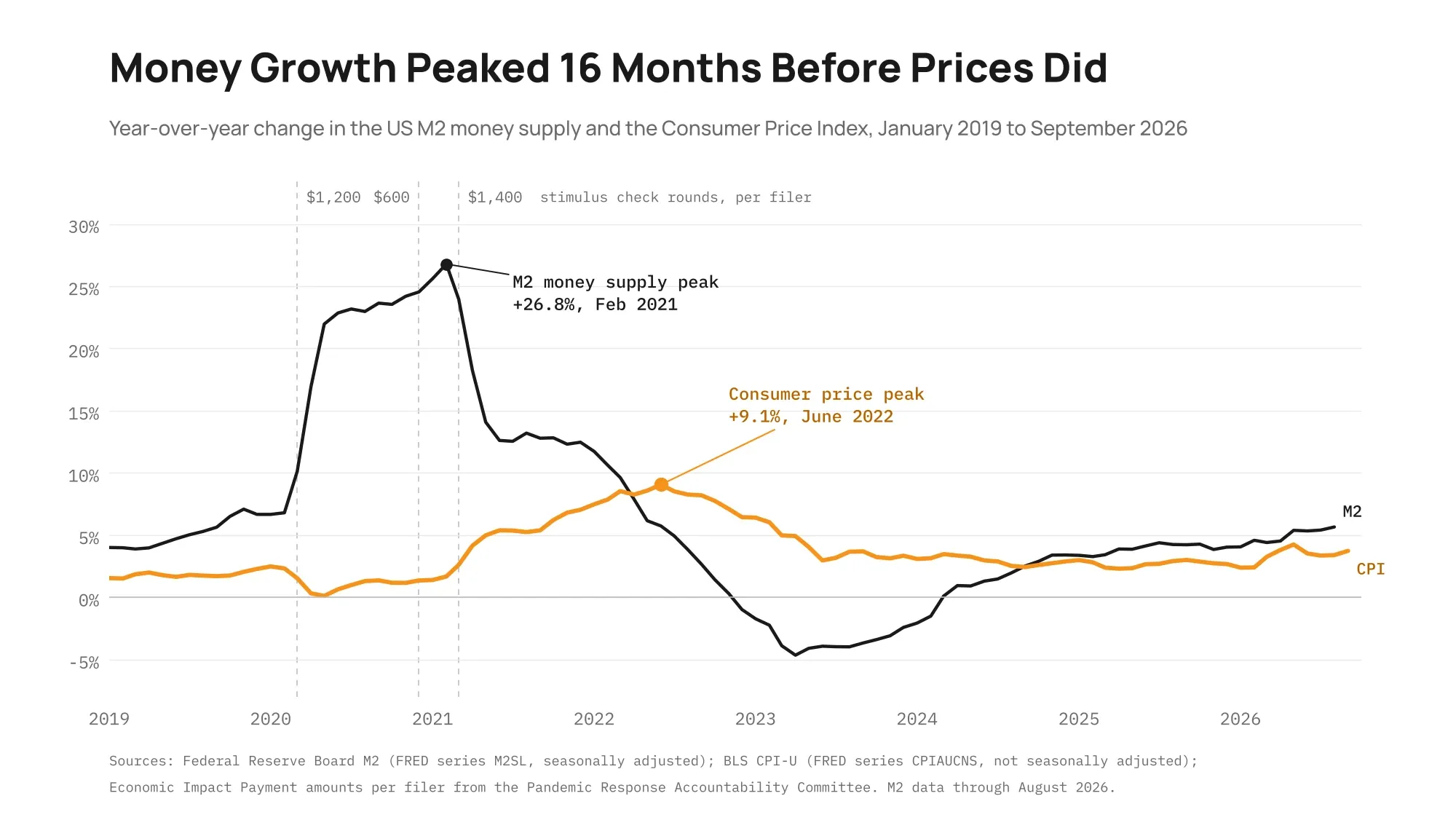
The US sent three rounds of Economic Impact Payments: $1,200 per filer in March 2020 under the CARES Act, $600 in December 2020, and $1,400 in March 2021 under the American Rescue Plan. The Pandemic Response Accountability Committee's count shows more than 476 million payments totaling $814 billion. Each round was a one-time payment, not a regular income.
Money and prices both jumped, but not at the same time. According to Federal Reserve data, the M2 money supply grew 26.8% in the 12 months to February 2021, the fastest year-over-year growth in a series that starts in 1959. The Bureau of Labor Statistics June 2022 CPI report showed consumer prices up 9.1% in the 12 months ending June 2022, the largest 12-month increase since November 1981. The two peaks were 16 months apart.
The research splits the blame. A San Francisco Fed Economic Letter from March 28, 2022 estimated that US income transfers may have added about 3 percentage points to inflation by the end of 2021. Bernanke and Blanchard's study of pandemic-era inflation found that most of the 2021 surge came from price shocks such as food and energy, not an overheated labor market. The transfers added to inflation, but they arrived alongside supply shocks and came as a temporary burst, not a permanent UBI.
Alaska Permanent Fund Dividend
Alaska has paid residents an unconditional cash dividend every year since 1982. The state puts the 2026 dividend at $1,200, including a $200 energy relief payment. Jones and Marinescu's study in the National Tax Journal found suggestive evidence of positive price effects from the dividend. They also wrote that much uncertainty remains about the causal effect on Alaskan prices. Alaska is not proof that a cash dividend leaves prices alone, and it is not proof that it drives them up.
Kenya Cash Transfers
A study in Econometrica by Egger, Haushofer, Miguel, Niehaus, and Walker tracked GiveDirectly transfers of about USD 1,000 to over 10,500 poor households in 653 villages in Kenya. The cash was a large shock, over 15% of local GDP. The authors estimate a local transfer multiplier of 2.5, which means each dollar of cash raised local economic activity by about 2.5 dollars. Average price inflation was 0.1%, and price effects stayed under 1% even when transfers peaked. The setting was rural Kenya with a lot of idle capacity, so the result shows what slack can do, not what a US program would do. Each household got a one-time transfer, not a permanent UBI.
None of these cases is a permanent national UBI. A payment people expect every month for life changes how much they work, borrow and bid for housing in ways a one-time check does not, so none of them settles what a permanent program would do to prices.
Could AI Offset UBI Inflation?
AI could offset UBI inflation only in the goods and services it makes cheaper to produce. On April 17, 2026, Elon Musk called on X for federal checks to people who lose work to AI and wrote: "AI/robotics will produce goods & services far in excess of the increase in the money supply, so there will not be inflation." That is the case for AI deflation, which we cover in its own piece. The argument holds only where AI output grows in the same places the new money gets spent.
The gains so far are uneven. AI has made software, research and office work cheaper much faster than it has made housing, food, healthcare or childcare cheaper, and those are the sectors where UBI dollars tend to land. AI also uses up supply of its own: data centers draw on the same power and capital that the rest of the economy needs, a constraint we watch as hosts because miners and data centers compete for the same grid. Where AI can't add supply, new money still bids up prices.
How Inflation Erodes Your Purchasing Power
Inflation erodes purchasing power by making each dollar buy less over time. Cash savings lose ground first, because their dollar amount stays fixed while prices rise. Wages and fixed incomes adjust later than prices, so earners and retirees fall behind while they wait.
Even "normal" inflation compounds. The Federal Reserve's longer-run goal is 2% inflation, measured by the annual change in the PCE price index, and each year's 2% stacks on the last. Over enough years, that compounding cuts what a dollar buys in half. The long-run version of that story is dollar debasement, and it is the backdrop for every UBI plan that leans on new money.
Why Bitcoin's Fixed Supply Matters in the UBI Debate
Bitcoin's supply is capped at 21 million coins, enforced by every node, and no UBI funding choice can change it. Lawmakers can raise taxes, borrow, or lean on new central bank money, and none of those choices adds a single Bitcoin. Holders see Bitcoin as a hedge against money creation for that reason.
The cap does not protect the price. Bitcoin's price is volatile, and a fixed supply does not stop it from falling in dollar terms. This is not investment advice, and Simple Mining gives no investment, tax, or custodial advice.
How Bitcoin Mining Fits
Bitcoin mining is how new Bitcoin enters circulation on a fixed schedule. Miners add each block and receive the block reward, and a UBI vote does not change the block reward schedule. Mining is an operating business: revenue moves with Bitcoin price and network difficulty, and the main costs are power and hosting.
What we watch on every hosted machine is power cost and machine efficiency, not forecasts of what Congress will pass. When revenue per terahash falls, the least efficient machines go dark first. Simple Mining runs 11 sites with 150+ MW of power capacity and 9+ EH/s hosted at 95% average uptime.
We run a managed mining hosting service with a hosting fee of $0.065 to $0.08 per kWh. Hosting is shown in $/kWh for reference; Simple Mining does not sell or resell electricity and is not a public utility. Run your own numbers in our Bitcoin mining calculator before you commit to hardware.
FAQs About UBI and Inflation
What did Elon Musk say about universal basic income?
Elon Musk called for universal high income paid through federal checks in an April 17, 2026 post on X. His term is universal high income, not basic income, and he presented it as the answer to unemployment caused by AI. He also argued that AI and robotics would turn out goods and services faster than the money supply grows, so the checks would not cause inflation.
Did stimulus checks cause inflation?
Pandemic income transfers, the checks included, added to inflation, but they were not the main driver. A San Francisco Fed Economic Letter estimated that US income transfers may have added about 3 percentage points to inflation by the end of 2021. Bernanke and Blanchard found that most of the 2021 surge came from price shocks such as food and energy, not an overheated labor market.
How much would UBI cost in the United States?
At $500 a month for each of 314 million citizens and permanent residents, a UBI costs $1.884 trillion a year, according to Fleischer and Hemel in the University of Chicago Law Review. Folding existing cash and near-cash programs into the payment covers $354 billion of that. The remaining $1.530 trillion would have to come from taxes, borrowing, or new money.
Would UBI replace Social Security and other benefits?
It depends on the proposal. Fleischer and Hemel's $354 billion offset counts SNAP, TANF, WIC, unemployment insurance, Section 8 rental assistance, the EITC, and the child tax credit, and it sets Social Security aside. They note that replacing Social Security retirement, disability, and SSI benefits with a $500 a month UBI would leave millions of elderly and disabled Americans worse off.
Is UBI the same as helicopter money?
No. Helicopter money is new central bank money handed out to the public. A UBI is a payment that can be funded by taxes, borrowing, or new money, and only the version paid with new central bank money is helicopter money.
What UBI Means for Your Financial Strategy
The UBI inflation question comes down to who pays. You can't vote on the funding mix, but you can choose what you hold while the debate plays out. If you want to acquire Bitcoin through an operating business rather than a purchase, you can buy Bitcoin miners from our inventory and host them with us. To see the work before you buy, start with a 7-day free trial on an Antminer S21+ at 235 TH/s.