
Universal Basic Income and AI: Will AI Bring UBI?
By Josh Heine, Content Strategist at Simple Mining
Published September 30, 2026
The likely answer is no, at least not soon and not in the form most people picture. AI companies now say displacement may outrun job creation, and that has revived the debate over universal basic income, with two 2026 policy proposals already on the table. Whether AI brings UBI depends on politics more than technology: on who owns AI's gains and whether voters demand a share. The technology sets the pace of job change, and legislatures decide what happens to the money.
On this page · 11 sections
- What Is Universal Basic Income?
- Why AI Is Driving the UBI Conversation
- Will AI Replace Most Jobs?
- What Tech Leaders Say About UBI
- How Could Universal Basic Income Be Funded?
- Which Countries Have Tested Universal Basic Income?
- Pros and Cons of Universal Basic Income
- Alternatives to Universal Basic Income
- How to Prepare for AI Job Displacement
- FAQs About Universal Basic Income and AI
- Will AI Bring UBI? What Comes Next
Key Takeaways
- No country pays a full national UBI, and every U.S. pilot to date is targeted guaranteed income rather than UBI.
- The 2026 proposals from OpenAI and Senator Sanders shift the debate from cash checks toward public ownership stakes in AI companies.
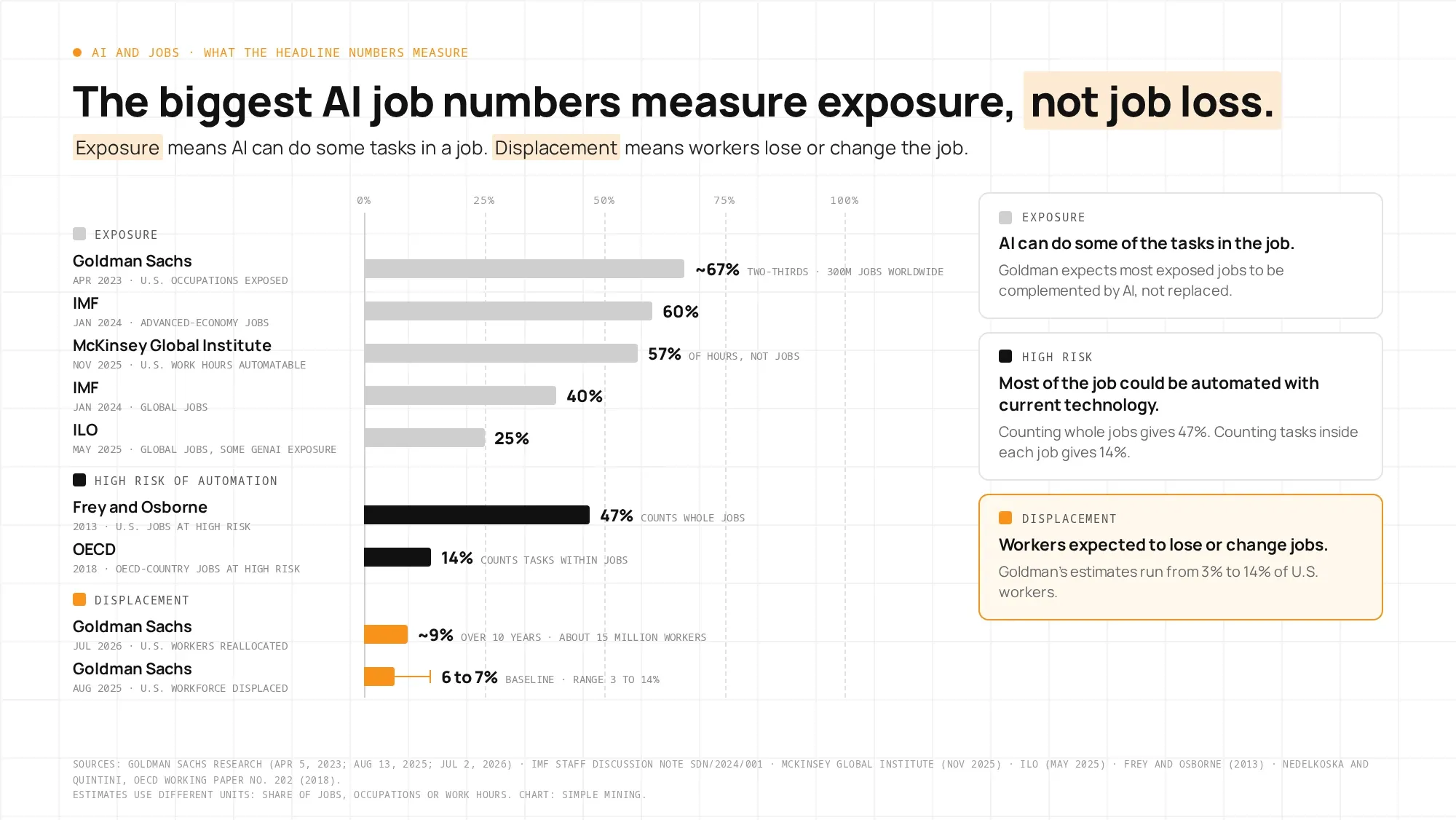
- Job studies measure exposure, not loss. The IMF puts 40% of global jobs in the exposed category while Goldman Sachs expects about 9% of U.S. workers to change jobs over a decade.
- Trial evidence on work incentives is small and mixed: Finland found six more days worked, and the OpenResearch study found 1.3 fewer hours a week.
- A $500 a month U.S. UBI costs about $1.884 trillion a year before offsets. Funding is the binding constraint and technology is not.
What Is Universal Basic Income?
Universal basic income is a regular cash payment made to every person with no conditions attached. The Basic Income Earth Network defines it as a periodic cash payment delivered unconditionally to all on an individual basis, without a means test or work requirement, and the Stanford Basic Income Lab uses the same five features. After this point the article uses UBI.
- Universal: every resident receives it, rich or poor.
- Unconditional: no work requirement and no means test.
- Individual: paid to each person, not to a household.
- Regular: paid on a schedule, not as a one-time grant.
- Cash: money the recipient controls, not vouchers or services.
UBI is not the same as guaranteed income. Guaranteed income is targeted: a city or nonprofit selects a group, often by income level, and pays them for a set period. Every U.S. city pilot to date falls in that second category.
Why AI Is Driving the UBI Conversation
AI is driving the UBI conversation because the companies building it now expect displacement to outrun job creation, and they have started writing policy to match. Two 2026 documents set the terms of the debate. Both move away from a check in the mail and toward giving the public a share of AI companies themselves.
In April 2026 OpenAI published a paper titled Industrial Policy for the Intelligence Age. It proposes shifting the tax base from labor to capital, explores what it calls taxes related to automated labor, and calls for a Public Wealth Fund whose returns could be distributed to citizens. It also floats employer pilots of a 32-hour week at full pay. The paper never uses the phrase robot tax.
On June 18, 2026 Senator Bernie Sanders introduced the American AI Sovereign Wealth Fund Act. The bill imposes a one-time 50% tax on the stock of AI companies with $200 million or more in annual AI receipts and deposits the shares into a public fund. Sanders estimates the fund at $7 trillion. Elon Musk's April 17, 2026 post calling for federal checks landed between the two.
That output is produced in physical buildings, and knowing what an AI data center is makes the stakes concrete: the AI and UBI debate is about who captures what those buildings produce.
Will AI Replace Most Jobs?
No major study says AI will replace most jobs. The useful frame comes from economists Daron Acemoglu and Pascual Restrepo in a 2019 paper titled Automation and New Tasks: automation displaces workers from existing tasks while new tasks reinstate them elsewhere. The open question is the gap between those two forces, not whether work ends.
History shows both forces at work. Farm labor made up 41% of the U.S. workforce in 1900 and 1.9% of the employed by 2000, according to the USDA Economic Research Service. Nobody would call that a collapse, because manufacturing and services absorbed the people. Estimates for AI disagree by a wide margin: Frey and Osborne put 47% of U.S. jobs at high risk of computerization in 2013, and a 2018 OECD task-based study put the high-risk share at 14%. The disagreement is the point, since the answer depends on whether you count jobs or tasks.
The current data show strain rather than collapse. U.S. unemployment stood at 4.1% in August 2026, according to the Bureau of Labor Statistics. For recent college graduates the picture is worse: the New York Fed reported 5.6% unemployed and 42% underemployed in the second quarter of 2026. Entry-level office work is where the pressure shows first.
Which Jobs Are Most Exposed to AI?
Office and clerical work is the most exposed category in every major study. The IMF found in January 2024 that 40% of global jobs are exposed to AI, rising to 60% in advanced economies. The ILO's May 2025 index put 25% of global employment in occupations with some generative AI exposure, with clerical roles at the top. Goldman Sachs estimated in April 2023 that the equivalent of 300 million full-time jobs worldwide are exposed to automation. Exposure means AI can do part of the work, and it is not a count of jobs lost.
Which Jobs Is AI Creating?
AI creates jobs in data, software, and energy, and it raises demand for care, teaching, and trades that machines cannot do. The World Economic Forum's Future of Jobs Report 2025 projects 170 million jobs created and 92 million displaced by 2030, a net gain of 78 million. About six in ten U.S. jobs in 2018 did not exist in 1940, according to MIT economist David Autor. Goldman Sachs finds that 85% of U.S. job growth over the last 80 years came from roles that technology created.
How Fast Could AI Displace Jobs?
Slower than the headlines and faster than past waves. Goldman Sachs set a baseline in August 2025 of 6 to 7% of the U.S. workforce displaced, with a range of 3 to 14%. In July 2026 the same team estimated that about 9% of U.S. workers, or about 15 million people, will move to new positions over a 10-year transition. Its April 2026 analysis found AI cutting about 16,000 jobs a month from U.S. payroll growth over the prior year. McKinsey said in November 2025 that current technology could automate about 57% of U.S. work hours, and its midpoint scenario has 27% automated by 2030. It states that the figure is not a forecast of job losses.
What Tech Leaders Say About UBI
The people building AI split three ways on UBI: cash now, ownership instead of cash, or taxes that fund something else. Their positions have shifted within the last two years. Here is what each one has said, dated and in their own words where possible.
Elon Musk on Universal High Income
Musk's term since late 2023 is universal high income, not basic income. On April 17, 2026 he wrote on X: "Universal HIGH INCOME via checks issued by the Federal government is the best way to deal with unemployment caused by AI." He added that AI and robotics would produce goods and services far in excess of the increase in the money supply, so there would be no inflation.
Sam Altman on Universal Basic Income
Altman funded a major U.S. cash study and then moved away from the idea. He put $14 million of the $60 million behind the OpenResearch Unconditional Cash Study. In March 2021 he proposed an American Equity Fund that would pay each adult about $13,500 a year from taxes on company equity and land. On the All-In podcast on May 10, 2024 he suggested universal basic compute, a slice of AI capacity that people could use, sell, or donate. Then on April 30, 2026 he told The Atlantic: "I no longer believe in universal basic income as much as I once did," and said he now prefers collective ownership in compute or equities.
Bill Gates and the Robot Tax
Gates proposed the robot tax in a Quartz interview published on February 17, 2017. His argument: a factory worker earning $50,000 pays income and Social Security taxes, so a robot doing the same work should be taxed at a similar level. He said the labor that automation frees up could go toward caring for older people, smaller class sizes, and helping kids with special needs. Gates framed it as a way to slow automation and fund human work, not as a UBI.
Dario Amodei on AI and Jobs
The Anthropic CEO has put a number and a timeline on displacement. He told Axios on May 28, 2025 that AI could eliminate up to half of entry-level white-collar jobs and push unemployment to 10 to 20% within one to five years. In a June 2026 essay titled Policy on the AI Exponential he wrote that if displacement is large and permanent, "mechanisms such as universal basic income could be financed through taxes on relevant companies or raising the capital gains tax." He also named universal capital accounts as another vehicle.
How Could Universal Basic Income Be Funded?
Three routes exist: tax AI companies, give citizens equity in them through a public fund, or redirect spending that already flows through the welfare system. None has been enacted anywhere. The cost math below explains why every serious proposal now leans on the second route.
Taxing AI Companies
The oldest idea is to tax the machine at the rate of the worker it replaces. That is Gates' robot tax from 2017. OpenAI's April 2026 paper picks up the thread with taxes related to automated labor and higher taxes on capital gains at the top, though it names no rate. Amodei's June 2026 essay points to taxes on relevant companies or a higher capital gains tax. Each proposal leaves the rate to legislators.
AI Sovereign Wealth Funds
The newer idea is ownership rather than taxation. OpenAI's Public Wealth Fund would hold assets that track AI growth and pay returns to citizens. On July 2, 2026 TechCrunch, citing a Financial Times report, said Altman had proposed giving 5% of OpenAI's equity to a U.S. sovereign wealth fund. Sanders' bill goes further with a one-time 50% stock tax and a $7 trillion fund estimate. The existing model is Alaska's Permanent Fund, built on state oil revenue, which has paid residents an annual dividend since 1982.
Redirecting Existing Spending
The cost of a U.S. UBI is the number that ends most conversations. A University of Chicago Law Review analysis priced $500 a month for 314 million citizens and permanent residents at $1.884 trillion a year. Consolidating cash and near-cash transfer programs would offset about $354 billion of that. Andrew Yang's Freedom Dividend proposed $1,000 a month for every adult over 18, twice the payment in that estimate. Any of these figures lands on top of a federal balance sheet that already prompts the question of whether the US has a debt problem.
Which Countries Have Tested Universal Basic Income?
No country pays a full national UBI. What exists is a set of time-limited trials, one resource dividend, several targeted pilots, and one national vote that failed. The labels matter, because only Finland and Kenya tested something close to the full definition.
| Program | Type | Payment | Result |
|---|---|---|---|
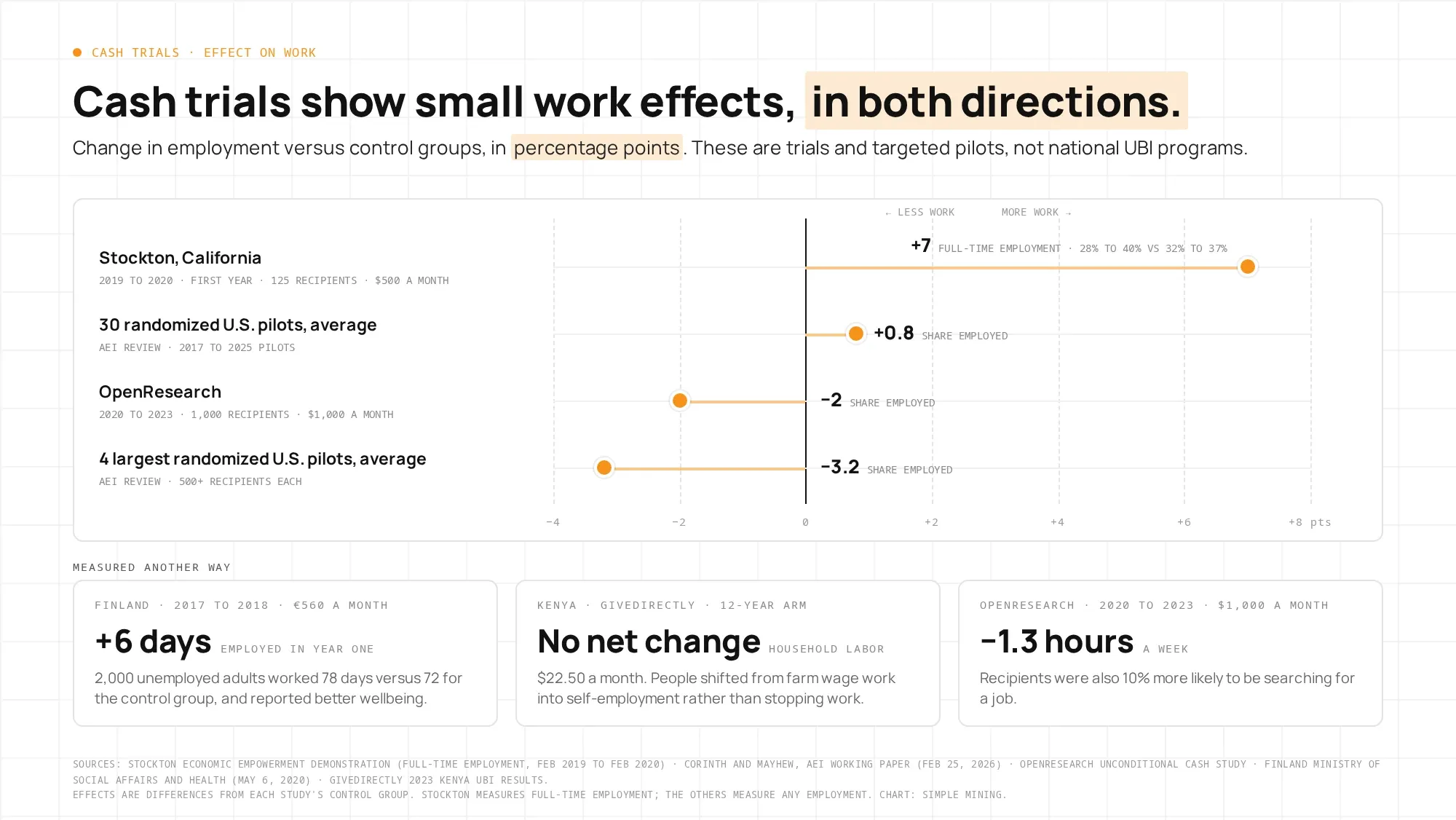
| Finland (2017 to 2018) | Government trial, 2,000 unemployed adults | €560 a month | Six more days employed than controls; better wellbeing |
| Kenya (2017 to present) | Nonprofit study by GiveDirectly, about 23,000 people | $22.50 a month for 12 years | No drop in total work; a shift from farm wage work into self-employment |
| Alaska (1982 to present) | Resource dividend for all residents | $1,200 in 2026 including $200 energy relief | Paid every year since 1982; amount set by the legislature |
| Stockton, California (2019 to 2021) | Guaranteed-income pilot, 125 residents | $500 a month | Full-time employment rose from 28% to 40% in the first year, versus 32% to 37% for controls |
| OpenResearch (2020 to 2023) | Randomized trial, 3,000 people in Illinois and Texas | $1,000 a month versus $50 for controls | Work fell 1.3 hours a week and employment fell 2 points |
| Switzerland (2016) | National referendum | CHF 2,500 a month proposed | Rejected 77% to 23% |
Two details get lost in summaries. The Finland result of six extra days worked came with a warning from researchers that a 2018 benefit reform makes the second year hard to read. The OpenResearch recipients worked less but were 10% more likely to be searching for a job, which points to pickier job choice rather than withdrawal.
Pros and Cons of Universal Basic Income
The strongest argument for UBI is simplicity, and the strongest argument against it is cost. The evidence from trials sits in between and supports neither side's confident claims. Here is the case each side makes.
Pros
- Income floor: Finland's recipients reported better financial wellbeing and mental health than the control group.
- Simpler than welfare: one payment replaces a stack of programs with different rules and cliffs.
- Room to find better work: OpenResearch recipients were 10% more likely to be searching for a job than the control group.
Cons
- Some work reduction: in the four largest U.S. pilots, employment fell 3.2 percentage points on average, an effect a February 2026 AEI working paper calls consistent with the academic literature.
- Inflation: this is contested. Musk argues AI output will outrun the new money. A May 2026 ILO research brief argued that AI cuts costs in software and digital goods while housing, care, and energy stay constrained, so new cash flows into the sectors least able to expand. Whoever receives new money first gains at the expense of those who receive it last, which is the Cantillon effect applied to a UBI.
- Work as meaning: a paycheck is also a schedule, a social circle, and a reason to build skill. Coinkite founder NVK argued on TFTC that removing the need to produce something the world values removes the drive that gives life meaning.
- Ownership: UBI does not change who owns the machines. A check from a government that taxes AI companies leaves the companies in charge of the capital, which is why the 2026 proposals shifted toward equity.
- Cost: $1.884 trillion a year at $500 a month, before any behavioral response.
Alternatives to Universal Basic Income
Four alternatives get serious attention, and each trades one of UBI's defining features for something else.
- Universal basic services: free public services such as health care, housing, transport, and information in place of cash. A 2017 report from the UCL Institute for Global Prosperity set out the case. It keeps the universal feature and drops the cash.
- Negative income tax: below an income threshold the tax system pays you instead of taxing you. It keeps the cash and drops the universal feature, since payments phase out with earnings.
- Job guarantee: government acts as employer of last resort at a living wage. It drops the unconditional feature and answers the work-as-meaning objection head on.
- Universal basic capital: citizens own a share of productive assets rather than receiving income from them. This is the idea behind the sovereign wealth fund proposals above and behind Amodei's universal capital accounts.
How to Prepare for AI Job Displacement
Whether or not UBI arrives, the practical response is the same: make your income less dependent on one employer and one skill. The four steps below run from cheapest to most capital-intensive.
1. Build Skills AI Complements
The jobs growing fastest in the WEF data combine technical fluency with human judgment. Learn to direct AI tools rather than compete with them, and pair that with a skill that requires presence: care, trades, negotiation, or teaching. McKinsey's November 2025 report found that more than 70% of skills employers ask for apply to both automatable and non-automatable work.
2. Diversify Income Sources
A single paycheck is a single point of failure. Add a second stream that does not rise and fall with your employer, whether that is contract work, a small business, or income from assets you own. The goal is not to replace a job but to make a job loss survivable.
3. Hold Scarce, Productive Assets
Assets that cannot be printed are not diluted when new money enters the system. Bitcoin's supply is capped at 21 million coins, and the question for most people is whether to mine or buy Bitcoin. Buying gives you the asset; mining gives you the asset plus an operating business with costs and revenue.
4. Bitcoin Mining
Bitcoin mining is a way to acquire Bitcoin through an operating business rather than a purchase. Revenue depends on Bitcoin price, network difficulty, machine uptime, and power cost, so it can rise or fall month to month. Hosting costs are known in advance; revenue is not. Simple Mining offers Bitcoin miner hosting in Iowa across 11 sites with 150+ MW under management and 9+ EH/s hosted. The hosting rate is a bundled service fee of $0.065 to $0.08 per kWh and average uptime runs 95%+. Before you commit, run your own numbers in our Bitcoin mining calculator, and if you want to see the dashboard first there is a 7-day free trial on an Antminer S21+ at 235 TH/s.
FAQs About Universal Basic Income and AI
Does any country have universal basic income?
No. No country pays a full national UBI that is universal, unconditional, individual, regular, and cash. Alaska pays an annual resource dividend to all residents, and Finland ran a two-year government trial for 2,000 unemployed adults. Switzerland rejected a national UBI by referendum in 2016.
What is universal high income?
Universal high income is Elon Musk's term for federal checks to people who lose work to AI. In an April 17, 2026 post he argued that AI and robotics will produce goods and services far in excess of the increase in the money supply, so the checks would not cause inflation.
How much would UBI cost in the US?
A $500 a month UBI for 314 million citizens and permanent residents costs about $1.884 trillion a year, according to a University of Chicago Law Review analysis. Consolidating existing cash transfer programs offsets about $354 billion. Andrew Yang's 2020 Freedom Dividend proposed $1,000 a month for every adult over 18.
Did people stop working in the OpenResearch study?
No. Recipients of $1,000 a month worked 1.3 fewer hours a week and were 2 percentage points less likely to be employed than the control group. They were also 10% more likely to be searching for a job, which the researchers read as more selective job choice rather than exit from work.
Is Bitcoin mining still profitable?
It can be, depending on Bitcoin price, network difficulty, your machine's efficiency, and your power cost. A miner at a hosting fee of $0.065 to $0.08 per kWh faces a different break-even than one paying residential rates.
Will AI Bring UBI? What Comes Next
The technology question is about how fast jobs shift, and the evidence says gradual: about 9% of U.S. workers over a decade on Goldman's estimate, with entry-level office work hit first. The UBI question is political. It asks who owns AI's gains and whether voters demand a share, and the 2026 answer from both OpenAI and Sanders is ownership stakes rather than checks. Watch the sovereign wealth fund bills, not the UBI bills.
Readers who would rather hold a piece of the machine economy than wait for a check can learn how to start Bitcoin mining first. Then buy Bitcoin miners from our inventory when the numbers work for your power cost and time horizon.