
AI Deflation: Why Cheaper Everything Collides With Debt
By Josh Heine, Content Strategist at Simple Mining
Published October 8, 2026
AI deflation is the idea that artificial intelligence will push the general price level down by making work, software, and services cheaper to produce. The cost of machine intelligence is falling fast, yet US consumer prices still rose 3.4% in the 12 months through August 2026. The harder question is what happens if AI deflation does arrive. A debt-based system carrying more than $40 trillion in federal debt cannot live with falling prices, so central banks are set up to fight them with new money. That collision matters more to Bitcoin holders and miners than the price of any chatbot.
On this page · 10 sections
- What Is AI Deflation?
- How AI Pushes Prices Down
- Is AI Deflationary Right Now?
- Why AI Deflation Collides With Debt
- Good Deflation vs. Bad Deflation
- What AI Cannot Make Cheaper
- What AI Deflation Means for Bitcoin
- What AI Deflation Means for Bitcoin Miners
- FAQs About AI Deflation
- Mine Bitcoin Where the Power Is Secured
Key Takeaways
- AI is not deflationary yet: US consumer prices rose 3.4% and the CPI for computers rose 8.4% in the 12 months through August 2026.
- The cost of AI at a fixed capability level falls about 10x a year on an a16z estimate from November 2024.
- Falling prices make each unpaid dollar of debt heavier, and federal debt held by the public sits at about 101% of GDP.
- The Fed targets 2% inflation and holds the tools to create it, so durable deflation is likely to meet new money.
- Power is the input AI cannot make cheaper, while Bitcoin mining hardware shows technological deflation at work: an Antminer S23 Hydro is about 10x as efficient as an S9.
What Is AI Deflation?
AI deflation is a sustained fall in the general price level driven by artificial intelligence lowering the cost to produce goods and services. The term borrows the standard definition, and the Cleveland Fed defines deflation as a sustained decline in the general price level. A cheaper laptop or a cheaper chatbot subscription is not deflation on its own. Deflation means the whole basket of goods and services gets cheaper over time.
Deflation vs disinflation is the distinction most AI forecasts blur. Disinflation is a slowdown in the inflation rate, with prices still rising. Deflation is prices falling. Read every AI forecast with that line in mind, because some predict slower inflation and others predict falling prices.
How AI Pushes Prices Down
AI pushes prices down by cutting the cost of tasks that used to require paid human hours, from writing code to answering customer questions. Three forces drive it: the falling price of machine intelligence, the economics of software, and a long record of technology lowering prices.
The Cost of Intelligence Is Falling
The price of running an AI model at a given level of capability falls by multiples every year. In November 2024 a16z partner Guido Appenzeller estimated that the cost of LLM inference falls about 10x a year for a model of equivalent performance. Epoch AI found in March 2025 that LLM prices fell between 9x and 900x a year depending on the performance level. The rate depends on what you measure, but every estimate points the same way.
Inference is the work a model does each time it answers a prompt. When that work gets 10x cheaper, every product built on it can cut its price or widen its margin. That falling cost of AI is the engine behind most AI deflation forecasts.
Software Scales at Near-Zero Marginal Cost
Software is expensive to build and close to free to copy. Once a model is trained, serving one more user adds compute and power but no new factory. Digital goods tend to fall in price as they scale for that reason. AI extends the pattern from apps to tasks such as drafting a contract, writing code, or sorting invoices.
The limit is physical. Every answer still runs on a chip inside a building connected to the grid. That chip and that grid connection do not get cheaper at software speed.
Technology Has Done This Before
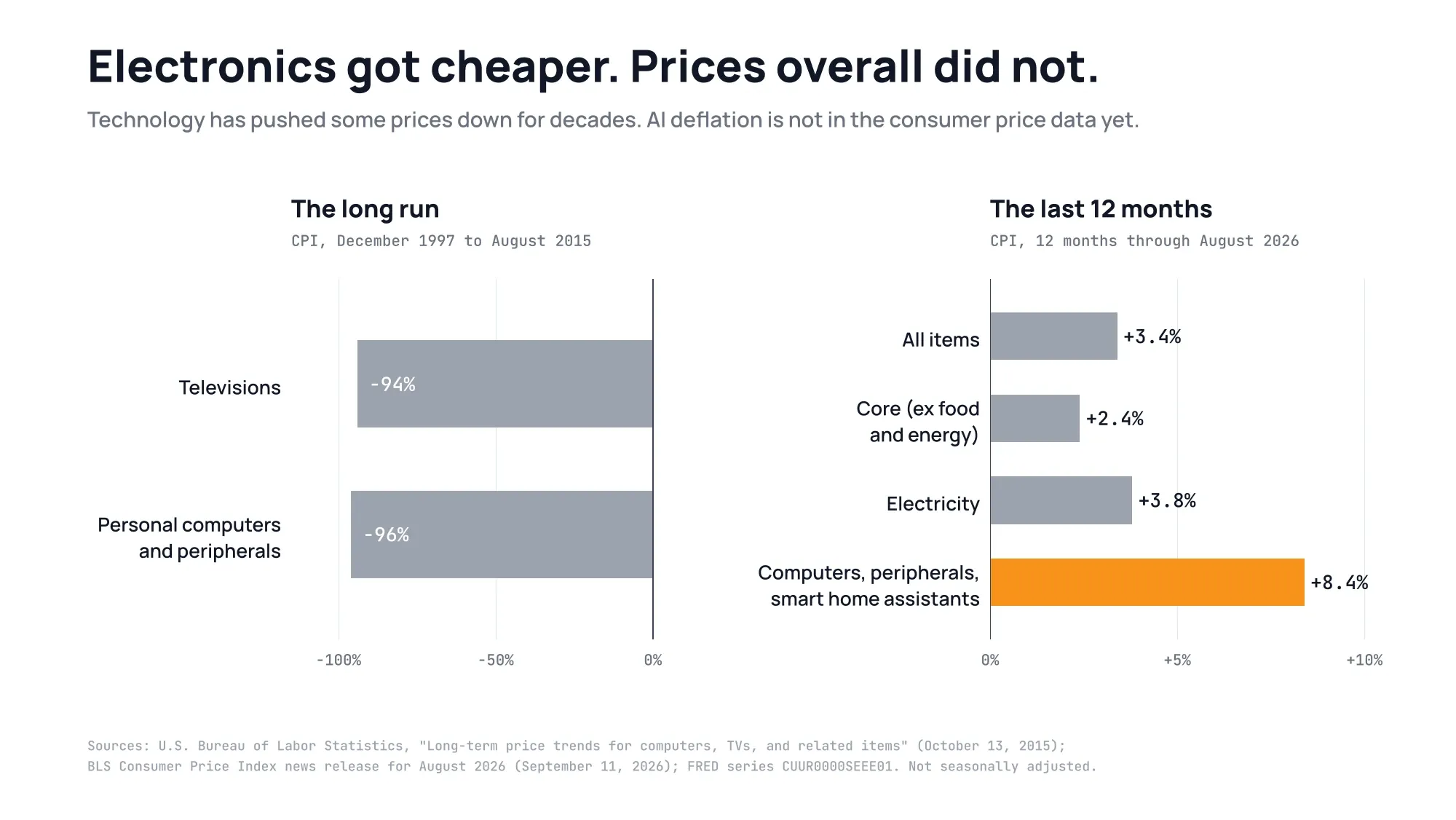
Technological deflation is the long-run fall in prices that comes from making things better and cheaper to produce. Consumer electronics are the clearest case on record. The CPI for televisions fell 94% from December 1997 to August 2015, according to the Bureau of Labor Statistics. Personal computers and peripherals fell 96% over the same stretch.
Those declines did not make the US economy deflationary. Over the same period the overall price level still rose. AI faces the same test: cheaper software does not lower the price of the things AI cannot produce.
Is AI Deflationary Right Now?
No, AI is not deflationary right now. US consumer prices rose 3.4% in the 12 months through August 2026 and core CPI rose 2.4%, according to Bureau of Labor Statistics CPI data. Electricity rose 3.8% over the same period. Even the CPI index for computers rose 8.4%, which runs against the long trend in electronics.
The Fed is not treating the moment as deflationary either. On September 16, 2026 the Fed raised its target range by a quarter point to 3.75% to 4.00%. Central banks raise rates to cool inflation, not to fight falling prices.
Building AI pushes some prices up before it pushes others down. Chips, power, and construction all feed the build-out. Northern Trust's June 24, 2026 analysis put it this way: "AI may still prove disinflationary over time, but investors should prepare for the inflationary cost of building it first." The split between the two camps comes down to timing: the build-out raises prices now, and cheaper cognitive work is the slower force.
The forecasts of AI deflation come from the people building AI and from Wall Street. Sam Altman said during an OpenAI town hall livestream on January 26, 2026 that AI will bring massive deflationary pressure. Elon Musk wrote on X in April 2026 that AI and robotics will produce goods and services far in excess of the increase in the money supply, so there will not be inflation. The same post called for federal universal high income checks, which ties the forecast to the debate over universal basic income and AI.
Citi warned clients in February 2026 that AI implementation would lead to higher unemployment and deflation. These are forecasts. The data through August 2026 still show cheaper intelligence inside a rising price level.
Why AI Deflation Collides With Debt
AI deflation collides with debt because falling prices raise the real burden of every loan written in dollars. Wages, profits, and tax receipts can shrink in dollar terms while the debt stays fixed. A modern economy runs on that debt, from mortgages to Treasury bonds.
Falling Prices Make Debt Heavier
Debt deflation is the spiral that starts when falling prices raise the real value of debt and borrowers cut spending to pay it down. Irving Fisher laid it out in his 1933 paper on debt deflation: "Each dollar of debt still unpaid becomes a bigger dollar." His sharpest line was "The more the debtors pay, the more they owe."
Here is the logic in plain terms. A borrower owes a fixed number of dollars. When prices and wages fall, each of those dollars takes more work to earn. Selling assets to raise cash pushes prices down further, which makes the remaining debt heavier still.
Federal Debt Sits Near Its 1946 Peak
US gross federal debt is more than $40 trillion. The CBO puts debt held by the public at about 101% of GDP this year, close to the 1946 record of 106%. The Congressional Budget Office projects that ratio rises to 120% in 2036.
Interest is the line to watch. Net interest reached $1,017 billion in fiscal 2026 through August, and the CBO projects about $2.1 trillion in 2036. The spending and deficits behind those numbers are the core of the US debt crisis.
A government carrying that load needs nominal GDP and tax receipts to keep growing. Deflation shrinks both while the debt stays the same size in dollars. That is the collision in the title.
Why Central Banks Fight Deflation
Central banks fight deflation because they target positive inflation and hold the tools to create it. The Fed targets 2% inflation measured by the PCE price index. Ben Bernanke made the point in a November 21, 2002 speech to the National Economists Club: "a determined government can always generate higher spending and hence positive inflation." He was describing the printing press.
The modern tool is quantitative easing, where the central bank buys bonds with bank reserves it creates. New money reaches banks and asset owners before it reaches wages, which is the Cantillon effect at work.
The likely result is a tug of war, and the two sides are not an even match. Macro analyst Lyn Alden put it this way: "AI has finite deflationary effects whereas fiat has no upper limit on its ability to offset said deflation." AI can only replace so much paid work, while money creation has no ceiling. Savers who hold dollars feel the dilution.
That is why AI deflation may never show up as falling prices. With the Fed steering the price level up about 2% a year, cheaper work shows up instead as the extra credit needed to stay on that path. Bitcoin analyst Joe Burnett argues that this credit reaches scarce assets first, the Cantillon effect in another form.
Good Deflation vs. Bad Deflation
Good deflation comes from rising productivity, while bad deflation comes from falling demand and heavy debt. The difference shows up in output and in what happens to borrowers.
Bordo, Landon Lane, and Redish found in a 2004 NBER paper that late-1800s deflation in the US, UK, and Germany was good for the most part. Productivity drove it. The US from 1929 to 1933 is the opposite case, with consumer prices down about 25% over those four years. Japan shows a slower version: its mild deflation began in the late 1990s and lasted about 15 years.
| Factor | Good Deflation | Bad Deflation |
|---|---|---|
| Cause | Productivity gains lower the cost to produce | Falling demand and debt repayment shrink spending |
| Output | Grows as each worker produces more | Stalls or shrinks as spending falls |
| Debtors | Real debt rises, but growing output helps carry it | Real debt rises as incomes fall |
| Historical example | US, UK, and Germany in the late 1800s | US from 1929 to 1933 (prices down about 25%); Japan from the late 1990s (about 15 years) |
| Where AI deflation would sit | Cheaper inference and software raise output per worker | Falling prices meet more than $40 trillion in federal debt |
AI deflation would start as the good kind. The risk is that it lands on a balance sheet built for the bad kind. That mismatch is why the Fed is likely to step in before falling prices take hold.
What AI Cannot Make Cheaper
AI has not made electricity cheaper, and it needs more of it every year. Electricity prices rose 3.8% in the 12 months through August 2026, faster than the 3.4% rise in headline CPI. Data centers used about 4.4% of US electricity in 2023, according to a Department of Energy report on data center demand. Berkeley Lab projects that share reaches 6.7% to 12% by 2028.
The buildings matter as much as the power. AI data centers turn electricity into computation, and they compete with every other large load for grid access. New supply is slow to arrive. Power plants built in 2023 took a median 5 years from interconnection request to commercial operation.
That timeline is why secured power has become an asset of its own. Miners and AI data centers end up competing for the same place in the interconnection queue, not only for cheap electricity. When we evaluate any site, the first question is the power contract and the second is how long until it's energized. A chip gets cheaper every generation, but a megawatt connected to the grid does not.
What AI Deflation Means for Bitcoin
AI deflation matters for Bitcoin because the likely response to falling prices is more money, and Bitcoin's supply does not respond to money creation. Bitcoin's supply is capped at 21 million. New supply shrinks at each Bitcoin halving, which arrives every 210,000 blocks. The April 2024 halving at block 840,000 cut the block subsidy to 3.125 BTC.
Jeff Booth made the technology half of the argument in The Price of Tomorrow, published in January 2020. His book argues that technology is a powerful deflationary force. He restated the case in January 2026: "The gap between natural deflation (thanks to technology) and forced inflation (from central banks) is the greatest wealth transfer in history." TFTC covered Jeff Booth discussing Bitcoin on the Stephan Livera Podcast in April 2024.
Bitcoin holders take the argument one step further. They argue that if technology keeps pushing prices down while central banks create money to push them back up, the gains from productivity flow to holders of scarce assets. A fixed supply of 21 million is the scarcest version of that idea. Swan CEO Cory Klippsten makes the point that more compute and more intelligence do not change Bitcoin's issuance schedule. Buying hard assets to step outside new money is known as the debasement trade.
The same logic reaches stocks. If AI pushes the price of services toward zero, the revenue of companies selling those services falls with it. That is a risk for equities priced on growth, and it is a step most of the AI deflation debate skips.
None of this is a price forecast. It describes an argument Bitcoin holders make, and the outcome depends on how central banks respond.
What AI Deflation Means for Bitcoin Miners
For Bitcoin miners, AI deflation already shows up in the hardware and has not reached the power bill. The 2016 Antminer S9 ran 13.5 TH/s on 1,323 W, about 98 J/TH. The Antminer S23 Hydro runs 563 TH/s on 5,349 W, about 9.5 J/TH. That is about 10x the efficiency for each terahash, a textbook case of technological deflation.
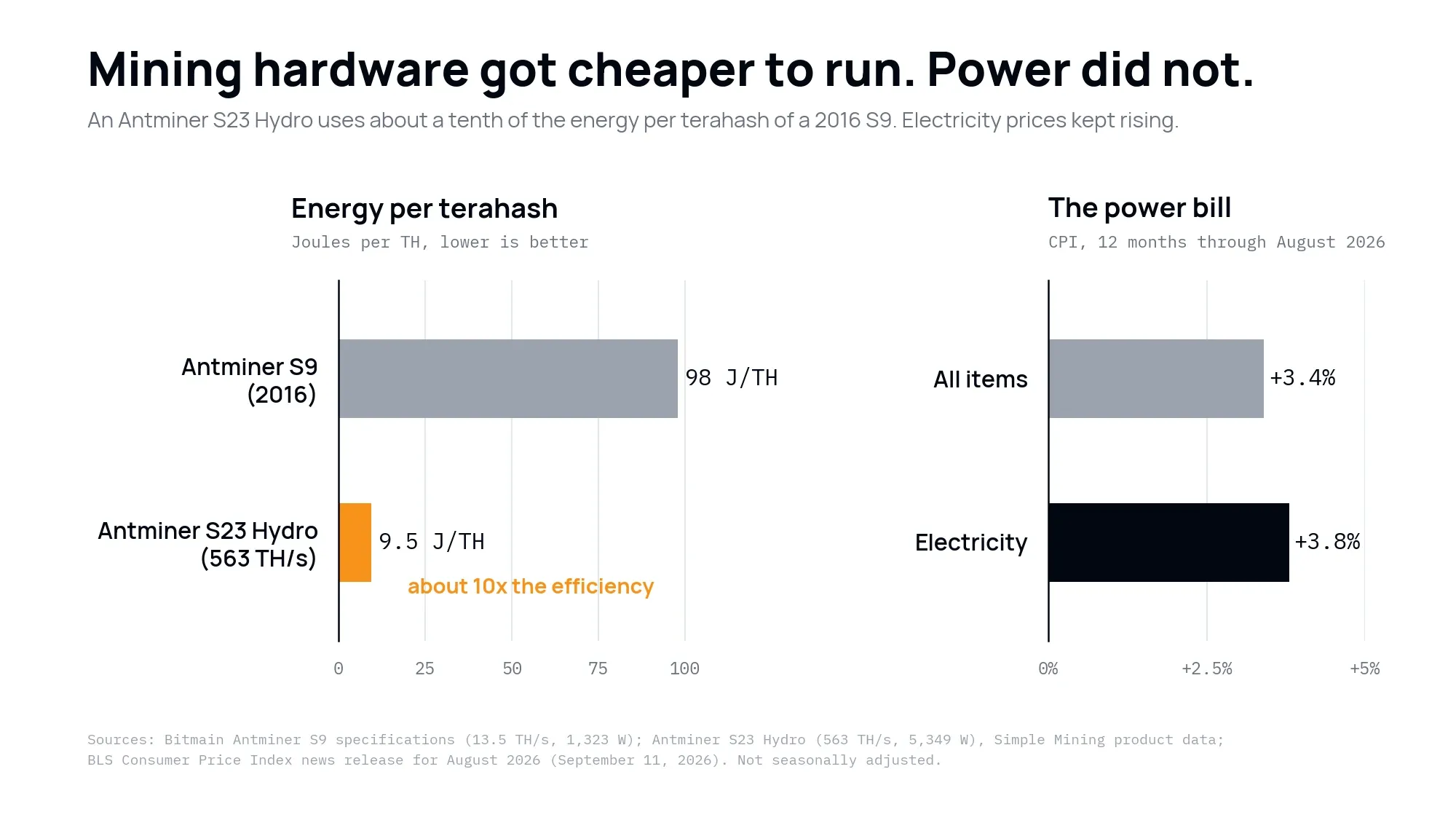
Electricity has not followed the hardware down. Power is the binding input in mining, and AI data centers now compete with miners for the same megawatts. When revenue per terahash falls, the least efficient machines are the first to go dark. Revenue still moves with Bitcoin price, network difficulty, and uptime. The math changes from month to month.
Here is what we watch on every machine we host:
- Power price: the all-in rate per kWh sets the floor under the cost to produce Bitcoin.
- Efficiency per TH: joules per terahash decide which machines keep running when revenue per TH falls.
- Grid access: a site without an energized connection mines nothing, however efficient the fleet.
Simple Mining manages 9+ EH/s with 150+ MW of power capacity at 11 sites across Iowa. We're headquartered in Cedar Falls and run at 95% average uptime. Bitcoin miner hosting in Iowa carries an all-in service fee of $0.065 to 0.08 per kWh. You can buy Bitcoin miners from our inventory and host them where the power is already in place.
FAQs About AI Deflation
Will AI cause deflation?
AI is not causing deflation yet. US consumer prices rose 3.4% in the 12 months through August 2026 even as estimates put the fall in LLM inference costs at about 10x a year. If AI does push the price level down, the Fed targets 2% inflation and is likely to answer with new money.
Is AI deflation good or bad?
It depends on the cause and on the debt it meets. Productivity-driven deflation in the late 1800s was good for the most part, while the debt deflation of 1929 to 1933 cut US consumer prices about 25%. AI deflation would start as the productivity kind but would land on more than $40 trillion in federal debt.
How does deflation affect debt?
Deflation makes debt heavier because the debt stays fixed in dollars while prices and incomes fall. Irving Fisher wrote in 1933 that each dollar of debt still unpaid becomes a bigger dollar. Borrowers who cut spending to repay push prices down further, which is the spiral known as debt deflation.
Can the Fed stop AI deflation?
The Fed has the tools to fight deflation and a 2% inflation target measured by the PCE price index. Ben Bernanke argued in 2002 that a government with a printing press can always generate inflation. The Fed can cut rates and buy bonds with reserves it creates, which pushes prices back up and dilutes the dollar.
Mine Bitcoin Where the Power Is Secured
AI lowers the cost of intelligence, but it does not lower the cost of a megawatt. The debt system answers falling prices with new money, and Bitcoin's fixed supply sits outside that loop. Miners sit where those two forces meet: efficient hardware on one side and scarce power on the other.
If you want to watch an efficient miner run before you buy, start with a 7-day free trial on an Antminer S21+ at 235 TH/s. You can follow its hashrate in the client dashboard before you decide on hardware.