
QE vs QT: Quantitative Easing vs Tightening Explained
By Josh Heine, Content Strategist at Simple Mining
Published September 25, 2026
Quantitative easing vs tightening comes down to one question: is the Fed adding bank reserves or draining them? Under QE the Fed buys longer-term bonds and pays for them by creating reserves. Under QT it lets those bonds mature and does not replace them. The choice moves long-term yields, the dollar, and the risk appetite that drives Bitcoin. Right now the Fed is doing neither, and that matters for how you read its next move.
On this page · 13 sections
- What Is Quantitative Easing?
- How Quantitative Easing Works
- What Is Quantitative Tightening?
- How Quantitative Tightening Works
- Quantitative Easing vs Tightening: Key Differences
- How QE and QT Affect the Economy
- How QE and QT Affect Bitcoin
- Historical Examples of QE and QT
- Is the Fed Doing QE or QT Right Now?
- Why Quantitative Easing Is Controversial
- What QE and QT Mean for Bitcoin Miners
- FAQs About Quantitative Easing and Tightening
- Start Mining Through Any Fed Cycle
Key Takeaways
- QE is the Fed buying longer-term Treasuries and mortgage-backed securities with bank reserves it creates on the spot.
- QT is the Fed letting those bonds mature without replacing them. It has never sold Treasuries or MBS outright during a QT program.
- QE lowered the 10-year Treasury yield by an estimated 80 to 120 basis points across the 2008 to 2014 programs. Fed staff model $2.5 trillion of runoff as a little more than 50 basis points of rate hikes.
- Bitcoin's biggest run lined up with pandemic QE, yet it finished higher over both full QT windows.
- The Fed ended QT on December 1, 2025 and has made no reserve purchases since mid-August 2026. It is running neither program today.
What Is Quantitative Easing?
Quantitative easing is the Fed buying large amounts of longer-term Treasury and agency mortgage-backed securities to push long-term interest rates down when the short-term policy rate is already near zero. The Fed's own description of its 2008 to 2014 programs says the purchases were made "with the goal of putting downward pressure on longer-term interest rates." The Fed pays for the bonds by crediting bank reserve accounts it creates on the spot. The result is a bigger Fed balance sheet and a banking system holding far more reserves than it needs.
QE is a tool for the zero bound. Once the federal funds rate hits zero the Fed cannot cut it further, so it targets the longer end of the curve instead.
How Quantitative Easing Works
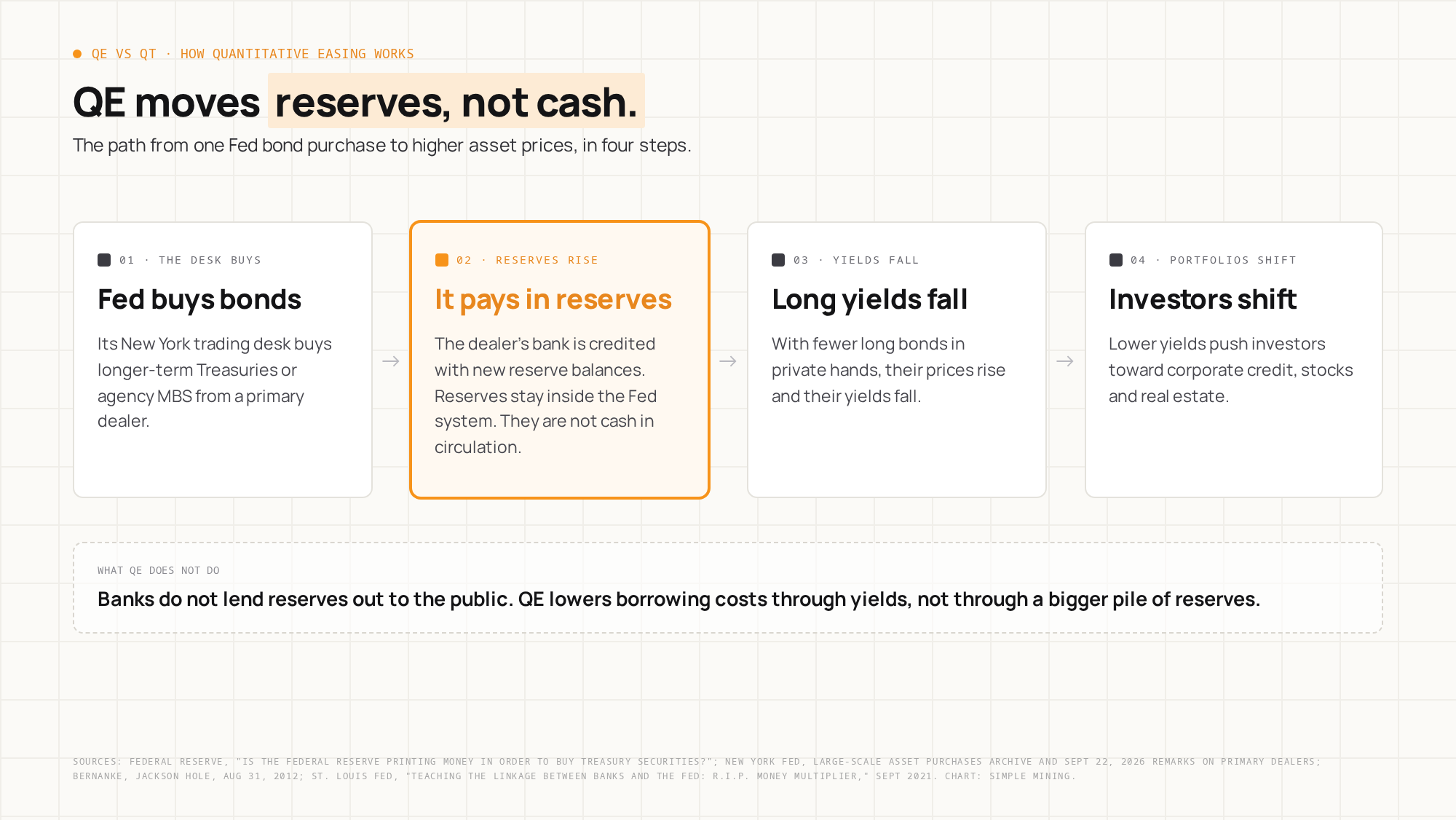
QE works in four steps that run in one direction: the Fed buys, reserves rise, long yields fall, and money moves into riskier assets. Each step has a specific mechanism and a specific place where the popular version goes wrong.
The Fed Buys Bonds From Primary Dealers
The New York Fed's trading desk buys bonds in the secondary market from primary dealers, not from commercial banks as a group. The ultimate seller behind a dealer can be a bank, a pension fund, an asset manager, or a foreign central bank. The Fed pays by crediting the reserve account of the dealer's bank.
Bank Reserves Increase
Every dollar of bonds the Fed buys becomes a dollar of reserves on the other side of its balance sheet. Reserves are deposits banks hold at the Fed, and only banks can hold them. The banking system as a whole cannot get rid of them; it can only pass them around.
Long-Term Yields Fall
The Fed takes duration out of the market, so investors bid up the remaining longer-term bonds and their yields fall. Ben Bernanke told the Jackson Hole conference in 2012 that studies put the combined effect of the Fed's purchase programs at 80 to 120 basis points off the 10-year Treasury yield. Banks do not lend more because they hold more reserves; they lend more because borrowing got cheaper and the outlook improved.
Asset Prices Respond
With Treasury yields pinned lower, investors who need a return move into corporate credit, equities, and real estate, a shift economists call the portfolio balance channel. Bernanke's 2012 review said the purchases "appear to have boosted stock prices" by lowering discount rates and improving the economic outlook. Note the wording: appear to have, not guaranteed to.
What Is Quantitative Tightening?
Quantitative tightening is the Fed shrinking its bond holdings by letting securities mature without reinvesting the proceeds. The Fed does not use the term QT in its own documents. It calls the process balance sheet reduction or runoff, done "by adjusting the amounts reinvested" of the principal it receives each month. The point is to remove accommodation and let term premiums rebuild, not to shrink the money supply.
QT is the mirror of QE in direction but not in speed. Purchases can be sized at will while runoff is capped by how much debt matures in a given month.
How Quantitative Tightening Works
QT reverses the four QE steps: the Fed stops replacing maturing bonds, reserves fall, term premiums rise, and asset prices adjust to a market with less support. The mechanics are subtler than "the Fed sells bonds," and the difference matters for reading the Fed's statements.
The Fed Lets Bonds Mature Without Replacing Them
Runoff works through caps set each month on how much maturing principal the Fed declines to reinvest. Anything above the cap gets rolled into new securities and anything below it leaves the balance sheet for good. In principle the Fed could sell bonds outright, but it has never sold Treasuries or MBS during either QT program.
Bank Reserves Decrease
Nobody buys bonds from the Fed during runoff. When a Treasury matures the Treasury Department repays the Fed from its account at the Fed and refinances that debt by selling new bonds to private investors. Those investors pay from their bank accounts, so bank deposits and bank reserves fall by the same amount.
Term Premiums Rise
The Fed's exit from the market puts duration back into private hands, and investors demand extra yield to hold it. Fed staff modeled this in a 2022 note: shrinking the balance sheet by about $2.5 trillion works out to a little more than 50 basis points of policy rate hikes on a sustained basis. Treat that as a model estimate rather than a measured result.
Asset Prices Adjust
In theory higher term premiums raise discount rates and pull money back toward safer assets. In practice the effect on stocks and Bitcoin is hard to isolate. Both QT programs overlapped with rate hiking cycles, so no study separates the two.
Quantitative Easing vs Tightening: Key Differences
The core difference between quantitative easing vs tightening is the direction of the Fed's balance sheet and of the bank reserves that sit on the other side of it.
| Factor | Quantitative Easing | Quantitative Tightening |
|---|---|---|
| What the Fed does | Buys longer-term Treasuries and agency MBS from primary dealers | Lets maturing bonds run off under caps set each month |
| Balance sheet | Expands as fast as the Fed chooses to buy | Shrinks only as fast as debt matures |
| Bank reserves | Rise one for one with purchases | Fall as the Treasury refinances with private buyers |
| Long-term yields | Fall; an estimated 80 to 120 basis points across 2008 to 2014 | Rise through term premiums; $2.5 trillion of runoff modeled as 50-plus basis points |
| Typical market backdrop | Policy rate at zero, credit stressed, risk appetite rebuilding | Policy rate rising, inflation above target, liquidity thinning |
How QE and QT Affect the Economy
- Interest rates: QE pushes long-term yields down and QT lets them rise. The best-documented effect is Bernanke's 80 to 120 basis point estimate on the 10-year yield.
- Inflation: QE can add to inflation pressure if left in place too long. Whether it drove the 2021 to 2022 inflation is disputed, and Bernanke and Olivier Blanchard found that most of the initial surge came from price shocks rather than an overheated labor market.
- Stocks and bonds: QE lifts bond prices and appears to have lifted stocks. QT reverses the bond side and likely weighs on stocks, though rate hikes ran alongside both QT programs and muddy the reading.
- The dollar: QE has tended to weaken the dollar by pulling U.S. yields below foreign yields. QT's effect is harder to separate from rate hikes, since the dollar rose in 2022 while both were happening.
How QE and QT Affect Bitcoin
Bitcoin often trades like a risk asset that feeds on Fed liquidity, but the record is messier than that story. Every Fed cycle since 2010 has a Bitcoin chapter, and the chapters do not all point the same way.
- Pandemic QE: Bitcoin's biggest run coincided with the 2020 to 2022 purchase program and peaked in November 2021, four months before the Fed stopped buying.
- Early QT: Its biggest drawdowns began in the first year of each QT cycle, through 2018 and through the first half of 2022.
- Full QT windows: Over both complete QT programs Bitcoin finished higher than it started, and it set a record high in October 2025 while QT was still running.
- The 2026 reserve purchases: Bitcoin fell during the first half of the Fed's 2026 reserve management purchases even as the balance sheet grew.
Liquidity matters at the margin, but it does not explain Bitcoin's cycles by itself. That is the case for the debasement trade: the bet is on money creation over decades, not on which month the Fed buys bills.
Historical Examples of QE and QT
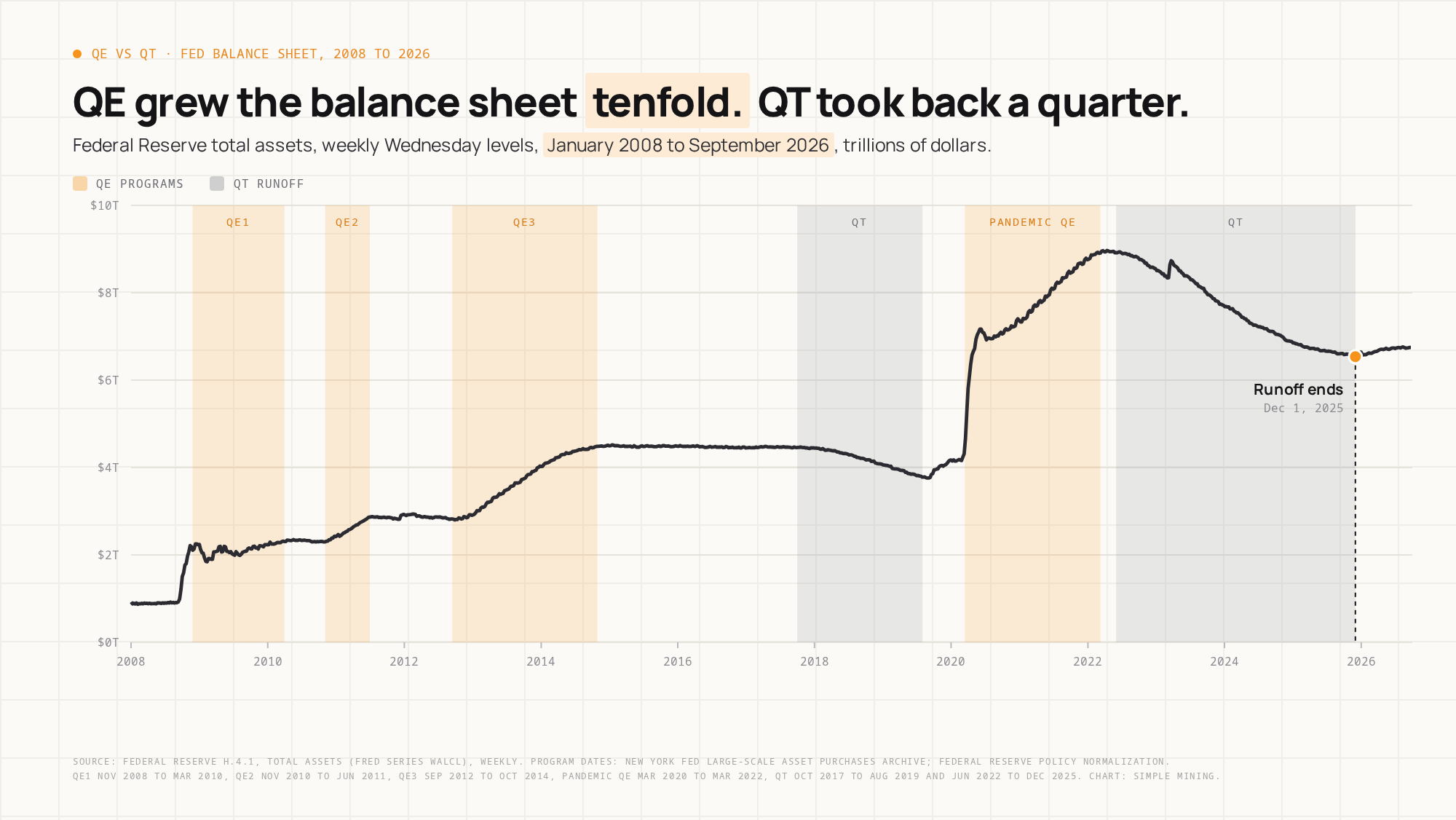
- QE after 2008: The Fed ran three purchase programs from November 2008 to October 2014, known as QE1, QE2, and QE3. The New York Fed's archive of its large-scale asset purchases lays out each round. Across the three the balance sheet grew from about $900 billion before the crisis to about $4.5 trillion.
- Pandemic QE from 2020 to 2022: The Fed launched open-ended purchases in March 2020 and settled into $80 billion a month of Treasuries plus $40 billion of MBS from June 2020. Purchases ended in early March 2022 and the balance sheet peaked at $8.97 trillion on April 13, 2022.
- QT from 2017 to 2019: The first runoff started in October 2017 with caps that stepped up to $30 billion a month for Treasuries and $20 billion for MBS. It ended two months early on August 1, 2019 because reserves were nearing the level the Fed wanted rather than because of market volatility. Repo rates spiked six weeks later in September 2019 and the Fed was buying bills again by October.
- QT from 2022 to 2025: The second runoff started on June 1, 2022 with caps that rose to $60 billion a month for Treasuries and $35 billion for MBS before slowing in June 2024 and again in April 2025. The Fed's policy normalization page records the end on December 1, 2025 as reserves approached ample levels. Total runoff came to more than $2.2 trillion.
Is the Fed Doing QE or QT Right Now?
As of September 2026, the Fed is doing neither. The Fed ended quantitative tightening on December 1, 2025. It began reserve management purchases of Treasury bills on December 12, 2025 at about $40 billion a month, stepped them down through the spring, and has made none since mid-August 2026. The Fed says these purchases exist to keep bank reserves ample and are not QE.
The New York Fed still reinvests principal from maturing mortgage bonds into Treasury bills, so the mix shifts toward Treasuries while the total holds. The New York Fed's operational details page posts the plan for each month on or around the ninth business day. The Fed's H.4.1 release each Thursday shows what the balance sheet did the week before.
Watch those two pages rather than the headlines. A restart of bill purchases would be a technical move, while a return to longer-term bond buying would be QE in all but name. That difference decides whether the US debt crisis gets financed by the market or by the Fed.
Why Quantitative Easing Is Controversial
- Wealth inequality: Critics argue that QE lifts the price of assets the wealthy already own while wage earners wait for growth to trickle down. That argument is a modern version of the Cantillon effect.
- Inflation risk: The Fed's own FAQ warns that high reserves and low rates held for too long can build inflation pressure. The 2021 to 2022 inflation keeps that debate alive even though its causes are disputed.
- Reach for yield: The Fed names this risk itself. Bernanke warned in 2012 that pinning long yields low "could induce an imprudent reach for yield by some investors" and threaten financial stability.
What QE and QT Mean for Bitcoin Miners
Fed cycles show up in a miner's spreadsheet as revenue per terahash and as the cost of capital for new machines. The last QE cycle lined up with record mining margins in 2021. The first year of QT lined up with a record-low hashprice in November 2022. Difficulty and halvings move margins more than the Fed does. Margins recovered through 2023 while QT kept running.
A macro view helps with sizing a fleet but it is not a timing signal. That is why the best time to buy a Bitcoin miner depends more on hardware prices and hashprice than on FOMC dates.
Simple Mining offers Bitcoin mining hosting at a bundled hosting service fee of $0.065 to $0.08 per kWh across 11 Iowa data centers with 150+ MW under management and 9+ EH/s hosted. Precision billing means you pay for actual consumption, not flat estimates. The Pause Period lets you stop mining during market volatility without losing your hosting slot, with one pause and restart allowed per calendar month. Average uptime runs 95%+.
Readers adding capacity can buy the Bitcoin miners for sale in our inventory with hosting bundled, so new hashrate comes online without a site build.
FAQs About Quantitative Easing and Tightening
How is QE different from printing money?
QE creates bank reserves rather than currency. Reserves stay inside the Fed's system and move between banks, and they reach the public only when a customer withdraws cash. The Fed's asset purchases did not change the amount of currency in circulation in any meaningful way, though deposits held by nonbank sellers can rise.
Does quantitative tightening cause a recession?
Neither QT program caused one. The 2020 recession came from the pandemic, not from the runoff that ended in 2019. QT's failure mode has been money market stress instead: the September 2019 repo spike and the funding pressure in late 2025 that pushed the Fed to end runoff.
How long does a QE or QT cycle last?
Anywhere from eight months to three and a half years. QE2 ran eight months and QE3 ran about two years, while the 2022 to 2025 runoff lasted 42 months. Cycles end when reserves reach the Fed's target or a crisis forces a restart, not on a schedule.
What is the difference between QE and open market operations?
QE is an open market operation done at scale in longer-term securities. Routine operations are small and short-dated and exist to keep the funds rate in its target range. QE buys hundreds of billions of dollars of long bonds to move yields years out on the curve.
Can the Fed do QE and QT at the same time?
Not as policy stances. It has run offsetting trades though: Operation Twist in 2011 and 2012 bought long Treasuries and sold short ones with the balance sheet held flat. Since December 2025 the Fed has let mortgage bonds run off while buying Treasury bills with the proceeds, which shrinks one holding and grows another.
Start Mining Through Any Fed Cycle
The Fed will buy again and it will shrink again, and a miner with a predictable hosting fee and the option to pause can operate through both. Start with a 7-day free trial on an Antminer S21+ at 235 TH/s and watch a real machine hash in our Iowa data center before you commit capital.