

When Is the Best Time to Buy a Miner?
By Josh Heine, Content Strategist at Simple Mining
Updated July 7, 2026Published November 2, 2024
The best time to buy a Bitcoin miner is when hashprice sits near cycle lows and miners are capitulating. Hardware is cheapest at that point and earns the most once Bitcoin's price rises faster than network difficulty. Most buyers do the opposite and pay peak prices at the top of a bull run. This guide shows how to read hashprice and difficulty and the Puell Multiple and the halving calendar before you deploy capital.
On this page · 12 sections
- Why Does Miner Purchase Timing Matter?
- How Do Bitcoin Price Cycles Affect Miner Prices?
- Use Hashprice and the Puell Multiple to Time Your Entry
- Why Price Outrunning Difficulty Is the Real Signal
- Should You Buy Before or After a Bitcoin Halving?
- How Do New ASIC Releases Affect Hardware Prices?
- How Hosting and Electricity Costs Shape Your Timing
- Key Factors That Signal the Right Time to Buy
- Is Now a Good Time to Buy a Bitcoin Miner?
- Smart Strategies for First-Time Miners
- FAQs
- Buy Smarter and Start Mining Sooner
Key Takeaways
- Hashprice is the single best indicator for timing an ASIC purchase, and the best entries in past cycles formed near multi-year hashprice lows
- Difficulty is the denominator of mining revenue; rising difficulty means less Bitcoin per terahash while flat or falling difficulty signals capitulation
- ASIC prices follow hashprice with a lag, so hardware stays cheap for a window after profitability bottoms
- Halvings reward efficient rigs rather than a calendar date, and there is no reliable hardware price rise into a halving
- Good timing still fails without a low power cost, which is why hosting rates shape break-even as much as purchase price
Why Does Miner Purchase Timing Matter?
Purchase timing sets your cost basis and shapes every month of mining that follows. An ASIC is a purpose built machine that does one job, which is hashing Bitcoin. New units cost thousands of dollars and depreciate on a schedule the market sets. Operational skill cannot recover an entry made at the top. Market cycles and halving timing and hardware release schedules all move prices, so a buyer who understands those forces pays less for the same terahash.
How Do Bitcoin Price Cycles Affect Miner Prices?
ASIC prices track Bitcoin price because a miner is valued on the cash flow it produces. A rig is a claim on future hashprice. When Bitcoin rallies, expected revenue per terahash rises and hardware reprices upward. When Bitcoin falls, the same machine earns less and its price follows. Our breakdown of Bitcoin price vs hashrate covers the mechanic in depth.
Bear Market Buying Opportunities
Hardware prices drop hardest when Bitcoin price falls and sentiment turns negative. One early tell is a sustained run of redemptions on the spot ETFs, which you can watch in the daily net flow record for every US spot Bitcoin ETF. Demand thins out and distressed operators sell inventory to raise cash. Patient buyers get the same terahash at a fraction of bull market cost. The best deals appear when the fewest people want them.
Bull Market Premium Pricing
Rising Bitcoin prices create hardware scarcity and premium pricing. Buyers in November 2021 paid about $11,000 for an S19 class unit at $119 per terahash. Hashrate Index later measured expected payback stretching from 13 months past 100 months for those peak purchases. FOMO is the most expensive emotion in mining.
Historical Price Patterns Worth Tracking
Three patterns repeat across every cycle:
- Hardware demand: rises and falls with Bitcoin price movements
- Resale market: used units flood the market during downturns as weak operators exit
- Manufacturer pricing: new models launch at a premium during bull runs
Use Hashprice and the Puell Multiple to Time Your Entry
Hashprice is the single best indicator of when to buy a miner. Hashprice measures the market value of one petahash of computing power per day. It combines four inputs, which are Bitcoin price, network difficulty, transaction fees, and the block subsidy. Price and fees push it up while difficulty pushes it down. Track it on the live Luxor Hashprice Index; the best entries in past cycles formed near multi-year lows.
Low hashprice means cheap hardware. ASIC prices follow hashprice with a lag, and Luxor found a near perfect correlation between Bitcoin price and Antminer S19 prices during the 2021 run. Machine prices took months to reprice after hashprice fell. That lag creates a real window. Hardware stays cheap for a stretch after mining profitability bottoms, and the buyers who act inside it own the cheapest terahash of the cycle.
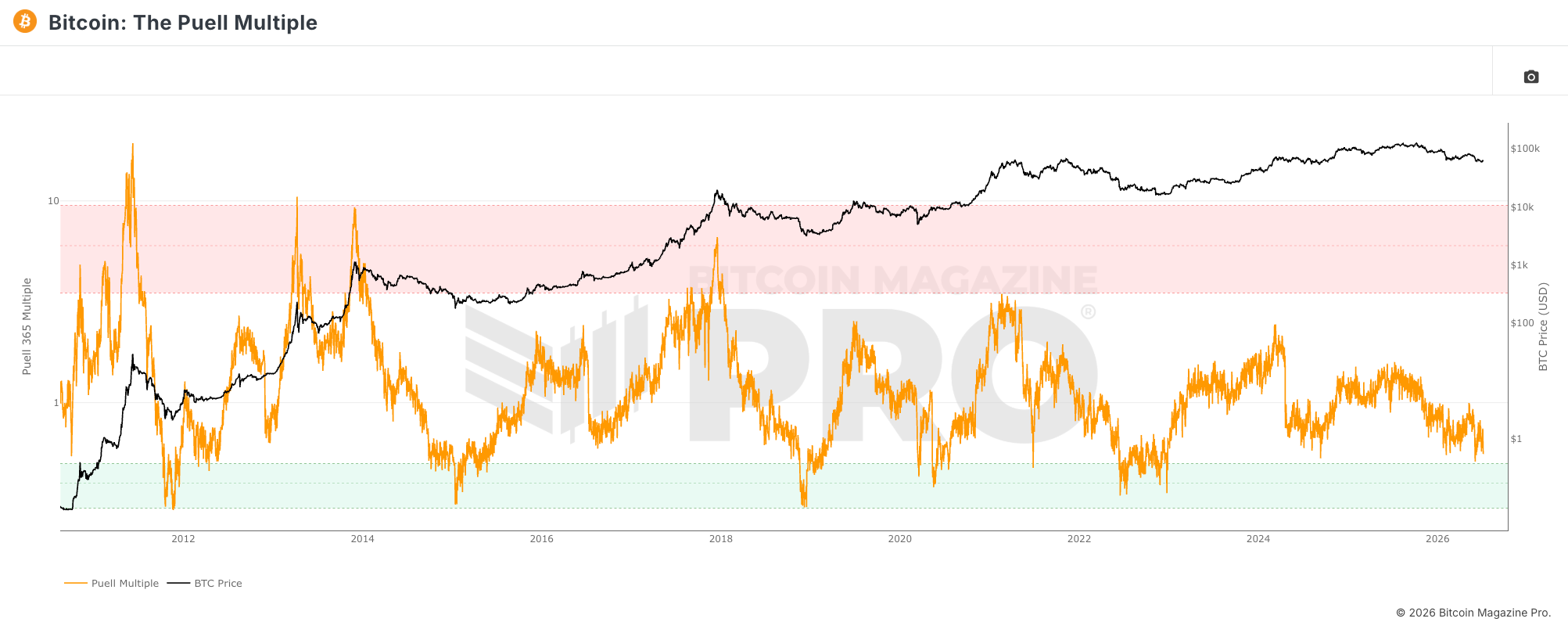
The Puell Multiple confirms what hashprice suggests. It divides the USD value of Bitcoin issued each day by its 365 day moving average. Readings at or below 0.5 have marked past cycle bottoms and readings above 4 have marked tops. A reading below 1 signals miner income stress. Check the live chart on Bitcoin Magazine Pro before you buy.
Timing is how mining beats a simple DCA into Bitcoin. An S19 bought at the 2021 top cost about $11,000 and now trades for a few hundred dollars at most on the used market. A buyer who put the same capital into Bitcoin would hold more value today. The same machine bought near a hashprice low tells the opposite story, because cheap hardware appreciates when price outruns difficulty. Our mine vs buy Bitcoin comparison runs the full math.
Why Price Outrunning Difficulty Is the Real Signal
Mining pays best when Bitcoin's price rises faster than network difficulty can follow. Your revenue is a share of the network rather than a fixed rate. Difficulty adjusts about every 2,016 blocks to hold block times near ten minutes. That works out to a reset about every two weeks. Every upward step means less Bitcoin per terahash for each machine on the network.
The lag is the profit window. Price can reprice in a day while new hashrate takes months of construction and shipping and racking to come online. When price runs ahead of difficulty, every deployed miner earns outsized margins until the network catches up. Each of the last three bull cycles produced this same breakaway, which is the pattern our price vs hashrate breakdown above charts in full.
The ideal setup follows from the mechanic. Buy into depressed difficulty and hashprice ahead of a price move that difficulty cannot match at once. Flat or falling difficulty tells you marginal miners are unplugging, which raises the share left for everyone still hashing. Machines bought during that capitulation both out-earn and appreciate once price breaks away.
Should You Buy Before or After a Bitcoin Halving?
Neither side of a halving is an automatic win because the event rewards efficiency rather than a purchase date. A halving cuts the block subsidy in half about every four years. The April 2024 halving cut the subsidy to 3.125 BTC and the next one in early 2028 cuts it to 1.5625 BTC.
One popular claim deserves correction. Hardware prices do not rise into halvings as a rule. ASIC prices bottomed near the 2020 halving and kept falling through the 2024 halving. What holds up is a premium on efficient rigs. The subsidy cut slashes revenue per terahash overnight and inefficient fleets feel the squeeze first.
| Timing | Potential advantage | Potential risk |
|---|---|---|
| Before a halving | Accumulate Bitcoin at the higher block subsidy | Hashprice drops on halving day unless price rallies to offset it |
| After a halving | Inefficient fleets capitulate and used supply grows | The lower subsidy cuts output per terahash |
How Do New ASIC Releases Affect Hardware Prices?
Every new generation resets the efficiency bar and reprices each older unit beneath it. Manufacturers ship a more efficient flagship every one to two years. Our guide on which ASIC to purchase covers the current lineup and the efficiency math.
The release timing trade-off works in both directions. Buy right before a launch and your unit drops a rung on the efficiency ladder the day the successor ships. Buy at launch and you pay an early adopter premium while supply is thin. The sweet spot is often the previous flagship a few months after its successor arrives, when sellers reprice and performance per dollar peaks. Watch announced release dates the same way you watch hashprice.
How Hosting and Electricity Costs Shape Your Timing
Perfect timing fails without a low operating cost behind it. Electricity is the largest recurring expense in mining and it compounds every month you run. Hosted Bitcoin mining gives individual buyers access to industrial rates. Simple Mining's bundled hosting rate runs $0.07 to $0.08 per kWh and clients pay only for actual online time. See our breakdowns of whether Bitcoin mining is still profitable and the cost of mining in 2026 for the operating side of the equation.
Time-to-hash matters as much as price paid. Every idle week between purchase and deployment is revenue you never recover. Buying and hosting through one provider removes shipping and setup gaps from that timeline. Model your own scenarios in the Bitcoin mining calculator before you commit capital.
Key Factors That Signal the Right Time to Buy
Five inputs decide whether a buying window is open. They are hashprice level and Bitcoin price and difficulty trend and rig efficiency and your power rate. The first three are market signals and the last two are choices you control.
Current Bitcoin Price and Outlook
The goal is not calling the exact bottom but avoiding an obvious top. A market well off its cycle peak carries a different risk profile than a euphoric high. Pair cycle position with hashprice. A deep drawdown alongside depressed hashprice has marked accumulation zones in past cycles.
Difficulty and Hashrate Trends
Rising difficulty means more competition for the same block rewards and less Bitcoin per terahash. Watch the adjustment trend on mempool.space before you buy. A string of flat or downward adjustments signals capitulation among marginal operators, which is the setup that preceded the best entries in past cycles. Steep upward adjustments during a price run mean the window is closing.
Rig efficiency and buying channels round out the checklist. Compare J/TH ratings in our ASIC selection guide above and vet sellers with our guide on how to buy Bitcoin mining hardware.
Is Now a Good Time to Buy a Bitcoin Miner?
The best windows in past cycles shared one profile rather than one date. Check the live sources above and score the market against four conditions:
- Hashprice near multi-year lows on the live index
- The Puell Multiple at or below 0.5
- Bitcoin well off its cycle peak
- Difficulty flattening or falling as marginal miners capitulate
When those conditions align, patient capital has done best. When hashprice and the Puell Multiple run hot near a euphoric top, the odds flip. None of that is a price prediction, so weigh the signals against your own situation. Four questions to answer before you buy:
- Do I have a competitive power rate or a hosting partner?
- Am I comfortable with Bitcoin's volatility?
- Can I hold through a full market cycle?
- Have I modeled my scenario in a mining calculator?
A 7-day free trial with 100 TH/s of live hashrate lets you test the dashboard and the economics before you commit capital to hardware.
Smart Strategies for First-Time Miners
Start with one machine and buy from a source you can hold accountable. One unit is enough to learn pool setup and dashboards and payout mechanics before you scale. Simple Mining hosts single unit clients with no fleet requirement.
Buy from a reputable US based dealer to reduce scam risk and overseas shipping delays. Hosted mining then removes setup work and noise and electrical constraints from the equation, which shortens the path from purchase to first payout.
FAQs
Is hashprice a good indicator of when to buy a miner?
Yes, hashprice is the single best market signal for timing an ASIC purchase. It measures the value of one petahash per day and bundles Bitcoin price and difficulty and fees into one number. ASIC prices track hashprice with a lag, so low hashprice tends to mean cheap hardware.
What is the Puell Multiple?
The Puell Multiple divides the USD value of Bitcoin issued each day by its 365 day moving average. Readings at or below 0.5 have marked the zones where miner capitulation peaked and past cycle bottoms formed. Readings above 4 have marked cycle tops.
What happens when Bitcoin price breaks away from network difficulty?
Mining profitability spikes when Bitcoin price rises faster than difficulty can adjust. Building hashrate takes months while price can move in a day, so difficulty lags and each deployed miner earns more. Miners racked before the breakaway capture the widest margins.
What is the risk of buying when hashprice is at all-time highs?
Peak hashprice means peak hardware prices and the longest payback risk. Buyers at the November 2021 top saw expected payback stretch from 13 months to more than 100 months as margins collapsed. High profitability attracts new hashrate, which raises difficulty and pushes hashprice back down.
Should I wait for a halving to buy a miner?
No, the halving calendar is a weaker signal than hashprice. Hardware prices show no reliable rise into halvings and fell through the 2024 event. Buy when hashprice is depressed and your rig is efficient enough to survive the next subsidy cut.
Buy Smarter and Start Mining Sooner
The market pays buyers who accumulate hashrate when nobody wants it. Timing sets the ceiling on your returns and execution decides whether you reach it. Simple Mining pairs Bitcoin miners for sale with hosting at a bundled $0.07 to $0.08 per kWh rate and 95%+ average uptime. Start with the free 7-day trial and put your entry to work.