

Cantillon Effect: Definition, Examples and Who Benefits First
By Josh Heine, Content Strategist at Simple Mining
Published September 24, 2026
The Cantillon effect is the uneven impact of new money on an economy. Whoever spends new money first buys at old prices. Everyone who receives it later pays prices that have already risen. The idea comes from Richard Cantillon, an Irish-born banker who ran a Paris bank in the 1710s.
Cantillon did not learn this from a textbook. He watched John Law's bank and Mississippi Company flood France with paper money from 1716 to 1720, and he profited on the way up and on the way down. He then wrote the book that explains why the front of the line wins.
On this page · 12 sections
- What Is the Cantillon Effect?
- Who Was Richard Cantillon?
- How the Cantillon Effect Works
- Who Benefits First From New Money
- Who Loses From the Cantillon Effect
- Cantillon Effect Examples in History
- The Cantillon Effect, the Inflation Tax and Wealth Inequality
- Quantitative Easing and the Modern Cantillon Effect
- Does Bitcoin Solve the Cantillon Effect?
- How People Respond to the Cantillon Effect
- FAQs About the Cantillon Effect
- Bitcoin Mining: New Coins by Rule, Not by Proximity
Key Takeaways
- New money enters at specific points and reaches wage earners last, so first spenders gain purchasing power and last receivers lose it.
- The Fed's balance sheet grew almost tenfold from 2008 to 2022, and home prices and stocks rose far faster than wages.
- Milton Friedman called inflation a tax imposed without specific legislation, but whether QE widened inequality on net is contested.
- Bitcoin removes discretion from money creation but not the advantage of capital and cheap power.
What Is the Cantillon Effect?
The Cantillon effect is the change in relative prices and wealth that follows a change in the money supply. New money does not reach everyone at once, so the people who get it first can spend it before prices adjust.
- Core principle: First receivers gain purchasing power. Last receivers lose it.
- Key insight: Money is not neutral. Where new money enters decides who wins.
- Why it matters: Money creation sorts people into winners and losers by their distance from the source.
Who Was Richard Cantillon?
Richard Cantillon was an Irish-born banker who made his fortune in Paris and wrote one of the earliest treatises on economics. He was born in County Kerry in about 1687 and took French nationality in 1708. He took over his cousin's failed Paris bank in 1716. He died in London on May 14, 1734. Most accounts say a cook he had dismissed murdered him and set his house on fire.
His only surviving work is the Essai sur la Nature du Commerce en Général. He wrote it between 1730 and 1734 and it circulated in manuscript until a French edition appeared in 1755. Cantillon never used the phrase "Cantillon effect." Mark Blaug coined the term in 1962 in Economic Theory in Retrospect.
How the Cantillon Effect Works
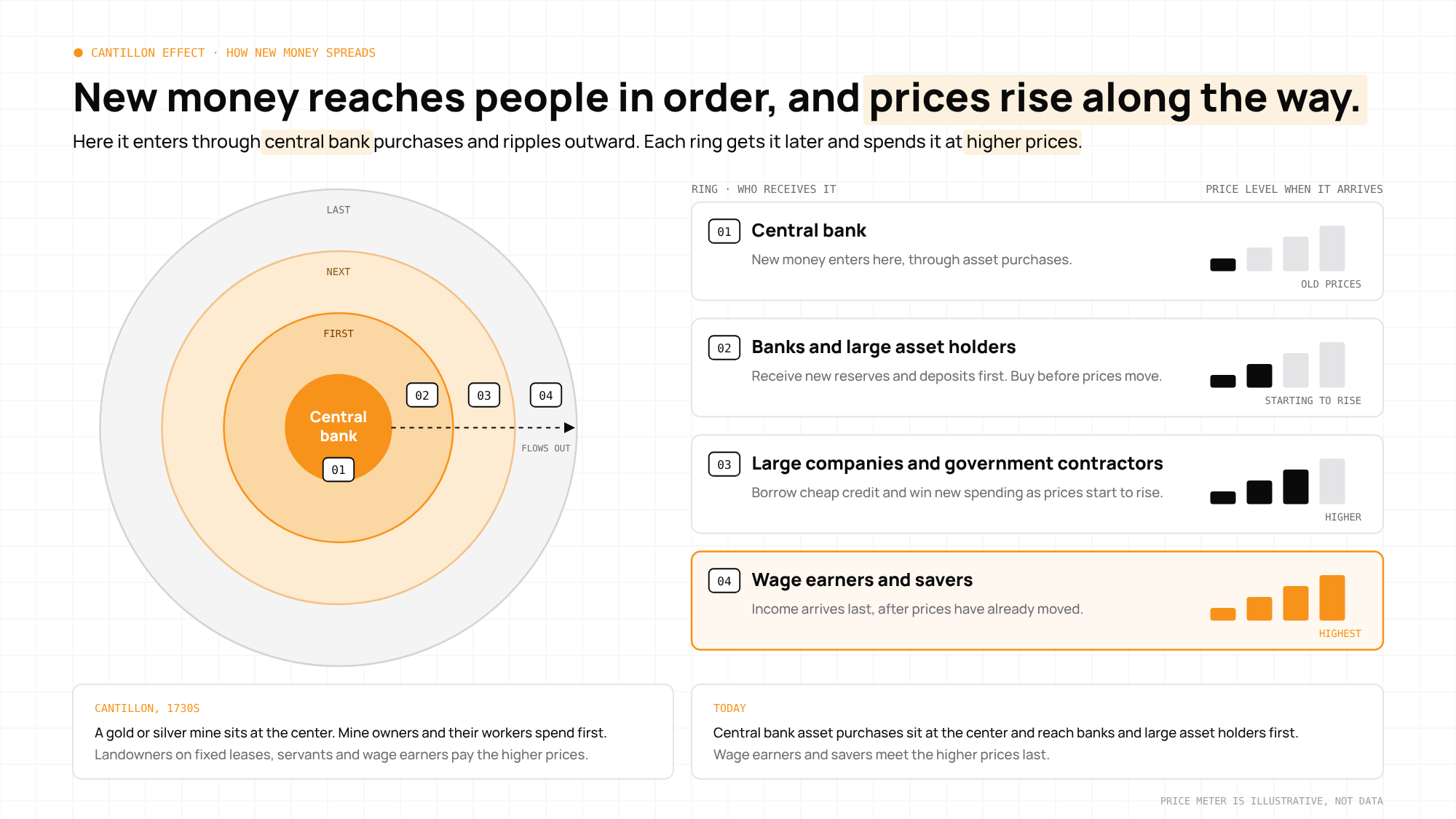
The Cantillon effect works in four steps: new money enters at a point, early receivers spend it, prices rise, and late receivers pay more. Cantillon's own example in Part II, Chapter VI of the Essai is a gold or silver mine. The mine owners and their workers spend their new income on more meat, wine and beer, and better clothes. That extra spending "diminishes of necessity the share of the other inhabitants of the State" and pushes up prices. The losers are landowners on fixed leases, servants, and wage earners whose pay lags.
New Money Enters the Economy at Specific Points
New money enters through a small set of doors: central bank asset purchases, commercial bank lending, and government spending. Nobody wakes up with new dollars in a checking account at the same moment as everyone else.
Early Receivers Spend Before Prices Rise
Early receivers spend or invest before the wider market has repriced. A dealer that sells a bond to the Fed holds fresh cash while the price of a house or a stock still reflects the old money supply. That gap is the whole advantage.
Late Receivers Face Higher Prices
Late receivers meet higher prices before their incomes catch up. By the time a wage increase arrives, rents and asset prices have already moved.
New Money Changes What Gets Produced
New money also changes what the economy makes. First spenders bid up the goods they want, and producers shift land and labor toward those goods. Cantillon traced this to its end in the same chapter. Higher prices at home pull in cheaper foreign goods, the new money drains abroad to pay for them, and once its circulation ceases, "poverty and misery follow." That happens even while the mines keep producing.
Austrian economists call the modern version malinvestment. Mark Thornton of the Mises Institute describes new money pushing interest rates below their natural level and starting a boom in capital goods that are later revealed as bad investments.
Who Benefits First From New Money
The people who benefit from inflation are the ones closest to where new money enters: banks, asset holders, government contractors, and large borrowers. Each group receives or borrows new money before the general price level has adjusted.
Banks and Large Asset Holders
Banks and large asset holders are the first counterparties of a central bank. When the Fed bought bonds after 2008 it traded with primary dealers, who often passed securities through from other holders. Fed researchers found that the largest sellers of Treasuries were households (a category that includes hedge funds), broker-dealers, and insurance companies. Banks received reserves at the Fed. The sellers received deposits they could redeploy at once.
Asset Owners and Investors
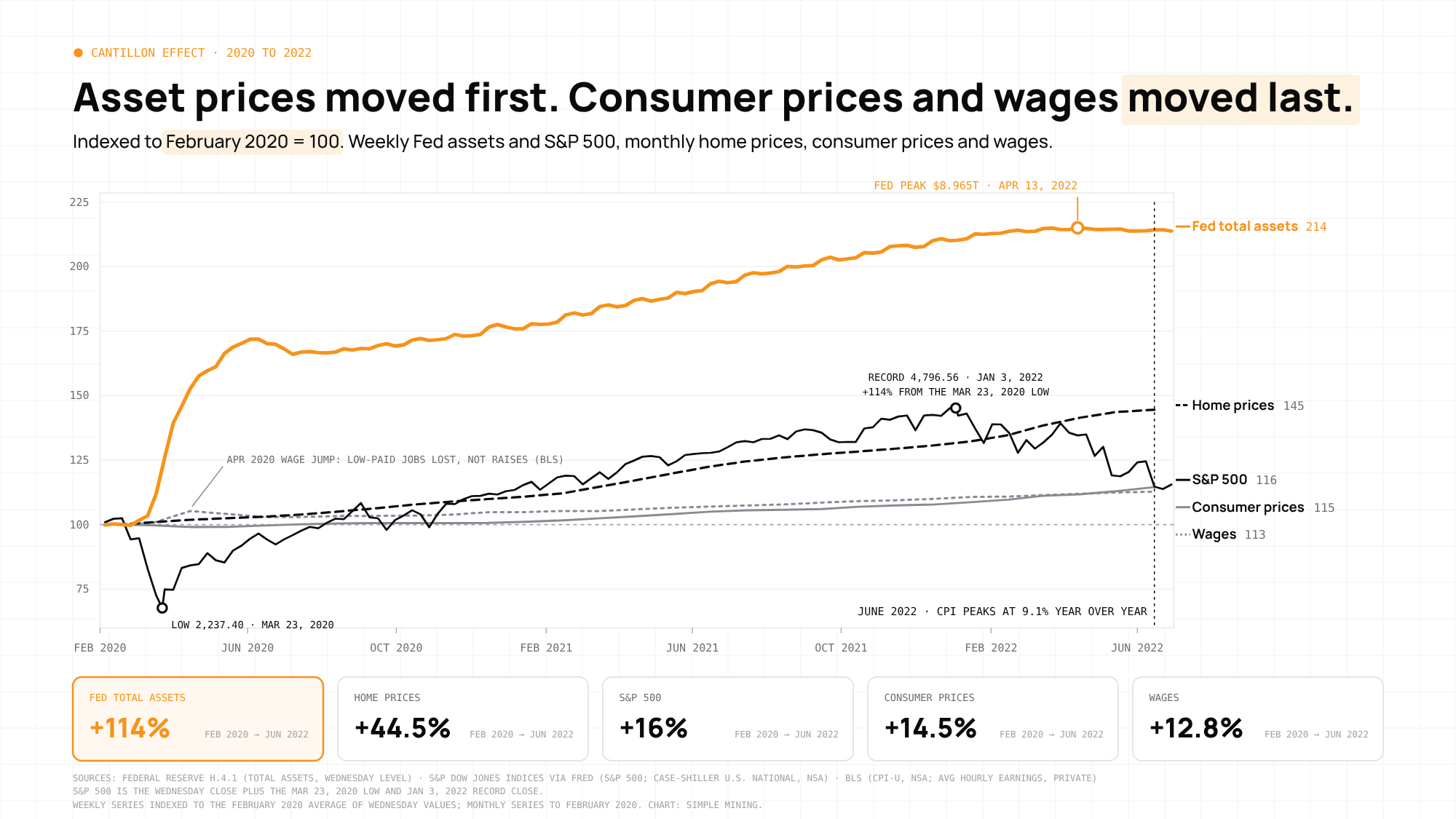
Anyone holding stocks or real estate gains as new money flows into markets before it reaches wages. The pandemic years below show how large that gap got.
Government Contractors and Subsidy Recipients
Government contractors and subsidy recipients receive new money at the source when deficit spending is funded by debt that the central bank later buys.
Large Corporations With Cheap Credit
Large corporations with access to cheap credit borrow at low rates during a monetary expansion. They refinance debt, buy back shares, or acquire competitors before rates and prices adjust.
Who Loses From the Cantillon Effect
The losers from the Cantillon effect are the people furthest from where new money enters. Their incomes lag, so they meet higher prices before any new money reaches them.
Wage Earners and Salaried Workers
Wage earners see prices rise before their paychecks do. In the 12 months to June 2022 consumer prices rose 9.1%, the largest 12-month increase since November 1981. Prices do not wait.
Savers and Fixed-Income Retirees
Savers holding cash and retirees on fixed pensions lose purchasing power as prices rise around them. The balance does not change. What it buys does.
First-Time Homebuyers and Younger Workers
First-time buyers pay inflated prices without having owned the assets that inflated. The National Association of Realtors' 2025 Profile of Home Buyers and Sellers put the median first-time buyer age at 40 and the first-time buyer share at 21%, both records. In the 1980s the typical first-time buyer was in their late 20s.
Cantillon Effect Examples in History
The Mississippi Bubble
John Law's Mississippi Company is the original case study. Law founded the Banque Générale in 1716 and the Compagnie d'Occident in 1717. The bank issued notes that funded share purchases, and rising shares justified more notes. Shares went from about 500 livres in January 1719 to a peak somewhere between 10,000 and 18,000 livres around the turn of 1720, depending on the source.
Shares fell to 2,000 livres by September 1720 and back to 500 by September 1721. Food prices rose as much as 60%. Latecomers lost most of their stake. Cantillon sold early, lent against shares, left Paris in April 1720, and made a second fortune on South Sea shares before declining Law's invitation to return.
Quantitative Easing After 2008
The Fed ran three rounds of quantitative easing between November 2008 and October 2014. QE1 (to March 2010) bought $1.25 trillion of mortgage-backed securities, $175 billion of agency debt, and $300 billion of Treasuries. QE2 (November 2010 to June 2011) bought $600 billion of Treasuries. QE3 ran from September 2012 to October 2014 at $40 billion a month in mortgage bonds plus $45 billion a month in Treasuries from December 2012.
The Fed's total assets stood at $905 billion on September 3, 2008. They reached $4.487 trillion when QE3 ended on October 29, 2014 and peaked at $4.516 trillion on January 14, 2015.
Pandemic Stimulus, 2020 to 2022
Total assets went from $4.24 trillion on March 4, 2020 to $8.965 trillion on April 13, 2022. M2 grew 26.8% in the year to February 2021, the highest year-over-year rate in the series.
Asset prices moved first. Home prices rose 44.5% between February 2020 and June 2022, while average hourly earnings rose 12.8%. The S&P 500 more than doubled from its March 23, 2020 low of 2,237.40 to 4,796.56 on January 3, 2022. Consumer prices arrived last.
The Cantillon Effect, the Inflation Tax and Wealth Inequality
The Cantillon effect works like a tax that nobody voted for. Milton Friedman wrote in 1975 that inflation is "a tax that can be imposed without specific legislation" and called it taxation without representation (There's No Such Thing as a Free Lunch, page 149). The mechanism is accepted. Whether it has widened wealth inequality on net is contested.
The Bank of England's July 12, 2012 review found that £325 billion of asset purchases had raised household financial wealth by about £600 billion, with the top 5% of households holding 40% of those assets. The Bank also argued most people would have been worse off without QE. ECB researchers Lenza and Slacalek found that euro-area QE lowered income inequality through employment and had negligible effects on wealth inequality. A 2023 Journal of Finance study of Danish households found the opposite gradient: a one-point rate cut raised disposable income under 0.5% at the bottom and about 5% at the top. Seb Bunney's conversation on the hidden cost of money covers the same tension from the Bitcoin side.
| Position | First receivers | Last receivers |
|---|---|---|
| Purchasing power | Gain it by spending at old prices | Lose it as prices rise before income |
| Assets | Own them before they reprice | Face inflated prices when they try to enter |
| Credit | Borrow at low rates early in the cycle | Pay higher rates once tightening starts |
| Savings | Held in assets that rose | Held in cash that bought less |
Quantitative Easing and the Modern Cantillon Effect
Quantitative easing is the modern Cantillon effect because a central bank creates money and hands it to a specific first counterparty. The Fed buys bonds from dealers and pays with new reserves. The sellers are the first receivers and everyone else meets the price effects later.
1971: When the Gold Constraint Ended
On August 15, 1971 President Nixon closed the gold window and foreign governments could no longer exchange dollars for gold. M2 stood at $685.5 billion in August 1971 and at $23.34 trillion in August 2026, about 34 times higher.
Zero Interest Rates and Asset Prices
Zero rates push savers and funds into stocks and real estate in search of returns. The Fed held its target range at 0 to 0.25% from December 16, 2008 to December 17, 2015, and again from March 16, 2020 to March 17, 2022. Both periods coincided with large asset-price gains.
Where Fed Policy Stands Now
The Fed raised rates in September 2026, and its balance sheet is larger than a year ago. The federal funds target range rose to 3.75% to 4.00% on September 17, 2026, the first increase since 2023. Total assets stood at $6.747 trillion on September 16, 2026, up $138 billion from a year earlier.
Balance sheet runoff (QT) began June 1, 2022 and ended December 1, 2025. The Fed began reserve management purchases of Treasury bills on December 12, 2025 at about $40 billion a month, stepped them down through the spring and summer, and has made none since August 14, 2026. It says these purchases are not QE. Because the Fed still reinvests maturing holdings into Treasury bills, its balance sheet stays tied to the US debt problem.
Does Bitcoin Solve the Cantillon Effect?
Bitcoin removes discretionary first receivers but not first receivers. Its issuance schedule is fixed and public, so no committee decides who gets new coins or when. Who earns those coins still depends on capital and the cost of power. Bitcoin writers describe this design as resistant to the Cantillon effect. Anyone asking whether Bitcoin is a good investment needs both halves of that answer.
Fixed Supply Prevents Discretionary Money Creation
Bitcoin's supply is capped at 21 million by a consensus rule. The block subsidy halves every 210,000 blocks and has been 3.125 BTC per block since block 840,000 on April 20, 2024. On September 24, 2026 the chain stood at block 968,405 and 20,088,766 BTC had been mined, 95.7% of the cap. The Bitcoin halving schedule puts the next halving at block 1,050,000, expected in spring 2028.
No Central Authority Decides Who Gets New Coins
No central authority decides who receives new Bitcoin. New coins go to whichever miner finds the next block under proof of work. The Bitcoin difficulty adjustment keeps that contest at about one block every ten minutes no matter how many miners join.
Where Bitcoin Still Has Early Winners
Bitcoin still has early winners. Early adopters earned 50 BTC per block in 2009 at near-zero cost. Mining is capital-intensive and concentrated across a few pools and one dominant ASIC maker. Access to cheap power is the modern version of Cantillon's proximity to the mine. ETFs and custodians route retail demand through a few intermediaries, and large holders who borrow against their coins can spend new credit before the market reprices.
There is a counterpoint. Niranjan Sapkota's 2026 working paper The Lazy Miner Hypothesis: Efficiency-Driven Cantillon Effects in Bitcoin treats miners as the first receivers of every new coin but argues competition stops them from keeping the advantage. Inefficient miners exit after each halving and the gains pass to others. Whether that offsets the head start in full is an open question.
How People Respond to the Cantillon Effect
This section describes what has happened, not investment advice.
Assets That Rose With the Money Supply, and When They Did Not
Asset prices rose with the money supply in 2020 and 2021 and fell in 2022 while the money supply was flat. In calendar 2022 M2 fell about 1%, the S&P 500 fell 19.4%, and Bitcoin fell 64% from $46,312 to about $16,500.
Bitcoin also fell in 2025 and in the first half of 2026 while M2 grew 5.7% in the year to August 2026. The Bitcoin vs gold record over the same years shows how far apart two scarce assets can trade.
Why Cash Loses Ground
Cash loses ground because its purchasing power falls whenever prices rise faster than the interest it earns. A fixed-coupon bond does the same when inflation runs above its yield. That is what happened in the year to June 2022, when consumer prices rose 9.1% while short-term rates sat near zero until March 2022.
Mining: Receiving New Bitcoin From the Protocol
Mining is the one way to receive new Bitcoin from the protocol rather than from a seller. The tradeoff in mining vs buying Bitcoin depends on hardware price, power cost, and network difficulty. The outcome is not promised. Hosting lowers the power and infrastructure barrier without removing it. Bitcoin miner hosting at Simple Mining runs on a bundled hosting service fee of $0.065 to $0.08 per kWh.
FAQs About the Cantillon Effect
What is the difference between M0, M1, M2, M3 and M4 money?
In the United States only M1, M2 and the monetary base are official measures. The M1 vs M2 money supply distinction is liquidity: M1 is currency plus demand deposits plus other liquid deposits, and M2 adds small time deposits and retail money market funds. Savings deposits moved into M1 in May 2020, so M1 jumped from $4.86 trillion in April 2020 to $16.31 trillion in May 2020 on reclassification alone. M4 is the Bank of England's main broad money measure.
| Measure | United States (Federal Reserve) | United Kingdom (Bank of England) |
|---|---|---|
| M0 | Not published; closest series is the monetary base ($5.41 trillion, August 2026) | Former narrow measure of notes, coin and banks' operational deposits, discontinued in 2006 |
| M1 | Currency, demand deposits, other liquid deposits including savings ($19.99 trillion, August 2026) | Not a headline measure |
| M2 | M1 plus small time deposits and retail money funds ($23.34 trillion, August 2026) | Published as retail M4; not a headline measure |
| M3 | Discontinued March 23, 2006 | Estimate published for EU comparison |
| M4 | Not a Fed series | Main broad money measure |
Has the Cantillon effect been proven?
The mechanism is widely accepted; the net effect on inequality is not settled. Central bank studies agree that asset purchases raised asset prices. They disagree on the result. The Bank of England found wealth gains skewed to the top 5% of households, while the ECB found QE reduced income inequality.
Does Bitcoin have its own Cantillon effect?
Bitcoin has early winners but no discretionary first receivers. Early adopters, low-cost miners, and large custodians hold advantages that resemble Cantillon's mine owners. What Bitcoin lacks is a committee that can change the schedule. The answer to how decentralized Bitcoin is in practice decides how strong those advantages become.
How long does it take for new money to raise prices?
New money usually takes more than a year to raise consumer prices, and often two years or longer. Friedman called the lag long and variable, and a 2001 Bank of England study confirmed that the peak effect on inflation comes more than a year after the policy action. A 2013 meta-analysis of 67 studies put the average lag at 29 months, with 25 to 50 months in developed economies.
Bitcoin Mining: New Coins by Rule, Not by Proximity
Bitcoin mining pays out new coins by rule, not by proximity to a central bank. Simple Mining is headquartered in Cedar Falls, Iowa and hosts miners across 11 sites in Iowa with 150+ MW of capacity and 9+ EH/s under management at 95%+ average uptime. The cost to mine a Bitcoin depends on hardware, power, and difficulty, and every miner faces the same schedule. You can buy Bitcoin miners from Simple Mining, or start with a 7-day free trial on an Antminer S21+ at 235 TH/s.