

Is Bitcoin Decentralized? The Complete Answer
By Josh Heine, Content Strategist at Simple Mining
Published June 10, 2026
Bitcoin is decentralized. No company runs it. No CEO can rewrite its rules and no government can switch it off. The honest version of that answer is more useful though: decentralization is a spectrum and Bitcoin scores different marks across four layers of the network. This article grades each layer with sourced data. It takes the strongest centralization critique head on and shows you how to verify every claim yourself.
On this page · 11 sections
- Is Bitcoin Truly Decentralized
- What Makes Bitcoin Decentralized
- Who Controls Bitcoin
- Do Mining Pools Threaten Decentralization
- Is the Bitcoin Supply Centralized
- Can Governments Shut Down Bitcoin
- Bitcoin vs. Other Cryptocurrencies
- Why Decentralization Matters for Bitcoin
- How to Measure Bitcoin Decentralization
- FAQs
- Mining Strengthens the Bitcoin Network
Key Takeaways
- Bitcoin operates without a central authority. About 15,000 to 25,000 publicly reachable nodes span about 170 countries, and the total including private and Tor-hidden nodes is estimated at 50,000 to over 100,000.
- Mining pool concentration is the strongest critique. The top two pools account for almost half of network hashrate, but pools coordinate work without owning it.
- Miners can repoint hashrate to a new pool in seconds, and Stratum V2 returns block template control to individual miners.
- The supply is not centralized. River research published in early 2026 estimates individuals hold about two thirds of all Bitcoin.
- Decentralization is measurable. Node counts, pool shares, and geographic hashrate data are public and verifiable by anyone.
Is Bitcoin Truly Decentralized
Yes, Bitcoin is truly decentralized in the ways that matter: no single entity controls its rules or its supply. It launched in 2009 as the first cryptocurrency to operate without a central bank or administrator. There is no headquarters to raid and no board to subpoena.
Decentralization is not a binary though. It exists on a spectrum across four distinct layers of the network. Each layer deserves its own grade.
| Layer | What it covers | How decentralized |
|---|---|---|
| Consensus | Nodes validating blocks and enforcing rules | Very high |
| Governance | Who can change the protocol | Very high |
| Ownership | Who holds the coins | High |
| Mining | Who builds blocks and where | Moderate and improving |
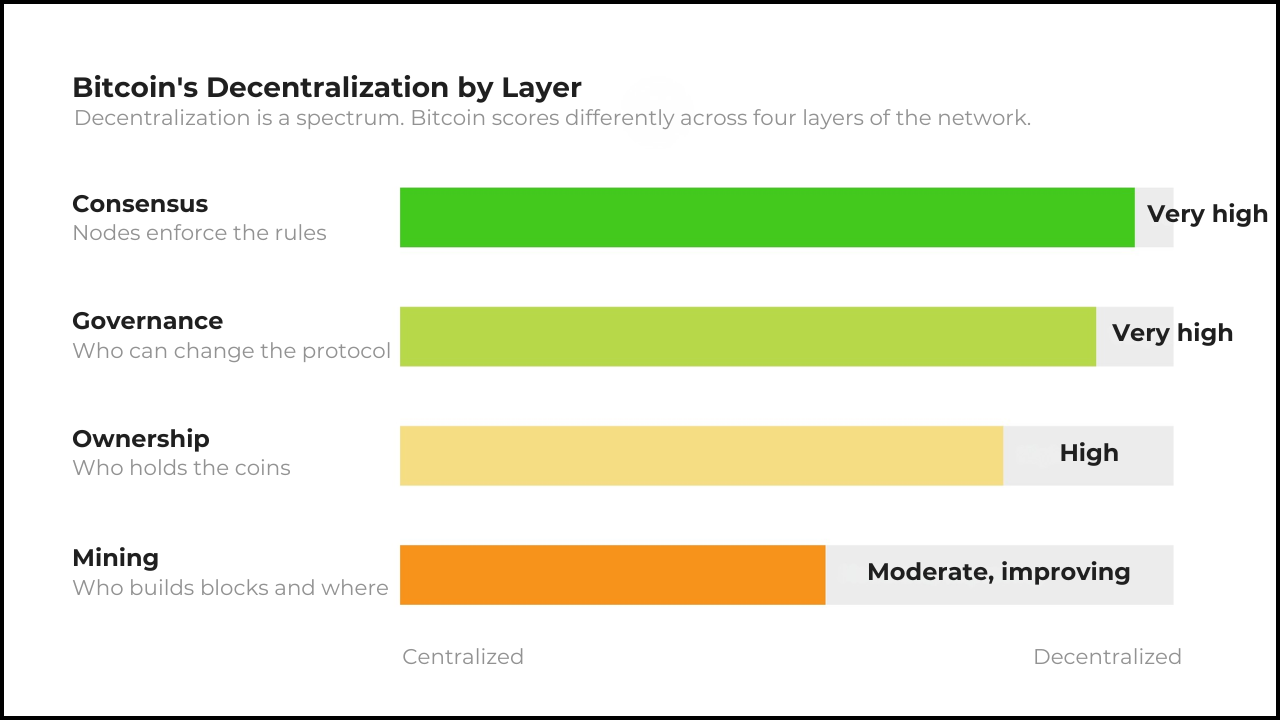
The rest of this article works through each layer. The mining layer draws the loudest criticism, so it gets the deepest treatment.
What Makes Bitcoin Decentralized
Four technical pillars distribute control across Bitcoin: a global node network, proof-of-work consensus, open-source code, and the absence of any central operator. Remove any one and the system weakens. Together they make capture impractical.
Distributed Node Network
A node is a computer running Bitcoin software that stores the full ledger and checks every transaction against the rules. Live trackers like the Newhedge Bitcoin Node Map and BitRef show about 15,000 to 25,000 publicly reachable nodes across about 170 countries. The true total is far higher because most nodes do not accept inbound connections and many run behind Tor or a firewall. Estimates that include those private nodes run from 50,000 to over 100,000. Anyone with a basic computer and about 700 GB of storage can run one. No node can alter past transactions, and every node rejects blocks that break the rules.
Proof-of-Work Consensus
Proof-of-work is the mechanism miners use to add new blocks. Miners spend real electricity to win the right to publish a block, and the network accepts the chain with the most accumulated work. This replaces a trusted third party with verifiable physical cost. Nobody approves a Bitcoin transaction. The math does.
Open-Source Protocol
Bitcoin's code is open for anyone to read, copy, or improve. No person or group can force a software update on the network. Changes require broad agreement among developers, miners, node operators, and users. Contested changes fail, which is a feature and not a bug.
No Central Authority
Visa can reverse your payment. A bank can freeze your account. PayPal can close it. Bitcoin has no equivalent chokepoint because there is no company in the middle. The contrast is structural, not cosmetic.
Who Controls Bitcoin
No one controls Bitcoin, and that is by design rather than by accident. Control is split among four groups that check each other:
- Miners order transactions into blocks and secure the chain with hashrate.
- Node operators enforce the consensus rules and reject invalid blocks regardless of who mined them.
- Developers propose code changes but cannot force anyone to run them.
- Users choose which software to run and which chain to value.
The 2017 block size fight proved the balance works. Large miners and businesses backed a contested upgrade. Node operators and users refused it. The network kept the original rules. The breakaway chain faded into irrelevance. A Federal Reserve Bank of Cleveland commentary on that episode notes the tradeoff with candor: decentralized governance is slower than a boardroom, but no single decision maker can hijack it.
Do Mining Pools Threaten Decentralization
Pool concentration is the strongest real critique of Bitcoin decentralization, and the numbers deserve a straight look before any rebuttal. A few pools dominate block production: the largest, Foundry USA, mines on the order of a quarter of all blocks, and the top three or four pools together make up the majority. Exact shares shift week to week, so check the live breakdown on mempool.space for the current picture. Academic work pushes the critique further: a 2024 paper in Decision Support Systems titled Is decentralization sustainable in the Bitcoin system? argues that economies of scale push mining toward a few large players. ASIC manufacturing concentration in a handful of firms adds another pressure point.
That is the steelman. Here is why it overstates the risk.
How Mining Pools Actually Work
A mining pool is a coordination service where thousands of independent miners combine hashrate to smooth out payout variance. The pool assembles block templates and distributes work, while the miners own the machines, pay the power bills, and earn rewards in proportion to contributed work. How Bitcoin mining pools work gets deeper into shares, payout models, and choosing one.
Pool Concentration vs. Miner Control
A pool's hashrate share measures blocks found, not power held. Pool operators cannot spend miners' rewards held at non-custodial pools, cannot change protocol rules, and cannot rewrite the ledger. Every block a pool publishes still passes through tens of thousands of independent nodes that reject anything invalid. A pool that attempted censorship or invalid blocks would burn its own revenue in public view. Concentration at the template layer is a real but narrow power, and the network is closing even that gap.
Why Miners Can Switch Pools Anytime
Pools coordinate work. They do not own your hashrate. You can repoint it in seconds. Switching pools means changing a stratum URL in the machine's config, and hosted miners do it from a dashboard in minutes. That exit option is the discipline mechanism: when a pool misbehaves or overcharges, hashrate leaves.
The protocol layer is improving too. Stratum V2 includes Job Declaration, which lets individual miners build their own block templates instead of accepting the pool's. In May 2026 seven pools representing about 75% of network hashrate joined the Stratum V2 working group, including Foundry and AntPool. Ocean's DATUM protocol delivers the same miner-side template control today. The trend line points away from pool power, not toward it.
Is the Bitcoin Supply Centralized
No, the Bitcoin supply is not centralized: individuals hold about two thirds of all coins and no single entity holds more than 5% of supply. River research published in early 2026 estimates personal wallets hold about 14 million BTC, or 66.7% of the 21 million cap. Funds and ETFs hold about 7.1%, corporate treasuries about 6.9%, and governments about 2.1%. These figures rest on filings and address tagging, so treat them as informed estimates rather than an on-chain census.
The launch history matters as much as the snapshot. Bitcoin had no premine. Satoshi Nakamoto mined an estimated 968,000 BTC under the same open rules as everyone else, and those coins have never moved. An estimated 3 to 4 million BTC are considered lost based on coin-age analysis, which spreads effective ownership further. Institutional share is growing through ETFs, which matters more for how investors get Bitcoin exposure than for governance, since holding coins grants zero protocol power. A trillion-dollar fund gets the same vote as a node on a Raspberry Pi: none.
Can Governments Shut Down Bitcoin
No single government can shut down Bitcoin because there is nothing central to shut down. A ban can push activity underground or offshore within one border. It cannot reach the network itself.
No Single Point of Failure
A company has servers, executives, and a registered address. Bitcoin has none of those. Seizing any single node or miner or developer changes nothing because thousands of replacements run the same software elsewhere.
Global Distribution of Nodes
Live node maps track reachable nodes across about 170 countries. The United States and Germany lead the visible count. Over 60% of reachable nodes hide their location behind Tor or other privacy layers. Shutting Bitcoin down would require simultaneous enforcement across every jurisdiction on earth plus the dark corners between them. No precedent for that level of coordination exists.
Historical Attempts and Outcomes
China proved the point at scale. It banned mining outright in mid-2021 while hosting most of the world's hashrate. The network slowed for a few months. Difficulty adjusted downward and hashrate migrated to North America and Central Asia. Within a year the network was stronger than before the ban. The Cambridge Centre for Alternative Finance reported in April 2025 that the US hosts 75.4% of surveyed mining activity, a survey-weighted figure that itself raises the next question about geographic balance. We address that in the measurement section below.
Bitcoin vs. Other Cryptocurrencies
Bitcoin is the most decentralized cryptocurrency because it lacks the central features almost every competitor carries. The comparison is structural:
| Factor | Bitcoin | Most Altcoins |
|---|---|---|
| Founding team | Anonymous founder, gone since 2011 | Known founder or foundation in charge |
| Premine | None | Common, often a large insider share |
| Protocol changes | Broad consensus required | Foundation or small group decides |
| Running a node | Consumer hardware | Often needs expensive equipment |
| Issuance | Fixed 21 million cap | Changeable by governance vote |
Bitcoin vs. Ethereum Decentralization
Ethereum launched in 2015 with about 72 million ETH created at genesis, most sold in a crowdsale with a slice reserved for the founding team and the Ethereum Foundation. The foundation still funds development and its leadership shapes the roadmap. Under proof-of-stake the validation layer concentrates too: Lido's own December 2025 reporting puts its share at just over 24% of all staked ETH, and the top ten staking entities control the majority of stake. Ethereum is a useful experiment. It is not Bitcoin's peer on decentralization.
Bitcoin vs. Centralized Exchanges
Coinbase and Binance are centralized companies built on top of Bitcoin, and their failures say nothing about the protocol. When FTX collapsed in 2022 the Bitcoin network did not miss a block. The lesson for holders is custody, not protocol design: coins on an exchange are an IOU, while coins in your own wallet answer to no one.
Why Bitcoin Remains the Most Decentralized
No premine. No foundation. A founder who mined under open rules and then vanished. The longest uninterrupted track record in the industry and the widest node distribution. Every other network compromises on at least one of those points.
Why Decentralization Matters for Bitcoin
Decentralization is the product, not a marketing line. Strip it away and Bitcoin becomes a slow database with extra steps. Three properties flow from it.
Censorship Resistance
No entity can freeze your Bitcoin or block a valid transaction. Banks close accounts under policy pressure every year. Bitcoin processes a dissident's transaction and a pension fund's transaction with equal indifference.
Security Through Distribution
Attacking Bitcoin means out-computing the entire global network at once. Duke University finance professor Campbell Harvey estimated in October 2025 that a one-week 51% attack would cost about $6 billion, with $4.6 billion in hardware alone. Even that figure understates the barrier because the ASIC supply to build such a fleet does not exist on the open market. Every distributed megawatt raises that wall higher.
Trustless Transactions
Trustless means you do not need to trust any intermediary, counterparty, or administrator. The protocol enforces the rules with math that every node checks for itself. Verify, don't trust is an operating instruction rather than a slogan.
How to Measure Bitcoin Decentralization
You can measure Bitcoin's decentralization yourself with three public metrics: node distribution, hashrate distribution, and developer diversity. Do not take this article's word for any of it.
Node Count and Distribution
The same live trackers, Newhedge and BitRef, publish reachable node counts by country, and the data is open for anyone to check. More nodes in more places means more independent rule enforcement. Better yet, run one. A node costs less than a single share of most tech stocks and gives you a personal copy of the ledger.
Hashrate Distribution
Watch two things: pool shares and geography. Our live mining pool stats page tracks current pool distribution. The Cambridge survey's 75.4% US figure overweights US respondents by its own admission. The direction is real and worth watching though. One country dominating hashrate is a softer version of the China problem Bitcoin already survived once. The fix is more mining in more grids, not less mining.
Developer and Governance Diversity
The Bitcoin Core project has hundreds of contributors across independent organizations, and alternative node implementations exist. Funding comes from many unrelated sources. No company employs a controlling share of the developers, and no developer can merge a change the network refuses to run.
FAQs
Is Bitcoin 100% decentralized?
No system is 100% decentralized, and Bitcoin is no exception. Its consensus and governance layers are very decentralized while mining pools show meaningful concentration. The honest framing is a spectrum where Bitcoin leads every other monetary network.
Which cryptocurrency is the most decentralized?
Bitcoin is the most decentralized cryptocurrency. It has no premine, no controlling foundation, an anonymous founder who left in 2011, and the widest node distribution of any network. Every major competitor fails at least one of those tests.
What did Warren Buffett say about Bitcoin?
Warren Buffett has called Bitcoin a speculative asset and once described it as rat poison squared. His criticism targets Bitcoin as an investment rather than its architecture. Nothing in his comments disputes that the network operates without central control.
Can one person or company control Bitcoin?
No single person or company can control Bitcoin. Any change requires agreement across thousands of independent nodes, miners, developers, and users worldwide. Even the largest holders and mining pools cannot alter the rules or rewrite the ledger.
Does hosted Bitcoin mining support decentralization?
Yes, hosted mining supports decentralization because the client owns the hardware and chooses the pool. Hosting changes where a machine sits, not who controls its hashrate. More independent owners running machines across more facilities spreads the network's security budget wider.
What happens if Bitcoin becomes centralized?
If Bitcoin became centralized it would lose censorship resistance and trustlessness, the two properties that justify its existence. A centralized Bitcoin would be a slower version of the banking system. That outcome is why node operators, miners, and developers guard the current balance.
Mining Strengthens the Bitcoin Network
Every independent miner makes the answer to this article's question more durable. More owners running machines across more grids means wider hashrate distribution, a higher attack cost, and less leverage for any single pool or country. Decentralization is not a settled fact to admire. It is a balance that miners maintain block by block.
Hosted mining participates in that balance with full sovereignty. Simple Mining clients own their hardware outright and point their hashrate at the Bitcoin mining pool of their choice. They verify their own payouts on chain. Our Iowa facilities add US-based capacity to a network that learned the cost of single-country concentration in 2021, and clients can weigh the economics with our guide to mining profitability. Owning hashrate is the most direct way to hold a stake in Bitcoin's decentralization.
A network no one controls is a network everyone can trust. If you want to put your own machines on that network, explore hosted mining with Simple Mining or start with our free 7-day trial.