

What Is DATUM? How Bitcoin's Decentralization Protocol Works
By Josh Heine, Content Strategist at Simple Mining
Updated September 23, 2026Published October 5, 2024
DATUM is a Bitcoin mining protocol that returns block construction to individual miners. Pools have built the blocks for years. DATUM flips that arrangement and gives miners a direct say in which transactions enter the chain. The protocol matters because two or three pool operators now shape most of Bitcoin's block construction. That fact has moved from a niche debate to a live institutional question over the past 18 months.
The takeaway: DATUM is the most credible attempt to restore miner sovereignty since pooled mining took over.
On this page · 10 sections
Key Takeaways
- DATUM is a Bitcoin mining protocol that moves block template construction from pools back to individual miners.
- Ocean launched DATUM in September 2024 and now runs it as the standard option for pool participants.
- Foundry USA holds about 24% of network hashrate and the top three pools exceed 60% combined, which is the centralization problem DATUM addresses.
- DATUM miners build blocks with their own full node and Gateway while Ocean handles reward splits through TIDES.
- Simple Mining's Ocean partnership applies the 1% DATUM pool fee to hosted clients with no firmware changes from the client side.
What Is DATUM in Bitcoin Mining
DATUM stands for Decentralized Alternative Templates for Universal Mining. Ocean launched the protocol with its first block mined on September 30, 2024.
The word "datum" carries other meanings in surveying and engineering. This article is about DATUM the Bitcoin protocol.
- General datum: a fixed reference point used for measurement.
- DATUM (Bitcoin mining): a protocol that lets miners construct their own block templates instead of accepting one from a pool.
A block template is the blueprint for the next block on the chain. It lists the transactions a miner attempts to confirm. The template sets the order and includes the coinbase output that pays the reward. Whoever builds the template decides what gets mined.
Why DATUM Matters for Bitcoin Decentralization
A small group of pools controls most of Bitcoin's block construction today. DATUM dilutes that control.
The Problem with Mining Pool Centralization
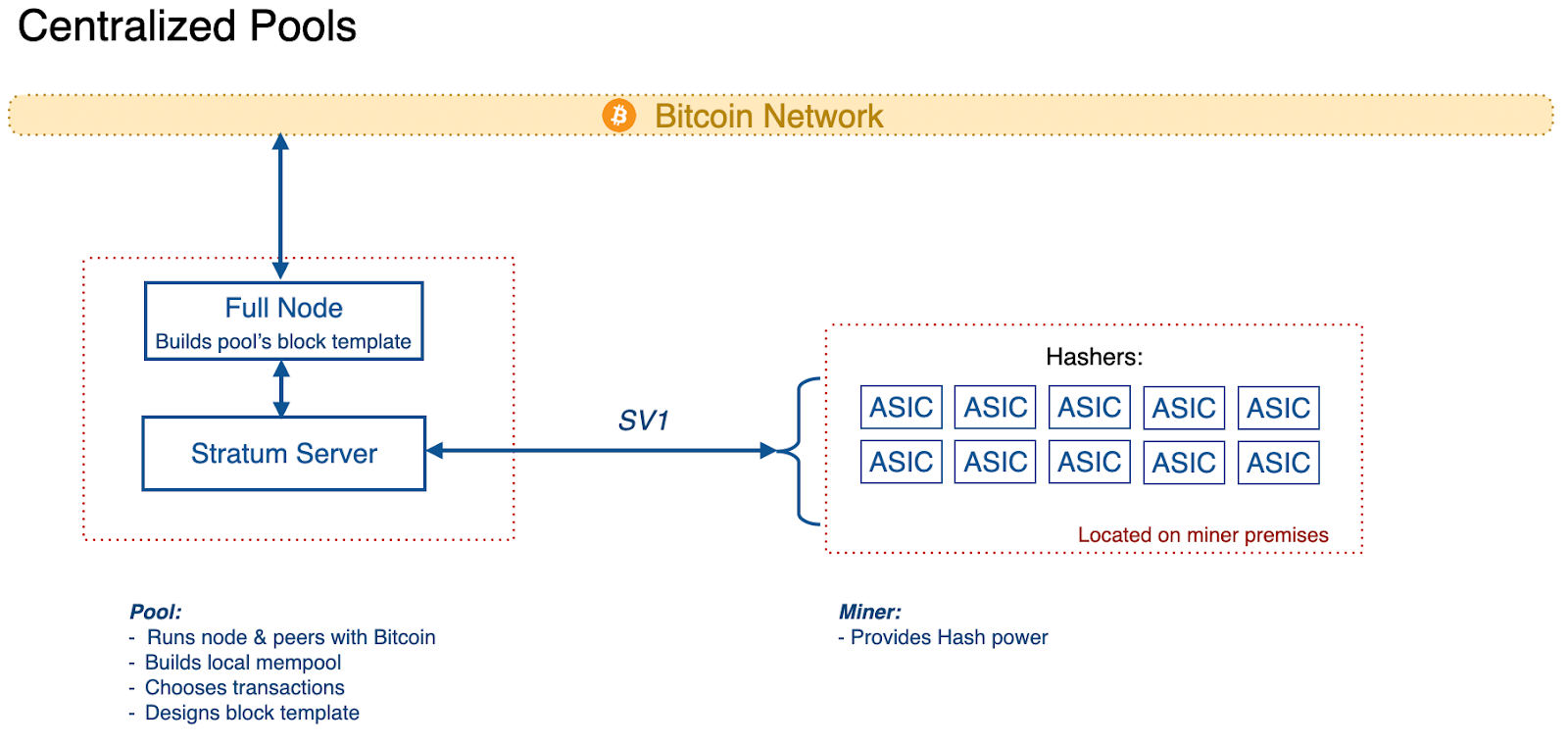
Foundry USA holds about 24% of network hashrate. The top three pools combined exceed 60%. You can watch that current pool hashrate distribution shift as blocks land. That concentration is a single point of pressure. Governments and regulators can lean on two or three companies and reshape what enters the chain. It is the most plausible attack surface against Bitcoin's neutrality.
As of September 2026: Foundry USA controls about 24.37% of global hashrate. AntPool sits near 20.96%. The combined share of the top three pools is about 61.6%. We track these figures on Simple Mining pool stats (7-day average) and review them on a rolling basis.
The 2023 Ordinals fee spikes showed what pool discretion looks like in practice. A small set of operators decided how to handle inscription traffic. Some pools filtered the new transactions. Others did not. The choice affected every Bitcoin fee market for months. The episode was not theoretical. It demonstrated how few hands sit at the controls.
In April 2026, Tether announced it would point hashrate at Ocean using DATUM. That deployment moved DATUM from niche project to a protocol with institutional weight behind it. Pool diversification depends on hashrate and not on opinions. Every gigawatt routed to a DATUM-supporting pool changes the math for the next operator deciding where to mine.
How Block Template Control Affects the Network
The pool that builds the template picks the transactions. A pool with enough hashrate can refuse transactions from sanctioned addresses. It can deprioritize Ordinals traffic or reorder fees to favor partners. That power was never supposed to live with intermediaries. Satoshi's design assumed each proof-of-work participant ran a full node and built blocks from its own view of the mempool.
Picture a court order naming three pool operators. Those three control more than half of network hashrate. A compliant filter on their templates could remove flagged transactions from over half of confirmed blocks within hours. The chain keeps running. Confirmation times stay normal. The neutrality assumption does not survive. That is the scenario DATUM is built to make harder.
The Case for Miner Sovereignty
Miner sovereignty means the operator controlling the hashrate also controls the block. DATUM restores that link. Each miner running the protocol becomes a real participant in chain construction and not a hash mercenary. Mining solo hands over the same control with no pool involved at all, and operators can model solo mining without a pool to see the block odds that keep almost everyone from taking that route.
How DATUM Works
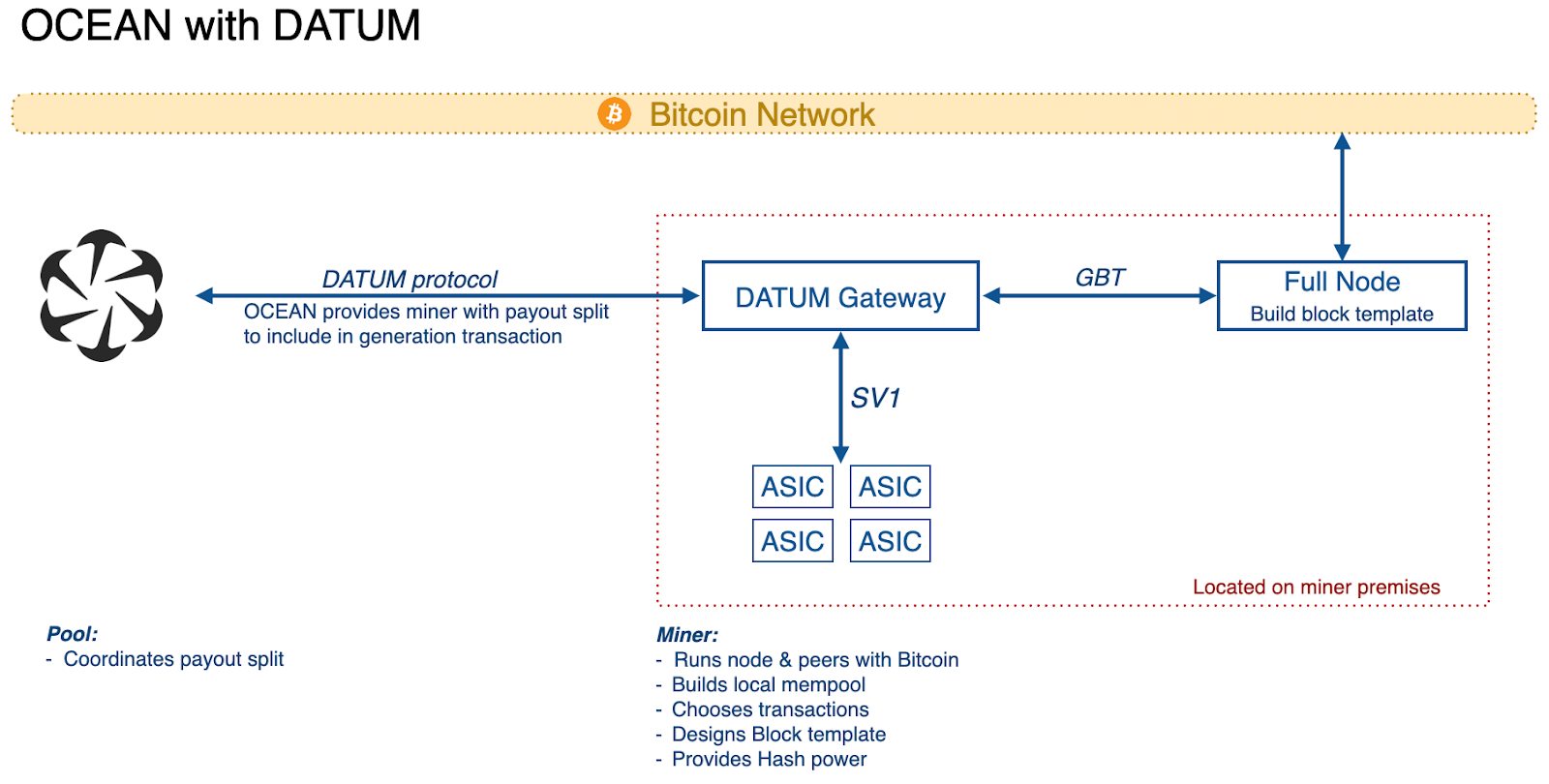
DATUM splits the old pool role in two. The miner builds blocks. The pool tracks contributions and splits payouts.
Block Template Construction
A miner runs a Bitcoin full node and the DATUM Gateway on the same machine or a co-located server. The node holds the mempool. The Gateway pulls transactions and assembles a candidate block. It feeds the work to the ASIC over Stratum v1 with version rolling.
The Gateway speaks three protocols at once. It talks to the Bitcoin node over RPC using getblocktemplate. It talks to the ASIC over Stratum v1 with ASICBoost extensions. It talks to Ocean's DATUM Prime over an encrypted custom protocol. The miner sees a normal Stratum endpoint. The pool sees normal share submissions. The decentralization happens in the middle.
Transaction Selection by Individual Miners
The miner sets the rules for which transactions go in. A nation-state operator can prioritize domestic payments. A privacy-focused miner can accept transactions other pools filter out. A fee-optimizing miner can chase the richest mempool slots without waiting for the pool's view.
How Pools Coordinate DATUM Mining
The pool still exists. Ocean coordinates the reward split through TIDES (its transparent non-custodial payout system that calculates each miner's share from a rolling window of work). The pool pays each contributor through the coinbase transaction. Payouts go to miner-owned addresses with no pool-held balance. The pool validates blocks during the beta phase. A future version will blind the pool to the contents of the template.
The TIDES window covers about the last eight blocks of network difficulty. Payouts arrive on every block Ocean finds. There is no withdrawal step. There is no pool-held wallet. The miner's payout address sits in the coinbase output of the block itself.
DATUM vs Stratum V2
Both protocols address pool centralization. They take different paths.
| Feature | DATUM | Stratum V2 |
|---|---|---|
| Block template control | Always miner-constructed | Optional miner-side via Job Negotiation |
| Origin | Built from scratch by Ocean | Extension of Stratum v1 by Braiins |
| Pool adoption | Ocean | Braiins Pool, with partial support elsewhere |
| Encryption | Custom protocol between Gateway and DATUM Prime | Native end-to-end encryption |
| Primary focus | Restoring miner sovereignty | Efficiency plus optional decentralization |
DATUM was designed for one job. Stratum V2 layered decentralization onto an older protocol that also packaged efficiency improvements. Both are useful. DATUM is more opinionated.
The practical choice for an operator comes down to pool selection. A miner that wants miner-side templates today and connects to Ocean runs DATUM. A miner that wants miner-side templates today and connects to Braiins Pool runs Stratum V2 with Job Negotiation. The two protocols are not competitors at the miner level. They are different paths to the same goal.
Why Miners Use DATUM
Miners adopt DATUM for four reasons.
- Censorship resistance. Each miner picks its own transactions, which dilutes any single entity's filter.
- Transparent transaction selection. The operator sees what its ASIC is hashing on.
- Non-custodial payouts. Rewards flow through Ocean's coinbase transaction to the miner's address.
- Lower pool fees. Ocean discounts the standard 2% fee to 1% for DATUM miners. Simple Mining's partnership rate with Ocean is 1% by default.
The 1% fee gap looks small on paper. It compounds. An operator running 100 modern units at 480 TH/s each generates 48,000 TH/s. Assume a hashprice near $39.76 per PH per day. That fleet produces about $1,908 in gross revenue per day. A 1% pool fee saving captures $19.08 per day. Across a 12-month contract that adds up to about $6,964 in extra Bitcoin kept by the miner. The number scales with fleet size and hashprice. The lever is real.
DATUM Challenges and Considerations
DATUM has real tradeoffs.
- Technical complexity. A solo operator needs a synced Bitcoin full node with Bitcoin Knots recommended for fine template control. The Gateway runs on Linux. The node needs fast storage and a stable connection.
- Limited pool support. Ocean is the production DATUM pool today. Until more pools ship support, a DATUM miner is also choosing Ocean.
- Beta software. DATUM Gateway is at v0.4.1beta. The specification can change before v1.0. Operators accept short-notice upgrade requirements.
Two failure modes show up most often in the field. The most common is an under-resourced node. The node lags behind the network. The Gateway feeds stale templates. The miner submits stale shares. Mitigation: oversize the node host's CPU and use NVMe storage.
The second failure mode is network latency between the Gateway and the pool. Submissions arrive late. Shares expire before validation. We watch for this in the dashboard as a rise in stale share percentage. Mitigation: place the Gateway on a host with a stable connection and avoid residential ISPs for production setups.
How DATUM Affects Hosted Mining
Hosted miners do not configure DATUM themselves. The hosting provider runs the node and the Gateway. The provider also handles the pool connection. Clients keep their existing ASIC hardware and inherit the protocol's benefits.
Simple Mining clients can point hashrate at Ocean today and pay the 1% partnership fee. We monitor the DATUM Gateway release cadence and apply updates during planned maintenance windows. That removes the upgrade-pressure issue that catches solo operators off guard.
Our operations team treats Bitcoin Knots node uptime as a first-class metric for any client routed to Ocean with DATUM. If the node degrades, the Gateway falls back to a known-good template source. The client's hashrate keeps earning. The decentralization benefit pauses for the duration of the fallback. That is the kind of operational nuance that does not appear in protocol documentation but shows up in real fleets.
How to Get Started with DATUM
The self-managed path takes four steps.
- Run a Bitcoin full node. Bitcoin Knots is recommended for full template control. Bitcoin Core works but limits customization.
- Install the DATUM Gateway. The current release lives on Ocean's GitHub repository. Ubuntu users can install through the official PPA.
- Point your ASIC at the Gateway. Configure the miner with the Gateway's Stratum v1 endpoint.
- Connect the Gateway to Ocean. Use Ocean's DATUM Prime address and your Bitcoin payout address.
If self-hosting is not the path you want, hosted mining removes every step above.
FAQs
Does DATUM require special mining hardware?
DATUM does not require new hardware. Any current-generation ASIC that speaks Stratum v1 with version rolling is compatible. The protocol change happens in software between the miner and the pool.
Can I use DATUM with Bitmain Antminers?
Yes. Antminers running standard firmware connect to the DATUM Gateway over Stratum v1. The Gateway handles translation between the miner and the pool. Specialty firmware is not required.
Is DATUM the same as solo mining?
DATUM is not solo mining. Solo miners keep the entire block reward but wait years between blocks. DATUM miners build their own templates and still receive smoothed payouts through Ocean's pool. The block construction is solo. The payout is pooled.
Will switching to DATUM change my mining rewards?
DATUM does not change the math behind pool payouts. Ocean pays through TIDES regardless of whether you run DATUM. The fee rate drops from 2% to 1% on Ocean for DATUM miners. Lower fees translate into a small uplift in mined Bitcoin over a 12-month contract.
Does DATUM affect my KYC status?
DATUM does not change your KYC profile. KYC status depends on pool selection and wallet hygiene. Ocean is non-custodial and pays direct to miner-owned addresses through the coinbase transaction.
The Path Forward for Bitcoin Mining Decentralization
Bitcoin is only as decentralized as its block construction. DATUM is the most direct fix on the table. Stratum V2 carries part of the load on the Braiins side. More pools will ship support over time. The protocol war is over how blocks get built. The winner is whichever framework moves the most hashrate.
If you want to point hashrate at Ocean with DATUM and pay a 1% pool fee, schedule a free consultation with our team.