

Bitcoin vs Gold: Which Is the Better Inflation Hedge
By Josh Heine, Content Strategist at Simple Mining
Updated June 23, 2026Published September 18, 2024
Bitcoin vs gold is the defining store-of-value debate for investors who want to protect purchasing power. Gold brings thousands of years of monetary history. Bitcoin brings a fixed supply of 21 million coins and a digital-native design. Both resist the debasement that erodes cash. The right pick depends on your time horizon and your tolerance for volatility.
On this page · 12 sections
- What Is Bitcoin?
- What Is Gold?
- What Is the Salability Framework?
- Bitcoin vs Gold as Inflation Hedges
- Bitcoin vs Gold Historical Performance
- Bitcoin vs Gold Supply and Scarcity
- Bitcoin vs Gold Volatility and Risk
- How to Invest in Bitcoin vs Gold
- Can Bitcoin Mining Strengthen Your Inflation Hedge
- Should You Own Bitcoin or Gold or Both
- FAQs
- Why Miners Treat Bitcoin as a Long-Term Hedge
Key Takeaways
- Gold protects purchasing power with a multi-century record while Bitcoin offers higher upside and sharper swings.
- Bitcoin's 21 million cap makes its scarcity mathematical while gold's scarcity stays geological.
- Over short crises Bitcoin has traded like a risk asset while gold has acted as insurance.
- You can hold either asset through funds or buy it outright and Bitcoin adds a third path through mining.
- The salability framework judges money across scale, space, and time. Bitcoin scores high on all three. Gold falls short on scale and space.
- Many investors own both because gold and Bitcoin play different roles in a portfolio.
What Is Bitcoin?
Bitcoin is decentralized digital money with a supply capped at 21 million coins. It runs as open software across a global network of computers. No single company or government controls it. Bitcoin launched in 2009 as an alternative store of value and payment rail. Many investors hold it for the same reason they hold gold, as protection against currency debasement.
What Is Gold?
Gold is a physical precious metal that has served as money and reserve for thousands of years. Its value comes from scarcity, durability and broad acceptance. People use gold in jewelry, electronics and dentistry. Central banks hold it as a reserve asset which anchors its monetary role. That long record is the core of the gold inflation-hedge case.
What Is the Salability Framework?
The salability framework judges money across three dimensions: scale, space and time. In The Bitcoin Standard, economist Saifedean Ammous argues that sound money must hold up on each one. Salability across scales means it divides for any size of payment. Salability across space means it moves from place to place at low cost. Salability across time means it holds value into the future, the dimension Ammous calls hardness.
The framework also explains how money evolved. Gold won on salability over centuries, but its weight forced trust into vaults and paper claims. That shift opened the door to fiat money, which fails across time through inflation. Bitcoin is the first asset to score high on all three without a central authority.
Here is how the two compare on each dimension, with fiat as context:
| Salability Dimension | Gold | Bitcoin | Fiat |
|---|---|---|---|
| Across scales (divisibility) | Poor without centralization. Hard to divide for everyday use. | Excellent. Divides to eight decimals (satoshis). | Excellent in digital form. |
| Across space (portability) | Poor. Heavy and expensive to move. | Excellent. Sends worldwide in minutes. | Good in digital form, but bank-dependent and open to censorship. |
| Across time (store of value) | Strong. Scarce by nature, durable, century-tested. | Superior. Capped at 21 million with issuance that approaches zero. | Poor. Unlimited supply growth via central banks. |
Bitcoin's case as the better inflation hedge sits on this framework. Gold solves the store-of-value problem but falls short on scale and space. Bitcoin answers all three.
Bitcoin vs Gold as Inflation Hedges
Both Bitcoin and gold hedge against inflation, but they work on different timelines and with different volatility. Gold offers a proven record across centuries of currency failures. Bitcoin offers a fixed supply that no central bank can inflate. Gold tends to hold steady. Bitcoin tends to deliver larger gains with deeper drawdowns.
How Bitcoin Protects Against Inflation
Bitcoin protects against inflation through a hard supply cap that no authority can raise. The protocol allows 21 million coins and no more. No central bank can print extra to fund deficits. New supply enters through mining and the issuance rate falls over time. Fixed scarcity drives the digital gold thesis.
Some investors mine Bitcoin rather than buy it, stacking coins through hashrate instead of market orders.
How Gold Protects Against Inflation
Gold protects against inflation through a long record of holding value as currencies lose it. Mining adds new gold each year but the pace stays slow. Its scarcity comes from geology, not from a printing decision. Central banks hold thousands of tons as reserves which validates its monetary role. When trust in paper money falls, gold tends to hold its footing.
Which Protects Purchasing Power Better
Neither asset wins for every investor. Gold offers stability over long horizons. Bitcoin offers higher upside with more risk.
Over short inflation spikes the two diverge. In 2022 Bitcoin fell with stocks while gold held up better. That makes Bitcoin a long-horizon hedge against monetary debasement, not a short-term crisis hedge yet. The answer depends on your time horizon and your risk tolerance.
| Feature | Gold | Bitcoin |
|---|---|---|
| Scarcity mechanism | Geological and hard to mine | Mathematical with a 21 million cap |
| Supply growth | About 1% to 2% a year | Fixed and falling toward zero |
| Track record as a hedge | Thousands of years | About 15 years |
| Volatility | Low to moderate | High |
| Behavior in a panic | Acts as insurance | Has traded like a risk asset |
| Portability | Heavy and hard to move | Sends worldwide in minutes |
| Custody | Vaults and dealers | Self custody or an ETF |
Bitcoin vs Gold Historical Performance
Bitcoin has produced the highest returns of any major asset over the past decade while gold has climbed in a slow steady line, and the full record of Bitcoin returns and drawdowns covers the entry-point math behind that headline. Their return profiles sit at opposite ends. Bitcoin behaves like a high-growth asset. Gold behaves like a wealth preserver.
How Gold and Bitcoin Returns Compare
Bitcoin has grown from a fringe experiment into a major asset over the past decade. The gains have been large and the drawdowns have been brutal. Several cycles have cut its price by more than 70% from a peak. It rewards patience and punishes leverage. Treat it as a high-risk growth holding, not a savings account.
The Bitcoin Power Law is one model that maps this long-term growth to a math curve.
Gold has appreciated in a steady climb with far less volatility than Bitcoin. It has set repeated record highs across multi-year stretches. The path stays smoother and the swings stay smaller. Gold trades stability for slower growth. That profile suits investors who value capital preservation.
Performance During Economic Crises
In a crisis gold tends to act as insurance while Bitcoin has often sold off with risk assets. Gold rose or held through past downturns. Bitcoin dropped hard in the 2020 crash and again through 2022. Its short-term link to stocks fades and returns as markets shift.
The Bitcoin vs gold correlation chart tracks this in real time.
Bitcoin vs Gold Supply and Scarcity
Supply is the heart of the inflation-hedge case, and both assets are scarce in different ways. Scarce assets resist debasement because no one can flood the market. Gold relies on geology. Bitcoin relies on math.
Bitcoin's Fixed 21 Million Cap
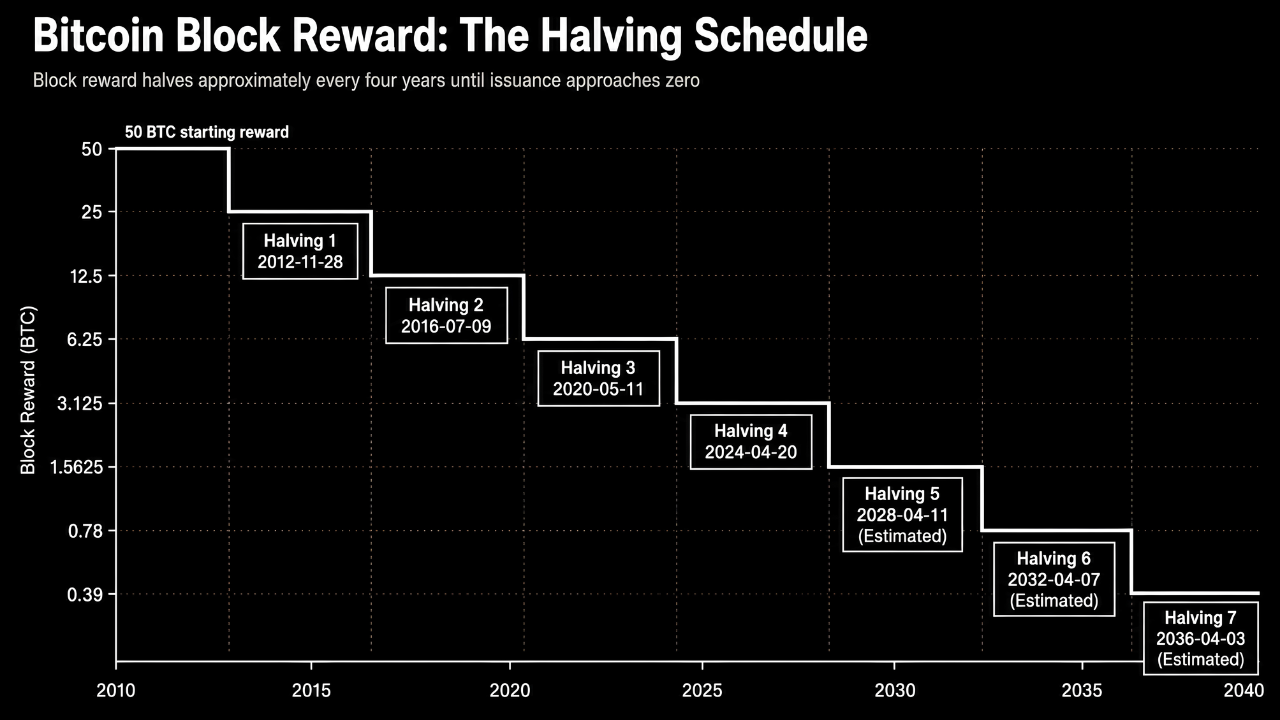
Bitcoin's supply is capped at 21 million coins by its source code. Miners earn new coins for securing the network. The reward cuts in half about every four years in an event called the halving. Each halving slows new issuance until it reaches zero. The schedule is public and predictable to the single coin.
Gold's Ongoing Mining Output
Gold's supply grows each year through mining but the increase stays small. New supply adds about 1% to 2% to the above-ground stock each year per the World Gold Council. Big new discoveries grow rare and extraction costs rise over time. Gold has no hard cap, yet its slow growth limits debasement. Its scarcity is real but less certain than Bitcoin's fixed cap.
Why Scarcity Matters for Hedging
Scarcity matters because an asset no one can overproduce holds value as money loses it. Bitcoin's scarcity is mathematical and known to the coin. Gold's scarcity is geological and harder to predict. Both beat fiat currency, which expands at the will of central banks. That is why each one draws inflation-wary investors.
The Stock-to-Flow ratio measures existing supply against annual new supply. A high ratio signals a hard money. Gold sits around 60. Bitcoin's ratio climbs with every halving and now exceeds gold's, the basis for the digital gold thesis.
Bitcoin vs Gold Volatility and Risk
Bitcoin swings far more than gold, and that volatility is the price of its higher upside. Volatility is not the same as risk, but it tests your nerve. Gold gives a calmer ride. Bitcoin demands a stronger stomach.
Bitcoin Volatility Explained
Bitcoin is volatile and can move double digits in a single day. Its market is younger and smaller than gold's. Thin liquidity and rapid adoption shifts amplify the swings. Drops of 20% or more happen in normal cycles. The upside has rewarded holders who ride out the storms.
Gold Volatility Explained
Gold carries low to moderate volatility and tends to move against traditional markets in a downturn. Its price drifts more than it spikes. Deep institutional ownership steadies the market. Gold often rises when stocks fall, which earns its safe-haven name. That stability is the trade-off for slower long-run growth.
How Risk Tolerance Shapes Your Choice
Your risk tolerance should drive the mix more than any forecast. The common mistake is buying Bitcoin at a top and panic-selling the next drop. A long horizon and steady accumulation soften that risk. Conservative investors lean toward gold for preservation. Growth investors lean toward Bitcoin for upside.
Many split the difference and hold both.
- Conservative profile: Values capital preservation and a longer time horizon, and leans toward a gold-heavy allocation.
- Growth profile: Accepts short-term volatility for long-term upside and leans toward a Bitcoin-heavy allocation.
- Balanced profile: Holds both assets for diversification across different risks.
How to Invest in Bitcoin vs Gold
You can buy each asset on the open market or hold it through a fund, and Bitcoin adds a third path through mining. Each route trades convenience against control. Direct ownership gives you the asset itself. Funds give you ease at the cost of counterparty exposure.
Buying Bitcoin or a Bitcoin ETF
You can buy Bitcoin on an exchange and self-custody it, or hold a spot Bitcoin ETF for simplicity. Self-custody means you hold the keys and carry full responsibility. A spot ETF skips the keys but adds counterparty exposure, and the daily creations and redemptions at each US spot Bitcoin ETF show how much capital has taken that route since January 2024. Direct coins give you true ownership and the option to mine. The trade-off is custody duty against ease of access.
Buying Physical Gold or Gold ETFs
You can buy physical gold as bullion or coins, or hold a gold ETF for convenience. Physical gold removes counterparty risk but needs secure storage and insurance. A gold ETF trades that burden for counterparty exposure. Bullion sits idle and pays nothing while it waits. Both give exposure without the option to produce more.
Mining Bitcoin as an Alternative
Mining is a third path that lets you earn new Bitcoin instead of buying it. Miners run specialized computers that secure the network and earn block rewards. Mining turns a one-time purchase into ongoing accumulation. Running hardware at home brings noise, heat and power headaches. Hosted mining services like Simple Mining let you own the machines while a facility handles the rest.

Can Bitcoin Mining Strengthen Your Inflation Hedge
Mining can strengthen an inflation hedge by turning one purchase into a stream of new Bitcoin over time. It lets you accumulate through every market phase rather than timing one entry. Buying locks in a single price. Mining spreads your cost across the cycle. The case for mining over buying depends on your power rate and your horizon.
Accumulating BTC Through Hashrate
Hashrate is the computing power a miner contributes to the Bitcoin network. More hashrate means a larger share of the block rewards. Mining produces new Bitcoin in bull and bear markets alike. You stack sats through the cycle instead of guessing the bottom. Returns track hashprice and network difficulty.
Mining vs Buying for Long-Term Holders
Buying gives you Bitcoin today while mining gives you a flow of Bitcoin at a variable cost. A purchase is simple and instant. Mining adds operating costs, hardware wear and execution risk. Profit depends on your power rate, the hardware and the network. Hosted operations remove the infrastructure burden while you keep ownership.
A modern ASIC drawing 3.5 kW at $0.07 per kWh runs near $173 in power a month at 95%+ uptime. Simple Mining hosts at that low rate with precision billing, so you pay for actual hashing time. When price outruns hashrate, mined Bitcoin can beat a dollar-cost average. Run your own numbers with the Bitcoin mining calculator.
Should You Own Bitcoin or Gold or Both
Many investors own both because gold and Bitcoin solve different problems. Gold supplies stability and crisis insurance. Bitcoin supplies growth and digital-native upside. Together they cover more scenarios than either alone.
The Case for Diversification
Diversification works here because gold and Bitcoin seldom fail at the same time for the same reason. Gold anchors a portfolio when markets break. Bitcoin lifts a portfolio when adoption climbs. Holding both smooths the ride and keeps you exposed to each thesis. Neither one cancels the other out.
Portfolio Allocation Strategies
A sound allocation flows from your age, your risk tolerance and your time horizon. Some investors hold gold as the core and Bitcoin as the satellite. Others flip that order as conviction grows. None of this is financial advice, so size each position to your own plan.
- Core-satellite approach: Hold one asset as the foundation and the other as a growth kicker.
- Equal-weight approach: Split exposure between the two inflation hedges.
- Dynamic approach: Adjust the mix as market conditions and your situation change.
FAQs
What if you bought $1,000 of Bitcoin ten years ago?
Bitcoin ranks among the best performing assets of the past decade. A small stake from ten years ago would have grown by a wide margin through several boom and bust cycles. Past performance is no guarantee of future returns.
Will gold be replaced by Bitcoin?
Gold and Bitcoin can coexist as separate stores of value. Gold keeps its place in central bank reserves while Bitcoin grows as a digital-native alternative. One asset replacing the other is not the base case.
Is Bitcoin legal to own and invest in?
Bitcoin is legal to own in most developed countries including the United States. Rules differ by region so confirm your local laws before buying. Tax treatment also varies from place to place.
How do Bitcoin and gold taxes compare?
In the United States both Bitcoin and gold count as property for tax purposes. Capital gains tax applies when you sell either one at a profit. Reporting rules and collectible tax rates can differ between them.
Can Bitcoin lose all its value?
Bitcoin going to zero would require its global base of users, miners and institutions to abandon it. That outcome grows less probable as adoption widens. No asset carries zero risk so size your position with care.
Why Miners Treat Bitcoin as a Long-Term Hedge
The people closest to Bitcoin often hold the strongest conviction in it. Miners produce the asset block by block and watch the network grow from the inside. They treat Bitcoin as the hardest money available and the cleanest hedge against debasement. Gold preserves what you hold. Bitcoin lets you accumulate more of it over time.
Test hosted mining with a 7-day risk-free trial and 235 TH/s of hashrate at Simple Mining.