
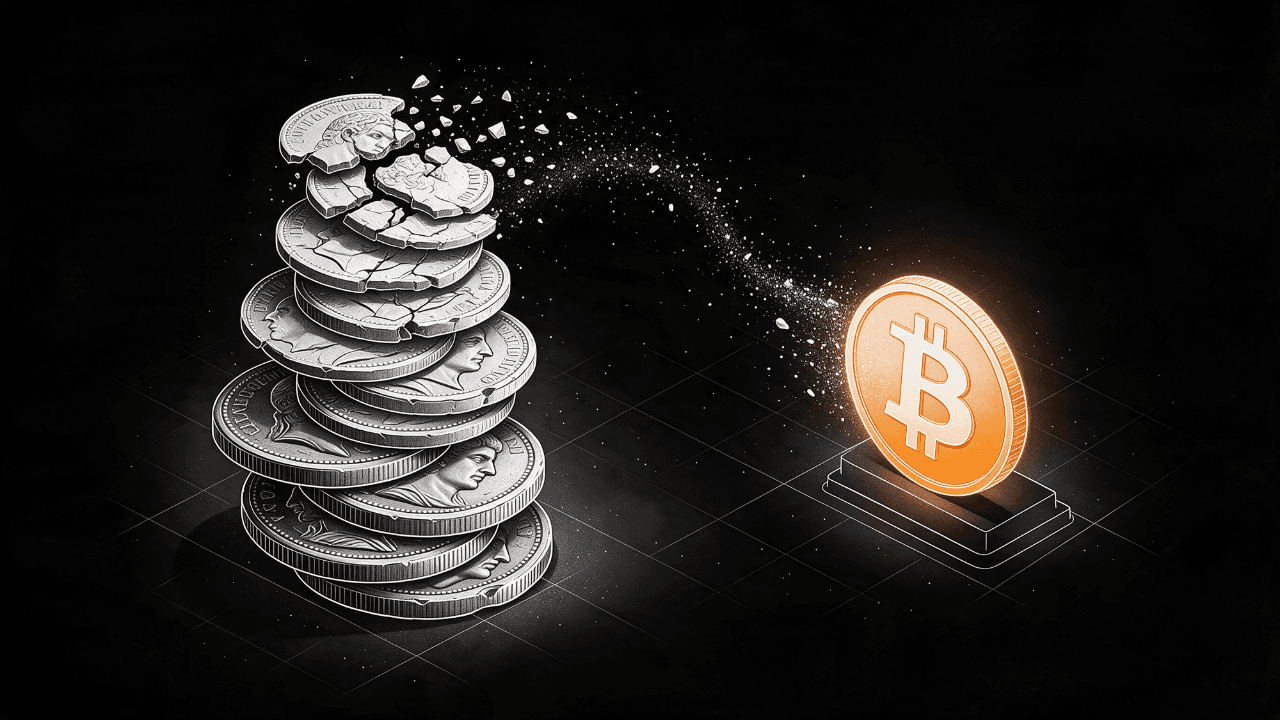
Debasement Trade: What Dollar Debasement Means for Bitcoin
By Josh Heine, Content Strategist at Simple Mining
Published September 25, 2026
The debasement trade is the move out of dollars and into assets no government can print: gold and Bitcoin. Investors make it because federal debt, money creation, and deficits look set to erode what a dollar buys. JPMorgan strategists put the phrase into wide use in October 2024, and gold carried the trade's first leg with a 62.9% gain in 2025. Bitcoin's case rests on something gold cannot offer: a supply cap that every node enforces. This guide covers what the trade is, what debases a currency, how each asset has done, and where mining fits.
On this page · 13 sections
- What Is the Debasement Trade?
- What Is Dollar Debasement?
- What Causes Dollar Debasement?
- Dollar Debasement vs. Inflation
- How Debasement Erodes Purchasing Power
- Assets Investors Use in the Debasement Trade
- Gold vs. Bitcoin in the Debasement Trade
- Why Bitcoin Fits the Debasement Trade Thesis
- How Bitcoin Mining Fits the Debasement Trade
- Risks of the Debasement Trade
- How to Participate in the Debasement Trade
- FAQs About the Debasement Trade
- Earning Bitcoin at Production Cost
Key Takeaways
- The trade moves capital out of the dollar and into scarce assets. JPMorgan strategists popularized the phrase in a note dated October 3, 2024.
- Gold rose 62.9% in 2025. JPMorgan later called Bitcoin the trade's main expression, until positioning reversed in early May 2026.
- M2, the broad money supply, grew about 40% from February 2020 to February 2022, and CPI inflation peaked at 9.1% in June 2022.
- Bitcoin's cap of 21 million coins is enforced by every validating node. More than 95% of it has already been mined.
- The dollar can strengthen and crowded trades can reverse, which is when the trade hurts.
What Is the Debasement Trade?
The debasement trade is an investment strategy that moves capital out of fiat currencies like the dollar and into hard assets like gold and Bitcoin. Charles Schwab frames it that way in its April 2026 explainer, and the goal is to hedge against the loss of purchasing power that unsustainable fiscal and monetary policy can cause. Fiat currency is government money that no commodity backs. Hard assets are scarce things that keep their value because nobody can issue more of them at will.
The phrase came from a bank rather than a Bitcoiner. JPMorgan's Global Markets Strategy team wrote in a note dated October 3, 2024 that rising geopolitical tension and the U.S. election were likely to reinforce "what some investors call the 'debasement trade.'" The same note described gold's rise as a re-emergence of the trade. That wording means the term existed before JPMorgan picked it up. Nobody has documented a single coiner.
What Is Dollar Debasement?
Debasement means cutting what a unit of money is worth while its face value stays the same. Kings once did it by mixing copper into silver coins. Modern governments do it through monetary debasement, creating money faster than the economy grows, which spreads the same output across more dollars. The Federal Reserve does not run a printing press when it eases policy. It creates bank reserves by buying securities from banks and dealers.
Currency Debasement in History
Four episodes show the pattern and one of them is American.
- Rome. Nero cut the denarius from about 98% silver to about 93% in AD 64. Fineness fell to about 57% under Septimius Severus (193 to 211). By 268 the double-denarius held 5% silver or less. The slide took about two centuries.
- Tudor England. Henry VIII's Great Debasement ran from 1544 to 1551. The Royal Mint records that copper replaced silver in groats and pennies to fund wars and royal spending. Sterling fell from 92.5% fine to 25%.
- Coin clipping. Clipping was private fraud rather than state policy. People shaved slivers from hammered coins and spent them at full face value. England's Great Recoinage (Act of January 13, 1696) replaced the worn coins with new ones that had milled edges to show any cut.
- The 1965 dollar. The Coinage Act of 1965 (Public Law 89-81, signed July 23, 1965) removed silver from circulating dimes and quarters. The quarter went from 90% silver to copper-nickel clad over a copper core. The face value never changed.
What Causes Dollar Debasement?
Dollar debasement comes from three sources: monetary expansion, deficit spending, and debt monetization. Each one adds claims on the economy faster than the economy adds goods. The three feed each other. Deficits require borrowing, borrowing invites central bank support, and central bank support expands the money supply.
Monetary Expansion and Quantitative Easing
Quantitative easing is a central bank buying bonds with new bank reserves it creates for the purpose. The purchases push down long-term rates and add money to the banking system. The Fed used it after 2008 and again in 2020.
The numbers set the scale. The Fed's balance sheet peaked at $8.97 trillion on April 13, 2022 per the H.4.1 balance sheet release. The Fed stopped shrinking it on December 1, 2025.
M2 tells the longer story. The broad money supply grew about 40% from February 2020 to February 2022 per the Fed's H.6 release, and its year-over-year growth hit a record 26.8% in February 2021. New money reaches some hands before others, which is the Cantillon effect that turns money creation into a transfer of wealth.
Deficit Spending
A deficit is spending that tax revenue does not cover. The Treasury fills the gap by selling bonds. A bond is a promise to pay dollars later, and every new bond adds to the claims on future dollars. Gross federal debt passed $40 trillion on August 18, 2026, and the US debt crisis is the reason the trade has an audience.
Debt Monetization
Debt monetization is a central bank buying its own government's debt so that money creation replaces borrowing from the public. The Fed is the largest single holder of Treasuries. It buys in the secondary market and frames every purchase as a policy tool rather than financing. Critics call the result de facto monetization. The Fed rejects the label.
Dollar Debasement vs. Inflation
Debasement describes the money and inflation describes the prices. Debasement is measured by money supply growth. Inflation is measured by the Consumer Price Index. The table shows the monetarist view, which treats one as cause and the other as effect.
The monetarist view
| Factor | Dollar debasement | Inflation |
|---|---|---|
| Definition | Expansion of the money supply | Rise in the prices of goods and services |
| Role | The cause | The effect |
| Measurement | M2 growth | Consumer Price Index (CPI) |
The record supports that view with a lag and with exceptions. M2 rose about 40% from February 2020 to February 2022, and CPI peaked at 9.1% in June 2022. Then the link loosened. M2 fell about 1% in 2022 while prices kept rising. Monetary expansion is one cause of inflation and it often works with a lag of a year or more.
Supply shocks, deficits, and expectations move prices too.
How Debasement Erodes Purchasing Power
A dollar saved in 2020 buys about 23% less in August 2026. The table uses the August 2026 CPI-U against the annual average for each start year.
| Year | What $1 from that year buys in August 2026 dollars |
|---|---|
| 1913 | $33.84 |
| 1971 | $8.27 |
| 2000 | $1.95 |
| 2020 | $1.29 |
Savers who hold cash lose to this table every year. Interest can offset the loss when rates run above inflation, and it fails when rates sit near zero as they did from 2020 to 2022. That is the moment the trade is built for. Gold and Bitcoin pay no interest, so they only make sense when the alternative is a currency that shrinks.
Assets Investors Use in the Debasement Trade
Investors express the trade through four asset classes: gold, real estate, commodities, and Bitcoin. Each behaves in its own way when the dollar weakens.
Gold
Gold is the trade's anchor. Central banks bought 863 tonnes in 2025 according to the World Gold Council, a level the council calls historically elevated. The LBMA price set 53 record highs during the year.
Real Estate
Real estate is a traditional hedge that carries rate risk. Mortgage rates track Treasury yields. Land holds value when prices rise. The loan against it gets more expensive when the same forces push yields up.
Commodities
Commodities are priced in dollars, so they tend to rise when the dollar weakens. Oil, copper, and grain also respond to their own supply and demand. The dollar link is real but loose.
Bitcoin
Bitcoin is the newest entry and the most volatile. It has a fixed supply, a global market, and no issuer. The next two sections cover how it has done and why the thesis holds up on paper.
Gold vs. Bitcoin in the Debasement Trade
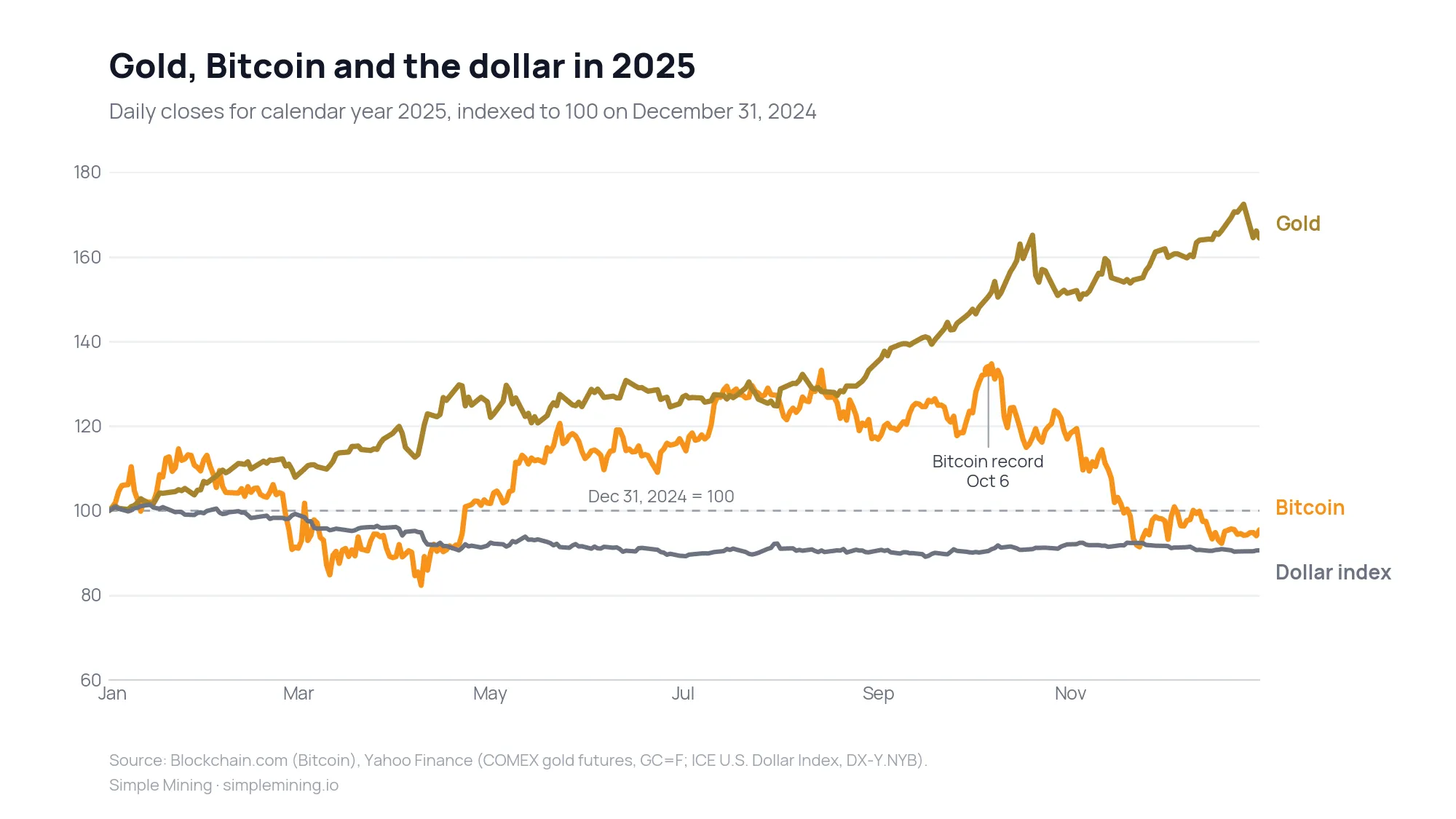
Gold led the debasement trade's first leg, and Bitcoin later became what JPMorgan called its main expression before both pulled back. The table compares the two.
| Gold | Bitcoin | |
|---|---|---|
| 2025 calendar year | +62.9% (LBMA) | about -5% |
| Record high | $5,589.38 spot on January 28, 2026 | about $126,000 on October 6, 2025 |
| Annual supply growth | about 1.7% | about 0.8%, falling to 0.4% after 2028 |
The LBMA Gold Price gained 62.90% from January 2 to December 31, 2025. The dollar index fell about 9% over the same year, and Bitcoin fell about 5%.
Citi's macro team called the trade "quite narrow, really just in gold" in its October 20, 2025 podcast transcript. The balance shifted in 2026. JPMorgan wrote that Bitcoin had been "the main expression of the debasement trade" from the start of the Middle East conflict until positioning reversed in early May, and by June it said both assets were trading more like risk assets than diversifiers, per its June 11, 2026 note. Over a longer window the order flips. Bitcoin traded near $600 in September 2016 and above $84,000 in September 2026, a gain gold has not come close to, and the full Bitcoin vs gold record shows what those gains cost in drawdowns.
Why Bitcoin Fits the Debasement Trade Thesis
Bitcoin fits the thesis on structure rather than track record. The evidence on whether it hedges inflation is mixed, and JPMorgan wrote in April 2025 that Bitcoin's volatility and correlation with equities raise questions over the digital gold narrative.
A Supply Cap Every Node Enforces
Bitcoin's supply is capped at 21 million coins, and the cap is enforced by every validating node. A block that pays more than the rules allow is rejected by the network. More than 95% of that supply has already been mined. The subsidy is 3.125 BTC per block and the next Bitcoin halving at block 1,050,000 cuts it in half around April 2028.
Self-Custody Without a Bank
Self-custodied Bitcoin cannot be frozen by a bank or central bank. The holder of the keys controls the coins and no third party sits in between. Exchange-held and ETF-held Bitcoin can be frozen by court order, because a custodian holds the keys. The property that matters for the trade only exists when you hold the keys yourself.
Portable and Divisible
One Bitcoin divides into 100 million satoshis. A transfer settles in minutes without a courier. Gold trades in fractions too, but physical bars ship and need insurance. Bitcoin's edge is that the smallest unit and the largest transfer use the same rails.
Proof of Work Keeps Issuance on Schedule
Proof of work secures the ledger by making every block expensive to produce. The difficulty adjustment keeps issuance on schedule no matter how much hashrate joins. Blocks keep arriving about every ten minutes whether hashrate doubles or halves. Mining does not create scarcity. The rules do, and mining makes them expensive to break.
How Bitcoin Mining Fits the Debasement Trade
Mining earns Bitcoin at production cost rather than market price. That removes market timing from the purchase but not price risk. Revenue still moves with Bitcoin's price and network difficulty. The cost to mine a Bitcoin depends on hardware, power, and difficulty. Mining changes how you acquire Bitcoin, not the price risk of holding it.
The dollar never leaves the picture. Mined Bitcoin is ordinary income at fair market value on the date of receipt under IRS Notice 2014-21. Hosting fees are invoiced in dollars. The choice between mining vs buying Bitcoin comes down to whether you want production economics on top of price exposure.
Simple Mining offers Bitcoin miner hosting across 11 Iowa data centers with 150+ MW under management and 9+ EH/s hosted. Average uptime runs 95%+ and the hosting service fee is a bundled $0.065 to $0.08 per kWh. New miners bought from Simple Mining ship with 12 months of free protection. That includes free labor for covered repairs, free fan replacements, and a $500/year parts allowance per miner. Parts above the allowance are billed to you.
Risks of the Debasement Trade
The trade carries four risks and each one has hit in the past year.
Crowded Trades Can Reverse
Gold's slide after its January 2026 record is one example. Schwab's Liz Ann Sonders summed it up: "Crowded trades don't need to be wrong to hurt you." A trade that everyone holds only needs the marginal buyer to step back.
The Dollar Can Strengthen
The dollar index gained ground in 2026, and the Fed raised its target range to 3.75 to 4.00% on September 16, 2026. Higher rates pull capital back into dollars and raise the cost of holding assets that pay nothing.
The Narrative Can Fade
Citi called the trade "a narrative, not a fact so far" in October 2025. JPMorgan reported a "broad based retreat" from it by both retail and institutional investors on June 11, 2026. A trade built on a story loses buyers when the story changes.
Volatility and Drawdowns
Bitcoin fell 64% in 2022, and both Bitcoin and gold have fallen sharply from their 2025 and 2026 records. Anyone weighing whether Bitcoin is a good investment should start with its drawdown history.
How to Participate in the Debasement Trade
There are four ways into the trade and each carries a different mix of custody, cost, and price risk.
- Buy and hold. Learn how to buy Bitcoin and move it to a wallet you control.
- Hold a spot ETF. A spot Bitcoin ETF gives price exposure without keys or custody work.
- Dollar-cost average. Buy a fixed amount on a fixed schedule so no single price sets your entry.
- Mine. Learn how to start Bitcoin mining. Then buy Bitcoin miners and let a host run them.
FAQs About the Debasement Trade
Who coined the term "debasement trade"?
No single coiner is documented. JPMorgan strategists popularized the phrase in a note dated October 3, 2024 that described it as what "some investors call" it. The wording shows the term was already in use.
Is the debasement trade over?
JPMorgan reported a "broad based retreat" from the trade on June 11, 2026 as gold and Bitcoin ETFs saw outflows. CNBC reported on August 25, 2026 that the trade had returned after the Treasury, under Secretary Scott Bessent, stepped up its debt buybacks. The trade fades and returns with the news cycle.
Does the Fed print money?
No. The Fed creates bank reserves when it buys securities, and reserves are balances that banks hold at the Fed. Paper currency is printed by the Treasury's Bureau of Engraving and Printing.
What is coin clipping?
Coin clipping was the private shaving of metal from the edges of hammered coins, which were then spent at full face value. It was fraud rather than state policy. England's Great Recoinage of 1696 introduced milled edges to stop it.
Is it too late to join the debasement trade?
The drivers are still in place: federal debt above $40 trillion and a money supply that keeps growing. The counterweights are real too: the dollar can strengthen and the Fed can raise rates, as it did in September 2026. Both sides are real, and the decision is yours.
Earning Bitcoin at Production Cost
The trade is a bet that scarce assets outlast a currency that keeps expanding. Buying Bitcoin puts you in at the market price. Mining puts you in at production cost with the same price risk and a different cost structure. The cheapest way to see the difference is to run one machine. Start with a 7-day free trial on an Antminer S21+ at 235 TH/s in Simple Mining's Iowa data centers.