

What Happened in 1971? The Nixon Shock and the Gold Standard
By Josh Heine, Content Strategist at Simple Mining
Published October 14, 2026
What happened in 1971 is the event that cut the last tie between the US dollar and gold. On August 15, 1971, President Richard Nixon told the nation he had suspended the dollar's convertibility into gold. Foreign governments could no longer trade their dollars for gold at $35 an ounce. The famous "WTF happened in 1971" charts treat that night as the turning point for wages, prices, and debt. The gold link did end that night, but the charts show a correlation and the cause is still debated.
On this page · 12 sections
- What Happened in 1971?
- What Is the Nixon Shock?
- How Did the Gold Standard Work Before 1971?
- Why Did Nixon End the Gold Standard?
- What Happened After the Gold Window Closed?
- When Did the US Go Off the Gold Standard?
- What Do the "WTF Happened in 1971" Charts Show?
- What Is Fiat Currency?
- Why Do Bitcoin Supporters Point to 1971?
- How Does Bitcoin Mining Fit the 1971 Story?
- FAQs About the Nixon Shock
- Mine Bitcoin Under Rules No One Can Change
Key Takeaways
- On August 15, 1971, Nixon closed the gold window, froze wages and prices for 90 days, and put a 10% surcharge on imports.
- Americans lost gold redemption in 1934, and the Nixon shock ended convertibility for foreign governments in 1971.
- The gold window closed because foreign-held dollars had grown larger than the US gold stock.
- The 1971 charts show a correlation, not a settled cause: EPI dates the pay gap to 1979 and Michael Green finds the break in the 1960s.
- Bitcoin supporters point to 1971 because Bitcoin's 21 million cap is set in code, and mining is how new coins enter circulation.
What Happened in 1971?
On August 15, 1971, President Nixon suspended the convertibility of the US dollar into gold in a televised address. Foreign governments could no longer exchange their dollars for gold at the fixed price of $35 an ounce. The same speech froze wages and prices for 90 days and added a 10% surcharge on imports. Those three moves together became known as the Nixon shock.
Nixon presented the gold move as temporary. By March 1973 the fixed exchange rates built around the dollar were gone. No later step has tied the dollar to gold again.
What Is the Nixon Shock?
The Nixon shock is the economic program President Nixon announced on August 15, 1971: an end to gold convertibility, a 90-day wage and price freeze, and a 10% import surcharge. Nixon and fifteen advisers planned it at Camp David from August 13 to 15, 1971. The plan went public that evening in a televised address.
Closing the Gold Window
The gold window was the arrangement that let foreign governments trade dollars for US gold at $35 an ounce. In Nixon's August 15, 1971 address, he put it this way: "I have directed Secretary Connally to suspend temporarily the convertibility of the dollar into gold or other reserve assets." After that night foreign governments could no longer exchange their dollars for gold. This is the part of the speech people mean when they talk about the Nixon gold standard decision.
The Wage and Price Freeze
The second part froze prices and pay across the country. Nixon's words were direct: "I am today ordering a freeze on all prices and wages throughout the United States for a period of 90 days." It marked the first time the US government enacted wage and price controls outside of wartime.
The 10% Import Surcharge
The third part was a tax on goods coming into the country. Nixon framed it in the same speech: "As a temporary measure, I am today imposing an additional tax of 10 percent on goods imported into the United States." The State Department's Office of the Historian describes it as an extra 10 percent tariff on all dutiable imports.
How Did the Gold Standard Work Before 1971?
Before 1971 the dollar was tied to gold through two layers: a domestic rule set in 1934 and an international system set in 1944. Americans had already lost the right to redeem dollars for gold. Foreign governments could still convert at $35 an ounce. The Nixon shock ended that second layer.
The Gold Reserve Act of 1934
President Roosevelt signed the Gold Reserve Act on January 30, 1934. The Act moved the official price of gold from $20.67 an ounce to $35. It also barred the Treasury and financial institutions from redeeming dollars for gold. Private gold ownership was restricted as well, and that rule held until 1974.
The Bretton Woods System
In 1944, 44 countries met in Bretton Woods, New Hampshire, and built a system of fixed exchange rates. Other currencies were fixed to the US dollar, and the dollar was fixed to gold at $35 an ounce. Only foreign governments could convert their dollars into gold. The US held about three-quarters of the world's official gold reserves at the start, so the system seemed secure.
Why Did Nixon End the Gold Standard?
Nixon ended the gold standard because the US no longer had enough gold to cover the dollars held abroad. Runs on gold through the 1960s showed the $35 price was hard to defend. By 1971 the economy at home was under strain too. The chain ran like this:
- Dollars flowed abroad through foreign aid, military spending, and foreign investment.
- Foreign-held dollars grew larger than the US gold stock.
- Markets tested the $35 price, and the defense of that price broke down in 1968.
- Nixon closed the gold window in August 1971.
More Dollars Abroad Than Gold at Home
The system rested on trust that the US could pay out gold for the dollars presented to it. A surplus of US dollars built up abroad from foreign aid, military spending, and foreign investment. Over time there were more foreign-held dollars than the United States had gold. The Federal Reserve's history of the gold window lays out how that gap left the $35 promise exposed.
Runs on Gold in the 1960s
The first big test came on October 20, 1960, when a run in the London gold market sent the price to $40 an ounce. In response, the London Gold Pool was formed on November 1, 1961. The group pooled gold reserves to keep the price at $35 an ounce. France later withdrew from the pool, and the pool collapsed in March 1968.
Inflation and Unemployment Before the Shock
By the end of the 1969 to 1970 recession, unemployment had climbed to 6%. Inflation, as measured by the Consumer Price Index, was 5.4%. Nixon pointed the speech at a different culprit: "The gainers are the international money speculators." The address joined the gold decision, the wage freeze, and the import tax in one package.
What Happened After the Gold Window Closed?
After the gold window closed, the US devalued the dollar twice and then let it float. In the Smithsonian Agreement of December 1971, the United States agreed to devalue the dollar against gold by about 8.5% to $38 an ounce. On February 12, 1973, the US devalued it by another 10% to $42 an ounce. Within a month almost all major currencies floated against the dollar, and the fixed rates of Bretton Woods were over.
The official dollar price of gold tells the story in a few rows.
| Date | Event | Official gold price |
|---|---|---|
| January 30, 1934 | Gold Reserve Act | $35 |
| 1944 | Bretton Woods | $35 |
| August 15, 1971 | Gold window closed | $35, no longer convertible for foreign governments |
| December 1971 | Smithsonian Agreement | $38 |
| February 12, 1973 | Second devaluation | $42 |
| March 1973 | Major currencies float | No fixed peg |
| 1974 | Ford signs law letting Americans own gold again | Market price |
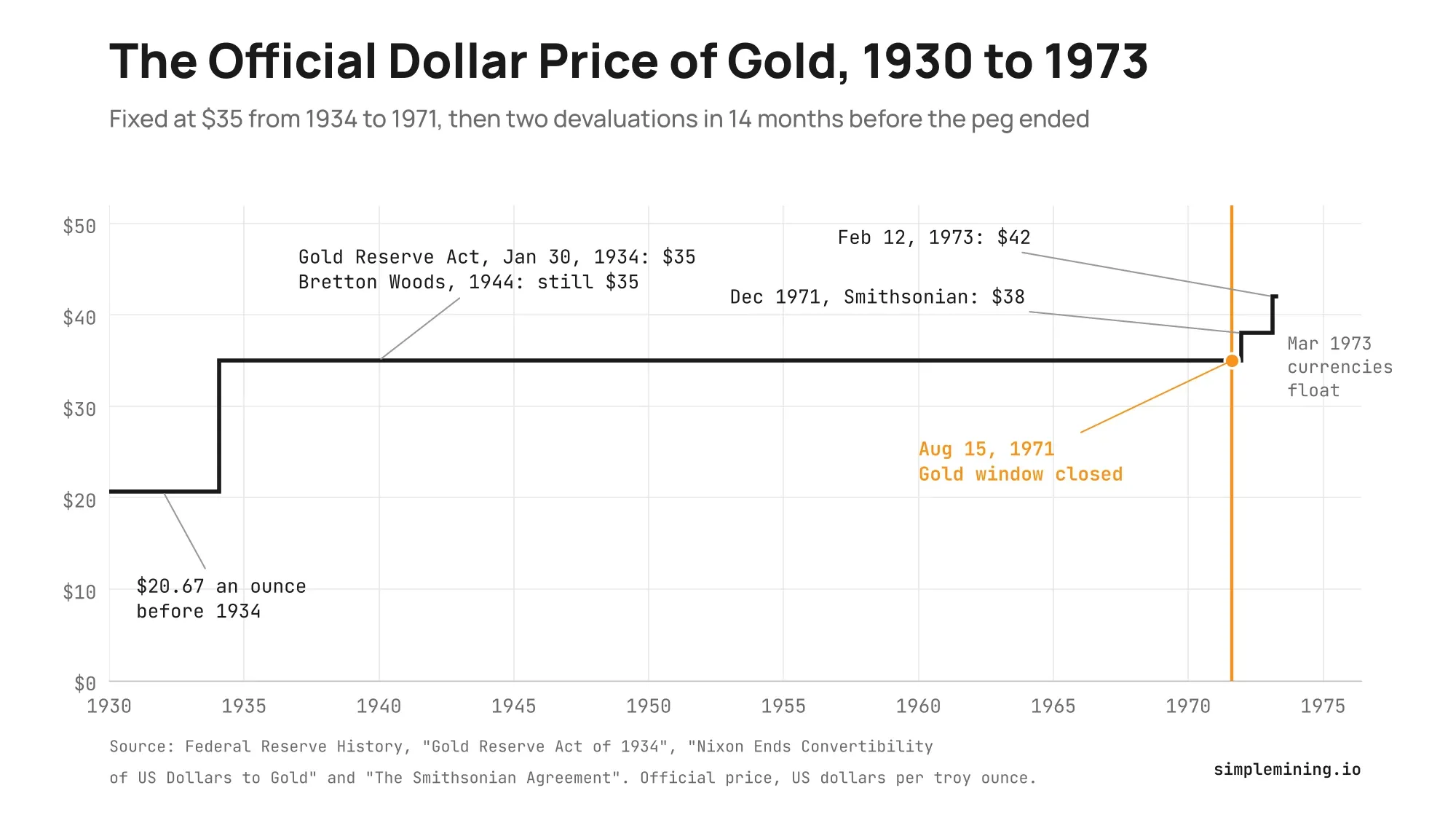
Americans regained the right to own gold under a law President Ford signed in 1974. From then on the price that mattered was the market price. TFTC's look at gold prices since 1971 tracks how that price has moved.
When Did the US Go Off the Gold Standard?
The US went off the gold standard in three stages: 1934, 1971, and 1973. In 1934 the Gold Reserve Act ended the redemption of dollars for gold at home. In 1971 the Nixon shock ended convertibility for foreign governments. In 1973 the fixed exchange rates of Bretton Woods gave way to floating currencies.
If you need one date for the end of the gold standard, use August 15, 1971. That was the day the last gold link on the dollar was cut. The 1973 float made the break permanent in practice.
What Do the "WTF Happened in 1971" Charts Show?
The "WTF happened in 1971" charts show economic lines that bend around 1971. The site wtfhappenedin1971.com collects charts of wages, prices, debt, and inequality around that year. The best-known chart compares worker pay with productivity. Others track cumulative inflation, home prices, and US gold reserves.
The site lets the charts make the case that 1971 was the turning point. They are a fair prompt for questions. They are not proof of cause, and serious critics read the same data another way.
What Critics Say About the 1971 Charts
The main critique is about timing. The Economic Policy Institute's productivity-pay tracker dates the widening gap between productivity and a typical worker's pay to 1979, not 1971. Michael Green's critique argues the break comes earlier, in the 1960s, and points to trade rules instead of the dollar. Green writes that the popular 1971 story "confuses cause and effect."
Neither critic disputes that the gold window closed. They dispute whether that closing explains the lines on the charts.
What 1971 Changed for Certain
1971 removed the last external gold constraint on the dollar. Before August 15, foreign governments could present dollars and ask for gold. After it, no outside gold stock limited how many dollars could exist.
Prices tell part of the story. By the Consumer Price Index, it takes more than eight dollars today to buy what one dollar bought in 1971. New money reaches some people before others, which is the Cantillon effect. Federal debt also grew without a gold limit behind the dollar, the backdrop for the US debt problem.
These measures show change after 1971. They do not prove that 1971 caused each change. An honest reading keeps both facts in view.
What Is Fiat Currency?
Fiat currency is money that cannot be converted into gold, silver, or another commodity. "Fiat" is Latin for "let it be done." Merriam-Webster defines fiat money as "money (such as paper currency) not convertible into coin or specie of equivalent value." Since 1971 the US dollar has had no gold convertibility for anyone.
What happens to a fiat currency over long stretches of time is the subject of our guide to dollar debasement.
Gold Standard vs. Fiat Currency
The two systems differ in what stands behind a dollar and what limits how many exist.
| Feature | Gold Standard (Bretton Woods) | Fiat Currency (Today's Dollar) |
|---|---|---|
| Backing | Gold at $35 an ounce | Collateral held by the Fed, most of it Treasury and agency securities |
| Supply limit | The US gold stock behind the $35 promise | No commodity limit |
| Who sets supply | Central bank decisions, constrained by the gold peg | Central bank decisions, with no gold limit |
| What a dollar can be exchanged for | Gold, for foreign governments only | Not redeemable in gold, silver, or any other commodity |
Why Do Bitcoin Supporters Point to 1971?
Bitcoin supporters point to 1971 because it is the year the dollar lost its last link to a supply limit outside government control. Bitcoin was built with a supply limit written into its code. Its genesis block, mined on January 3, 2009, carries the headline "The Times 03/Jan/2009 Chancellor on brink of second bailout for banks." Supporters read that line as a statement of what Bitcoin was built to stand apart from.
The Bitcoin white paper describes "a purely peer-to-peer version of electronic cash," sent from one party to another without a financial institution in the middle. It notes that commerce on the internet had come to rely on financial institutions serving as trusted third parties. Only 21 million Bitcoin will ever be created, and new coins come from mining. Supporters argue that this makes Bitcoin a form of sound money that no central bank can expand.
Gold played that role until 1971, but one speech was enough to suspend it. We compare the two in depth in Bitcoin vs. gold as an inflation hedge.
None of this is a price forecast. It is the argument Bitcoin supporters make, and the outcome depends on far more than a supply cap.
How Does Bitcoin Mining Fit the 1971 Story?
Bitcoin mining is how new Bitcoin enters circulation on a fixed schedule and how the network is secured. Miners compete to add each block, and the block reward brings new coins into supply. At each Bitcoin halving new issuance is cut on a schedule set in code, not in a weekend meeting at Camp David.
Simple Mining runs 9+ EH/s across 11 data centers. What we watch on every machine is power cost and machine efficiency, not price predictions. When revenue per terahash falls, the least efficient machines are the first to go dark. The halving schedule is a cost input we plan around, not a forecast we trade on.
Bitcoin miner hosting in Iowa puts your machines in our data centers with our team on site. If you need hardware first, you can browse Bitcoin miners for sale and have them deployed in one of our sites.
FAQs About the Nixon Shock
Is the US dollar backed by gold?
No, the US dollar is not backed by gold. According to the Federal Reserve's currency FAQ, Federal Reserve notes are not redeemable in gold, silver, or any other commodity. They have not been redeemable in gold since January 30, 1934. The Fed must hold collateral equal in value to the notes, most of it Treasury and agency securities.
Was the Nixon shock meant to be temporary?
Yes, on paper. Nixon said he had directed Secretary Connally to "suspend temporarily" convertibility, and he called the 10% import surcharge "a temporary measure." Once major currencies floated in March 1973, the end of convertibility became permanent in practice.
Did Nixon blame speculators for ending the gold standard?
Nixon ended the gold standard because foreign-held dollars had grown larger than US gold reserves. Gold runs in the 1960s and the collapse of the London Gold Pool in March 1968 showed the $35 price could not hold. He blamed international money speculators for the pressure on the dollar.
Can Americans own gold today?
Yes, Americans can own gold today. They regained the right under a law President Ford signed in 1974. The Gold Reserve Act of 1934 had restricted private gold ownership for four decades.
Mine Bitcoin Under Rules No One Can Change
1971 showed that a monetary rule can end with one speech. Bitcoin's supply rule lives in code, and miners add each block under it. If you want to see that work from the inside, start with a 7-day free trial on an Antminer S21+ at 235 TH/s. You can watch its hashrate in the client dashboard before you decide on hardware.