
Fractional Reserve Banking Explained: How Banks Create Money
By Josh Heine, Content Strategist at Simple Mining
Published October 22, 2026
Fractional reserve banking is a system in which banks hold only part of their customers’ deposits as reserves and put the rest to work as loans. It’s the reason your bank balance is a promise, not a pile of cash. Many explainers still teach the textbook version, where a bank lends out 90% of each deposit and money multiplies tenfold. In the US, reserve requirements have been 0% since March 26, 2020, and the Bank of England says lending creates deposits, not the other way around. This guide walks through both versions and shows what limits banks today.
On this page · 13 sections
- What Is Fractional Reserve Banking?
- How Does Fractional Reserve Banking Work?
- What Is the Money Multiplier?
- What Is the Reserve Requirement?
- Does the US Still Use Fractional Reserve Banking?
- What Limits Bank Lending Today?
- Where Did Fractional Reserve Banking Come From?
- Benefits of Fractional Reserve Banking
- Risks of Fractional Reserve Banking
- Fractional Reserve vs. Full Reserve Banking
- How Is Bitcoin Different From Fractional Reserve Money?
- FAQs About Fractional Reserve Banking
- Earn Bitcoin From the Network, Not From Credit
Key Takeaways
- Banks hold a fraction of deposits as reserves and lend against the rest, and a deposit is a debt the bank owes you.
- The textbook money multiplier is 1 divided by the reserve ratio, so a 10% ratio implies up to $10 of deposits for every $1 of reserves.
- The Bank of England explains that lending creates deposits and repaying a loan destroys money, the reverse of the textbook sequence.
- US reserve requirements have been 0% since March 26, 2020, so borrower demand, capital rules, liquidity rules, and interest on reserve balances now limit lending.
- Bitcoin issues new coins only to miners on a fixed schedule, with a 21 million cap that no lending can expand.
What Is Fractional Reserve Banking?
Fractional reserve banking is a system where banks keep a fraction of customer deposits as reserves and lend out the rest. Reserves are the cash in a bank's vault plus the balances it holds at the central bank. A deposit is a debt the bank owes you, not cash sitting in a box with your name on it. The bank promises to pay you on demand and counts on not everyone asking at once.
In a fractional reserve banking system, three points matter most.
- Who uses it: Commercial banks, the places where most people keep checking and savings accounts.
- Why it matters: Commercial banks create most of the money in the modern economy when they make loans.
- The catch: A bank can't pay every depositor back at the same time.
How Does Fractional Reserve Banking Work?
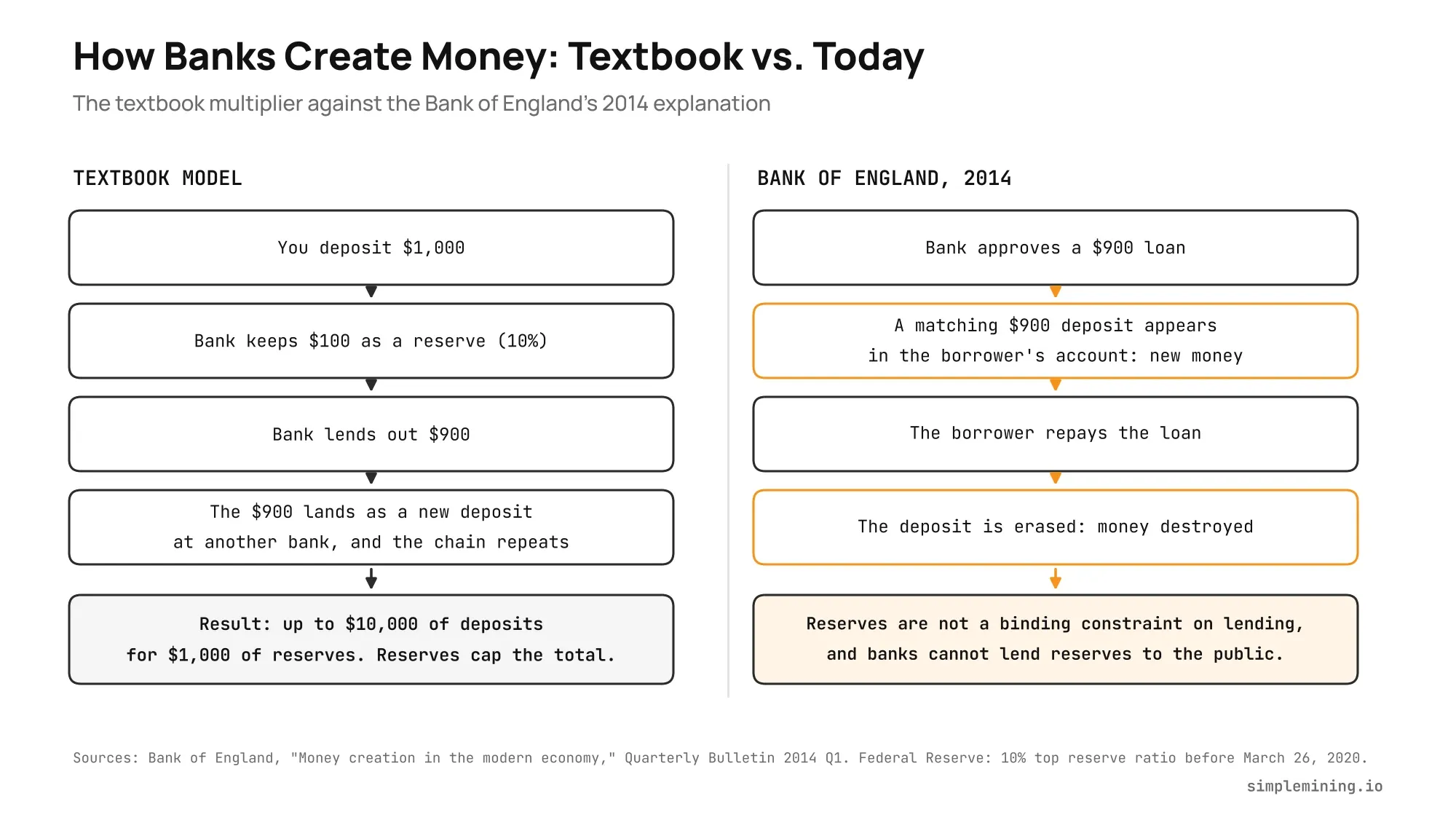
Fractional reserve banking works in four steps: you deposit cash, the bank holds a reserve, the bank lends out the rest, and the loan becomes a new deposit. The walk-through below shows how banks create money from a $1,000 deposit in the textbook version. It uses the 10% top reserve ratio US banks faced before 2020. The sections after it show what changed.
1. You Deposit Cash
You deposit $1,000 in cash at your bank. The bank now owes you $1,000, and you can still spend it with a card or a check. The cash becomes the bank's asset, and your balance becomes its liability.
2. The Bank Holds a Reserve
The bank keeps $100 as a reserve. The reserve ratio is the share of deposits a bank holds as reserves, here 10%. In the textbook model, a regulator sets the minimum ratio and the reserve covers everyday withdrawals.
3. The Bank Lends Out the Rest
The bank lends the other $900 to a borrower as a car loan, a mortgage, or a business loan. It charges the borrower a higher interest rate than it pays you. That gap is the interest spread, and it's how the bank earns income on lending.
4. The Loan Becomes a New Deposit
The borrower spends the $900, and the seller deposits it at another bank. Now there's a new $900 deposit, and your own $1,000 balance hasn't changed. Two people hold spendable money where one did before. In the textbook story, the second bank holds $90, lends $810, and the chain repeats.
What Is the Money Multiplier?
In the textbook model, the money multiplier is 1 divided by the reserve ratio, so a 10% ratio implies up to $10 of deposits for every $1 of reserves. That's the money multiplier formula: multiplier = 1 ÷ reserve ratio. Follow the chain from the last section to its end and a $1,000 cash deposit supports up to $10,000 of deposits across the system. The smaller the ratio, the bigger the multiplier.
The Bank of England describes money creation in the modern economy the other way around. Its 2014 article, Money Creation in the Modern Economy, says "the act of lending creates deposits." The Bank calls this the reverse of the textbook sequence. Whenever a bank makes a loan, it creates a matching deposit in the borrower's account at the same moment.
Money creation runs in reverse too. When a borrower repays a loan, the deposit shrinks and that money is gone. In the Bank's words, "the repayment of bank loans destroys money." The Bank also says banks do not "multiply up" central bank money.
Reserves sit in a separate layer. The reserves that matter here are the balances banks hold at the Fed. Only banks and other deposit-taking institutions can hold them, they move between those institutions inside the Fed's system, and banks don't lend them out to the public. Reserves don't cap how much banks lend. The Bank of England says the amount of money created in the economy depends in the end on the central bank's monetary policy.
What Is the Reserve Requirement?
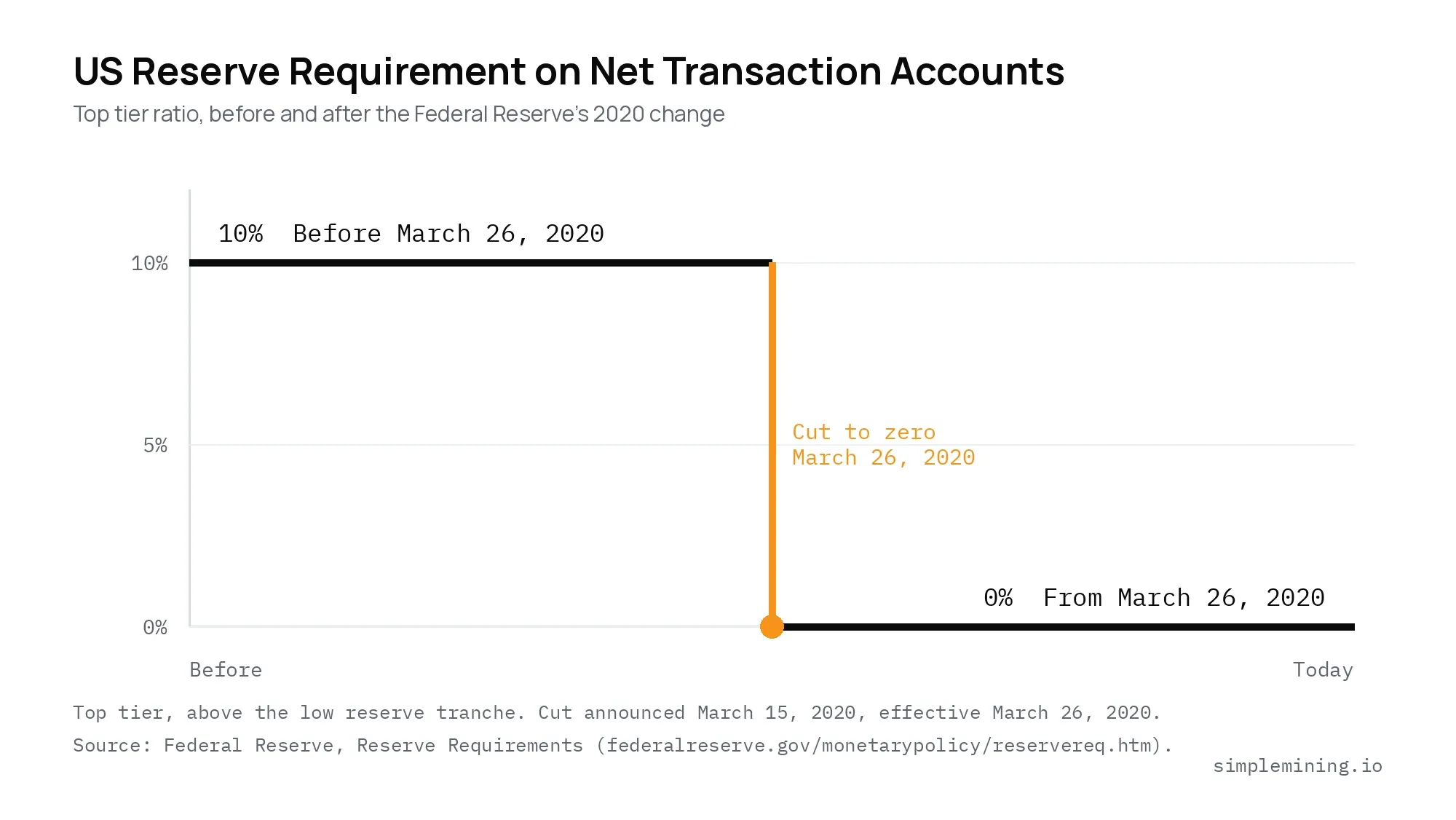
The reserve requirement is the share of certain deposits a bank must hold as reserves, and in the US it has been 0% since March 26, 2020. The Federal Reserve announced the cut on March 15, 2020, and the Fed's reserve requirements page records the change. So the current reserve requirement for US banks is zero.
Before that, net transaction accounts carried 0% up to a $16.9 million exemption, 3% on the low reserve tranche up to $127.5 million, and 10% above it (2020 figures). Net transaction accounts are checking-style accounts.
Does the US Still Use Fractional Reserve Banking?
Yes, the US still uses fractional reserve banking. Banks hold only a fraction of their deposits as reserves, and holding reserves is now a choice, not a legal minimum. Banks keep reserves for liquidity, meaning money on hand to meet withdrawals and payments. They also earn interest on those balances at a rate the Fed's Board sets.
The zero rule removed a legal floor. It didn't tell banks to hold nothing, and it didn't change how deposits get created.
What Limits Bank Lending Today?
No reserve rule doesn't mean no limits. Four forces shape how much US banks lend today: borrower demand and credit risk, capital requirements, the liquidity coverage ratio, and interest on reserve balances.
Borrower Demand and Credit Risk
A loan needs a borrower who wants one and can repay it. Banks turn down applicants who look likely to default, because a bad loan costs the bank money. When households and businesses want less credit, lending slows whatever the rules say.
Capital Requirements
Capital is the owners' money in a bank, the cushion that absorbs losses before depositors take any. Regulators require banks to hold capital in proportion to the risk of their loans and other assets. Every new loan uses up some capital, so a bank with a thin cushion has to slow lending or raise more.
Liquidity Coverage Ratio
The liquidity coverage ratio requires large banks to hold high-quality liquid assets to cover projected net cash outflows during a 30-day stress period. High-quality liquid assets are holdings a bank can turn into cash fast with little loss. US regulators finalized the liquidity coverage ratio on September 3, 2014.
Interest on Reserve Balances
Interest on reserve balances (IORB) is the rate the Fed pays banks on the balances they hold at the Fed. The Fed's Board sets it, and the Fed calls it an important tool for monetary policy. When IORB rises, holding reserves pays more, so a loan has to pay the bank more to be worth making.
Where Did Fractional Reserve Banking Come From?
Fractional reserve banking came from goldsmiths, who gave customers receipts for money left with them for safekeeping and lent that money out at a profit. The Bank of England Museum traces paper money in Britain to those goldsmith receipts. The Bank of England, founded in 1694, gave notes as receipts for deposits, and those notes turned over time into modern banknotes.
Central banks grew out of this model and took over issuing notes, which for a long time could be exchanged for gold. The dollar's last tie to gold ended with the Nixon shock. What remains is fiat money: currency that has value because a government declares it legal tender, not because you can redeem it for a commodity.
Benefits of Fractional Reserve Banking
The main benefit of fractional reserve banking is that it turns idle deposits into credit while savers keep access to their money.
- Credit for borrowers: Households and businesses can borrow to buy homes, build plants, and hire staff.
- Interest for savers: Banks share part of their lending income with depositors.
- An elastic money supply: Deposits grow when lending grows and shrink when loans are repaid, so the money supply can expand with the economy.
- Maturity transformation: Banks fund long-term loans with short-term deposits, so savers can withdraw on demand while borrowers repay over years.
Risks of Fractional Reserve Banking
The risks of fractional reserve banking come from one fact: a bank never has all of its depositors' money on hand at once. That gap is what makes the system useful, and it's also where the system breaks.
Bank Runs
A bank run happens when many depositors try to withdraw at the same time because they fear the bank will fail. Silicon Valley Bank shows how fast a modern run moves. Customers pulled more than $40 billion in deposits on March 9, 2023, and the bank failed on March 10, 2023, as the Fed's Michael Barr described in his March 28, 2023 testimony.
The backstop is deposit insurance. FDIC deposit insurance covers $250,000 per depositor, per FDIC-insured bank, for each account ownership category. Since the FDIC was founded in 1933, no depositor has lost a penny of FDIC-insured funds. Balances above that limit have no FDIC coverage.
Inflation and Lost Purchasing Power
When bank lending grows faster than the economy's output of goods and services, more money chases the same goods and prices rise. Purchasing power is how much a dollar buys, and savers lose it as prices climb. New money also doesn't reach everyone at the same time. The Cantillon effect explains who gets it first and why that matters.
Bailouts and Moral Hazard
A lender of last resort is a central bank that lends to banks in a crisis when no one else will. Moral hazard is the risk that people take bigger bets when someone else absorbs the losses. If banks expect a rescue, they have less reason to hold back. Bitcoin's genesis block, mined on January 3, 2009, carries the headline "The Times 03/Jan/2009 Chancellor on brink of second bailout for banks." That line ties Bitcoin's first block to the bailout debate.
Boom and Bust Credit Cycles
Because lending creates money, credit can feed on itself. Easy credit pushes up asset prices, higher prices make borrowers look safer, and banks lend more. When the cycle turns, banks pull back and borrowers repay or default. The money supply then shrinks along with the loans.
Fractional Reserve vs. Full Reserve Banking
Full reserve banking is a system where banks hold 100% of demand deposits as reserves and can't lend them out. Today's banks hold a fraction and lend against the rest. The idea isn't new. During the Great Depression, leading US economists proposed the Chicago Plan, which called for 100% reserve backing for deposits. An IMF working paper by Benes and Kumhof revisited the plan in 2012.
| Feature | Fractional Reserve | Full Reserve |
|---|---|---|
| Share of each deposit held | A fraction, set by rules or by the bank's own choice | All of it |
| Where loans come from | New deposits the bank creates when it lends | Savings that lenders commit for a set term |
| Who creates money | Commercial banks through lending, plus the central bank | The central bank or government alone |
| Bank run risk | Present, since the bank can't pay everyone at once | Small, since every deposit sits in reserve |
| Need for deposit insurance | High | Low |
| Credit available | More, and it swings with the credit cycle | Less, limited to committed savings |
Full reserve banking trades credit for stability.
How Is Bitcoin Different From Fractional Reserve Money?
Bitcoin differs from fractional reserve money because no bank can create it by lending. New coins enter only through mining on a fixed schedule, and the total supply has a hard cap. Bitcoin is a monetary system with fixed issuance, so its supply doesn't grow or shrink with credit.
A Fixed Supply
Bitcoin's supply is capped at 21 million coins. The protocol enforces the cap, so no loan, bailout, or policy decision can add to it.
New Coins Only Through Mining
Mining is the process where specialized computers compete to add the next block of transactions to Bitcoin's ledger, and the winner earns new coins plus fees. That's the only way new Bitcoin enters circulation. Lending can move existing Bitcoin around, but it can't create new coins.
A Halving Schedule Anyone Can Check
The reward for each new block halves about every four years. The Bitcoin halving is written into the code, so anyone can see in advance when issuance slows next.
A Public Ledger
A node is a computer that keeps a full copy of Bitcoin's ledger and checks every transaction against the rules. Anyone can run one and audit the total supply. A bank's balance sheet shows up only in periodic reports.
No Lender of Last Resort
Bitcoin has no central bank to rescue anyone. That cuts both ways: no bailouts, and no safety net. A custodian that holds Bitcoin for customers can still run fractional books by lending or spending coins it owes, which is why the FTX collapse matters.
FAQs About Fractional Reserve Banking
Is fractional reserve banking a Ponzi scheme?
No. A Ponzi scheme pays earlier investors with money from new ones and collapses when new money stops. Bank loans are backed by borrowers' promises to repay, and banks operate under regulation with insured deposits. Critics argue the design is fragile because banks can't pay every depositor at once.
What did Satoshi Nakamoto say about fractional reserve banking?
On February 11, 2009, Satoshi Nakamoto wrote that banks "lend it out in waves of credit bubbles with barely a fraction in reserve." In the same post on the P2P Foundation forum, he wrote, "The central bank must be trusted not to debase the currency."
Do crypto exchanges use fractional reserve banking?
Crypto exchanges aren't banks, and customer crypto held on an exchange isn't FDIC-insured. An exchange that lends out or spends customer coins runs fractional books without a bank's rules or backstops. FTX founder Sam Bankman-Fried was sentenced to 25 years in prison on March 28, 2024, after a jury convicted him of fraud and conspiracy. Prosecutors said he stole over $8 billion of customers' money.
How does the Fed create money?
The Fed creates reserves when it buys securities, crediting new balances to banks' accounts at the Fed. That's how quantitative easing creates bank reserves. Reserves stay inside the Fed's system, and banks don't lend them to the public. Commercial banks create most of the deposit money people spend, and they do it by making loans.
Is it safe to have $500,000 in one bank?
Not all of it is insured if it sits in one ownership category at one bank. FDIC insurance covers $250,000 per depositor, per FDIC-insured bank, for each account ownership category, so $500,000 in a single account leaves $250,000 uninsured. Deposits in different ownership categories, such as a single account and a joint account, each get their own $250,000 of coverage, and so do deposits at different FDIC-insured banks. Since the FDIC was founded in 1933, no depositor has lost a penny of FDIC-insured funds.
Earn Bitcoin From the Network, Not From Credit
Banks create money by lending, and that money disappears when loans are repaid. Bitcoin issues new coins only to miners, on a fixed schedule anyone can check.
With Bitcoin miner hosting at Simple Mining, clients own the hardware and pick their own pool. Rewards go to a wallet the client controls, and Simple Mining never takes custody. The hosting fee runs $0.065 to $0.08 per kWh.
Hosted machines run at 95% average uptime, and mining revenue moves with Bitcoin's price, network difficulty, and hashprice. You can buy Bitcoin miners from Simple Mining, or start with a 7-day free trial on an Antminer S21+ at 235 TH/s.