
What Are Hard Assets? Meaning, Definition, and Examples
By Josh Heine, Content Strategist at Simple Mining
Published November 17, 2026
Hard assets are physical things you can own, such as real estate, gold, commodities, and equipment, that have value because they exist rather than because someone promised to pay you. They range from a house or a bar of gold to a barrel of oil or a Bitcoin miner in a data center. This explainer covers the hard assets definition, common examples, how they compare with financial and soft assets, and what their prices did during past inflation spikes.
On this page · 10 sections
- What Are Hard Assets?
- What Are Examples of Hard Assets?
- Hard Assets vs. Financial Assets
- What Is the Difference Between Hard and Soft Assets?
- How Have Hard Assets Behaved During Inflation?
- Is Bitcoin a Hard Asset?
- Is a Bitcoin Miner a Hard Asset?
- What Are the Downsides of Hard Assets?
- FAQs About Hard Assets
- Own a Hard Asset That Mines Bitcoin
Key Takeaways
- Hard assets are physical things with value of their own. Investors also call them tangible assets or real assets.
- "Hard asset" is investor shorthand, not a legal or tax category. The IRS uses the term tangible property instead.
- A hard asset is the thing itself. A stock or a bond is a contract that depends on a company or a borrower.
- In the 1970s and again in 2021 to 2022, some hard assets rose faster than consumer prices and others later fell, so results depended on the asset and the timing.
- Bitcoin is digital, not physical. A Bitcoin miner is a hard asset: a machine the IRS treats as tangible personal property.
What Are Hard Assets?
Hard assets are physical assets that hold value in their own right, such as land, buildings, precious metals, commodities, and machinery. Investors also call them tangible assets or real assets. Many of them, including real estate, commodities, and collectibles, also turn up on lists of alternative investments.
The hard assets meaning is informal. "Hard asset" is investor shorthand, not a legal or tax category. The closest formal idea is tangible property. IRS Publication 946 lists buildings, machinery, vehicles, furniture, and equipment as tangible property a business can depreciate. Land is tangible too, but the IRS says it can't be depreciated because land does not wear out, become obsolete, or get used up.
Most hard assets share a few traits:
- Physical: You can see it, touch it, and point to where it sits.
- No issuer behind it: Its value doesn't depend on a company or government paying you.
- Limited supply for many of them: There is only so much land or gold, though factories can always build more trucks and machines.
- Costs to hold: Storage, upkeep, security, and taxes come with ownership.
The term shows up in two settings. Investors use it when they talk about portfolios. Businesses use the same idea on the balance sheet, where buildings and machines sit apart from patents and goodwill.
What Are Examples of Hard Assets?
The main examples of hard assets are real estate and land, precious metals, commodities and energy, machinery and equipment, infrastructure, and collectibles. Each type earns its value in a different way.
| Type | Examples | Where the value comes from |
|---|---|---|
| Real estate and land | Homes, office buildings, warehouses, farmland | Use, location, and rent |
| Precious metals | Gold and silver bars and coins | Scarcity and demand from buyers; no income |
| Commodities and energy | Oil, copper, timber, crops | Use as raw materials; most investors hold them through futures or funds, a paper contract tied to the physical good |
| Machinery and equipment | Factory machines, vehicles, Bitcoin mining hardware | What the machine produces |
| Infrastructure | Power plants, pipelines, data centers | Fees or output from essential services |
| Collectibles | Art, rare coins, wine | Rarity and collector demand |
Hard asset examples fall into two groups. Some produce something, such as rent from a building or output from a machine. Others produce nothing and depend on what the next buyer will pay, the way gold and art do. Infrastructure is the hardest group for an individual to own outright, since one power plant or pipeline is a large purchase. Data centers sit in this group too, and there are several ways to invest in data centers without building one.
Some hard assets are bought for use first. A family home, a farm tractor, and a delivery van are hard assets their owners rely on every day. They count as hard assets all the same, even when nobody thinks of them as a holding.
Hard Assets vs. Financial Assets
A hard asset is the thing itself, while a financial asset is a contract that depends on someone else. Investor.gov, the SEC's site for investors, describes a stock as a share of ownership in a company. It describes a bond as a debt security, like an IOU. Both depend on a company or borrower to perform, while a gold bar or a warehouse has no one on the other side.
| Feature | Hard assets | Financial assets |
|---|---|---|
| What you own | A physical object or property | A share of a company or a loan to a borrower |
| Who stands behind it | No one; the object is the value | The company or borrower that issued it |
| Costs to hold | Storage, upkeep, security, and property taxes | Account or fund fees in most cases |
| How fast you can sell | Slow; it takes a buyer, a dealer, or a broker | Fast for listed stocks and bonds |
| Income | Rent or output for some (property, equipment); none for gold or art | Dividends or interest for some |
Funds blur the line. A gold ETF or a commodity fund is a financial asset that tracks a hard asset. The fund holds the metal or the contracts, and you hold shares in the fund.
Each side carries its own risk. A financial asset can lose value if a borrower stops paying or a company fails. A hard asset can't default, but it can be damaged, stolen, or left behind by newer technology. Its price still moves with demand.
What Is the Difference Between Hard and Soft Assets?
Soft assets are intangible: they have value, but you can't touch them, such as goodwill, patents, copyrights, and software. The IRS uses those same examples when it defines intangible property. A factory is a hard asset, while the patent on what it makes is a soft one.
Some writers also call stocks and bonds soft assets, but this article keeps them in their own group as financial assets. In that narrower sense, hard assets vs soft assets comes down to physical vs. intangible.
Most businesses hold both kinds. A software company's code and brand are soft assets, while its servers and offices are hard ones. A mining company works the other way around, with machines and buildings doing most of the work and a brand on top.
How Have Hard Assets Behaved During Inflation?
The record is mixed: some hard assets rose faster than consumer prices in past inflation spikes, others fell while prices kept climbing, and the timing mattered. Results turned on which asset someone held and when they bought it.
Some investors buy hard assets hoping they will keep pace with inflation. The three periods below test that idea against the record. The figures describe the past and are not a forecast.
The 1970s
Consumer prices more than doubled from December 1972 to December 1980, based on the BLS CPI-U index. Twelve-month inflation peaked at 14.8% in March 1980, at the tail end of the 1970s stagflation.
Several hard assets rose faster than that. The Census Bureau's median sales price for a new house went from $29,200 in the fourth quarter of 1972 to $66,400 in the fourth quarter of 1980. Oil quadrupled during the 1973 to 1974 embargo, from $2.90 a barrel to $11.65 in January 1974, according to the Federal Reserve's history of the 1973 oil shock.
Gold had a fixed price for decades. Under the Bretton Woods system the dollar was convertible to gold at a fixed $35 an ounce, and the end of gold convertibility in 1971 cut that link. Gold then hit $850 an ounce for a brief spell in January 1980.
After the 1980 Peak
Gold fell after its peak while consumer prices kept rising. According to the LBMA, gold ended 1989 at just above $400 an ounce. The CPI-U rose 62% from January 1980 to December 1989. Someone who bought gold at the January 1980 peak was still far below that price ten years later.
2021 to 2022
The most recent spike ran on a shorter clock. Consumer prices rose 9.1% in the 12 months ended June 2022, the largest 12-month increase since 1981, according to the BLS.
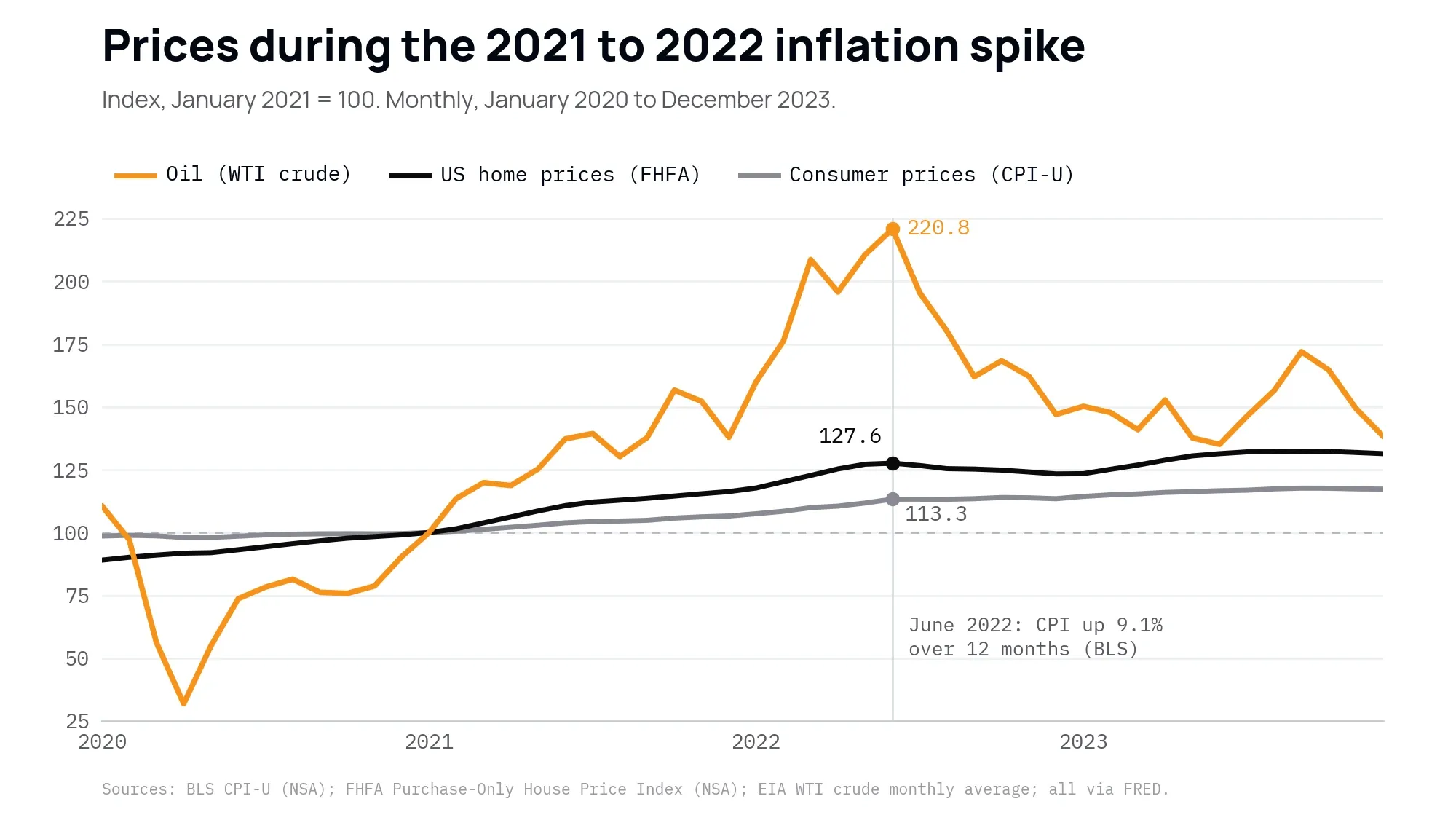
Home prices rose faster than consumer prices, then slipped. The Federal Housing Finance Agency's purchase-only house price index rose about 28% from January 2021 to June 2022, then fell about 3% by January 2023. Oil swung harder in both directions. West Texas Intermediate crude averaged $52.00 a barrel in January 2021 and $114.84 in June 2022, then $76.44 in December 2022, based on EIA averages for each month.
These windows show that results depended on the asset and on the start date, and the same gold bar looked different to a buyer in 1972 than to one in 1980. Some investors make a broader case about currency debasement, and the debasement trade explains that argument.
Is Bitcoin a Hard Asset?
Bitcoin is not a hard asset in the physical sense: it is digital, though many investors group it with gold because its supply is capped at 21 million. The IRS defines digital assets as value recorded on a blockchain, a distributed ledger secured by cryptography. For US tax purposes it treats them as property, not currency.
Investors who call Bitcoin a hard asset point to that fixed supply, not to anything you can hold. The Bitcoin vs. gold comparison covers where the two differ. The debate comes down to labels: Bitcoin shares scarcity with gold but not physical form.
Is a Bitcoin Miner a Hard Asset?
Yes, a Bitcoin miner is a hard asset: a physical machine, the kind of equipment the IRS treats as tangible personal property. Like a truck or a factory press, it wears out with use. Newer models replace it over time. That makes it a hard asset in the equipment sense, not a store of value like gold. As business equipment it can be depreciated, and bonus depreciation for Bitcoin miners explains how that works.
Owning the machine differs from renting its output. With cloud mining, you pay for hashrate on someone else's hardware and own no machine. At Simple Mining you buy and own the hardware, pick your own pool, and Simple Mining never takes custody of your Bitcoin.
A miner's value tracks its place in the equipment cycle. A newer model that does the same work on less power makes older units worth less, which is the miner's version of wear and tear. Browse current Bitcoin mining hardware, or see how Bitcoin miner hosting works when the machine runs in a data center and stays yours.
The physical side is plain to see on a mining floor: rows of machines, fans, power cables, and heat. It can change hands like any other piece of equipment.
What Are the Downsides of Hard Assets?
The main downsides of hard assets are that they are slow to sell, cost money to hold, and in some cases pay nothing while you own them.
- Slow to sell: Selling a house, a machine, or a painting takes a buyer, a dealer, or a broker, and that takes time.
- Costs to hold: Storage, upkeep, security, and property taxes add up whether the price rises or not.
- No income from some: Gold and art produce nothing, so any gain has to come from a higher sale price.
- Equipment loses value with use and age: Machines wear out and newer models replace them, while land does not wear out.
- Prices can swing: Gold fell from $850 in January 1980 to just above $400 at the end of 1989. US home prices fell about 3% from June 2022 to January 2023, and oil fell from $114.84 to $76.44 between June and December 2022.
None of these rule hard assets in or out. They are costs and risks to weigh against what a given asset does. They also differ a great deal between a plot of land and a machine that runs around the clock.
FAQs About Hard Assets
Are hard assets the same as tangible assets?
Yes, in everyday use the two terms mean the same thing: physical assets you can touch. "Tangible" is the more formal word, and it is the one the IRS uses.
Are hard assets the same as real assets?
In most uses, yes, and the two terms are often swapped for each other. "Real assets" is more common in fund and institutional language, where it tends to stress real estate, infrastructure, and natural resources.
Are stocks hard assets?
No, a stock is a financial asset: a share of ownership in a company. That holds even when the company owns factories, mines, or buildings, because you own a piece of the business, not the property itself.
Own a Hard Asset That Mines Bitcoin
A Bitcoin miner is a hard asset with one job: running the computations that secure the Bitcoin network. Simple Mining clients buy and own their machines, choose their own pool, and keep custody of what they mine. The machines run in Simple Mining's Iowa data centers. To see a hosted miner at work before you buy one, apply for a 7-day free trial on an Antminer S21+ at 235 TH/s.