
What Are Alternative Investments? 9 Types and Examples
By Josh Heine, Content Strategist at Simple Mining
Published November 4, 2026
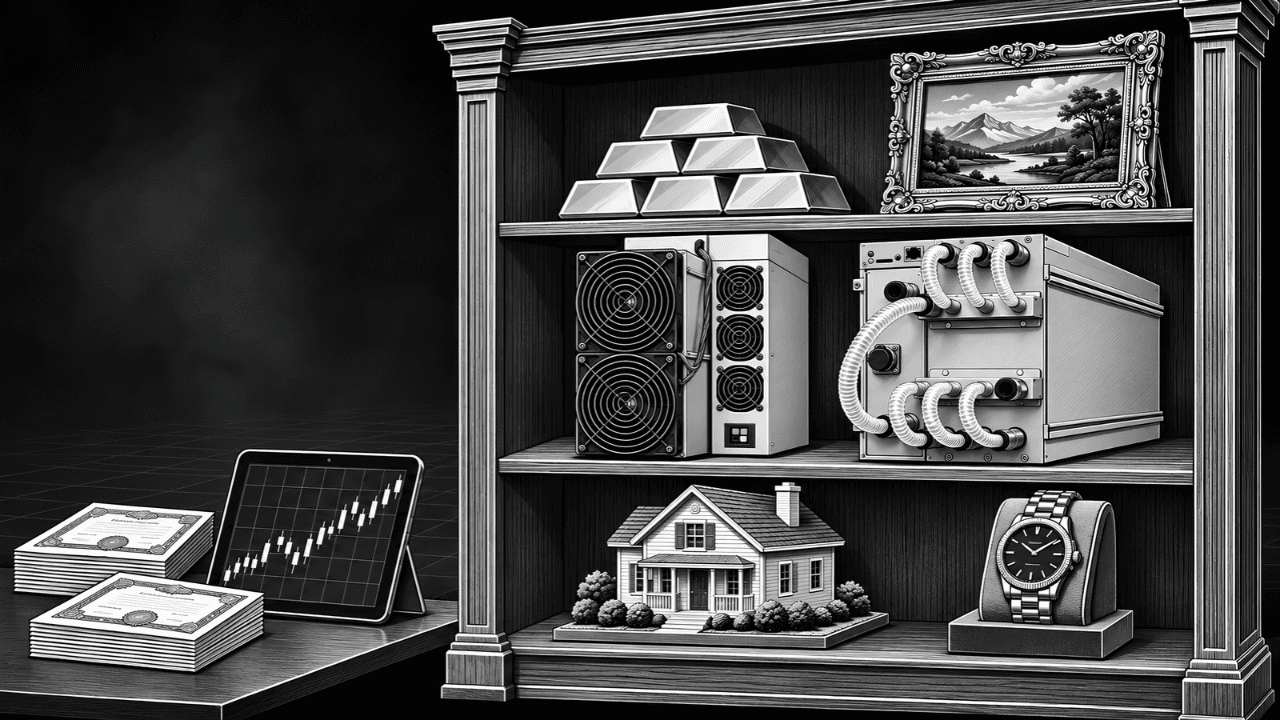
Alternative investments are assets outside the three traditional categories of stocks, bonds, and cash. The group runs from private equity and hedge funds to rental property, gold, art, and Bitcoin mining hardware. Each has its own rules on who can buy, how it's taxed, and how easy it is to sell. The common thread is that many trade less often, carry higher fees, and disclose less than a stock or bond fund.
On this page · 11 sections
- What Are Alternative Investments?
- Alternative Investments vs. Traditional Investments
- Types of Alternative Investments
- Is Bitcoin Mining an Alternative Investment?
- How Is Mining Different From Buying Bitcoin?
- Which Alternative Investments Produce Cash Flow?
- Which Alternative Investments Have Tax Advantages?
- Who Can Invest in Alternative Investments?
- What Are the Downsides of Alternative Investments?
- FAQs About Alternative Investments
- Own Bitcoin Mining Hardware With Simple Mining
Key Takeaways
- Alternative investments are assets outside stocks, bonds, and cash, also called alternative assets.
- Common types include private equity, real estate, hedge funds, commodities, collectibles, and digital assets.
- FINRA warns that many alternatives are complex, can be hard to sell, and carry fees that can erode gains.
- Some alternatives pay while you hold them, through rent, interest, or new Bitcoin from mining; others pay nothing until you sell.
- Bitcoin mining hardware is a physical alternative asset: a machine that produces Bitcoin only while it's powered and hashing.
What Are Alternative Investments?
Alternative investments are assets that fall outside stocks, bonds, and cash. FINRA's guide to alternative and emerging products notes that investors "have numerous alternatives to conventional stock and bond investments," which are sometimes referred to as "alternative, emerging, complex, structured or non-conventional investments." FINRA also notes there's no formal definition of the category. In practice, people also call them alternative assets. Private equity is one type of alternative investment, not the whole category.
Everyday examples of alternative investments include:
- A rental house, or shares of a real estate investment trust (REIT)
- Gold coins or bars
- A stake in a private company or a venture capital fund
- Fine art, rare coins, and other collectibles
- Bitcoin, or an ASIC miner that produces it
Alternative Investments vs. Traditional Investments
Traditional investments have public markets and prices published every trading day, while many alternative investments trade in private deals, change hands less often, and disclose less.
| Feature | Traditional Investments | Alternative Investments |
|---|---|---|
| Where it trades | Public exchanges, bond markets, and fund companies | Private deals, funds, dealers, and auctions; listed REITs trade on exchanges |
| How it's priced | Market prices through the trading day, or the next calculated net asset value (NAV) for mutual funds | Appraisals, fund statements, or the last private sale, unless it has a public market |
| How easy to sell | Easy for listed stocks and funds; some bonds trade less often | Secondary trading is often limited, and a sale may come at a significant loss |
| Info shared | Standard public reporting | Some products, such as private placements, have fewer disclosure obligations |
| Fees | Varies by product | Often high, and high fees can erode gains |
| Who can buy | Any investor, through a brokerage account or a fund company | Anyone for some products; many private funds and placements require accredited investor status |
Fewer price updates mean fewer visible price changes, not fewer risks.
Types of Alternative Investments
Types of alternative investments include private equity and venture capital, private credit, real estate, hedge funds, commodities and precious metals, infrastructure, collectibles, digital assets, and Bitcoin mining hardware. The list of alternative investments below shows how each works and how to access it.
1. Private Equity and Venture Capital
Private equity funds buy stakes in private companies, or take public companies private, with the aim of selling them later. Venture capital is the branch that backs startups and young, fast-growing companies in exchange for ownership. Both lock money up for years, and most pay out only when a company sells or lists.
How you access it: private funds and private placements, many of them limited to accredited investors.
2. Private Credit
Private credit is lending that happens outside banks and public bond markets. A private credit fund lends to companies and collects interest and principal over the life of each loan. FINRA lists leveraged loans among the assets alternative funds might hold.
How you access it: private credit funds and business development companies (BDCs).
3. Real Estate
Real estate investment means owning property, or a share of it, to rent out or sell. You can own a building yourself and collect rent, or buy shares of a REIT that owns many buildings.
How you access it: rental property, REITs, or private real estate funds.
4. Hedge Funds
A hedge fund is a private pooled fund that can use strategies such as short selling, leverage, and derivatives. Strategies, fees, and results vary from one fund to the next.
How you access it: private placements, which require you to be an accredited investor or a qualified purchaser.
5. Commodities and Precious Metals
Commodities are raw goods such as oil, grain, and copper, and precious metals include gold, silver, and platinum. Physical gold earns nothing while it sits in a vault. For a side-by-side look at two scarce assets, see Bitcoin vs. gold.
How you access it: commodity funds, futures accounts, or physical metal from a dealer.
6. Infrastructure
Infrastructure covers the physical systems an economy runs on: toll roads, pipelines, power lines, cell towers, and data centers. Many of these assets earn fees from the people and companies that use them, such as tolls or lease payments. Investors who want to invest in data centers look at the same things: the building, the power, and the tenants.
How you access it: listed infrastructure companies and funds, or private funds.
7. Collectibles
Collectibles are physical items valued for rarity, such as art, rare coins, stamps, wine, and watches. They pay nothing while you own them, and their value depends on what the next buyer will pay.
How you access it: auctions, dealers, private sales, or fractional ownership platforms.
8. Digital Assets
Digital assets are recorded on a blockchain or similar technology, and Bitcoin was the first cryptocurrency. Its supply is capped by design, and new coins enter circulation only through mining. Holding Bitcoin pays nothing by itself, so its value comes down to what buyers will pay for it.
How you access it: an exchange and a wallet you control, or a fund that holds Bitcoin.
9. Bitcoin Mining Hardware
Bitcoin mining hardware means owning ASIC miners, machines built for one job: securing the Bitcoin network and earning new Bitcoin. It's a physical asset that produces another asset, closer to a small factory than a stock.
How you access it: buy a miner and run it at home, or place it with a hosting provider.

Is Bitcoin Mining an Alternative Investment?
Yes, Bitcoin mining is an alternative investment, because you own productive hardware, an ASIC miner, that sits outside stocks, bonds, and cash. The miner contributes hashrate, the computing power it points at the Bitcoin network. Through a mining pool, that work earns a share of the pool's rewards, paid in Bitcoin. What you own is the machine, and what it produces is Bitcoin.
Six things shape what a miner earns: Bitcoin's price, network difficulty, the block reward and fees, the machine's efficiency, power cost, and uptime. The first three move with the market and the network. The owner influences the last three through which machine they buy, where it runs, and who runs it.
A common misunderstanding among first-time buyers: a miner produces Bitcoin only while it's powered and hashing. A machine still in its box, offline with a fault, or switched off during curtailment produces nothing. That's why many owners use Bitcoin miner hosting in Iowa, where the client owns the machine and the host supplies the building, cooling, network, and staff.
How Is Mining Different From Buying Bitcoin?
Buying gives you Bitcoin now at the market price, while mining turns capital into hardware that produces Bitcoin over time. A buyer owns Bitcoin from day one. A miner owns a machine, pays to run it, and receives Bitcoin as the machine works. The tax treatment differs from the first day as well.
| Buying Bitcoin | Mining Bitcoin | |
|---|---|---|
| What you own | Bitcoin | An ASIC miner that produces Bitcoin |
| How you get Bitcoin | Purchase it at the market price | Earn it over time through a pool while the machine hashes |
| Tax on day one | Your cost basis is what you paid, including transaction fees; gain or loss is taxed when you sell or dispose of it | Fair market value on the date of receipt is included in gross income; self-employment tax applies if mining is a trade or business |
| Ongoing costs | Exchange or custody fees, if any | Hosting or power, pool fees, and upkeep |
IRS Notice 2014-21 states that "for federal tax purposes, virtual currency is treated as property," and it sets the income rule for mined coins. For the cost and break-even side of the decision, see our breakdown of mining vs. buying Bitcoin.
Which Alternative Investments Produce Cash Flow?
The alternative investments that produce cash flow are the ones that own something that pays: rental property collects rent, private credit collects interest, royalties pay from intellectual property or mineral rights, and mining hardware earns Bitcoin while it hashes. Private equity and venture capital funds tend to pay out as the fund sells or lists its companies, while commodities, collectibles, and Bitcoin held without mining pay nothing until you sell. Cash flow is not profit. Rent comes with property costs, loans come with fees and defaults, and a miner's Bitcoin comes with hosting fees and power.
- Pays as it goes: rental real estate, private credit, infrastructure that collects user fees, and Bitcoin mining hardware while it hashes.
- Pays at exit or sale: private equity and venture capital (when the fund sells or lists a company), commodities and precious metals, collectibles, and Bitcoin you hold.
- Depends on the strategy: hedge funds, which vary by fund.
For a miner, you can estimate cash flow with our Bitcoin mining calculator, and the estimate moves with Bitcoin's price and network difficulty.
Which Alternative Investments Have Tax Advantages?
One common tax advantage among alternative investments is depreciation on assets that wear out, such as rental buildings and equipment like Bitcoin miners. IRS Publication 946 describes depreciation as "an annual income tax deduction that allows you to recover the cost or other basis of certain property," an allowance for wear and tear, deterioration, or obsolescence. Land doesn't qualify, because "land does not wear out, become obsolete, or get used up."
- Bonus depreciation: The One, Big, Beautiful Bill provides a permanent 100% additional first-year depreciation deduction for eligible depreciable property acquired after January 19, 2025, and Treasury and the IRS issued guidance on it in IRS release IR-2026-06. Our guide to bonus depreciation for Bitcoin miners covers how it applies to mining hardware.
- Passive activity limits: Under IRS Publication 925, passive activities include trade or business activities without your material participation, and rental activities unless you're a real estate professional. As a rule, a passive activity loss for the year isn't allowed against your other income.
- Collectibles rate: Net capital gains from selling collectibles, such as coins or art, are taxed at a maximum 28% rate under IRS Topic 409. That's a tax drawback, not an advantage.
- Mined Bitcoin: Under IRS Notice 2014-21, the fair market value of Bitcoin you mine is included in gross income on the date you receive it.
Depreciation is one of several ways to reduce taxable income, and each comes with conditions. Simple Mining does not give tax advice; a tax professional can apply these rules to your situation.
Who Can Invest in Alternative Investments?
Anyone can buy some alternative investments, such as listed REITs, commodity funds, collectibles, and physical hardware, while many private funds and private placements are limited to accredited investors. The SEC's accredited investor rules let an individual qualify on net worth, income, or professional credentials.
- Net worth: over $1 million, alone or with a spouse or partner, not counting your primary residence.
- Income: over $200,000 on your own, or $300,000 with a spouse or partner, in each of the prior two years, with a reasonable expectation of the same in the current year.
- Professional credentials: a Series 7, Series 65, or Series 82 license held in good standing.
Simple Mining has no minimum quantity, and one machine makes you a real customer.
What Are the Downsides of Alternative Investments?
The downsides of alternative investments include illiquidity, high fees, less disclosure, and complexity, all of which FINRA flags. Assets that produce Bitcoin or track commodity prices add volatility, and physical hardware adds operational risk.
- Illiquidity: Secondary trading, your ability to trade out of the product, is often limited. You may be unable to sell, or able to sell only at a significant loss.
- High fees: FINRA warns that fees are often high with these products and can erode, and even evaporate, gains.
- Less disclosure: Some products, such as private placements, have fewer disclosure obligations than traditional investments.
- Complexity: FINRA says these products tend to be complex by nature, with features that can make them hard to understand and evaluate.
- Volatility: Bitcoin and commodity prices can rise or fall fast, in either direction.
- Operational risk: Downtime and rising network difficulty cut how much Bitcoin a miner produces, and higher power costs cut what it keeps.
None of these risks rules an asset in or out; each investor weighs them on their own terms.
FAQs About Alternative Investments
Is private equity an alternative investment?
Yes. Private equity is one type of alternative investment, alongside real estate, hedge funds, commodities, and others. Private equity funds count among alternative investments, but not every alternative investment is private equity.
Can you hold alternative investments in an IRA?
Yes, through a self-directed IRA held at a custodian that permits alternative assets such as real estate or digital assets. Tax law still sets limits: an IRA can't invest in collectibles such as art or antiques, and it can hold certain precious metals only if they meet specific requirements. Within those limits, the custodian decides what the account can hold. For Bitcoin, see whether you can buy Bitcoin in a Roth IRA.
What is an alternative fund?
An alternative fund, or alt fund, is a fund that holds assets or uses strategies outside traditional stocks and bonds. FINRA notes that alt funds might invest in assets such as global real estate, commodities, and leveraged loans.
Are REITs alternative investments?
Yes. FINRA includes REITs on its list of alternative and emerging products, along with interval funds and private placements. A REIT owns or finances income-producing real estate, so its shares give you exposure to real estate without buying a building yourself.
Own Bitcoin Mining Hardware With Simple Mining
Simple Mining sells and hosts ASIC miners for investors who want to own Bitcoin mining hardware. You own the machine, pick your own pool, and receive rewards in a wallet you control, and Simple Mining never takes custody of your Bitcoin. We run 9+ EH/s across 11 data centers and 150+ MW of capacity, at 95% average uptime. The hosting fee runs $0.065 to $0.08 per kWh, and Precision Billing means you're billed only for the hours a machine is hashing.
You can buy Bitcoin miners from our inventory, or start with a 7-day free trial on an Antminer S21+ at 235 TH/s.