

What Is a Blockchain and How Does It Work
By Josh Heine, Content Strategist at Simple Mining
Updated June 23, 2026Published June 17, 2024
A blockchain is a shared digital ledger that records transactions across a network of computers. Once data is written and confirmed, no single party can change it without the network noticing. That property is what makes Bitcoin possible. This guide explains the mechanics in plain language and shows how the technology powers the mining work Simple Mining does every day.
On this page · 11 sections
- What Is a Blockchain?
- How Does a Blockchain Work?
- What Are the Key Components of a Blockchain?
- What Are the Types of Blockchain Networks?
- Is Blockchain Secure?
- Blockchain vs Cryptocurrency: What Is the Difference?
- What Are the Benefits and Limitations of Blockchain?
- Real-World Blockchain Applications
- How Does Blockchain Power Bitcoin Mining?
- FAQs About Blockchain
- Start Mining Bitcoin with Confidence
Key Takeaways
- A blockchain is a shared digital ledger of transactions distributed across many computers and locked together by cryptographic hashes.
- It works in six steps: request, broadcast, validation, block creation, chaining, and confirmation. Bitcoin uses Proof of Work to drive that process.
- Five components make it run: blocks, the chain, nodes, hashes, and a consensus mechanism.
- Public chains like Bitcoin trade speed for openness and security. Private chains do the opposite.
- Miners are the operators who turn the ledger from a claim into settled history, block by block.
What Is a Blockchain?
A blockchain is a distributed database where records are stored in linked blocks and shared across many computers. Each new block carries a cryptographic fingerprint of the block before it. This chain of fingerprints makes the history hard to rewrite.
Think of it as a shared Google Doc that everyone in a group can see and verify but no single person can edit in secret. Three traits define it:
- Decentralized: No single authority controls the network.
- Distributed: Copies of the ledger live on many machines at once.
- Immutable: Confirmed records cannot be altered without breaking the chain.
How Does a Blockchain Work?
A blockchain transaction moves from request to permanent record through six steps. Each step adds a layer of verification before the data becomes part of the chain.
1. A transaction is initiated
A user requests a transaction. On Bitcoin this is a payment from one wallet to another. The request includes the sender, the receiver, and the amount.
2. The transaction broadcasts to the network
The request travels to a peer-to-peer network of computers called nodes. Nodes hold copies of the ledger and relay new transactions to each other.
3. Nodes validate the transaction
Nodes check the request against the rules of the network. They confirm the sender has the funds and the signature is valid. Agreement among nodes is called consensus.
4. Validated transactions form a block
Verified transactions are bundled into a Bitcoin block. Each block holds the transaction data, a timestamp, and a cryptographic hash of the block before it. Those transactions are condensed into a single fingerprint by a Merkle tree.
5. The block joins the chain
The new block links to the existing chain through its hash. Change one byte in any past block and every hash that follows changes too. That is what makes tampering visible.
6. The transaction is confirmed
Once enough new blocks build on top, the transaction is treated as settled. On Bitcoin, six confirmations is the common standard for high-value transfers.
What Are the Key Components of a Blockchain?
A blockchain is built from five parts that work together: blocks, the chain itself, nodes, cryptographic hashes, and a consensus mechanism.
- Blocks are containers of transaction records with a timestamp and a hash.
- The chain is the linked sequence of blocks ordered by time.
- Nodes are the computers that hold the ledger and validate new transactions. Anyone can run one on public networks.
- Cryptographic hashes are short fingerprints of data. A tiny change in the input produces a different hash, so tampering is easy to spot.
- Consensus mechanisms are the rules nodes follow to agree on what is valid. Bitcoin uses Proof of Work. Other networks use Proof of Stake.
What Are the Types of Blockchain Networks?
Four main types of blockchain serve different needs. The distinction comes down to who can join and who controls the rules.
| Type | Access | Control | Example |
|---|---|---|---|
| Public | Open to anyone | Decentralized | Bitcoin |
| Private | Restricted | Single organization | Internal databases |
| Consortium | Selected participants | Group of organizations | Trade finance |
| Hybrid | Mixed | Varies | Supply chain tracking |
Public blockchains like Bitcoin sit at one end of the spectrum. Anyone can read the ledger, send transactions, or run a node. Private and consortium chains trade openness for speed and control. Most of the blockchain debate worth having is about the public chains, because they are the ones that solve the trust problem without a gatekeeper.
Is Blockchain Secure?
Yes, public blockchains are secure because security is the product of decentralization, cryptography, immutability, and consensus working together.
- Decentralization removes the single point of failure that hackers target in a normal database.
- Cryptography locks transactions to specific private keys so only the rightful owner can spend.
- Immutability makes silent edits impossible. Changing one block forces every later block to be redone.
- Consensus means an attacker needs to outvote the rest of the network to push false data through.
A 51% attack on Bitcoin would require more honest hashrate than the entire rest of the global mining network combined. Even if an attacker could assemble that compute, a successful attack would destroy the value of the very Bitcoin the attacker would be trying to steal. The capital cost of the ASICs plus the certain destruction of their economic incentive is what makes the attack economically irrational. Security here is a math problem, not a promise.
What can go wrong: users still lose funds when they lose their private keys or fall for phishing.
Mitigation: keep keys in cold storage and treat seed phrases like cash.
Blockchain vs Cryptocurrency: What Is the Difference?
Blockchain is the technology. Cryptocurrency is one application built on it. All cryptocurrencies need a blockchain to record balances and transfers. But a blockchain can exist without a currency at all and is used for things like supply chain tracking and digital identity.
Bitcoin is the first and best-known cryptocurrency. It runs on the Bitcoin blockchain, which was introduced in the original Bitcoin whitepaper in 2008. The two terms get mixed up in casual conversation, but they are not the same thing.
What Are the Benefits and Limitations of Blockchain?
Blockchain offers real advantages over centralized systems and carries real trade-offs. A balanced view helps when deciding where the technology fits.
Benefits:
- Transparency. Anyone can inspect a public chain end to end.
- No middlemen. Settlement happens between parties without a clearing house.
- Strong security. Distributed storage and cryptography raise the cost of fraud.
- Global access. A wallet works from anywhere with an internet connection.
Limitations:
- Energy use. Proof of Work secures Bitcoin with real-world energy. This is a feature for security and a cost for operators.
- Throughput. Public chains process fewer transactions per second than centralized payment networks, a gap Bitcoin's Lightning Network closes off-chain.
- Regulatory uncertainty. Rules vary by country and keep changing.
- User experience. Self-custody puts the burden of key management on the user.
Real-World Blockchain Applications
The most established use case for blockchain is digital money, and Bitcoin is the proof. Bitcoin moves value between two parties without a bank, an exchange, or a clearing house in the middle. That single capability is why the technology was invented.
Beyond Bitcoin, blockchain shows up in a handful of practical places: tokenized supply chain records that trace a product from origin to shelf, smart contracts that execute on conditions without an intermediary, and identity systems that let people prove credentials without exposing every detail. The deeper you go past Bitcoin, the more the use cases trade decentralization for convenience. That trade-off is the whole story of why Bitcoin remains the cleanest expression of the idea.
How Does Blockchain Power Bitcoin Mining?
Bitcoin mining is the work that builds and protects the blockchain. Miners compete to solve a cryptographic puzzle. The winning miner adds the next block to the chain and earns the block reward plus transaction fees. The puzzle is hard on purpose. It forces real cost into the system, which is what makes rewriting history too expensive to attempt.
The current block reward is 3.125 BTC, halved from 6.25 in April 2024. The next Bitcoin halving is scheduled for April 2028. A winning miner is paid that subsidy plus every transaction fee in the block, paid about every ten minutes. Over a year that is roughly 52,500 blocks of paid work distributed across the global network.
At scale, mining looks like rows of ASIC miners running hot, loud, and around the clock. A modern S21-class machine draws about 3.5 kW and produces a steady wall of fan noise. Thousands of them packed into a facility need real power, real cooling, and someone watching the dashboard when a hashboard fails. The repair bench sees hashboard failures as the most common ASIC issue, ahead of PSU and control board problems.
Most miners join mining pools to smooth rewards across many blocks instead of waiting for the rare solo win. The miner that finds the next valid hash signs the block, and every node updates its copy of the chain. Without that ongoing work, the ledger is just a claim. With it, the ledger is settled history.
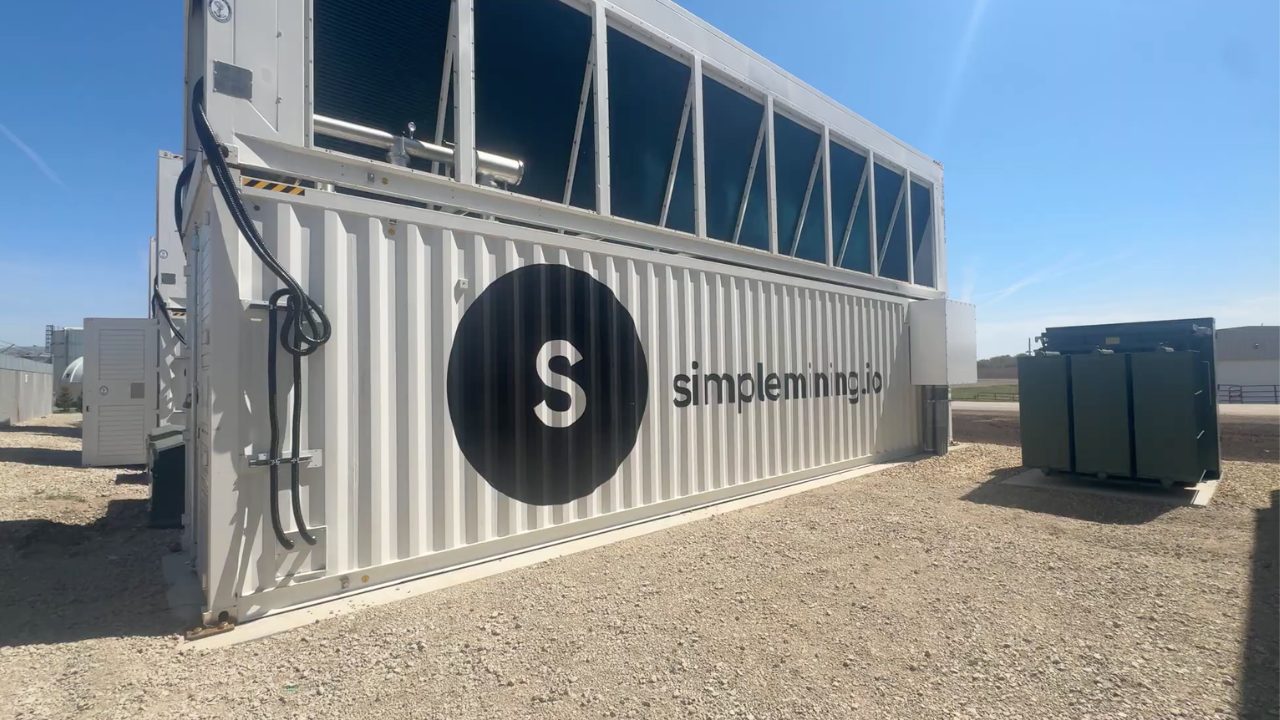
Simple Mining contributes more than 4 EH/s of that hashrate from a 150+ MW footprint in Iowa. Our fleet runs at 95%+ average uptime, and we handle repairs on site instead of shipping units overseas. Bitcoin mining hosting is the service layer that hides the racks, the noise, the cooling, and the repairs from the owner who just wants the rewards to land.
FAQs About Blockchain
Who invented blockchain technology?
The first working blockchain was introduced in 2008 by an anonymous figure using the pseudonym Satoshi Nakamoto. The design was published in the Bitcoin whitepaper as the ledger behind a new digital cash system. Earlier work by Stuart Haber and W. Scott Stornetta in 1991 on cryptographic time-stamping of digital documents set the technical groundwork.
Can a blockchain be hacked?
A single wallet or exchange can be compromised through phishing, weak keys, or poor operational security. The Bitcoin blockchain itself has never been altered through a successful attack on its history. Rewriting confirmed blocks would require more honest computing power than the rest of the network combined.
How long does a Bitcoin blockchain transaction take to confirm?
Bitcoin produces a new block about every ten minutes on average. Most exchanges and merchants treat a transaction as settled after six confirmations, which takes about an hour. Smaller transfers often clear with one or two confirmations.
Do you need to understand blockchain to mine Bitcoin?
No. You can own a miner and earn Bitcoin without writing a single line of code. A hosting provider handles the firmware, the pool connection, the cooling, and the repairs. The owner gets the rewards.
Is blockchain the same as Bitcoin?
No. Blockchain is the underlying technology. Bitcoin is the first and most secure application of that technology. Every cryptocurrency uses a blockchain, but not every blockchain runs a cryptocurrency.
Does Simple Mining require KYC to host my miner?
KYC status depends on the pool you mine to and the wallet you use, not on the hosting provider. Pointing your hashrate to a non-custodial pool like Ocean and a fresh wallet keeps the rewards non-KYC at the protocol level.
Start Mining Bitcoin with Confidence
Understanding blockchain is step one. Earning Bitcoin from it is step two. Simple Mining handles the hardware, the power, the repairs, and the monitoring so the chain keeps getting blocks from your machine without you watching a screen at 3 a.m.
A ledger nobody can rewrite is worth more than a promise everyone can break.
Start with a 7-day free trial to see hosted mining run before you commit to hardware.