

Is Bitcoin Bad for the Environment? What the Data Shows
By Josh Heine, Content Strategist at Simple Mining
Updated August 21, 2026Published July 17, 2024
Is Bitcoin bad for the environment? The honest answer requires data rather than headlines. Bitcoin mining consumes electricity at national scale and that consumption is real. But more than half of that power now comes from sustainable sources and the share keeps climbing. This guide walks through the numbers so you can judge the question for yourself.
On this page · 11 sections
- How Much Energy Does Bitcoin Mining Use
- What Is Bitcoin's Carbon Footprint
- Why Bitcoin Mining Requires Significant Electricity
- How Much Renewable Energy Powers Bitcoin Mining
- Bitcoin Mining vs Traditional Banking and Gold Mining
- Common Misconceptions About Bitcoin's Environmental Impact
- E-Waste and Hardware Lifecycle in Mining
- How Mining Efficiency Continues to Improve
- What Miners Are Doing to Reduce Environmental Impact
- FAQs
- The Future of Sustainable Bitcoin Mining
Key Takeaways
- Bitcoin mining uses about 138 TWh per year, which equals about 0.5% of global electricity (Cambridge CCAF, 2025)
- 52.4% of mining electricity comes from sustainable sources, while coal has fallen to 8.9% of the mix
- Bitcoin accounts for about 0.08% of global emissions, comparable to the annual emissions of Slovakia
- Mining hardware lasts 4 to 5 years and 87% of retired units get recycled, resold or repurposed
- Miners earn payments to power down during grid stress, a flexibility almost no other industry offers
How Much Energy Does Bitcoin Mining Use
Bitcoin mining consumes about 138 TWh of electricity per year, or about 0.5% of global electricity consumption. That estimate comes from the Cambridge Centre for Alternative Finance, the most cited research group on this topic. The number is large and deserves honest context rather than dismissal. Mining runs on proof of work, a system where computers spend electricity to compete for the right to add the next block of transactions. That competition is what the rest of this article measures.
The Cambridge Bitcoin Electricity Consumption Index estimates annual consumption near 138 TWh and updates daily, so check the live figure for the current number.
Annual Electricity Consumption Estimates
The Cambridge Bitcoin Electricity Consumption Index (CBECI) is the standard source for Bitcoin energy data. It publishes a floor estimate, a ceiling estimate and a best guess that updates around the clock.
- Global network demand: mining runs nonstop across every time zone, so consumption stays steady rather than spiking with usage
- Growth trajectory: consumption grows with Bitcoin's price and hashrate, though Cambridge revised its 2021 and 2022 estimates downward by 10 to 15 TWh after improving its hardware methodology
That downward revision deserves more attention than it gets. The benchmark index corrected itself toward less consumption, not more.
Comparisons to Countries and Industries
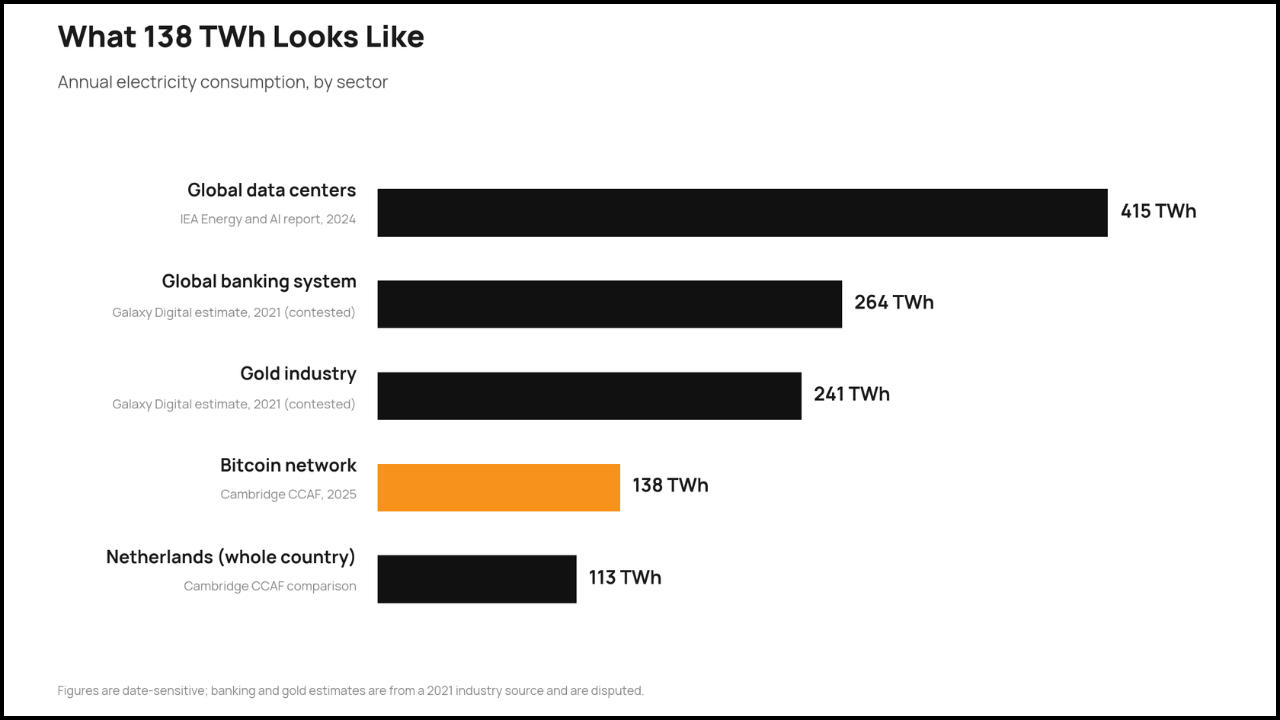
Bitcoin uses about as much electricity as the Netherlands and about a third as much as the world's data centers. The table below puts the network in context.
| Energy Consumer | Annual Electricity | Source |
|---|---|---|
| Bitcoin network | ~138 TWh | Cambridge CCAF (2025) |
| Netherlands (entire country) | ~113 TWh | Cambridge CCAF comparison data |
| Global data centers | ~415 TWh (2024) | IEA Energy and AI report |
| Global banking system | ~264 TWh | Galaxy Digital estimate (2021) |
| Gold industry | ~241 TWh | Galaxy Digital estimate (2021) |
The banking and gold figures come from a 2021 industry report and carry caveats covered later in this article. The Bitcoin and data center figures come from academic and government sources.
Energy Per Transaction vs Per Block
Per-transaction energy figures mislead because Bitcoin does not spend energy per transaction. Miners secure one block about every ten minutes. The energy cost of that block stays the same whether it holds one transaction or four thousand. Researchers at the IMF make the same point in a 2023 paper on payment system energy design. They note that batching and the Lightning Network's payment channels let 100 million on-chain transactions carry about 250 million payments in 2022.
What Is Bitcoin's Carbon Footprint
Bitcoin mining produces about 39.8 million tonnes of CO2 equivalent per year, or about 0.08% of global emissions. That figure comes from the same 2025 Cambridge report and compares to the annual emissions of Slovakia. Energy consumption alone does not determine environmental harm. The source of the energy decides the footprint.
Total Annual CO2 Emissions
Emissions equal electricity consumed multiplied by the carbon intensity of the grid supplying it. A terawatt-hour from Norwegian hydro carries almost no emissions. The same terawatt-hour from Kazakh coal carries a heavy footprint. A UN University study measured the network during 2020 and 2021 when coal supplied 45% of mining power. That era shapes most of the scary headlines you still see today.
Carbon Intensity by Region
Location decides emissions more than consumption does.
- Coal-heavy grids: the highest emissions per kWh, which is why the brief 2021 migration to Kazakhstan raised the network's footprint
- Hydro-dominant regions: Norway, Quebec and Paraguay host mining at a fraction of the emissions per terahash
- Mixed grids: impact shifts by season and hour, which rewards miners that can pause and resume on demand
Critics hold real cards here. A 2025 study in Nature Communications traced air pollution from 34 large US mines back to fossil power plants. The finding is legitimate and the answer is location. Mines on clean grids do not create that problem.
Why Estimates Vary Between Studies
Headlines disagree because methodologies disagree. Some studies survey miners about their actual power contracts. Others assign emissions from IP addresses and regional grid averages. Some count marginal generation while others count the average mix.
None of these choices is dishonest but each produces a different number. Cambridge surveys miners that represent 48% of global mining activity, which makes its data the most grounded available.
Why Bitcoin Mining Requires Significant Electricity
Bitcoin mining requires electricity because the energy is the system, not a flaw in it. Strip the energy out of Bitcoin and you are left with every other digital ledger: reversible, editable and controlled by whoever holds access. Proof of work replaces permission and trust with real-world energy expenditure. An attacker cannot shortcut the work because the difficulty adjustment binds everyone to the same physical limits. The energy is what makes the record impossible to fake or reverse.
The security follows from the cost. Miners spend real resources to add blocks and rewriting history means redoing all of that work. That cost makes the ledger immutable in practice. It is the price of a monetary network that no single party controls. The amount of computational work securing the network is its hashrate, and the higher it climbs the harder Bitcoin becomes to attack.
How Much Renewable Energy Powers Bitcoin Mining
Sustainable sources supply 52.4% of Bitcoin mining electricity. The April 2025 Cambridge Digital Mining Industry Report, a survey of 49 firms representing 48% of global mining activity, found renewables provide 42.6% and nuclear adds 9.8%. Natural gas remains the largest single fuel at 38.2% while coal has fallen to 8.9%.
Current Renewable Energy Adoption Rates
The trend matters more than the snapshot. The UN study measured coal at 45% of the mix during 2020 and 2021. Cambridge now puts coal at 8.9%. The methodologies differ but the direction is unmistakable. Mining left China after the 2021 ban and resettled on cleaner grids.
Regions Leading in Sustainable Mining
- Iceland and Norway: geothermal and hydro supply close to all grid power in both countries
- Texas: the top US state for installed wind capacity and home to the largest flexible mining loads
- Paraguay and Canada: surplus hydroelectric capacity from Itaipú and provincial utilities
- Iowa and the Midwest: Iowa generates a larger share of its electricity from wind than any other state
Stranded Energy and Grid Stabilization Benefits
Stranded energy is power produced where no buyer or transmission line exists. Curtailed wind on a gusty night and flared gas at a remote oil pad both qualify. Bitcoin miners can buy that power because mining works anywhere with an internet connection.
The methane angle is the strongest version of this story. Generators at oil pads combust 99.89% of the methane in flare gas while open flares manage about 93%. That difference cuts CO2 equivalent emissions by up to 63% versus continued flaring. A 2024 paper in the Journal of Cleaner Production frames Bitcoin mining as a financing tool for landfill methane mitigation as well.
Bitcoin Mining vs Traditional Banking and Gold Mining
Common estimates put the banking system and the gold industry above Bitcoin in total energy use, though every cross-industry comparison carries caveats. The fair question is whether Bitcoin's consumption is out of line for a global monetary network. The data suggests it is not.
Global Banking System Energy Use
A 2021 Galaxy Digital report estimated the banking system consumes about 264 TWh per year across data centers, branches and card networks. That figure comes from an industry source and critics dispute it. IMF researchers offer a narrower comparison: the global payment system uses about 0.2% of world electricity. Neither comparison is clean because Bitcoin is a settlement network and a store of value at once. We concede the imperfection and still note the order of magnitude.
Gold Mining Environmental Costs
Gold is the closest comparison since both assets serve as stores of value. We weigh the two as investments in Bitcoin vs gold. On the environmental side, gold extraction carries costs Bitcoin never touches:
- Land disruption: open-pit mines move enormous volumes of earth per tonne of metal recovered
- Water contamination: cyanide and mercury runoff from extraction and processing
- Emissions: the World Gold Council attributes over 100 million tonnes of CO2e per year to the industry
Data Centers and Payment Networks
The world's data centers consumed about 415 TWh in 2024 according to the IEA. The agency projects that figure to more than double to 945 TWh by 2030 as AI grows. Bitcoin's 138 TWh equals about a third of today's data center load. Society runs streaming and cloud computing and AI without existential debate. Scale alone does not make an industry harmful.
Common Misconceptions About Bitcoin's Environmental Impact
The loudest criticisms of Bitcoin's footprint rest on stale data or flawed framing. Three errors repeat across mainstream coverage.
The Per-Transaction Energy Fallacy
Dividing total network energy by transaction count produces a scary number and a meaningless one. Bitcoin's energy secures the entire ledger and every coin on it with each block. A card swipe is a database entry that depends on layers of settlement behind it. A Bitcoin transaction is final settlement. Comparing the two is comparing a wire between central banks to a coffee purchase.
Ignoring Renewable Energy Progress
Many viral studies still use the energy mix from the China era of mining. That mix died with the 2021 mining ban. Studies built on 2020 grid data describe a network that no longer exists. Check the vintage of the energy mix behind any emissions headline before you trust it.
Conflating Bitcoin With Other Cryptocurrencies
Bitcoin's energy profile is unique to proof of work. Ethereum switched to proof of stake in 2022 and cut its electricity use by over 99%. Statistics about "crypto" as a category tell you little about either network. Bitcoin keeps proof of work because spent energy is what makes the chain expensive to attack.
E-Waste and Hardware Lifecycle in Mining
Bitcoin mining produced about 2,300 tonnes of e-waste in 2024 according to Cambridge. That is a small fraction of the figure critics cite and 87% of retired hardware gets recycled, resold or repurposed. Hardware turnover is a real issue worth taking head-on rather than waving away.
ASIC Repair and Refurbishment Solutions
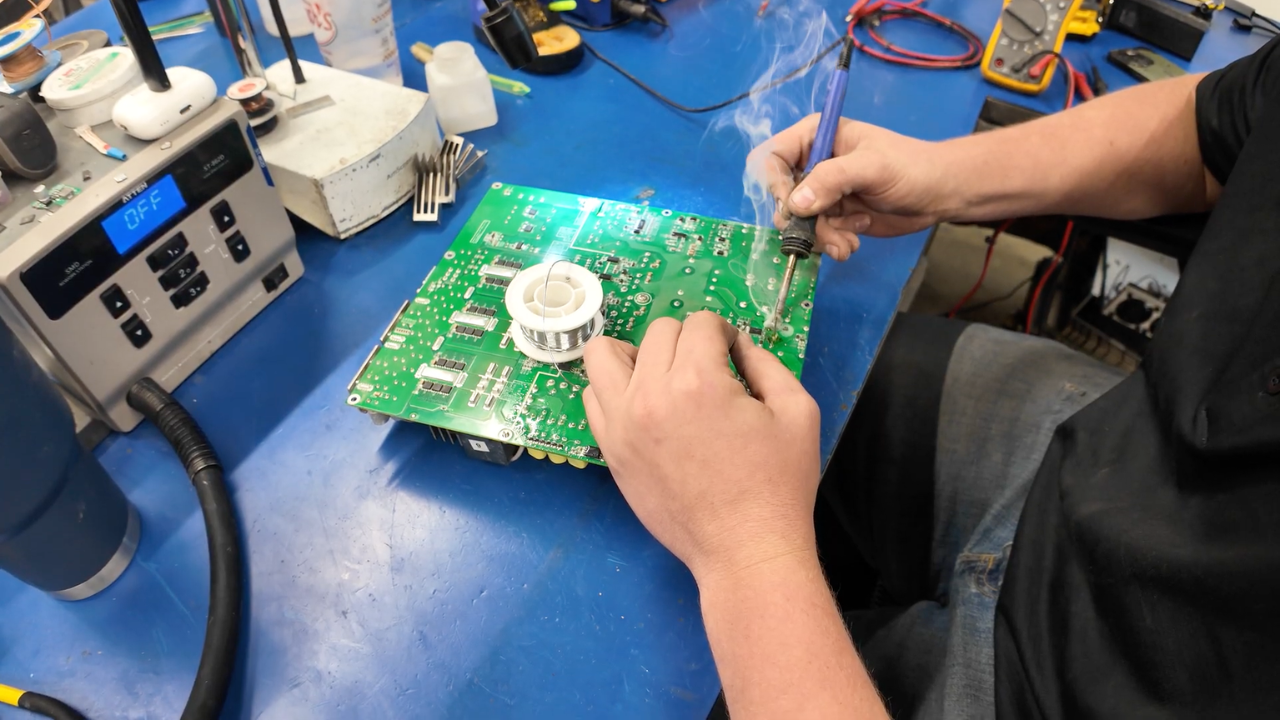
An ASIC (Application-Specific Integrated Circuit) is a computer built for one job: mining. ASICs cannot run other software, which is why critics frame them as disposable. Repair changes that math. The most common failure we see on the bench is a single dead hashboard on an otherwise healthy machine. Component-level micro-soldering at our ASIC repair center returns those machines to service instead of scrap.
Every miner purchased through Simple Mining includes 12 months of repair coverage through our hosting service. Keeping a 3.6 kW machine hashing for years is the most direct e-waste mitigation that exists.
Hardware Lifespan and Disposal Challenges
The viral e-waste estimate assumed miners die after 1.3 years. A 2024 peer-reviewed analysis of market sales data puts real lifespan at 4 to 5 years. Disposal remains a genuine challenge for the minority of units beyond repair. The honest answer is longer service life through maintenance, not pretending the issue away.
How Mining Efficiency Continues to Improve
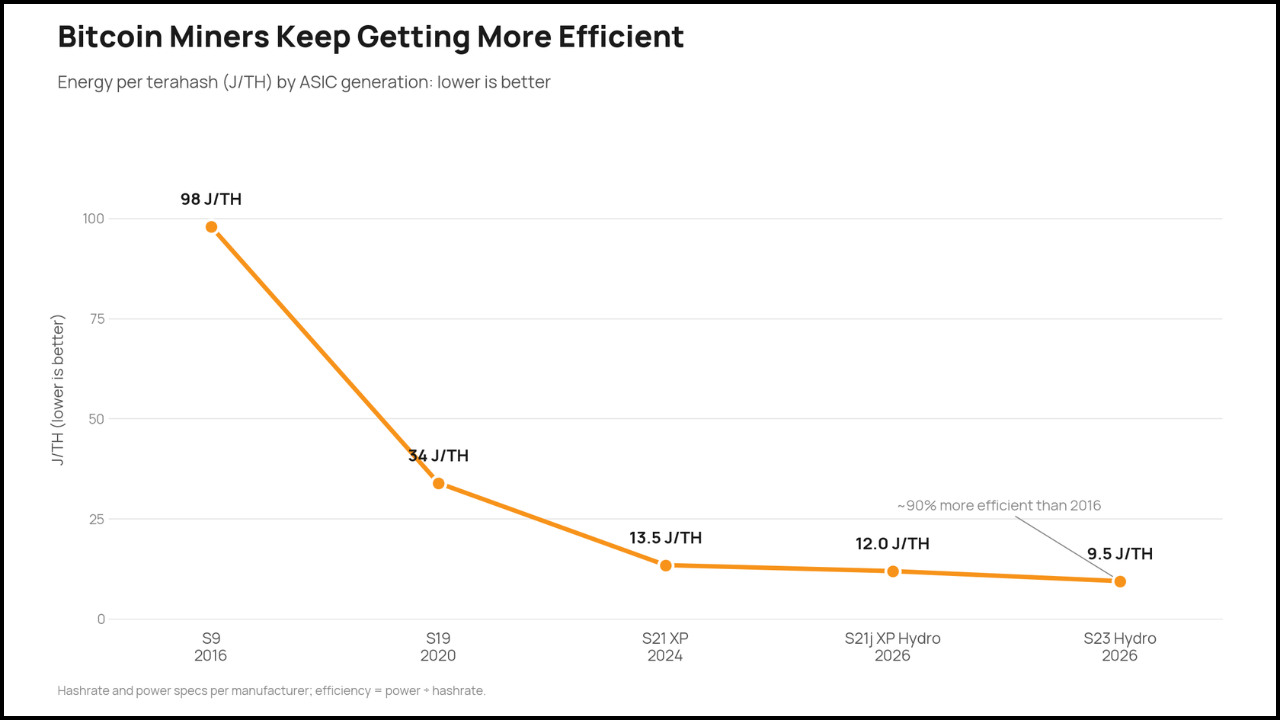
Each ASIC generation produces more hashrate per watt, and energy per unit of work has fallen about 90% since 2016. Joules per terahash (J/TH) is the metric that captures this. Lower is better.
ASIC Efficiency Gains Across Generations
| Miner | Year | Hashrate | Power | Efficiency |
|---|---|---|---|---|
| Antminer S9 | 2016 | 14 TH/s | 1,372 W | ~98 J/TH |
| Antminer S19 | 2020 | 95 TH/s | 3,250 W | ~34 J/TH |
| Antminer S21 XP | 2024 | 270 TH/s | 3,645 W | 13.5 J/TH |
| Antminer S21j XP Hydro | 2026 | 495 TH/s | 5,940 W | 12.0 J/TH |
| Antminer S23 Hydro | 2026 | 563 TH/s | 5,349 W | 9.5 J/TH |
Run the math on the newest hydro unit. It produces 563 TH/s on 5,349 watts. That works out to 9.5 joules per terahash. The S9 needed about 98 joules for the same terahash in 2016. The network now does more than ten times more work per watt than it did a decade ago. Fleet upgrades push this forward as operators buy Bitcoin miners from the newest generation and retire the oldest.
Facility Optimization and Cooling Technology
Hardware is half the efficiency story. Hosting facilities optimize cooling, airflow and power management beyond what any garage setup can match. Hydro-cooled machines like the S23 Hydro reach the lowest J/TH figures in part because of the cooling method itself. Iowa's cool climate cuts cooling load for much of the year, which is one reason we built here.
What Miners Are Doing to Reduce Environmental Impact
Miners are sourcing cleaner power, capturing methane and selling grid flexibility that other industries cannot offer. The flexibility piece is the least understood and the most valuable.
Renewable Energy Sourcing
Miners chase the cheapest power and cheap power now means wind and solar in much of the world. Operations co-locate with wind farms in Texas and hydro dams in Quebec and Paraguay. Simple Mining runs on an Iowa grid mix that is about 60% renewable.
Carbon Offset and Neutrality Initiatives
Some operators purchase carbon credits or pursue certified neutrality. We treat offsets as a supplement rather than a substitute. Buying clean power beats buying paper that says you did.
Demand Response and Curtailment Programs
Curtailment means powering down by agreement when the grid needs the electricity more. Miners work as a two-way valve on the grid and no other industrial load matches that role. In one direction they act as a Buyer of Last Resort: they purchase stranded and curtailed power no one else will take, which makes remote renewable projects bankable.
In the other direction they act as a Seller of First Resort: they shed load in seconds during peak demand and free megawatts for homes and the grid, earning payments through demand response programs. A factory cannot do that. An AI data center cannot do that. A miner does it on command and without damage.
The proof sits in public filings. Riot Platforms earned $31.7 million in credits from the Texas grid operator in August 2023 while cutting its load by more than 95% during peak demand. Curtailment requests amount to a few hours per month in practice.
Simple Mining participates in utility curtailment programs in Iowa. That participation keeps our rates low and the local grid stable, and clients pay for uptime only.
FAQs
Does Bitcoin use more energy than Ethereum?
Yes. Bitcoin uses far more energy because it runs on proof of work. Ethereum switched to proof of stake in 2022 and cut its electricity use by over 99%.
Can Bitcoin miners operate using only renewable energy?
Yes. Many operations run on renewable power by locating near hydro dams, wind farms or solar installations. Success depends on geography and grid infrastructure.
What does Elon Musk say about Bitcoin's environmental impact?
Elon Musk paused Tesla's Bitcoin payments in 2021 over concerns about fossil fuel use in mining. He said Tesla would reconsider once mining reaches a cleaner energy mix. The sustainable share has since passed 50% according to Cambridge data.
How much water does Bitcoin mining consume?
Bitcoin mining consumes water through power plant cooling and through on-site facility cooling. Total use varies by cooling method and energy source at each operation. Closed-loop hydro cooling and air cooling in cool climates keep facility water use low, the same dynamics that drive how much water data centers actually use.
Will environmental regulations affect Bitcoin mining operations?
Some jurisdictions restrict mining energy use while others offer incentives. New York paused new fossil-powered mining in 2022 and states like Texas and Iowa encourage mining with tax breaks. Miners keep relocating toward cleaner grids and friendlier rules.
The Future of Sustainable Bitcoin Mining
Bitcoin mining moves toward a smaller footprint every year. The sustainable share has passed 52% and keeps rising. Energy per terahash has fallen about 90% in a decade. The e-waste narrative collapsed under peer review. Miners now earn revenue for stabilizing the grids they join.
One risk remains for the individual investor. A miner plugged into a coal-heavy grid with no repair support still carries a dirty footprint and a short life. Environmental impact is one of several factors behind the decision to hold Bitcoin in a portfolio. The mitigation is simple: choose where and how you mine. Simple Mining hosts 40,000+ machines in Iowa on a grid mix that is about 60% renewable. Our on-site repair center keeps that hardware hashing for years instead of months.
Energy use measures Bitcoin's security. Energy source measures its footprint. Start a free 7-day mining trial and watch a hosted miner run on a wind-heavy grid from your own dashboard.