

Do Data Centers Use a Lot of Water? How Much They Really Use
By Josh Heine, Content Strategist at Simple Mining
Published July 27, 2026
Yes, data centers use a lot of water. A single hyperscale facility can consume up to 5 million gallons per day. That equals the water a town of 10,000 to 50,000 people uses in one day. The full picture depends on design because cooling choices decide almost everything. Some modern facilities use almost no water at all.
On this page · 10 sections
- Do Data Centers Really Use a Lot of Water
- How Much Water Does a Data Center Use
- Why Data Centers Need Water for Cooling
- What Is Water Usage Effectiveness (WUE)
- Data Center Water Use Compared to Other Industries
- Can Data Centers Run Without Water
- How Location and Climate Affect Water Consumption
- How Data Centers Are Reducing Water Usage
- FAQs About Data Center Water Usage
- What This Means for Bitcoin Mining Operations
Key Takeaways
- Data centers consume water two ways: on-site cooling and the power plants that generate their electricity. The power-plant side is the larger share.
- An enterprise data center averages 300,000 to 500,000 gallons per day. Hyperscale sites can reach 1 to 5 million gallons per day.
- Water usage effectiveness (WUE) is the standard efficiency metric. It measures liters of water per kilowatt-hour of IT energy and lower is better.
- Data centers can run with little to no water. Air-cooled, closed-loop, and immersion designs trade water for energy or capital cost.
- Simple Mining's Iowa facilities run closed-loop cooling with zero evaporative water consumption, using about 300 gallons per year per 10 MW.
Do Data Centers Really Use a Lot of Water
Yes, most data centers consume significant water through on-site cooling and through the power plants that feed them. The on-site share cools servers that run hot around the clock. The off-site share hides in electricity generation because thermal power plants boil water to make steam. Research led by Virginia Tech's Landon Marston found the off-site share makes up about three quarters of a data center's total water footprint. His newer estimates put it closer to 90 percent.
The same study in Environmental Research Letters found the industry draws water from 90% of U.S. watersheds through one path or the other. About one fifth of servers pull water from stressed watersheds. Growth in AI compute raises the stakes since AI data centers run their training clusters denser and hotter than standard racks.
So the honest answer is yes. The more useful answer is that water use varies by orders of magnitude between designs. The rest of the article puts numbers on that range.
How Much Water Does a Data Center Use
An enterprise data center consumes 300,000 to 500,000 gallons of water per day on average, according to the Environmental and Energy Study Institute. Consumption means water withdrawn and not returned, which in practice means water lost to evaporation. Actual usage varies with cooling method, climate and facility scale.
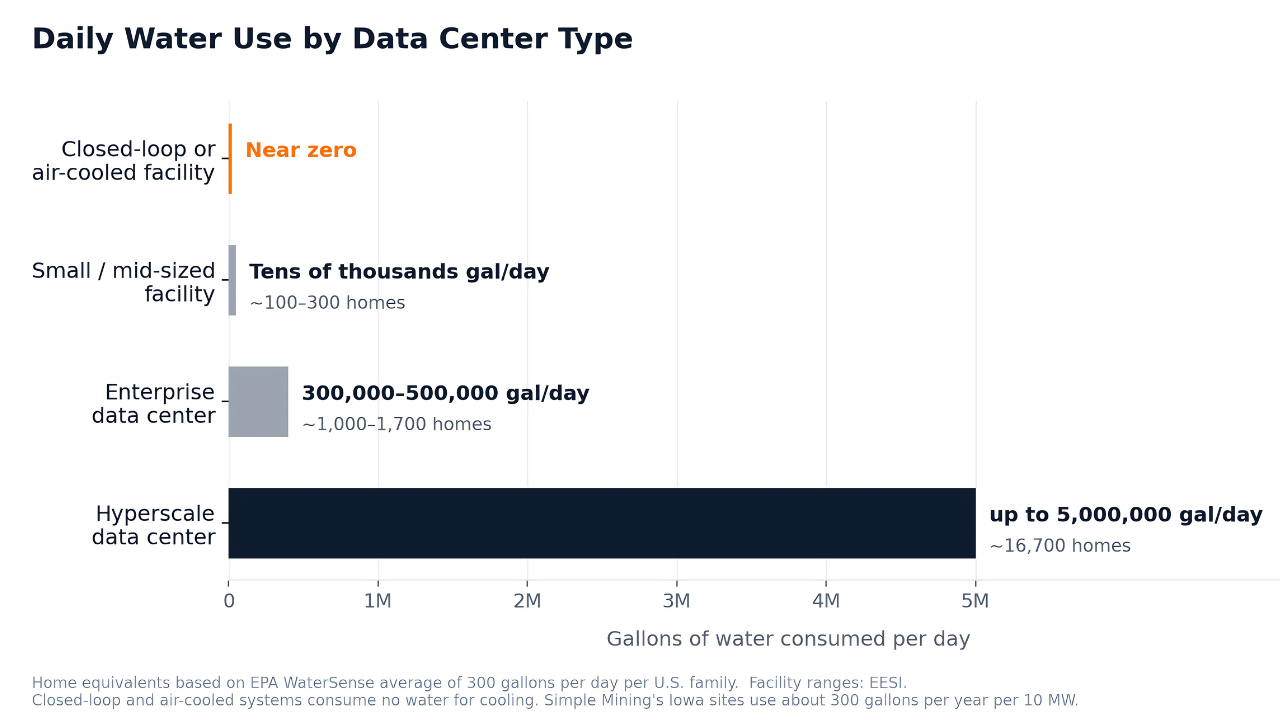
Daily Water Consumption by Facility Size
Facility size sets the ceiling and cooling design sets the floor.
- Small and mid-sized facilities: tens of thousands of gallons per day, and near zero with air-cooled designs
- Enterprise facilities: 300,000 to 500,000 gallons per day on average
- Hyperscale facilities: up to 1 to 5 million gallons per day under peak conditions
At the top end, one facility rivals municipal-level demand. That is why large projects now face water scrutiny during permitting.
Annual Water Usage for Typical Facilities
Continuous operation compounds each day's draw into large annual totals. A facility using 300,000 gallons per day consumes about 110 million gallons per year. A hyperscale site at 5 million gallons per day matches the annual water use of a small city. Summer heat makes it worse because warm weather can triple demand.
Water Use Per Megawatt of Power
Per-megawatt water use normalizes comparisons across facility sizes. A 10 MW site and a 100 MW site tell you nothing side by side until you divide by capacity. Run the math on a 100 MW facility at the industry-average water intensity and you get over 1 million gallons per day. The same 100 MW built with closed-loop cooling consumes almost none.
Simple Mining operates 150+ MW across its Iowa facilities on closed-loop cooling and uses about 300 gallons of water per year for every 10 MW. The EPA puts the average American family's household use at more than 300 gallons every single day. Scale does not have to mean thirst.
Why Data Centers Need Water for Cooling
Servers convert almost all their electricity into heat and water is the cheapest way to move that heat out of the building. Heat that stays inside kills hardware. Cooling is the reason water shows up on a data center's meter at all. The summaries below cover only the water profile of each method, not the mechanics of how data center cooling moves the heat.
Evaporative Cooling Systems
Evaporative systems consume the most water because they reject heat by turning water into vapor. The method dominates the industry since it saves energy at the direct expense of water.
Chilled Water Systems
Chilled water loops recirculate the same water to carry heat away from server rooms. A closed loop consumes almost nothing. Simple Mining's closed-loop systems work on this principle. They run on a propylene glycol-based coolant that circulates like the fluid in a car radiator, absorbing heat, releasing it to the air outside, and looping back without ever leaving the system.
Hybrid Cooling Approaches
Modern operators switch methods with the weather. Microsoft cools its Georgia datacenters with outside air for about 85% of the year. Evaporative cooling runs only on the 55 or so hottest days and the water cycles 2 to 5 times before returning to the utility.
What Is Water Usage Effectiveness (WUE)
Water usage effectiveness (WUE) measures how many liters of water a data center consumes per kilowatt-hour of IT energy. The Green Grid created the metric in 2011 as the water counterpart to PUE. It is the industry standard for comparing water efficiency across facilities. Regulators and ESG analysts now treat it as the number that matters.
How WUE Is Calculated
The formula divides water in by compute out.
- Numerator: annual site water consumption in liters
- Denominator: annual IT equipment energy in kilowatt-hours
- Result: WUE in L/kWh, where lower means more efficient
A worked example makes it concrete. A facility that consumes 50 million liters of water while its IT equipment uses 100 million kWh scores a WUE of 0.5.
Industry Benchmarks for Water Efficiency
The industry average sits around 1.8 to 1.9 L/kWh. Below 0.5 is strong. Above 2.0 signals heavy evaporative use in a hot climate. A WUE near zero is achievable only with air-cooled or closed-loop designs.
Here is what can go wrong when you rely on the number. About half or fewer operators track water use at all and most track it per site rather than fleet-wide, per Uptime Institute surveys. A fleet average can hide one thirsty site in a dry market. The mitigation is simple: ask for per-site WUE and ask how the operator defines consumption.
Simple Mining's closed-loop sites land at the far end of that scale. At roughly 300 gallons per year per 10 MW, water consumption per kilowatt-hour rounds to effectively zero, because no water is consumed for cooling at all.
Data Center Water Use Compared to Other Industries
Data centers rank among the top 10 water-consuming industries in the U.S. yet remain a small share of total national water use. Context matters because headlines seldom provide it.
| Industry | Water Use Context |
|---|---|
| Agriculture | Largest consumer of freshwater overall |
| Power generation | Massive withdrawals for cooling thermal plants |
| Manufacturing | Varies by sector, from light to intensive |
| Data centers | Growing fast but a small share of total use |
The national share is modest. The local impact is not, because data centers cluster. Northern Virginia's 300+ facilities consumed close to 2 billion gallons in 2023, a 63% increase from 2019. Concentration turns a small national number into a big local one.
Can Data Centers Run Without Water
Yes, data centers can run with little to no water when they trade water for energy or capital cost. No design escapes physics. Every waterless option pays for its water savings somewhere else. The trade-offs below stay at the water level, not the mechanics of how each cooling method works.
Air-Cooled Systems
Air-cooled chillers reject heat with ambient air and consume zero water. They draw more electricity in exchange, which is why water-scarce regions accept the energy penalty.
Liquid Immersion Cooling
Immersion cooling submerges hardware in a non-conductive fluid and pairs with dry coolers as a near-zero-water option.
Free Air Cooling in Cool Climates
Free cooling pulls in outside air whenever temperatures allow and uses no water while it runs. Cool regions get this benefit for most of the year. Iowa's cool climate supports efficient cooling for much of the year, which is one reason the state attracts compute infrastructure.
How Location and Climate Affect Water Consumption
Geography decides both how much cooling a facility needs and how much water the local supply can spare. Hot regions demand more cooling right where water is scarcest. That collision is the core siting problem.
- Hot, arid regions: high cooling demand meets limited water supply
- Humid climates: evaporative cooling loses effectiveness as a general principle
- Cool, temperate climates: lower cooling demand and free cooling for much of the year
- Water-abundant regions: less strain on local supplies and easier permitting
Poor siting carries real consequences for communities. Records released after a legal battle showed Google's data centers in The Dalles, Oregon used 355 million gallons of city water in 2021. That was triple the company's 2017 usage and 29% of the city's total water consumption, per reporting by The Oregonian. Responsible operators avoid that outcome by pairing grid-connected renewable energy with abundant water from the start.
How Data Centers Are Reducing Water Usage
Operators cut water use through better cooling technology, water recycling and smarter site selection. Pressure comes from three directions at once: communities, regulators and investors reading WUE reports.
Advanced Cooling Technologies
Direct-to-chip liquid cooling in closed loops eliminates evaporation. Microsoft's newest chip-level design uses zero water for cooling. Rear-door heat exchangers and software-optimized cooling controls squeeze further gains from existing plants.
Water Recycling and Reclamation
Facilities substitute reclaimed water, gray water and captured rainwater for potable supply. Closed-loop systems fill once and recirculate for years. Policy is moving the same direction, with more jurisdictions rewarding non-potable water use in new permits.
Site Selection in Water-Abundant Regions
The cheapest gallon is the one the site never needs. Forward-thinking operators pick locations with sustainable water access and reliable grids. Cool climates and renewable generation seal the choice. Simple Mining built in Iowa for those reasons.
FAQs About Data Center Water Usage
How far away should you live from a data center?
Most data centers pose no direct risk to nearby residents. Cooling equipment is the sound source residents notice, and how loud a data center measures at the property line depends on the cooling method and the setback. Local zoning rules set the setbacks that apply to industrial facilities.
What is the biggest environmental issue with data centers?
Energy consumption and the emissions tied to it remain the primary concern. Water use draws growing scrutiny as facilities scale to meet AI and cloud demand. Both come down to siting and design choices.
Do AI data centers use more water than Bitcoin mining facilities?
AI chips often run hotter than Bitcoin ASICs and can need more intensive cooling. Actual water use depends on facility design and cooling method rather than workload alone. A closed-loop Bitcoin site can use less water than an evaporative AI campus and the reverse can also hold.
How do data centers affect local water supplies?
Large facilities drawing from municipal systems or groundwater can strain local supplies. The risk is highest in water-stressed regions with clustered development. Operators reduce it by siting in water-abundant areas and using low-water cooling designs.
What certifications indicate a water-efficient data center?
Look for operators that report WUE for each site. LEED certification and the EPA ENERGY STAR program for data centers also signal attention to resource efficiency. Public reporting matters more than any single badge.
What chemicals are in data center cooling water?
Open cooling systems typically add biocides to prevent bacterial growth and corrosion inhibitors to protect equipment, and that treated water eventually returns to a wastewater system. Closed-loop systems avoid the question because nothing is discharged. Simple Mining's loops circulate a propylene glycol-based coolant, the same non-toxic fluid the FDA recognizes as safe in food and pharmaceuticals, sealed inside the system with a Safety Data Sheet maintained on site.
What This Means for Bitcoin Mining Operations
Bitcoin mining facilities are data centers built for ASIC hardware and the water question comes down to the same design choices. ASICs pack dense heat loads that demand serious cooling infrastructure. Nothing about mining requires evaporative water use, though. Design decides.
Simple Mining runs zero-water cooling across 150+ MW of Iowa facilities producing 9+ EH/s, using a mix of air-cooled and hydro closed-loop systems. Neither consumes water for cooling, and the fleet is moving toward hydro closed loop for its efficiency and lower noise. The coolant is a propylene glycol-based fluid, the same non-toxic antifreeze used in hospitals and food processing plants, sealed inside the loop with no discharge and no contact with soil, drains, or groundwater. The loops consume zero evaporative water, and the largest water use at our facilities is employee restrooms. Our technicians watch coolant temperature and loop pressure rather than a water meter.
That same design is what lets Simple Mining stay a good neighbor in the Iowa communities around its sites, and it feeds the larger question of whether Bitcoin mining is bad for the environment.
Water use in a data center is a design decision. If you want your miners running in facilities engineered around that principle, explore Bitcoin miner hosting at our Iowa sites.