

What Is Immersion Cooling? A Guide for Bitcoin Mining and AI Data Centers
By Josh Heine, Content Strategist at Simple Mining
Updated July 29, 2026Published July 1, 2026
Immersion cooling submerges computing hardware in dielectric fluid. The fluid conducts heat but not electricity. It absorbs heat straight from the chips and carries it to a heat exchanger. The method removes fans from the equation and supports far more power per rack than air. Bitcoin mining facilities and AI data centers both use it.
Cooling now decides how much compute a building can hold. Air handles about 25 kW per rack of ASICs while immersion tanks support double that or more. This guide explains how immersion works and where it beats air. It also covers where air still wins.
On this page · 11 sections
- What Is Immersion Cooling?
- How Does Immersion Cooling Work?
- What Are the Types of Immersion Cooling?
- What Are the Benefits of Immersion Cooling?
- Immersion Cooling for Bitcoin Mining
- Immersion Cooling for AI Data Centers
- Immersion Cooling vs Air Cooling
- What Are the Challenges and Costs of Immersion Cooling?
- How Do You Get Started with Immersion Cooling?
- FAQs
- Choosing the Right Cooling Strategy for Your Operation
Key Takeaways
- Immersion cooling submerges miners or servers in non-conductive fluid that pulls heat straight off the chips.
- Single-phase systems hold about 81% of the market and remain the practical choice for Bitcoin mining.
- Immersion facilities reach PUE of 1.02 to 1.10 versus 1.4 to 1.6 for typical air-cooled data centers.
- Submerging a standard air-cooled ASIC voids the Bitmain warranty. Purpose-built immersion models keep coverage only in manufacturer-specified fluids.
- Modern AI racks use direct-to-chip cold plates rather than immersion. As of July 2026 flagship AI racks draw 120 to 140 kW.
What Is Immersion Cooling?
Immersion cooling is a thermal management method that places entire machines inside a bath of dielectric fluid. Dielectric means the fluid does not conduct electricity. Boards and chips run submerged without shorting. Liquid moves heat far better than air so hardware runs cooler at higher loads. The approach started in supercomputing and found its second major application in Bitcoin mining data centers.
Heat is the tax every computer pays. An ASIC that draws 3,500 watts converts almost all of it into heat that must go somewhere. Air moves that heat with fans and volume. Fluid moves it with contact. That single difference drives everything else in this guide.
How Does Immersion Cooling Work?
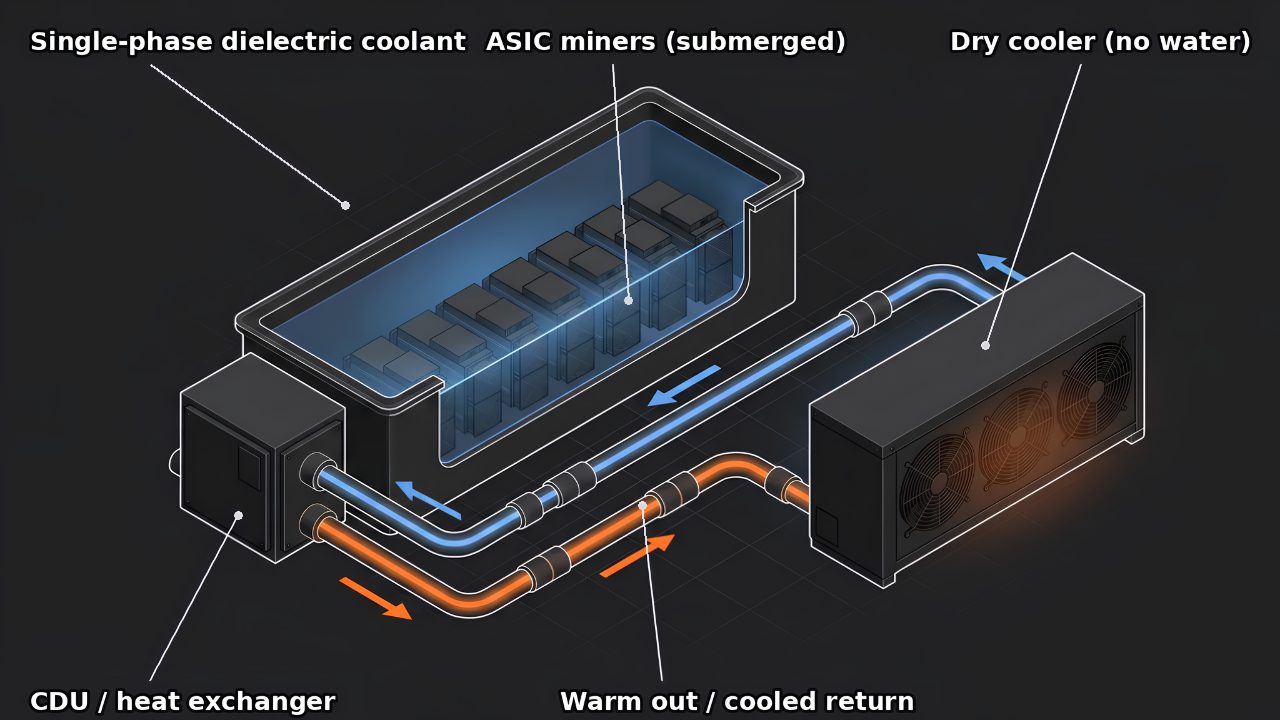
Immersion cooling works through a simple loop. Hardware sits in fluid. The fluid absorbs heat. A pump moves warm fluid out and a heat exchanger rejects the heat.
- Submersion: Miners or servers sit in a tank filled with dielectric fluid.
- Heat absorption: The fluid contacts every hot surface and pulls heat off chips and boards.
- Circulation: Pumps move warm fluid from the tank to an external loop.
- Heat rejection: A heat exchanger or dry cooler dumps the heat outdoors and cooled fluid returns to the tank.
The heat rejection step decides water use. Dry coolers reject heat to outdoor air with no water. Evaporative and adiabatic systems consume water to boost capacity in hot weather. More on that below.
What Are the Types of Immersion Cooling?
Immersion cooling comes in two forms: single-phase and two-phase. The names describe what the fluid does.
Single-Phase Immersion Cooling
Single-phase systems keep the fluid liquid through the entire loop. Warm fluid pumps to a heat exchanger and returns cool. The fluids are engineered hydrocarbons or mineral oils that cost less and face no special regulation. Single-phase holds about 81% of the data center immersion market. It is the practical choice for Bitcoin mining because the tanks are simple and the fluid stays stable for years.
Two-Phase Immersion Cooling
Two-phase systems use a fluid that boils at low temperature right on the chip surface. Vapor rises to a condenser coil and rains back down as liquid. The physics remove heat faster than any pumped loop. Supply is the problem. 3M made the fluorinated fluids that two-phase depended on and ceased production at the end of 2025 as part of its PFAS exit. Remaining alternatives face the same regulatory pressure and as of July 2026 no hydrocarbon two-phase fluid is qualified at data center scale. Treat two-phase as a constrained niche rather than a plan.
What Are the Benefits of Immersion Cooling?
Immersion cooling cuts cooling energy and noise while raising power density and hardware stability. Five benefits carry most of the weight.
Energy Efficiency and Lower PUE
PUE measures total facility power divided by computing power. A perfect score is 1.0. Immersion facilities report PUE between 1.02 and 1.10. Typical air-cooled data centers run 1.4 to 1.6 and the best hyperscale air designs reach about 1.1. One caveat keeps the comparison honest. Air-cooled PUE counts server fan power as IT load so published air numbers flatter air cooling a little.
Extended Hardware Lifespan
Submerged hardware avoids dust and runs at stable temperatures. Fans are the most common mechanical failure in an ASIC and immersion removes them. Less thermal cycling means less expansion stress on solder joints. Operators report longer service life though the gains are directional rather than proven in controlled studies. One caution: some thermal pastes and capacitor types degrade in dielectric fluid so hardware compatibility matters.
Higher Compute Density
Immersion supports more power per square foot than air. Air-cooled ASIC racks run about 25 kW while immersion and hydro deployments support 50 kW or more per rack. On the AI side air tops out around 8 to 25 kW per rack and direct-to-chip reaches 40 to 80 kW. Immersion tanks go higher still. Density matters when power is secured but building space is not.
Reduced Noise and Smaller Footprint
An air-cooled mining hall runs at 75 decibels or more. An immersion tank is near silent because nothing moves except pumps, though the data center noise a site puts past its own walls comes from the dry coolers rather than the tank. Facilities also shrink since airflow corridors and exhaust walls disappear.
Near-Zero Water Use
Immersion can be designed for near-zero water use when paired with dry coolers. The heat rejection loop, not the tank, decides the water a data center actually draws. Evaporative and adiabatic systems still consume water on hot days. Paired with dry coolers immersion cuts water use 95 to 98% versus evaporative cooling towers. That matters in drought-prone regions where permits hinge on water.
Immersion Cooling for Bitcoin Mining
Bitcoin miners use immersion to run ASICs cooler and denser and to push hashrate past stock settings. The economics reward operators at industrial scale.
ASIC Thermal Management
A modern ASIC concentrates several kilowatts of heat in a small chassis. Immersion holds chip temperatures steady regardless of the weather outside. Stable chips hash at rated speed through summer peaks without thermal throttling.
Overclocking for Higher Hashrate
Immersion gives the thermal headroom to overclock. Operators using third-party firmware like Braiins OS+ or VNish report sustained gains of 10 to 30% above stock hashrate. Vendor claims above that range exist but treat them as marketing. The math on a 200 TH/s unit: a 20% overclock adds 40 TH/s. Power draw rises with the clock so profit depends on your rate per kWh rather than hashrate alone.
Two costs come with the gain. Third-party firmware and over-frequency settings void the Bitmain warranty. Higher power also stresses the PSU past its design point.
Reduced Downtime and Fewer Repairs
Removing fans removes the part that fails most often. Dust never reaches the boards. Repairs drop but do not disappear since hashboards and power supplies still fail. Fewer repairs is not zero repairs so access to in-house ASIC repair still matters.
Hydro Cooling Is Not Immersion
Bitmain sells factory hydro models like the S23 Hydro and the S21 XP Hydro. Hydro circulates treated water through a cold plate bonded inside the machine. Nothing gets submerged. Hydro units ship with full manufacturer support and reach immersion-class rack density without the tank. Compare hydro-cooled Bitcoin miners for sale if you want the density without the conversion risk.
Immersion Cooling for AI Data Centers
AI data centers face rack densities that air cannot cool, but the current standard answer is direct-to-chip liquid rather than immersion. Anyone planning AI infrastructure should understand the distinction.
GPU Heat Density Challenges
As of July 2026 flagship AI racks draw about 120 to 140 kW. The NVIDIA GB200 NVL72 carries a 120 kW nominal rating and deployed racks report closer to 130 kW under load. GB300-class racks land in the 130 to 150 kW band. Racks above 200 kW belong to the next hardware generation rather than current shipments. Air cooling tops out near 25 kW per rack so every one of these systems requires liquid. For the full infrastructure picture see our guide to what an AI data center is.
Direct-to-Chip Is the Current AI Standard
Direct-to-chip cooling pipes coolant through cold plates mounted on the CPUs and GPUs. Networking and storage stay air cooled. NVIDIA mandates this design for the GB200 NVL72 and every major server vendor builds to it. Immersion is not what hyperscale AI runs today. Any pitch that implies otherwise is selling something.
Where Immersion Fits in AI
Immersion offers density headroom beyond cold plates because the fluid touches every component. That makes it a prospective path as rack power keeps climbing toward the 200+ kW generation. It also suits operators who value uniform cooling and heat capture over compatibility with standard racks. Watch the fluid supply question before betting a facility design on it.
Water Conservation and Compliance
AI facilities draw scrutiny for water use. Immersion paired with dry coolers meets tight water budgets that evaporative systems cannot. Permits in water-stressed regions can hinge on this design choice.
Immersion Cooling vs Air Cooling
Immersion beats air on efficiency and density while air wins on cost and simplicity. The table shows the trade in one view.
| Factor | Air Cooling | Immersion Cooling |
|---|---|---|
| Cooling efficiency | Limited by ambient air temperature | Direct fluid contact with the heat source |
| PUE | ~1.4 to 1.6 typical; ~1.1 best in class | ~1.02 to 1.10 |
| ASIC density | ~25 kW per rack | 50+ kW per rack |
| Hardware lifespan | Dust and thermal cycling wear | Stable temps and no dust; fluid compatibility required |
| Noise | 75+ dB | Near silent |
| Water use | Depends on design; evaporative systems consume water | Near zero with dry coolers |
| Upfront cost | Lower | Higher: tanks, fluid, heat exchangers |
| Warranty | Intact on standard miners | Voided on standard air-cooled miners |
| Maintenance | Fan and filter replacement | Fluid monitoring; replacement every 5 to 8 years |
What Are the Challenges and Costs of Immersion Cooling?
Immersion demands more capital and more specialized skill before it pays back. Be honest about four hurdles.
Upfront Investment
Capital costs stack up before the first hash:
- Tanks and racking built for fluid
- The dielectric fluid itself
- Heat exchangers, pumps, and outdoor dry coolers
- Facility plumbing and floor-loading upgrades
Engineered single-phase fluids cost several times what mineral oil costs. Industry estimates put fluid at 8 to 15% of total system capex.
Fluid Maintenance
Dielectric fluid lasts 5 to 8 years with regular monitoring. Operators test for contamination and degradation and then filter or top up as needed. Skipping fluid care shortens hardware life and erases the reliability benefit.
Hardware Compatibility and Warranty
Submerging a standard air-cooled miner voids the Bitmain warranty. Bitmain's service terms exclude damage from liquid immersion along with damage from over-frequency firmware. Purpose-built immersion models like the S21 IMM keep coverage only when they run in manufacturer-specified fluids. Check compatibility lists before any conversion.
Operational Learning Curve and Payback
Staff need training on fluid handling and leak response and tank service. Payback comes from energy savings plus density plus hardware life. It depends on your power rate and your scale so run the numbers per kW rather than per machine. Small deployments struggle to justify the tank. Label every assumption when you model it.
How Do You Get Started with Immersion Cooling?
The path from air to immersion runs through four decisions.
1. Evaluate Your Cooling Requirements
Measure current heat load and power density. Immersion pays at high density with cheap power. A ten-machine garage setup seldom earns back a tank.
2. Select the Right Immersion System
Choose single-phase unless you have a documented reason not to. Two-phase fluid supply remains constrained as of July 2026. Match tank capacity to your growth plan rather than your current fleet.
3. Plan Infrastructure and Retrofitting
Map tank placement and electrical upgrades and heat exchanger routing. Fluid-filled tanks are heavy so check floor loading early. Budget for the fan simulators and firmware work that conversions require.
4. Partner with an Experienced Provider
Immersion rewards operators who have already made the mistakes. If you would rather skip the capex then hosted air-cooled mining delivers most of the operational benefit without the tank.
FAQs
Can existing air-cooled ASIC miners be retrofitted for immersion cooling?
Yes. Operators remove the fans and install a fan simulator or firmware that disables the fan check while the heatsinks stay on and the power supply gets a simulator or an immersion-rated swap. Bitmain also sells purpose-built immersion models like the S21 IMM and S23 IMM for buyers who want factory support.
Does immersion cooling void Bitcoin miner warranties?
Submerging a standard air-cooled miner voids the Bitmain warranty. The service terms exclude damage from liquid immersion and from third-party firmware that raises frequency. Immersion-specific models keep coverage only when they run in manufacturer-specified fluids.
How often does dielectric fluid need to be replaced?
Quality dielectric fluid lasts 5 to 8 years with regular monitoring. Operators test for contamination and degradation and filter or replace fluid when readings drift. Fluid condition matters more than a fixed calendar schedule.
What is the difference between immersion cooling and direct-to-chip liquid cooling?
Immersion submerges the entire machine in fluid while direct-to-chip pipes coolant through cold plates mounted on specific chips. Modern AI racks like the NVIDIA GB200 NVL72 use direct-to-chip with air-cooled networking and storage. Immersion offers simpler whole-machine heat capture but direct-to-chip fits standard rack designs.
Do any Bitcoin mining hosting providers offer immersion-cooled facilities?
Yes. Riot Platforms operates large-scale immersion-cooled Bitcoin mining, and EZ Blockchain builds and deploys single-phase immersion containers for miners. Availability varies by site, so ask any prospective host what cooling its facility runs before you ship hardware.
Choosing the Right Cooling Strategy for Your Operation
Match the cooling method to your scale and your goals rather than to the newest headline. Immersion earns its capex at industrial density with cheap power and staff who know fluids. Most miners face a bigger question first. Do you want to run and maintain the hardware yourself at all?
There is a third path that skips the cooling question. Professional Bitcoin mining hosting moves the thermal problem onto an operator's balance sheet instead of yours. Simple Mining runs hosting sites across Iowa. Hosted fleets hold 95%+ average uptime and get hardware repair coverage with free repair labor and unlimited fan replacements. The operation runs 9+ EH/s across 150+ MW under management with precision billing. A 7-day risk-free trial on an Antminer S21+ (235 TH/s) lets you test the dashboard before committing capital.
The best cooling system is the one you never have to think about.
Start your free 7-day hosting trial and see your first hashes this week.