

What Is Demand Response and How Does It Work?
By Josh Heine, Content Strategist at Simple Mining
Published July 23, 2026
Demand response is a change in electricity use by consumers from their normal consumption patterns in response to price signals or incentive payments, designed to lower usage during periods of high wholesale prices or grid stress. In plain terms the grid pays flexible energy users to power down when supply runs tight. The concept matters more each year as data centers and electrification push peak demand higher. For Bitcoin miners it represents something rare: a way to get paid for not working.
On this page · 12 sections
- What Is Demand Response
- How Demand Response Works
- Types of Demand Response Programs
- Benefits of Demand Response
- Who Uses Demand Response Programs
- Demand Response Examples in Practice
- Demand Response Incentives and Payments
- Demand Response in the United States
- How Bitcoin Miners Benefit from Demand Response
- How to Participate in Demand Response
- FAQs About Demand Response
- Making Demand Response Part of Your Mining Strategy
Key Takeaways
- Demand response pays consumers to reduce or shift electricity use during periods of grid stress.
- Programs fall into five main types: emergency, economic, ancillary services, capacity-based and time-of-use.
- Participants can stack capacity payments, energy payments and performance bonuses.
- FERC Orders 745 and 2222 opened wholesale markets to demand response and to small aggregated loads.
- Bitcoin miners rank among the best participants because ASICs power down in seconds and restart without damaging hardware.
What Is Demand Response
Demand response is an energy management strategy where grid operators or utilities pay consumers to reduce or shift electricity use during peak demand or grid stress. The strategy also goes by demand side response or DSR. It sits under the broader umbrella of demand-side management. That umbrella covers everything done on the customer side of the meter.
Demand response differs from energy efficiency. Efficiency lowers consumption across every hour of the year. Demand response reduces or shifts consumption for a defined window when the grid asks. The payoff is a grid that avoids blackouts without building power plants that sit idle most of the year.
How Demand Response Works
Demand response works through a simple exchange: the grid operator sends a signal and enrolled participants cut load in return for payment. The alternative is firing up expensive peaking power plants that exist for a handful of hours each year. The process has three parts.
Grid Operators Signal Peak Demand Events
An event begins when the grid operator or utility notifies enrolled participants that demand is about to outrun supply. Heat waves and cold snaps are the classic triggers. Generation outages and sudden drops in wind or solar output cause events too. Notice windows range from a day ahead to a few minutes depending on the program.
Participants Reduce or Shift Energy Usage
Once the signal arrives participants respond in one of two ways:
- Manual curtailment: operators power down equipment or processes by hand
- Automated response: smart devices, building management systems or industrial controls scale back usage on their own
The act of powering down load is known as curtailment. Curtailment is the action. Demand response is the program that pays for it.
Incentive Payments Reward Flexibility
Participants receive financial compensation for the load they reduce. Payment structures vary by program and get full treatment later in this article. The short version: flexibility has cash value.
Types of Demand Response Programs
Demand response programs fall into two broad categories: incentive-based programs that pay for reductions and price-based programs that charge more at peak. Five program types cover most of the landscape.
| Program Type | How It Works | Typical Participants |
|---|---|---|
| Emergency DR | Curtail load during grid emergencies | Industrial, large commercial |
| Economic DR | Reduce load when wholesale prices spike | Commercial, industrial |
| Ancillary Services | Provide frequency regulation and reserves | Large flexible loads |
| Capacity-Based | Commit curtailment capacity in advance | All participant types |
| Time-of-Use | Shift usage to off-peak hours | Residential, small commercial |
Emergency Demand Response
Emergency demand response asks large users to curtail when the grid nears its capacity limit. Utilities call these events during genuine reliability threats. Participants earn payment for availability and for the load they shed.
Economic Demand Response
Economic demand response responds to price rather than emergency. Participants reduce usage when wholesale electricity prices climb past a set threshold. Participation is voluntary and driven by real-time price signals.
Ancillary Services Demand Response
Ancillary services demand response provides grid balancing functions like frequency regulation and operating reserves. These programs demand fast response and often require automated controls. The fastest loads earn access to the highest-paying tiers.
Capacity-Based Programs
Capacity-based programs pay participants to commit curtailment capacity in advance. Enrollees receive recurring payments for standing ready plus event payments when called. The commitment carries obligations and penalties for non-performance.
Time-of-Use Rate Programs
Time-of-use rates make electricity cost more during peak hours. The price signal nudges users to shift heavy loads like EV charging into off-peak windows. This is the price-based side of demand response and it reaches households as well as businesses.
Benefits of Demand Response
Demand response creates value for participants first and for the grid and environment right behind them.
Cost Savings and Revenue for Participants
Participants earn payments for curtailing and can lower their own bills by avoiding peak usage. A flexible load stops being a pure cost center and starts acting like a revenue-generating asset. Earnings are never guaranteed and depend on program design and event frequency.
Grid Reliability and Peak Load Reduction
Demand response reduces strain on the grid during peak demand. It cuts the need for peaking power plants that sit idle most of the year. The International Energy Agency counts this flexibility among the cheapest tools for keeping grids stable. Every megawatt of flexible load is a megawatt of generation the grid does not have to build.
Renewable Energy Integration
Demand response helps balance the grid as wind and solar output rises and falls. Flexible loads absorb surplus power and back off during shortfalls. The same dynamic drives the debate over whether Bitcoin mining helps or harms the environment. A cleaner grid needs loads that can move.
Who Uses Demand Response Programs
Demand response participants range from factories and data centers to homes with smart thermostats.
Industrial Facilities and Data Centers
Industrial plants and data centers bring large and consistent loads with some operational flexibility. Many can shift non-critical processes or lean on backup generation during events.
Bitcoin and Cryptocurrency Mining Operations
Bitcoin mining operations are near-ideal participants because the load is big and interruptible without lost product. ASICs power down in minutes and restart without damaging hardware. Some hosting providers manage curtailment participation at the facility level.
Commercial Buildings and Campuses
Commercial buildings reduce consumption through HVAC setbacks and lighting controls with minimal occupant impact. Building management systems automate the response across a campus.
Residential Customers with Smart Devices
Households join through devices like smart thermostats and EV chargers. Utilities and third parties aggregate thousands of homes to reach meaningful scale.
Demand Response Examples in Practice
Demand response shows up in scenarios like these:
- Summer heat wave: a grid operator calls an afternoon event and participating factories reduce HVAC and pause non-essential equipment
- Winter cold snap: utilities signal smart thermostats to pre-heat homes before peak and then ease heating during the event window
- Renewable shortfall: cloud cover cuts solar output and flexible loads curtail to match available supply
- Mining curtailment: Bitcoin miners power down ASICs during a grid emergency and resume hashing once the event clears
Demand Response Incentives and Payments
Demand response compensation stacks several payment streams on top of each other. Under FERC Order 745, grid operators pay demand response the same wholesale price they pay generators for producing power. The Supreme Court upheld the rule in 2016.
Capacity Payments
Capacity payments reward participants for standing ready to curtail. They arrive on a recurring schedule and get paid whether or not events occur. Think of them as rent the grid pays for your flexibility.
Energy Payments
Energy payments compensate the actual load reduced during an event. Program administrators measure the reduction against a baseline of normal usage. The bigger the verified drop below baseline the bigger the payment.
Performance-Based Bonuses
Performance bonuses reward speed and reliability. Programs pay extra for responding fast or curtailing more than committed. Poor performance runs the other way and can trigger penalties.
Demand Response in the United States
Demand response in the United States runs through federal rules and regional grid operators.
FERC Order 2222 and Wholesale Market Access
FERC Order 2222 requires regional grid operators to let aggregated distributed energy resources compete in wholesale markets. FERC issued the order in September 2020 and it covers demand response along with storage and rooftop solar. The order opens energy markets as well as capacity and ancillary services markets to these aggregations. It applies to organized RTO and ISO markets only.
The order also bars operators from setting a minimum aggregation size above 100 kW. That threshold is what lets smaller loads join through aggregators.
ISO and RTO Program Availability
Program availability depends on which regional grid operator serves your area. Seven organized markets cover most of the country:
- PJM (Mid-Atlantic and parts of the Midwest)
- ERCOT (most of Texas)
- CAISO (California)
- MISO (the Midwest and parts of the South)
- SPP (the central plains)
- NYISO (New York)
- ISO-NE (New England)
The rest of the country has no organized wholesale market. Regions like the Northwest, Southwest, and Southeast are served by local utilities that run their own demand response programs instead of an ISO or RTO.
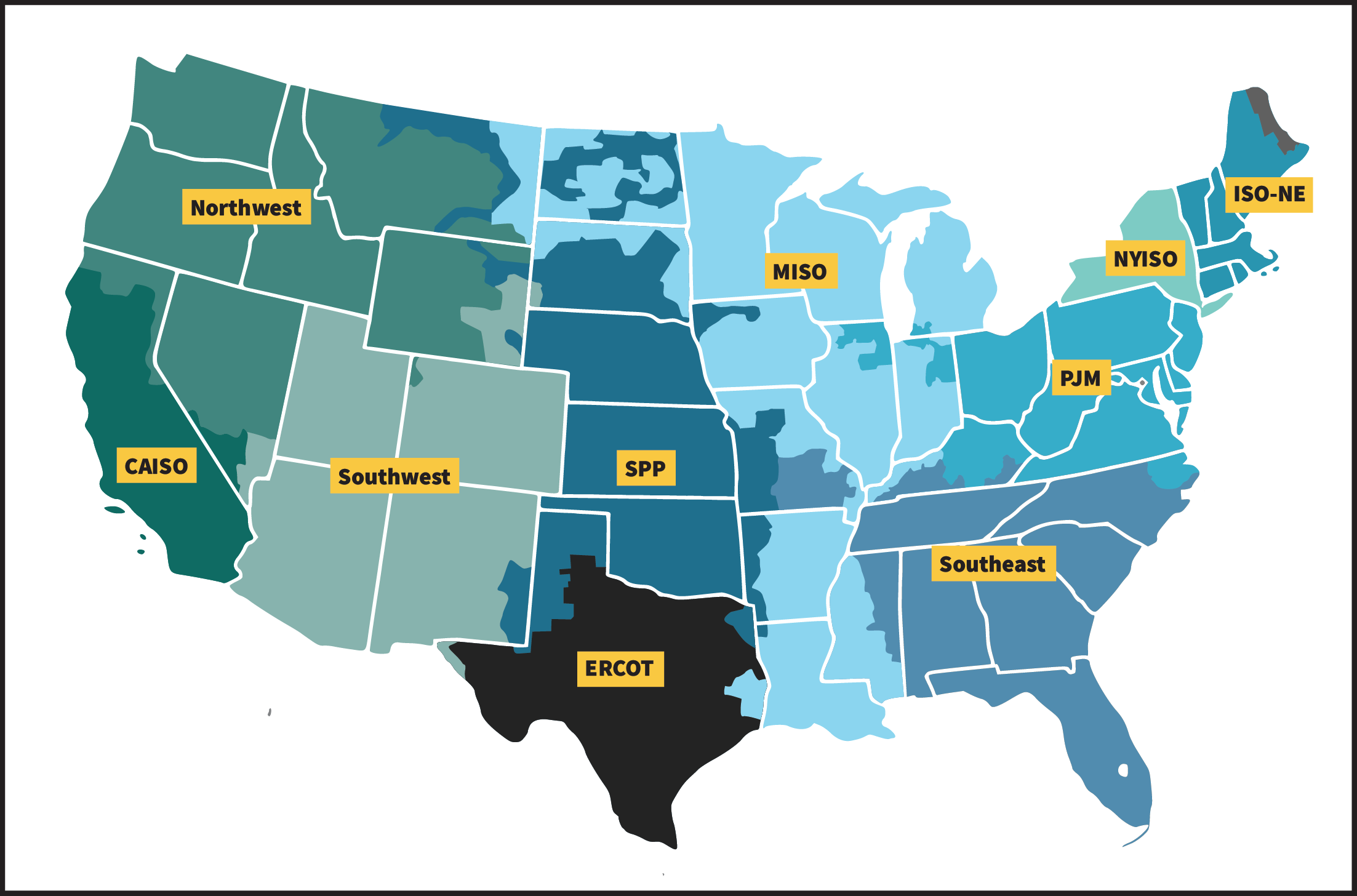
Iowa itself is split. Most of the state including the Cedar Falls area sits in the MISO footprint while parts of western Iowa fall under SPP. Each market runs different program structures and compensation. Check your specific region before planning participation.
How Bitcoin Miners Benefit from Demand Response
Bitcoin miners benefit from demand response because the machines tolerate interruption better than almost any other industrial load.
Ideal Load Flexibility for Curtailment
An ASIC fleet can drop to near zero load in seconds without damaging equipment or losing product. There is no ramp-down sequence and no batch to scrap. The real cost is hashrate not produced during the event window plus a managed restart afterward. Units running tuned firmware need that restart handled with care rather than a bare power flip.
Additional Revenue Beyond Block Rewards
Demand response payments can create a secondary income stream beside block rewards. During thin-margin stretches those payments can offset operating costs. Flexibility changes the math behind the cost to mine one Bitcoin. None of it is guaranteed. Event frequency and program rates set the ceiling.
Positioning Mining as a Grid Asset
Participation proves that Bitcoin mining can support grid stability rather than strain it. Simple Mining's Cedar Falls facilities sit in the MISO footprint and operate as flexible load, participating in utility curtailment programs that help balance the grid. The community and grid record in Iowa shows what that looks like in practice. Regulators and utilities notice loads that show up when the grid needs help.
How to Participate in Demand Response
Participation follows four steps from assessment to automation.
1. Assess Your Load Flexibility and Baseline
Determine how much load you can curtail and how fast and for how long. Establish your baseline usage pattern because curtailment gets measured against it. A weak baseline undercuts every payment that follows.
2. Identify Programs in Your Utility or ISO Region
Research the programs available in your area. Start with your utility and your regional grid operator's website. Compensation and requirements vary a great deal by region.
3. Enroll With a Utility or Aggregator
Large loads may qualify to enroll with the utility or the ISO on their own. Smaller participants work with third-party aggregators that bundle loads to meet minimum thresholds. Aggregators handle the market interface in exchange for a share of the payments.
4. Implement Automated Response Protocols
Set up systems that receive curtailment signals and act on them without a human in the loop. Automation improves response speed and compliance rates. For mining operations this means firmware and facility controls that can drop load on command.
FAQs About Demand Response
What is the minimum load required to participate in demand response?
Minimum load requirements vary by program and region. Smaller operations can enroll through third-party aggregators that combine multiple sites to meet program thresholds. FERC Order 2222 bars grid operators from setting minimum aggregation sizes above 100 kW.
Can demand response participation affect mining equipment or uptime?
Properly managed curtailment does not damage ASIC miners. Machines can power down and restart without harm and most events last a few hours. The site loses hashrate during the event window and units need a managed restart afterward.
What happens if a participant fails to curtail during a demand response event?
Failing to curtail during an event can reduce payments or trigger penalties. Repeated non-compliance can lead to removal from the program. Exact consequences depend on program rules and contract terms.
How is demand response different from load shedding?
Demand response is voluntary and compensated while load shedding is mandatory and uncompensated. Participants choose to enroll and receive payment for reducing load. Load shedding disconnects customers during emergencies without consent or payment.
Is demand response available in every U.S. state?
Demand response exists across the United States but availability varies by state and utility territory. Organized wholesale markets cover most of the country while some regions rely on utility-run programs. Check with your local utility or your ISO or RTO for options in your area.
Making Demand Response Part of Your Mining Strategy
Demand response turns flexibility into strategy rather than compromise. For miners it reduces risk while adding a potential income stream. It also shows the industry serving the grid it runs on. Simple Mining's Iowa infrastructure is built for flexible operation. Clients can pause mining when conditions warrant and precision billing means no charges accrue while units sit offline.
The most valuable megawatt during a peak is the one you can turn off. Explore hosted Bitcoin mining built for flexibility from day one.