

What Is Strategy (Formerly MicroStrategy) and How It Works
By Josh Heine, Content Strategist at Simple Mining
Updated August 5, 2026Published December 9, 2024
Strategy is the enterprise software firm that converted its balance sheet into the largest corporate Bitcoin position in the world. The company holds 842,138 BTC as of August 5, 2026. That stack cost $63.51 billion at an average of $75,419 per Bitcoin. The story investors knew through 2025 changed this year: the stock now trades below the value of its coins, and the company sold Bitcoin three times in 2026. This guide explains what Strategy is, how it funds the stack, and what its bet means for the mining side of the market.
On this page · 13 sections
- What Is Strategy (Formerly MicroStrategy)?
- Why MicroStrategy Rebranded to Strategy
- What Does Strategy Do?
- Why Strategy Is Buying Bitcoin
- How Much Bitcoin Strategy Holds
- How Strategy Buys and Holds Bitcoin
- Why Strategy Started Selling Bitcoin in 2026
- Who Is Michael Saylor?
- Buying MSTR Stock vs. Buying Bitcoin Directly
- Risks of Strategy's Bitcoin Approach
- What Strategy's Bitcoin Bet Means for Miners
- FAQs About Strategy
- Earn Coins Instead of Buying the Wrapper
Key Takeaways
- Strategy holds 842,138 BTC as of August 5, 2026, the largest corporate Bitcoin position by a wide margin. Second place is Twenty One Capital at 43,514 BTC.
- The company announced its rebrand from MicroStrategy on February 5, 2025 and made Strategy Inc its legal name that August.
- Funding comes from common stock sales, convertible notes, and four series of perpetual preferred stock. The preferred series pay dividends of 8% to 12%.
- MSTR now trades below the value of the Bitcoin it holds on the basic mNAV measure. The premium that defined the stock through 2024 and 2025 is gone.
- Strategy sold 5,258 BTC across three sales in 2026 to fund preferred dividends and rebuild cash. Holdings are still up 169,638 BTC on the year.
What Is Strategy (Formerly MicroStrategy)?
Strategy is an enterprise analytics software company and the largest corporate holder of Bitcoin, founded in 1989 by Michael Saylor and Sanju Bansal and headquartered in Tysons Corner, Virginia. The Class A common stock trades on Nasdaq under MSTR. Four perpetual preferred series also list on Nasdaq: STRK, STRF, STRD, and STRC.
Business intelligence software is the original trade. It helps organizations pull data out of their systems and turn it into dashboards, reports, and answers. Strategy sold that product for three decades before most investors had heard the name.
Since August 2020 the company has run a second business: buying Bitcoin and holding it as its main treasury asset. Strategy describes itself as the first Bitcoin Treasury Company in the world. The market now treats the stock as a Bitcoin vehicle first and a software vendor second.
Why MicroStrategy Rebranded to Strategy
MicroStrategy unveiled the shorter Strategy name on February 5, 2025. The corporate registration caught up that summer. Per the company's own press release, MicroStrategy Incorporated took Strategy Inc as its legal name on August 11, 2025.
The ticker did not change. Neither did the tickers on the preferred series or the CUSIP numbers. The new name signals that Bitcoin sits at the center of the business rather than off to one side of a software company.
What Does Strategy Do?
Strategy runs two businesses under one roof: an enterprise analytics software operation and a Bitcoin treasury. The software pays some of the bills while the treasury defines the stock.
Enterprise Analytics Software
The software arm sells two flagship products: Strategy One and Strategy Mosaic. Strategy One is an AI-powered analytics platform for dashboards, reporting, and embedded AI assistants. Strategy Mosaic is a universal semantic layer that lets a company define its business logic once and reuse it across data tools.
The segment produced $122.4 million of revenue in Q2 2026, up 6.9% year over year. Gross profit came in at $81.6 million at a 66.6% margin. The numbers are healthy for a mature software business and small next to the treasury.
Bitcoin Treasury Operations
Since August 2020 Strategy has bought Bitcoin as its primary treasury reserve asset, which means the company parks its long-term capital in Bitcoin instead of cash or bonds. Dozens of firms now copy the Bitcoin treasury company model it created. Few match its scale or its access to capital markets.
The treasury dwarfs the software business. The coins carry a $63.51 billion cost basis against software revenue of $122.4 million in the latest quarter. That ratio is why the stock moves with Bitcoin and not with software earnings.
Why Strategy Is Buying Bitcoin
Strategy buys Bitcoin because Michael Saylor's thesis holds that Bitcoin preserves capital better than cash, which loses purchasing power to inflation and currency debasement. Saylor frames cash as a melting asset and Bitcoin as digital property with a fixed supply of 21 million coins. Under that view a company sitting in cash bleeds value every year, while one holding Bitcoin owns an asset no central bank can print.
The board adopted the thesis in August 2020. It has held through two full market cycles since, including the 2026 drawdown that pushed the position underwater against its cost basis.
How Much Bitcoin Strategy Holds
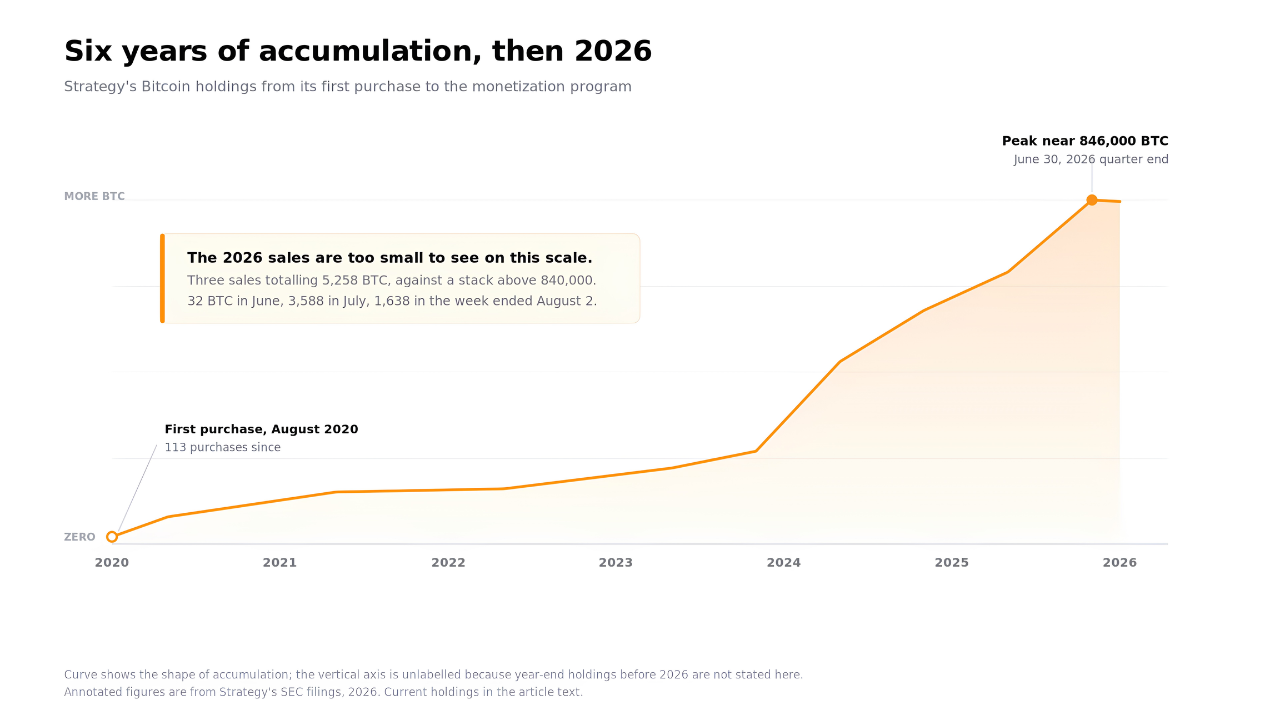
Strategy holds 842,138 BTC as of August 5, 2026, per the live dashboard the company runs. The count matches the Form 8-K it filed on August 3. The stack cost $63.51 billion at an average price of $75,419 per Bitcoin. That is 4.01% of the 21 million coins that will ever exist.
No other company comes close. Second place belongs to Twenty One Capital (NYSE: XXI) at 43,514 BTC, less than a twentieth of Strategy's count. Holdings peaked near 846,000 BTC at the June 30 quarter end and sit lower today after the sales covered below.
How Strategy Buys and Holds Bitcoin
Strategy funds its Bitcoin position by selling securities: common stock, convertible notes, and perpetual preferred shares. The mix shifted hard toward preferred stock in 2026.
Convertible Note Offerings
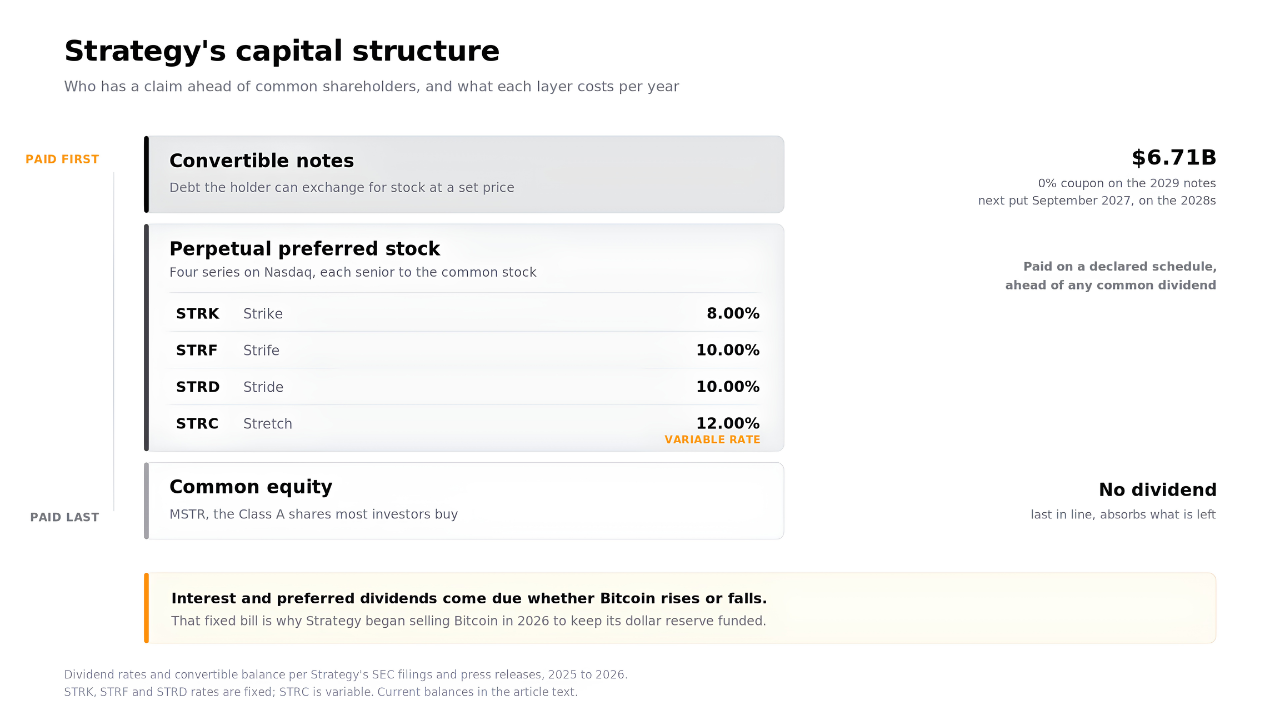
Convertible notes are loans the lender can swap for stock at a set price. Strategy issued billions of dollars of them between 2020 and 2025 to fund Bitcoin purchases. It issued none in 2026, and the direction reversed. In May 2026 the company repurchased $1.5 billion of its 0% notes due 2029 at about an 8% discount to par, cutting convertible debt from $8.21 billion to $6.71 billion. The next put date lands in September 2027 on the 2028 notes.
At-the-Market Stock Sales
An at-the-market program sells new shares straight into the open market at prevailing prices. Strategy raised about $17.06 billion through ATM programs in 2026 through early August, including $290.6 million of MSTR common in the week of July 27. In past years those proceeds bought Bitcoin. In 2026 most of the money has gone to the US dollar reserve, preferred dividends, and repurchases of preferred shares.
Perpetual Preferred Stock
Preferred stock now carries the financing load: 44% of Strategy's 2026 raises came through preferred instruments rather than common equity. Four series trade on Nasdaq. STRK pays 8.00%, STRF pays 10.00%, STRD pays 10.00%, and STRC pays a variable rate the board set to 12.00% in July 2026. Those dividends are a real cash bill: the company's dashboard puts the annual interest and dividend obligation at $1.75 billion.
Operating Cash Flow
The software business generates cash, but the amounts are modest next to the treasury program. Gross profit of $81.6 million a quarter cannot move a $63.51 billion Bitcoin position, and the 2026 obligations get funded from the reserve, equity sales, and Bitcoin sales instead. Software keeps the lights on and the brand alive in enterprise accounts. The stack itself is a capital markets creation.
Why Strategy Started Selling Bitcoin in 2026
Strategy sold Bitcoin in 2026 for the first time at scale, using the proceeds to fund preferred dividends, rebuild its cash reserve, and repurchase preferred shares. The never-sell posture ended in May 2026 with a first small sale: 32 BTC reported in early June. A BTC monetization framework followed on June 29, 2026 and formalized selling as a capital tool.
Two larger sales came under it. Strategy sold 3,588 BTC in early July for about $216 million at a $203 million loss, then 1,638 BTC in the week ended August 2 for about $105 million. The 2026 total comes to 5,258 BTC. Proceeds went to preferred dividends, the US dollar reserve, and STRC repurchases.
Context matters here. Three sales stand against 113 purchases since August 2020, and holdings are still up 169,638 BTC on the year. Management frames the sales as tactical balance sheet work rather than a change of conviction.
The market still took notice. The company posted an $8.22 billion net loss in Q2 2026 on unrealized Bitcoin markdowns. Its own dashboard shows a one-year return on MSTR of negative 74%. We track these Monday filings the way miners track difficulty adjustments, and the questions from hosting clients shift within days of one.
Who Is Michael Saylor?
Michael Saylor is Strategy's co-founder and Executive Chairman, and the most visible corporate advocate for Bitcoin. He served as CEO from the 1989 founding until August 2022, when Phong Le became President and CEO. Saylor now runs point on the treasury strategy and the public case for it.
His reach moves the story as much as the filings do. Goldman Sachs put him on stage at its London digital assets conference in the summer of 2026, where he pitched Bitcoin-backed credit to the bank's clients. He argues that institutional flows have replaced the halving cycle as the main force setting Bitcoin's price. His posts on X set the tone for the entire treasury sector.
One point trips up new investors. Saylor's personal never-sell message and the company's treasury policy are separate things, and the June 2026 monetization framework made that separation official.
Buying MSTR Stock vs. Buying Bitcoin Directly
MSTR gives you Bitcoin exposure through a corporate wrapper, while buying Bitcoin gives you the asset itself. The wrapper adds a software business, convertible debt, preferred dividends, and a market multiple that floats above or below the coins.
| Factor | MSTR stock | Bitcoin held outright |
|---|---|---|
| Exposure | A claim on the company's Bitcoin, filtered through a corporate balance sheet | The asset itself at spot price |
| Custody | Shares sit at your broker | You control the coins |
| Valuation | Priced below the gross value of its Bitcoin on the basic mNAV measure | Always worth spot |
| Extra exposure | Software business, convertible debt, and preferred dividend obligations | None |
| Tax treatment | Taxed like any listed share | Taxed as property in the US; treatment varies by country |
The valuation row deserves the most attention. The metric is mNAV, the multiple of net asset value the market pays for its Bitcoin. The market prices MSTR below the gross value of its Bitcoin on the basic measure and a touch above it once debt and preferred stock are netted out. The variants land on opposite sides of par by design, which is why any mNAV quote needs a label and a date. The premium that defined the stock through 2024 flipped during the 2026 drawdown.
Strategy has its own framing for the wrapper. The company describes MSTR as amplified exposure to its Bitcoin, with the common stock absorbing the volatility and performance left over once the credit instruments take their cut. The dashboard quantifies the claim with an amplification figure of 1.50x and net leverage of 5.04%.
Custody is the other structural difference. A brokerage holds your MSTR shares under its own rules and its own hours. Bitcoin bought outright rides on the private keys in your own Bitcoin wallet, which no intermediary can freeze. There is also a records angle: coins bought through a broker inherit the KYC trail a brokerage account creates, while self-custody keeps the paper trail thinner.
One ticker confuses this comparison: MSTY. MSTY is an income fund that sells options on MSTR rather than holding Bitcoin. Its payouts come from option premium, so it trades away upside in exchange for a stream of income and owns no coins at all.
Spot Bitcoin ETFs are a third door. They track the coin's price for a fee, and you can watch daily net flows across the US spot Bitcoin ETFs to see how much capital moves through them each session.
Mining is the fourth. A miner earns new Bitcoin at production cost rather than buying it at market, and equipment owners can pair that income with bonus depreciation on mining equipment at tax time. Which door fits depends on what you want: convenience, income, control, or production.
Risks of Strategy's Bitcoin Approach
Strategy's structure carries risks that plain Bitcoin ownership does not. Three matter most in 2026: the discount, the dividend load, and the debt calendar.
mNAV Discount Risk
The premium that powered the model is gone. At a premium the company could sell stock and grow Bitcoin per share with every raise. The basic measure flipped to a discount in 2026. At a discount the old flywheel runs in reverse, because issuing stock below net asset value dilutes the Bitcoin behind each share. A discount can persist for as long as sentiment stays cold.
Preferred Dividend Obligations
Four preferred series sit senior to the common stock and demand cash on schedule. The rates run from 8% to 12%, and the bill comes due whether the coin rises or falls. Against it Strategy holds a $4 billion US dollar reserve, which the dashboard sizes at 2.3 years of coverage. The 2026 Bitcoin sales exist to keep that reserve funded.
Convertible Debt and Put Dates
Strategy owes $6.71 billion on its convertible notes after the May 2026 buyback. Nothing comes due soon: the next put date is September 2027 on the 2028 notes. Management noted on the Q2 call that the stack would exceed the convertible balance even at a $9,000 Bitcoin price. The near-term maturity risk is small. The real risk is a long bear market that forces refinancing on bad terms while the dividend clock keeps running.
What Strategy's Bitcoin Bet Means for Miners
Strategy's bet matters to miners as a signal of institutional conviction, not as a mechanical driver of demand for new coins. A balance sheet this size treating Bitcoin as its reserve asset tells allocators the asset class has an institutional case. Whether that translates into flows is a market question nobody can promise.
From where we sit, the useful comparison is cost basis. Strategy pays market price plus a capital markets toll for every coin: banker fees, dividend loads, and interest. A miner acquires new Bitcoin at production cost, and the all-in cost to mine a Bitcoin at an efficient site can sit below spot when power, hardware, and difficulty line up.
The honest answer depends on your machine, your power rate, and the network. We keep a full breakdown of whether mining or buying Bitcoin accumulates more over a holding period. The question we ask investors who bring up Strategy on calls is simple: do you want exposure to Bitcoin's price, or a position in its production? The two behave in different ways during a drawdown, as 2026 keeps demonstrating.
FAQs About Strategy
What does MSTR exposure consist of?
MSTR is a claim on the company's Bitcoin, filtered through a corporate structure. Convertible notes of $6.71 billion and four preferred series stand ahead of common shareholders, and the software business rides along. The market then applies its own multiple to the package, and in 2026 that multiple prices the stock below the gross value of its Bitcoin.
Does Strategy pay dividends?
The common stock pays no dividend. The four preferred series do: STRK at 8%, STRF at 10%, STRD at 10%, and STRC at a variable rate set to 12% in July 2026. Funding those payments now drives much of the company's capital activity.
What is Strategy's stock ticker symbol?
Strategy's Class A common stock trades on Nasdaq under MSTR. The four preferred series trade under STRK, STRF, STRD, and STRC.
What is the difference between MSTR and MSTY?
MSTR is Strategy's common stock and carries the company's Bitcoin on its balance sheet. MSTY is an income fund that sells options on MSTR rather than holding Bitcoin, so it trades away upside for income and owns no coins.
Can Strategy go bankrupt if Bitcoin crashes?
A bankruptcy is hard to see on current numbers, though the leverage is real. Strategy holds a $4 billion US dollar reserve covering about 2.3 years of preferred dividends and interest, and its $6.71 billion of convertible notes face no put date before September 2027. Management notes the Bitcoin stack would exceed the convertible balance even at a $9,000 price. Software revenue near $122 million a quarter is not a meaningful buffer against those obligations.
How does MSTR compare to Bitcoin ETFs?
A spot ETF tracks Bitcoin's price for a fee and nothing more. MSTR adds convertible debt, preferred dividends, a software business, and a market multiple that floats around the value of its coins. In 2026 that multiple is a discount, so the two products have not moved together this year.
Earn Coins Instead of Buying the Wrapper
Strategy shows what conviction at balance sheet scale looks like. Miners take the other route and earn coins at production cost instead of market price. If that side of the trade fits your goals, Bitcoin miner hosting in Iowa turns a machine purchase into a managed position. Run your numbers first in our Bitcoin mining calculator with live difficulty and your own power assumptions. You can also start with a 7-day free trial on S21-class hardware before committing capital.