

Bitcoin Knots vs Bitcoin Core: Key Differences Explained
By Josh Heine, Content Strategist at Simple Mining
Published August 19, 2026
Almost every Bitcoin node runs one of two programs. Bitcoin Core is the reference implementation most of the network runs, and Bitcoin Knots is the best known alternative. This guide covers what separates them, what a node operator configures differently, and how to move a node from one client to the other.
On this page · 9 sections
- What Is Bitcoin Knots?
- Key Differences Between Bitcoin Knots and Bitcoin Core
- BIP-110, the August 2026 Split, and Which Build You Run
- Is Bitcoin Knots Safe to Use?
- How to Switch From Bitcoin Core to Bitcoin Knots
- Which Bitcoin Node Software Should You Run?
- Why Node Software Matters for Bitcoin Mining
- FAQs About Bitcoin Core and Bitcoin Knots
- Start Mining Bitcoin With Confidence
Key Takeaways
- Bitcoin Core and Bitcoin Knots enforced identical consensus rules for years, and that ended in May 2026 when mainline Knots began enforcing BIP-110.
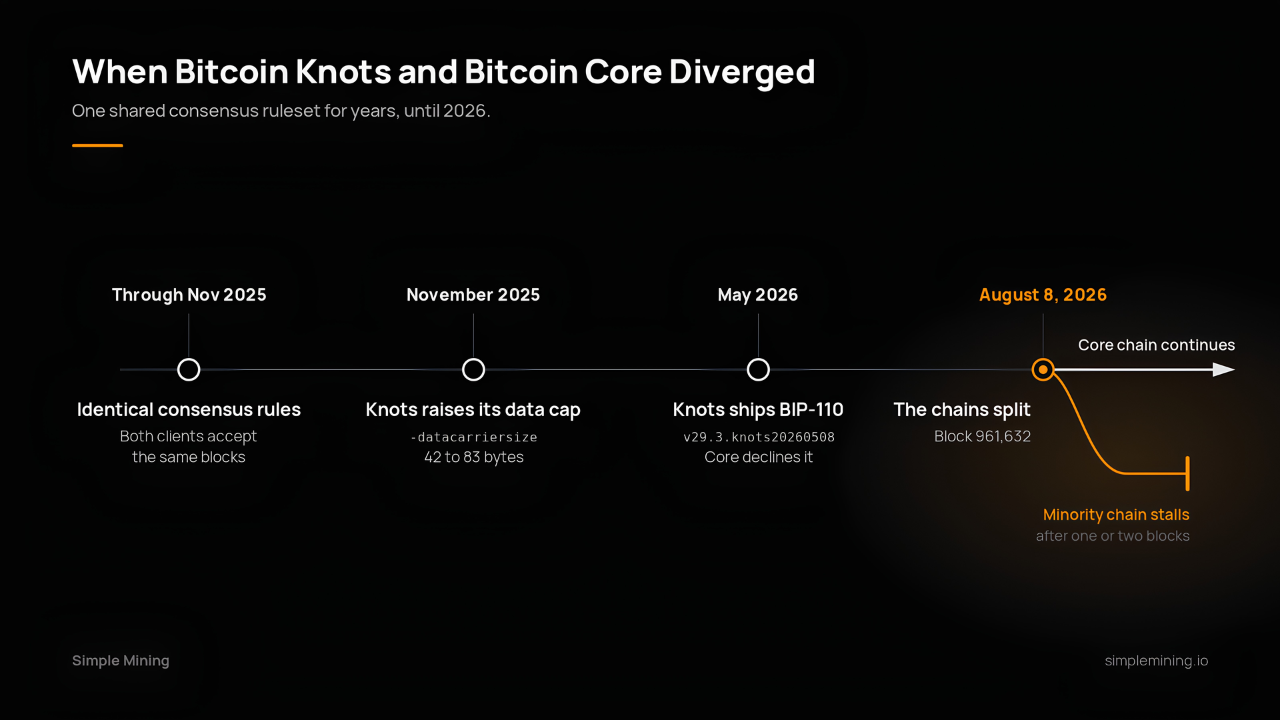
- On August 8, 2026 the Knots nodes enforcing BIP-110 followed a minority chain that produced one or two blocks and stalled.
- Knots now ships two builds: the enforcing mainline and a non-RDTS build that stays consensus-identical to Core.
- Knots keeps restrictive relay defaults and legacy wallet support, while Core keeps permissive defaults and the largest review community.
- Switching clients does not require a full re-sync, but the build choice comes before every other step.
What Is Bitcoin Knots?
Bitcoin Knots is a derivative of Bitcoin Core, maintained as a patch set rebased onto Core release branches and distributed from a GitHub fork. Both are Bitcoin clients, meaning programs that implement the protocol and run a node. Its lead maintainer is Luke Dashjr, a longtime Bitcoin Core contributor who holds no commit access to Core today. Knots ships everything its Core base ships plus patches Core has not merged.
The choice between clients comes second, because before either client matters you need a Bitcoin full node doing the validating. Both programs download, verify, and relay the chain. The differences live in what each one relays, what each one enforces, and how much the operator can tune.
Key Differences Between Bitcoin Knots and Bitcoin Core
The two clients diverge in five places: maintainership, release base, consensus rules, relay policy defaults, and wallet support. The consensus row is the one that changed the stakes in 2026.
| Difference | Bitcoin Core | Bitcoin Knots |
|---|---|---|
| Maintainer | Five maintainers hold commit access | Luke Dashjr, lead maintainer |
| Release base | Core 30.x and 31.x | Still tracks the Core 29.x branch |
| Consensus rules | Does not enforce BIP-110 | Mainline builds enforce BIP-110 since May 2026 |
| Relay policy defaults | Permissive | Restrictive, several filters on by default |
| Wallet formats | Legacy wallet loading removed in v30 | Legacy wallet support retained |
Development Philosophy and Maintainers
Bitcoin Core treats relay as neutral plumbing. If a transaction is valid and meets standard rules, Core relays it without judging what it is for. Bitcoin Knots treats relay as an operator decision. It ships filters the operator can tune, and several of them arrive switched on.
The maintainer structures mirror that split. Five maintainers hold commit access to Bitcoin Core: Ava Chow, Michael Ford, Ryan Ofsky, Hennadii Stepanov, and TheCharlatan. Knots concentrates that authority in one person, and every release carries his signature.
Release Cadence and What Knots Backports
Knots ships Core's release lineage plus patches Core has not merged, and since 2026 that includes a consensus rule Core declined. It is not a staging ground for future Core features. Some of its patches were proposed upstream and rejected, and some were never proposed at all.
The version strings tell the story. The current release is 29.4.knots20260508, which means Knots still tracks the Core 29.x branch and never rebased onto v30. That matters because Core v30 raised the -datacarriersize default from 83 bytes to 100,000 bytes, which uncaps it in practice. The option remains configurable in Core, and the change never reached Knots because Knots never adopted the v30 base.
Default Policy Settings
Knots ships restrictive relay defaults, and Core ships permissive ones. In both clients these settings govern the Bitcoin mempool your node maintains, which decides what your node stores and passes along. The options a Knots operator touches:
-datacarriersize: caps OP_RETURN data. Knots defaults to 83 bytes in current releases, raised from 42 bytes in November 2025 to match Core's then-current 83-byte default, which Core abandoned in v30. Core defaults to 100,000 bytes.-rejectparasites: filters detectable parasitic transaction patterns. On by default; disable it with-rejectparasites=0.-rejecttokens: filters token-protocol transactions. Available in Knots; check your release notes for its default.-datacarriercost: weights data bytes when computing a transaction's effective size.-maxscriptsize: caps the script sizes your node relays.-mempoolreplacement: sets replace-by-fee behavior to off, opt-in only, or full replacement.-corepolicy: one switch that resets multiple Knots options to Core-like behavior.
Why these defaults became a fight is a longer story, and it runs through the next section.
Wallet and Interface Differences
Knots still loads legacy wallets, and Core v30 removed that ability. Core users holding old wallet.dat files must migrate to descriptor wallets. Knots users can keep loading them unchanged, which is the single most practical difference for anyone with a wallet older than 2021.
Knots also adds a sweep-private-key dialog and matching RPC, a NetWatch tab for live network activity, and codex32 seed support. These are conveniences rather than reasons to switch on their own.
BIP-110, the August 2026 Split, and Which Build You Run
Mainline Bitcoin Knots has enforced BIP-110 since May 2026, and Bitcoin Core does not enforce it. The first enforcing release was v29.3.knots20260508. A parallel build named v29.3.knots20260507 ships without RDTS enforcement and remains consensus-identical to Core.
The divergence stopped being theoretical on August 8, 2026. At block 961,632 the enforcing nodes began rejecting blocks that did not signal for the rule. The chain they followed produced one or two blocks and then stalled, while the majority chain continued and no exchange recognized the minority chain. We cover the BIP-110 soft fork and the data limits it tried to enforce in a dedicated breakdown, so this page stays on the practical question.
The two camps describe the same event in opposite terms. On bitcoinknots.org and in its release notes, the Knots project frames it as an attack on Bitcoin and warns that non-enforcing software no longer validates every rule. Critics such as Adam Back frame it as a failed minority fork that lacked consensus, and the exchanges that ignored the minority chain acted on that view. Take neither framing on faith; both are positions, not facts.
What it means for you is simple. Choosing Knots today means choosing between two builds first. The enforcing mainline follows BIP-110 rules on a chain that stopped advancing, and the non-RDTS build follows the same chain Core follows.
Is Bitcoin Knots Safe to Use?
Bitcoin Knots is open source software with signed releases and a public repository, and it is reasonable to run when you verify your download. Luke Dashjr signs and publishes each release. The review community is smaller than Core's, which is the honest trade-off of any minority client. bitcoin.org lists Knots in its wallet directory and notes that its extra features "are not as well-tested."
The security question and the consensus question are separate. The enforcing mainline build follows different block-validity rules than Core, and the non-RDTS build does not. Pick the build that matches the chain you intend to follow, and the safety picture is the ordinary one for minority software. Our own operations team runs Knots in production and treats its uptime as a first-class metric.
Download from bitcoinknots.org and verify signatures before running anything.
How to Switch From Bitcoin Core to Bitcoin Knots
Switching takes five steps: choose your build, back up, download and verify, reuse your data directory, and start the node.
1. Choose Your Build
Decide between the enforcing mainline and the non-RDTS build before you download anything. The mainline enforces BIP-110 rules, and v29.3.knots20260507 stays on the same chain Core follows. This is the decision that matters, so make it first.
2. Back Up Your Wallet and Blockchain Data
Copy your wallet files and your data directory to separate storage before you change clients. A backup turns every mistake below into an inconvenience instead of a loss.
3. Download From the Official Source and Verify
Download from bitcoinknots.org and grab the matching SHA256SUMS and SHA256SUMS.asc files. Builder keys live at github.com/bitcoinknots/guix.sigs. Verify the signatures against those keys before you install anything.
4. Reuse Your Existing Data Directory
Point Knots at your existing Core data directory and skip the re-sync. Two caveats apply. Moving from Core 30.x or later back to a 29.x-based Knots is a downgrade across a major version, and downgrades can hit index or format incompatibilities. A data directory touched by the enforcing build can also require chain-state recovery when you switch back to Core.
5. Start the Node and Confirm It Is Syncing
Launch the client and confirm it recognizes your existing chain data. Check your tip height against a public block explorer rather than trusting the progress bar. A node that synced onto a stalled chain looks healthy from the inside.
Which Bitcoin Node Software Should You Run?
Run Bitcoin Core if you want stability and the broadest ecosystem compatibility, and run Bitcoin Knots if you want granular control over relay policy and block templates.
- Choose Bitcoin Core if: you want the largest review community, default compatibility with wallets and services, and the fewest configuration decisions.
- Choose Bitcoin Knots if: you want tunable relay filters, legacy wallet support, and full control over the block templates you build.
Core runs the large majority of reachable nodes, and Knots holds a meaningful minority share. Neither number changes what your own node enforces.
Why Node Software Matters for Bitcoin Mining
Node software matters for mining only when the miner builds its own block templates. Under standard pooled mining the pool builds the template and pays by submitted shares, so the client on your desk does not change your payout. Most hosted miners never touch this decision, because the pool handles templates end to end.
That changes when DATUM hands template construction back to the miner, because the operator chooses which node builds them. Knots exposes more template controls than Core, including size and reserved-weight overrides plus its full filter set applied to the templates it builds. One caveat carries over from the split: hashrate pointed at an RDTS-enforcing node or pool endpoint mines for a chain that stalled, and rewards there need 100 confirmations to mature.
FAQs About Bitcoin Core and Bitcoin Knots
Can I run Bitcoin Core and Bitcoin Knots on the same computer?
Yes. You can install both and switch between them, but they cannot run at the same time on one data directory. Separate data directories let both run at once.
Does switching from Bitcoin Core to Bitcoin Knots require re-downloading the blockchain?
No. Bitcoin Knots can use the same data directory as Bitcoin Core, so you skip the full re-sync. Moving a data directory from Core 30.x or later back to a 29.x-based Knots is a downgrade across a major version, so back up first.
Will running Bitcoin Knots affect my mining pool payouts?
Under standard pooled mining, no. The pool builds the block templates and pays you by submitted shares, so your local client does not change the math. Pointing hashrate at a node or pool endpoint enforcing BIP-110 after August 2026 is a different story, because rewards on the stalled minority chain need 100 confirmations to mature.
Is Luke Dashjr still maintaining Bitcoin Knots?
Yes. Luke Dashjr leads the project and signs each release. He is a longtime Bitcoin Core contributor who now maintains Bitcoin Knots, and he holds no commit access to Core.
Start Mining Bitcoin With Confidence
Running your own node is the sovereignty half of Bitcoin, and mining is the income half. It does not require a rack in your garage or a node-software debate in your living room. If you want machines hashing without the operational load, our ASIC miner hosting service puts your hardware in our Iowa facilities with precision billing and a team that watches uptime for you.