
What Is the Petrodollar System? Meaning, History, and Future
By Josh Heine, Content Strategist at Simple Mining
Published November 5, 2026
A petrodollar is a US dollar earned from selling oil. The petrodollar system is the name for what happens around those dollars: most oil is priced in dollars, and oil exporters put their earnings back into US assets and bank deposits. This guide keeps the documented record apart from the popular claims that the system is ending.
On this page · 11 sections
- What Is a Petrodollar?
- How Did the Petrodollar System Begin?
- How Does the Petrodollar System Work?
- Why Is Oil Priced in US Dollars?
- Is the US Dollar Backed by Oil?
- Did the Petrodollar Agreement Expire?
- Is the Petrodollar System Ending?
- What Happens If the US Loses the Petrodollar?
- What Does the Petrodollar Have to Do With Bitcoin?
- FAQs About the Petrodollar
- Turn Energy Into Bitcoin With Simple Mining
Key Takeaways
- A petrodollar is a US dollar an oil exporter earns from oil sales, and "the petrodollar system" has no official definition.
- The system grew out of the 1973 oil embargo and the 1974 US-Saudi financial ties, not a signed oil-pricing treaty.
- Most oil is priced in dollars out of long habit, but no document requiring it has been produced.
- The viral 2024 claim that Saudi Arabia would not renew a 50-year petrodollar agreement was rated False by PolitiFact.
- Diversification away from the dollar is happening at the edges, but the dollar was still on one side of about 89% of foreign exchange trades in April 2025.
What Is a Petrodollar?
A petrodollar is a US dollar that an oil-exporting country earns by selling oil abroad. Merriam-Webster's definition says much the same: foreign exchange a petroleum-exporting country gets from its sales abroad. The petrodollar meaning is about where a dollar came from, because a petrodollar is still an ordinary US dollar.
The phrase "petrodollar system" has no official definition. This guide describes it through its documented parts: most oil is priced and sold in dollars, and exporters recycle those dollars into US assets and bank deposits.
The word itself came into use in 1973, the year Merriam-Webster gives as its first known use. Georgetown University credits economist Ibrahim Oweiss, who joined its economics faculty in 1967, with coining it. His own paper introducing the term was written in early 1974, to study oil revenues in light of the sharp rise in oil prices.
How Did the Petrodollar System Begin?
The petrodollar system began in the 1970s, when the dollar lost its link to gold, oil prices quadrupled during the 1973 embargo, and the US and Saudi Arabia built new financial ties. Each step is on record, and no document from those years requiring oil to be sold in dollars has been produced.
The Dollar Loses Its Gold Link
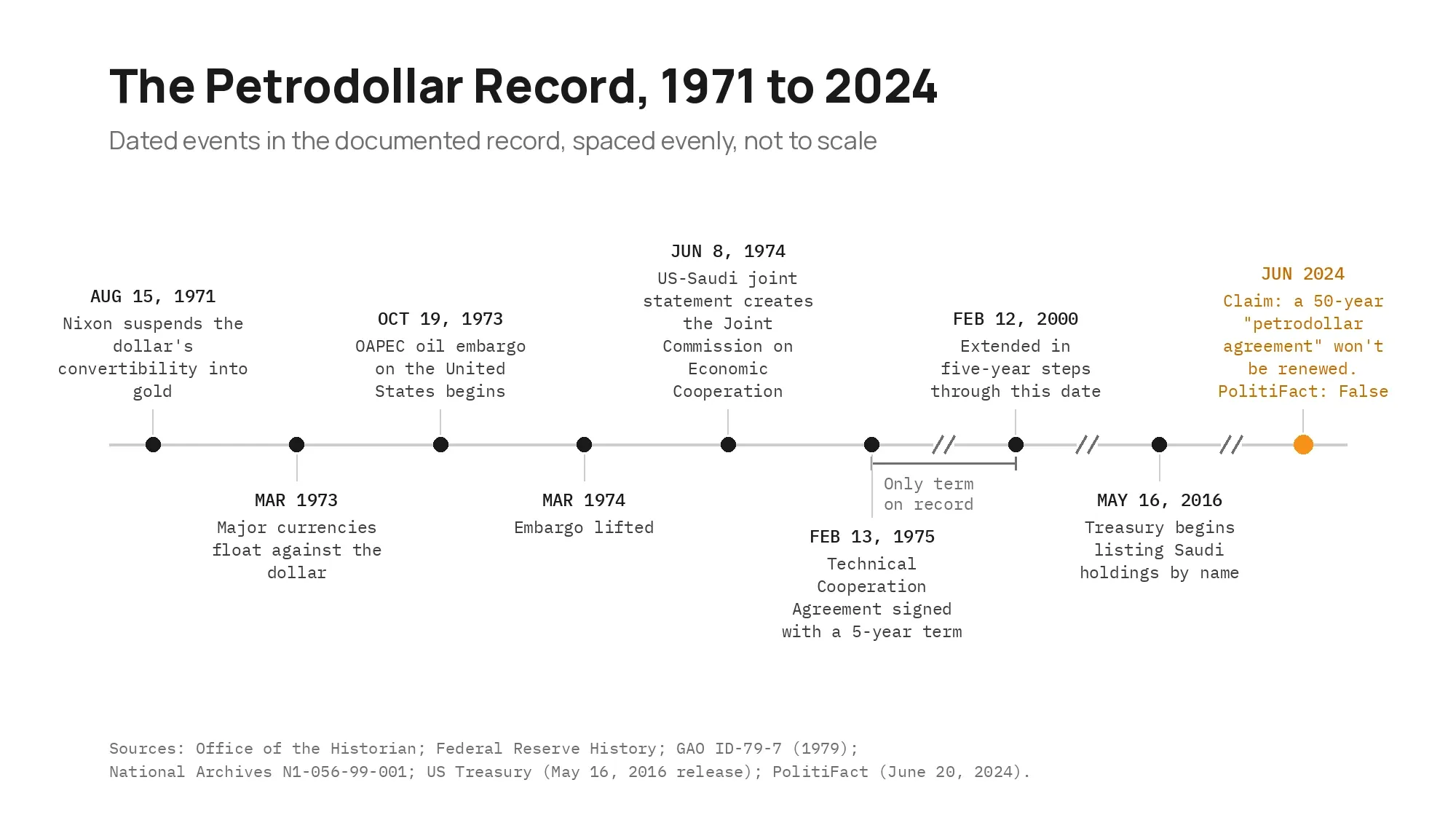
On August 15, 1971, President Nixon suspended the dollar's convertibility into gold, a step he called temporary. Foreign governments could no longer exchange their dollars for gold. By March 1973 the major currencies were floating against the dollar. The petrodollar story picks up where the Nixon Shock of 1971 leaves off, with a dollar no longer tied to gold.
The 1973 Oil Embargo
On October 19, 1973, the Organization of Arab Petroleum Exporting Countries (OAPEC) imposed an oil embargo on the United States in response to US support for Israel during the Yom Kippur War. Oil prices quadrupled, from $2.90 a barrel before the embargo to $11.65 in January 1974, and the embargo was lifted that March. Federal Reserve History's account of the oil shock adds a detail the usual story skips: oil was quoted in dollars, the dollar's fall in the early 1970s cut exporters' revenue, and OPEC nations turned to pricing oil in gold. The embargo arrived in the middle of the stagflation of the 1970s, a separate story about inflation at home.
The US and Saudi Arabia Build Financial Ties
On June 8, 1974, Secretary of State Henry Kissinger and Prince Fahd of Saudi Arabia issued a joint statement that created the US-Saudi Joint Commission on Economic Cooperation. A 1979 GAO report on the Joint Commission says the two countries wanted to work together on Saudi industrialization, trade, manpower training, agriculture, and science and technology.
The commission's working instrument came later: a Technical Cooperation Agreement signed on February 13, 1975, by Treasury Secretary William Simon and Saudi Finance Minister Abalkhail. It had a five-year term and was extended in five-year increments through February 12, 2000, according to the National Archives. GAO's and the Archives' descriptions of the June 8 statement name no currency clause.
Treasury added a financial channel in 1974: an "add-on" facility that let foreign central banks buy Treasury securities without bidding in the regular auctions. A 1979 GAO report on OPEC financial holdings says the facility was first offered to Saudi Arabia as part of a bilateral financial package, and that Treasury officials said it was created "to attract and manage petrodollars." Treasury offered it to other OPEC countries in 1975 and then to all official foreign institutions.
Washington wanted oil dollars in US securities. On July 9, 1974, Simon told President Nixon he would try to get a commitment from Gulf states to put their funds in long- and short-term securities, according to the State Department's Foreign Relations of the United States record. GAO reported in 1979 that sources said Treasury had promised Saudi Arabia confidentiality; Treasury denied it. What is documented is that Treasury reported Saudi holdings only inside regional totals until 2016.
How Does the Petrodollar System Work?
The petrodollar system works in two steps: most oil is sold for dollars, and exporters recycle those dollars into US assets and bank deposits. The first step puts dollars in exporters' hands. The second sends them back into the financial system through purchases of Treasury securities and deposits at international banks.
What Is Petrodollar Recycling?
Petrodollar recycling is the flow of oil exporters' dollar earnings back into banks and US assets. The FDIC's history of the 1980s says the oil price rise of the 1970s swelled exporters' dollar deposits in the Eurodollar market, which fueled a lending boom. Banks channeled those funds to oil-importing developing countries as loans.
The lending boom contributed to the debt crisis of the less developed countries (LDCs). The crisis began on August 12, 1982, when Mexico's finance minister told the Fed chairman, the Treasury secretary, and the IMF managing director that Mexico couldn't meet its August 16 obligation on an $80 billion debt.
Recycling into US government debt shows up in Treasury data too. Treasury began listing Saudi Arabia by name on May 16, 2016, when it started replacing its oil-exporter aggregate with individual country data, and Saudi holdings stood at $116.8 billion at the end of March 2016. As of August 2026, Treasury's Major Foreign Holders table shows Saudi Arabia holding $141.2 billion of Treasury securities.
Why Is Oil Priced in US Dollars?
Oil is priced in US dollars out of long habit and the depth of dollar markets, not because of any treaty on record. Most oil has been priced in dollars since the 1970s, but no document requiring it has been produced. Economist Ibrahim Oweiss wrote in 1974 that oil was priced in dollars "for certain historical reasons."
One regional data point comes from the European Central Bank. In a June 2019 report, it found that around 85% of the EU's oil imports from outside the bloc were invoiced in dollars. That's an EU figure, not a global one, but it fits the ECB's broader point: goods like oil tend to be priced in one dominant currency, such as the dollar.
The dollar's depth shows up across currency markets. In April 2025, the dollar was on one side of about 89% of all foreign exchange trades, up from about 88% in 2022, according to the BIS Triennial Survey. In the second quarter of 2026, it made up 56.70% of global foreign exchange reserves, per the IMF's COFER data. Those numbers describe the dollar's reach, and they don't show that oil pricing is what gives the dollar its reserve role.
Is the US Dollar Backed by Oil?
No, the US dollar isn't backed by oil. A dollar can't be exchanged for a set amount of oil, and since August 15, 1971, foreign governments haven't been able to exchange dollars for gold either. Oil is priced in dollars by practice, not by a documented rule. Oil sales earn dollars, but a dollar carries no claim on a barrel.
Did the Petrodollar Agreement Expire?
No 50-year petrodollar agreement exists in the record, so none expired. In June 2024, viral posts claimed that Saudi Arabia would stop selling oil in dollars and would not renew a 50-year US-Saudi petrodollar agreement. PolitiFact rated the claim False on June 20, 2024, after experts told it they knew of no such agreement, and Radio Free Asia's Asia Fact Check Lab also rated it False on July 8, 2024.
The closest match in the 1974 record is the Joint Commission on Economic Cooperation, which PolitiFact says encouraged stronger political ties through economic cooperation and didn't commit Saudi Arabia to sell oil only for dollars. The only term on record belongs to the 1975 Technical Cooperation Agreement: five years, extended in five-year increments through February 12, 2000. Nothing in that record runs for 50 years or ends in 2024.
The diplomatic memos from the week of the June 8 statement point the same way. In a June 6, 1974 conversation printed in the State Department's Foreign Relations of the United States series, Kissinger told Prince Fahd the visit was "not primarily to discuss oil policy." He also listed "cooperation in international investment and finance" as a topic for the economic talks. None of the four memoranda from June 5 and 6 uses the word "dollar", but the record of those economic talks isn't among them.
Two related claims go further than the documents. One says Saudi Arabia agreed to buy Treasuries in return for US military protection, but GAO describes the add-on facility only as part of a bilateral financial package, and none of the documents above ties those purchases to protection in writing. The other treats Treasury's secrecy about Saudi holdings as proof of a hidden deal. The aggregated data is documented and the confidentiality promise is disputed, but neither shows a requirement to price oil in dollars.
Is the Petrodollar System Ending?
The record shows gradual diversification at the edges, not the end of dollar oil pricing. The dated moves behind talk of the end of the petrodollar involve Saudi Arabia, China, and Russia.
On June 5, 2024, the BIS announced that the Saudi Central Bank (SAMA) was joining Project mBridge as a full participant, and in October 2024 the BIS handed the project over to its partner central banks. BIS General Manager Agustin Carstens described the handover as a graduation, not a failure or a political decision.
Sorted into what's changing vs. what still holds, the dated record looks like this:
| Development | Date | Source |
|---|---|---|
| Changing | ||
| Russia's dollar and euro share of export invoicing fell from about 85% before the invasion of Ukraine to about a third (all goods and services, not oil alone) | Reported July 2023 | Bank of Russia data via the Bank of Finland (BOFIT) |
| The People's Bank of China announced a three-year currency swap with SAMA worth 50 billion yuan, or 26 billion riyals | November 20, 2023 | People's Bank of China |
| SAMA joined Project mBridge as a full participant, and the BIS later handed the project over to its partner central banks | June 5, 2024, and October 2024 | BIS |
| Still holds | ||
| The dollar was on one side of about 89% of all foreign exchange trades, up from about 88% in 2022 | April 2025 | BIS Triennial Survey |
| The dollar made up 56.70% of global foreign exchange reserves | Second quarter of 2026 | IMF COFER |
No source we found measures how much oil is now settled outside dollars worldwide. For a named opposing view, energy economist Anas Alhajji argues in an interview with TFTC that the petrodollar is here to stay.
What Happens If the US Loses the Petrodollar?
If the US lost the petrodollar, fewer oil dollars would flow back into US assets and bank deposits. The effect would depend on which currency replaced the dollar in oil trade and where exporters put their earnings instead, and no source in this guide measures either. The record so far shows diversification at the edges, not a loss. A threat to the dollar's reserve role would be a wider question, and how US debt affects the dollar's reserve status is part of it.
What Does the Petrodollar Have to Do With Bitcoin?
The petrodollar and Bitcoin have no formal link, but both stories run on energy. Oil sales earn dollars for exporting countries, and Bitcoin mining turns electricity into new coins.
Bitcoin isn't issued by any government or tied to any commodity. Its supply is capped at 21 million coins, and new Bitcoin goes to miners who compete under proof-of-work, a process that uses electricity. One system prices energy in dollars, and the other spends energy to issue new coins up to a fixed cap.
FAQs About the Petrodollar
Who coined the term petrodollar?
Georgetown University credits economist Ibrahim Oweiss with coining the term petrodollar. Merriam-Webster dates the word's first known use to 1973, and Oweiss's own paper introducing it was written in early 1974.
What is the difference between a petrodollar and a eurodollar?
A petrodollar describes where a dollar came from: oil sales. A eurodollar describes where a dollar deposit sits: the New York Fed defines the Eurodollar market as US dollar deposits held at banks or bank branches outside the United States. In the 1970s, oil exporters' dollar deposits in that market were part of petrodollar recycling.
How much US debt does Saudi Arabia hold?
Saudi Arabia held $141.2 billion of US Treasury securities as of August 2026, according to Treasury's Major Foreign Holders data. Treasury notes that securities held in overseas custody accounts may not be attributed to their actual owners, so country figures aren't a precise count of ownership.
When did the petrodollar system start?
The petrodollar system took shape in 1973 and 1974. Oil prices quadrupled during the 1973 embargo, the US and Saudi Arabia issued a June 8, 1974 joint statement that created their Joint Commission on Economic Cooperation, and Treasury offered Saudi Arabia its add-on facility for buying Treasury securities that same year.
Turn Energy Into Bitcoin With Simple Mining
Simple Mining hosts clients' ASIC miners, and the client owns the hardware. We run 9+ EH/s of hosted hashrate across 150+ MW of power capacity at 95% average uptime. You can start with our ASIC miner hosting service or buy ASIC miners from our inventory. We also offer a 7-day free trial on an Antminer S21+ at 235 TH/s.