
What Are Tax-Advantaged Investments Beyond 401(k)s and IRAs?
By Josh Heine, Content Strategist at Simple Mining
Published November 5, 2026
Tax-advantaged investments are accounts and assets whose tax rules let you defer, reduce, or exclude tax on what they earn. Retirement accounts get most of the attention, but the tax code also rewards owning certain assets: rental buildings, oil and gas wells, business equipment, and municipal bonds. Each asset lowers tax through a different rule, and each rule comes with conditions. This guide explains how the asset side works and where the passive activity rules limit it.
On this page · 10 sections
- What Are Tax-Advantaged Investments?
- What Investments Can Lower Your Taxable Income?
- How Does Real Estate Depreciation Work?
- What Is Cost Segregation?
- What Are the Tax Benefits of Oil and Gas Investments?
- How Does Mining Equipment Create a Tax Deduction?
- Which Investments Give the Biggest First-Year Write-Off?
- Do You Need to Be Involved to Use These Deductions?
- FAQs About Tax-Advantaged Investments
- Own Productive Equipment Through Simple Mining
Key Takeaways
- Tax-advantaged assets work through three levers: deductions, exclusions, and deferral.
- Rental buildings depreciate over 27.5 or 39 years, and a cost segregation study can move parts of a building into 5-, 7-, or 15-year classes.
- An oil and gas operator can elect to expense intangible drilling costs, and independent producers and royalty owners can take percentage depletion.
- Business equipment such as Bitcoin miners can take 100% bonus depreciation when acquired and placed in service after January 19, 2025.
- Passive activity rules decide whether a loss offsets wages, so your participation matters as much as the asset.
What Are Tax-Advantaged Investments?
Tax-advantaged investments are investments whose tax rules let you defer, reduce, or exclude tax on income or gains. The topic splits into two halves: accounts and assets. Accounts are the wrappers that hold investments, and assets are the things you own.
The account half covers the 401(k), IRA, HSA, and SEP-IRA, where the tax break comes from the account, not what sits inside it. Contribution rules for those accounts are among the ways to reduce taxable income we cover in a separate guide, so this one stays on the assets.
On the asset side, the tax benefit comes from the asset itself, through three levers:
- Deductions: depreciation on buildings and equipment, intangible drilling costs, and percentage depletion on oil and gas.
- Exclusions: interest on state or local bonds is left out of gross income, with exceptions.
- Deferral: a like-kind exchange of real property means no gain is recognized on the swap, and a Qualified Opportunity Fund lets you defer tax on eligible gains for a time.
What Investments Can Lower Your Taxable Income?
Investments that reduce taxable income include rental real estate, cost-segregated buildings, oil and gas working interests, business equipment such as Bitcoin miners, municipal bonds, and Qualified Opportunity Funds. Each one lowers tax through a different rule, and each rule has a catch.
| Investment | How it lowers tax | Rule (IRS or statute) | The catch |
|---|---|---|---|
| Rental real estate | Depreciation on the building, straight-line over 27.5 years (residential) or 39 years (nonresidential) | MACRS (Section 168), IRS Publication 946 | Land isn't depreciable, and rental losses are passive apart from the $25,000 allowance unless you're a real estate professional |
| Cost-segregated commercial or rental buildings | Moves parts of the building into 5-, 7-, or 15-year classes that can take bonus depreciation | IRS Publication 5653, Section 168(k) | Results depend on the facts, the study has its own cost, and a building already in service needs Form 3115 |
| Oil and gas working interests | An operator may expense intangible drilling costs; percentage depletion of 15% of gross income from the property for independent producers and royalty owners | Treas. Reg. 1.612-4, 26 U.S.C. 613A | The passive-loss exception applies only when your liability isn't limited |
| Business equipment, including Bitcoin miners | Bonus depreciation or Section 179 expensing in the year placed in service | IRS Publication 946, Sections 168(k) and 179 | Needs business use, and the year turns on when the equipment is ready and available, not when you pay |
| Municipal bonds | Interest is excluded from gross income | 26 U.S.C. 103 | Exceptions apply under section 103(b) |
| Qualified Opportunity Funds | Defers tax on eligible gains for a time | IRS opportunity zones guidance | The deferred gain still comes due; only the fund investment's own appreciation can be excluded, after a 10-year hold |
Rental property, oil and gas interests, and mining equipment each count as one of several alternative investments outside stocks, bonds, and cash. The sections below explain how each tax rule works, starting with real estate.
How Does Real Estate Depreciation Work?
Real estate depreciation lets the owner of a rental building deduct its cost over time: 27.5 years for residential rental property and 39 years for nonresidential real property, using the straight-line method. Land is never part of that deduction, because land doesn't wear out, become obsolete, or get used up. The building and its improvements carry the depreciable cost.
Among tax-advantaged real estate investments, a rental building faces one big limit: rental activity is passive, even with material participation, unless you're a real estate professional. The real estate professional rules covered in our taxable income guide set a stricter path.
Other owners have a smaller carve-out. If you meet the active participation standard, you can deduct up to $25,000 of rental loss against income that isn't passive. Active participation is a lower bar than material participation: making management decisions in a significant and bona fide sense can be enough. The allowance drops by half of your modified adjusted gross income (MAGI) above $100,000, and it's gone at $150,000.
Instead of selling, you can use Section 1031 to exchange real property held for business or investment for real property of like kind. When you receive only like-kind real property in return, no gain is recognized on the exchange.
What Is Cost Segregation?
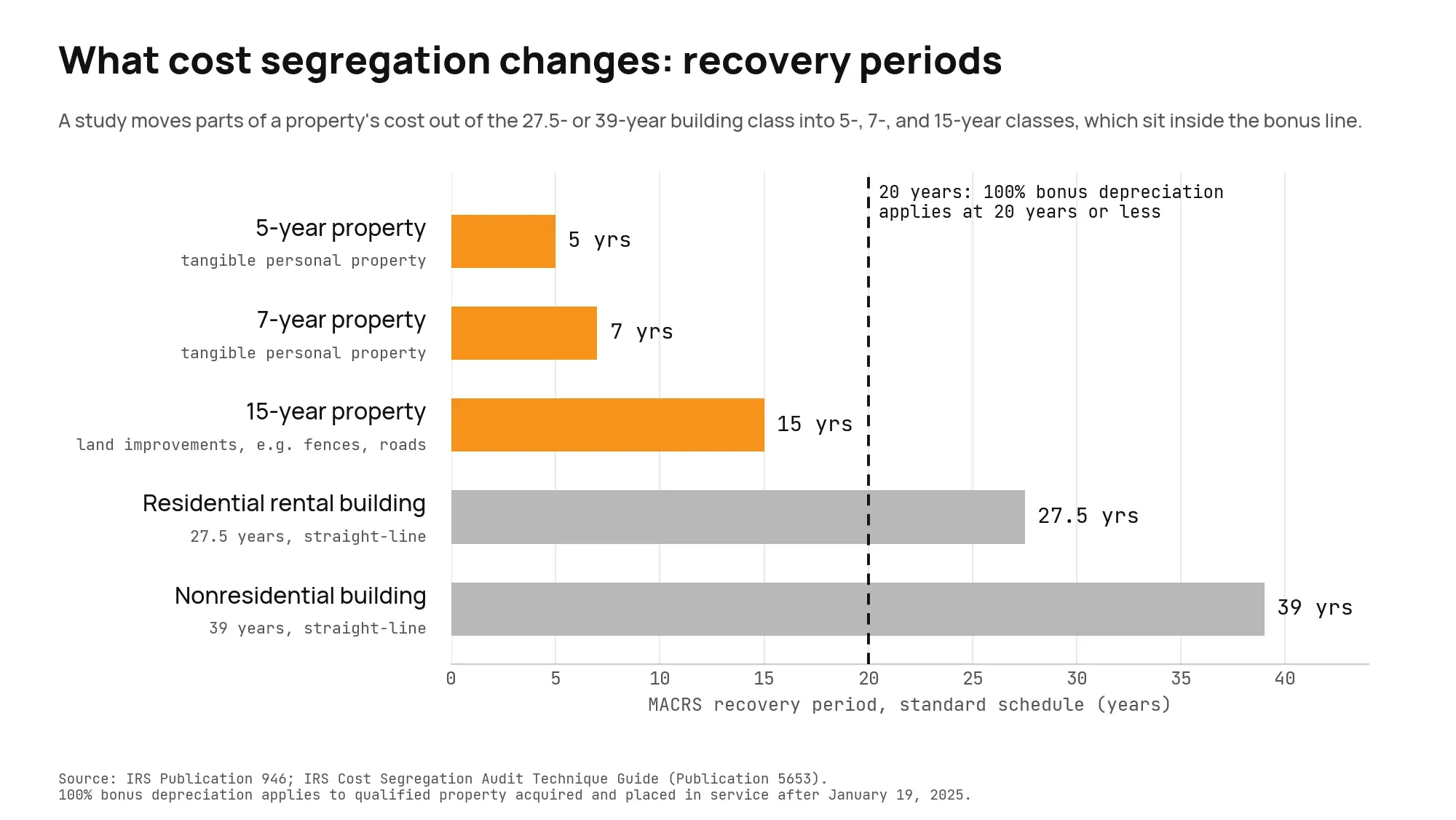
Cost segregation is allocating a building's lump-sum cost to its individual assets, such as land, land improvements, the building, equipment, furniture, and fixtures. The IRS calls this analysis a cost segregation study. Parts reclassified as tangible personal property carry a shorter recovery period, such as 5 or 7 years, and land improvements such as fences, roads, and sidewalks carry 15 years.
Those shorter classes matter for bonus depreciation. Qualified property includes tangible property under MACRS with a recovery period of 20 years or less. That puts 5-, 7-, and 15-year property inside the rule, while the 27.5- or 39-year building shell stays outside it.
The IRS lists carpeting, wall coverings, partitions, millwork, and lighting fixtures as parts of a building a study may treat as personal property. Whether each item qualifies depends on the facts and circumstances of the building.
A study on a building already in service changes the depreciation method or recovery period, and the IRS treats that as a change in accounting method. That change, as a rule, requires Form 3115, Application for Change in Accounting Method.
Most of these details come from the IRS Cost Segregation Audit Technique Guide, written for IRS examiners. The guide says it isn't an official pronouncement of the law.
What Are the Tax Benefits of Oil and Gas Investments?
The tax benefits of oil and gas investments come from three rules: the option to expense intangible drilling costs, percentage depletion, and a passive-loss exception for certain working interests. An operator with a working interest gets the drilling-cost option, while independent producers and royalty owners can take percentage depletion.
Intangible drilling costs (IDCs) are the wages, fuel, repairs, hauling, and supplies incident to and necessary for drilling a well. Under the Treasury regulations on intangible drilling costs, an operator, meaning one who holds a working or operating interest, may charge them to capital or to expense. Tangible equipment such as pipe, casing, tanks, and engines isn't an IDC. Those are capital items, recovered through depreciation instead.
The rule for percentage depletion under Section 613A sets the rate at 15% of the gross income from the property for independent producers and royalty owners. It applies only to production up to the taxpayer's depletable oil or natural gas quantity, a cap on average production per day.
A working interest in an oil or gas well isn't passive when you hold it in your own name or through an entity that doesn't limit your liability, such as a general partner interest, and participation doesn't matter. The trade is liability exposure: the exception applies only when your liability isn't limited. An interest held through an entity that limits your liability, such as a limited partnership interest, doesn't get this exception. Once you treat a working-interest loss as nonpassive, later net income from that property is nonpassive too.
How Does Mining Equipment Create a Tax Deduction?
Mining equipment creates a tax deduction through depreciation: ASIC miners used in a business or income-producing activity are depreciable equipment, while property used only for personal activities isn't. The deduction starts in the year the miner is placed in service, which IRS Publication 946 defines as when property is ready and available for a specific use. Applied to a hosted miner, that test points to when the unit is ready and available in the facility, not the date on the invoice.
A pattern we see: buyers assume the purchase date sets the deduction year. Publication 946's own example treats a machine delivered last year but not installed and operational until this year as placed in service this year. A miner paid for in late December that isn't installed and ready until January can land in the next tax year.
Under the One Big Beautiful Bill Act, 100% bonus depreciation applies to qualified property acquired and placed in service after January 19, 2025, and the IRS describes the deduction as permanent. Qualified property can be new or certain used property. Under IRS Notice 2026-11, the acquisition date follows the written binding contract rules, so a miner ordered under a written binding contract entered into before January 20, 2025, isn't treated as acquired after January 19, 2025, and stays on the old phase-down rate even if it's delivered later.
Section 179 is the alternative: you elect to deduct the cost, subject to a dollar limit and a business income limit. The deduction can't exceed taxable income from the active conduct of a trade or business. For tax years beginning in 2026, the maximum is $2,560,000, reduced once section 179 property placed in service during the year exceeds $4,090,000.
The Bitcoin a miner produces counts as income. Under IRS Notice 2014-21, mined Bitcoin is included in gross income at its fair market value on the date of receipt. If mining is a trade or business, net earnings from it are self-employment income. Our breakdown of bonus depreciation for Bitcoin miners covers the full mechanics.
Owning miners doesn't require running a facility. With Bitcoin miner hosting, you own the hardware, and Simple Mining runs the facility, cooling, network, and security.
Which Investments Give the Biggest First-Year Write-Off?
The first-year deduction depends on the asset's recovery class and the elections available, not on the investment label. A building shell, a cost-segregated component, a drilling cost, and a miner each follow a different schedule.
| Cost | First-year treatment | Condition |
|---|---|---|
| Building shell | Straight-line over 27.5 or 39 years | Recovery period above 20 years, so no bonus depreciation |
| Cost-segregated components | Bonus depreciation in the year of the study | 5-, 7-, or 15-year class based on the facts; acquired and placed in service after January 19, 2025 for 100%; Form 3115 for a building already in service |
| Intangible drilling costs | Expensed in the year incurred | An operator with a working interest who elects to expense |
| Business equipment, including Bitcoin miners | Bonus depreciation in the year placed in service | Business use; acquired and placed in service after January 19, 2025 for 100% |
| Section 179 property | Expensed in year one up to the limit | Capped by business taxable income and the annual dollar limit |
The table describes how each rule works, not which asset fits you. Faster deductions also raise the question of depreciation recapture on a later sale, which deserves its own discussion.
Do You Need to Be Involved to Use These Deductions?
You often need to be involved if you want losses to offset wages and other income, because passive activity losses aren't allowed as a rule. The depreciation still exists either way, but a passive loss can be suspended instead of used in the current year. Whether an activity is passive depends on your participation and on the type of asset.
IRS Publication 925 names two kinds of passive activity: a trade or business without your material participation, and rental activity, even with material participation, unless you're a real estate professional.
Material participation has seven tests, and meeting any one is enough. Two examples: more than 500 hours in the activity during the year, or more than 100 hours and at least as much as any other individual. Another test looks at whether your involvement is regular, continuous, and substantial.
Oil and gas working interests are the exception. Held without limited liability, they aren't passive, regardless of participation. For hosted miners, the passive-loss section of our bonus depreciation article covers what participation looks like in practice.
Talk to a CPA or tax professional before you count on a loss offsetting wages. The answer turns on your hours, your records, and how you hold the asset.
FAQs About Tax-Advantaged Investments
Are municipal bonds tax-advantaged investments?
Yes. Interest on state or local bonds is excluded from gross income under federal law, with exceptions listed in section 103(b). That makes municipal bonds an exclusion, not a deduction or a deferral.
Is cost segregation worth it for a rental home?
It depends on how much of the home's cost a study can move into 5-, 7-, or 15-year classes, and the study itself has a cost. Rental losses also stay under the passive activity rules, which can limit how much of an early deduction you use in the current year.
Can hosted Bitcoin miners qualify for bonus depreciation?
Yes, when they're used in a business and acquired and placed in service after January 19, 2025. Publication 946's placed-in-service test still sets the year: the miner has to be ready and available for its specific use.
Do tax-advantaged investments reduce taxes on mined Bitcoin?
Mined Bitcoin is income at its fair market value on the date you receive it, so the income itself isn't excluded. Deductions from the mining business, such as depreciation on the miners, can offset business income, subject to the passive activity rules. How much they offset depends on your facts.
Own Productive Equipment Through Simple Mining
Simple Mining sells ASIC miners and hosts them in 11 Iowa data centers, with a hosting fee of $0.065 to $0.08 per kWh. You own the hardware, and we run 9+ EH/s across 150+ MW of capacity at 95% average uptime. You can buy Bitcoin miners from our inventory or start with a 7-day free trial on an Antminer S21+ at 235 TH/s. Simple Mining doesn't give tax or investment advice, so talk to a CPA or tax professional and model the deduction before you buy.