

The True Cost of Slow Repairs: Why Repair Turnaround Time Defines Mining Profit Margins
By Josh Heine, Content Strategist at Simple Mining
Updated September 22, 2026Published May 27, 2026
Repair turnaround time is the gap between a miner failing and the same unit hashing again. Every day in that gap burns Bitcoin earnings that never come back. Operators obsess over hashrate and J/TH efficiency. Repair turnaround does more to shape annual returns than any spec on a datasheet.
This guide breaks down the math behind downtime losses and how to pick a repair partner that protects your fleet.
On this page · 9 sections
- How Much Revenue You Lose for Every Day a Miner Sits Offline
- Why Repair Turnaround Is Bitcoin Mining's Most Overlooked Profitability Lever
- What Causes Slow ASIC Miner Repairs
- How Repair Delays Compound Across a Multi-Miner Fleet
- Repair vs. Replace: When Turnaround Time Changes the Math
- What to Look for in a Fast-Turnaround ASIC Repair Provider
- How Hosting Providers With In-House Repairs Reduce Miner Downtime
- FAQs
- Turn Repair Speed Into a Profitability Advantage
Key Takeaways
- Repair turnaround time is the gap between a miner failing and the same unit hashing again, and every day in that gap forfeits Bitcoin revenue the network does not refund.
- The visible cost of a repair (parts and labor) is only part of the story. Forfeited mining profit compounds as turnaround stretches from days into months.
- Slow repairs result from parts sourcing delays and diagnostic backlogs as well as shipping logistics and certified technician shortages.
- The repair vs. replace decision shifts with expected downtime; current-gen hardware with three or more years of useful life justifies repair in most cases.
- Hosting providers with on-site repair centers cut shipping and intake delays to near zero, which protects fleet uptime and profitability.
How Much Revenue You Lose for Every Day a Miner Sits Offline
Downtime in Bitcoin mining is any period a unit is online to the wall but not hashing to a pool. Every offline day forfeits one day of mining revenue (block rewards plus fees) that the network does not refund later.
Mining pools pay based on contributed hashrate over a payout period. If your unit contributes zero hashes during a repair, your share of pool payouts for that period is zero. Block production rolls forward without you.
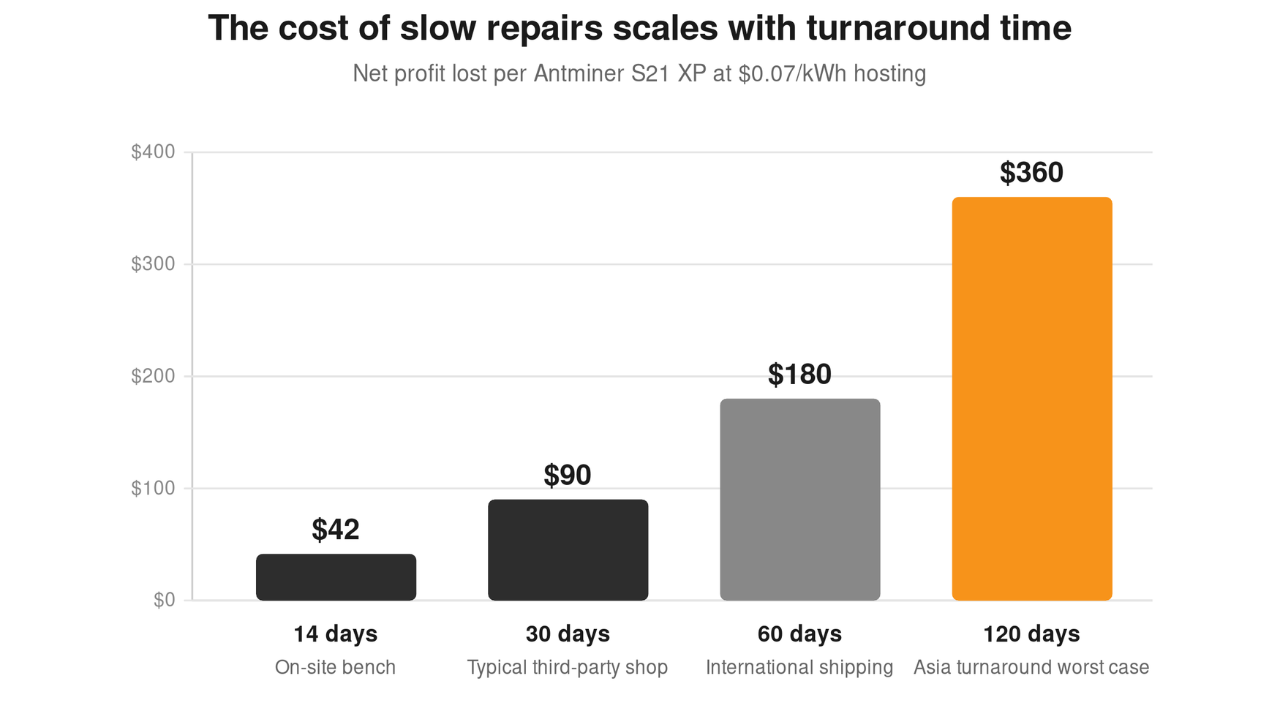
As of September 2026, an Antminer S21 XP nets around $4.99 per day at $0.07/kWh hosting (about 45% margin on mining-revenue). Daily profit moves with hashprice. Check Bitcoin network stats for current numbers. A 14-day repair on one unit forfeits roughly $70 in net profit. A 60-day Asia-shipped repair forfeits about $300. Across a 10-unit S21 XP fleet hit by a single event, a 14-day repair forfeits about $700 in net profit.
- Lost block rewards: pools pay based on the hashrate you contribute, not the hashrate you own. With precision billing, you save the hosting cost during downtime but still lose the Bitcoin you would have mined.
- Difficulty adjustments: the Bitcoin network keeps issuing blocks at 10-minute intervals whether your machine is on or off
- Opportunity cost: Bitcoin price moves while you are offline and unmined coins stay unmined
Why Repair Turnaround Is Bitcoin Mining's Most Overlooked Profitability Lever
Repair turnaround gets ignored because the cost lives outside the invoice. Operators see the price of parts and labor on a bill. They never see a line item for the Bitcoin they did not mine while waiting. That silent cost can match or exceed the visible cost on a slow repair cycle.
Operators Focus on Hardware Specs Over Operational Uptime
Most buyers stress-test TH/s and J/TH numbers before purchase. They compare datasheets. They model breakeven. They shop electricity rates. They seldom ask the repair vendor how long a hash board replacement takes from intake to ship-back.
Repair Costs Are Visible but Downtime Costs Are Hidden
The repair invoice tells one story (parts, labor, sometimes shipping) and shows up in your records. The forfeited mining revenue during the downtime window does not. A 14-day wait on an S21 XP forfeits about $70 in net profit. A 60-day Asia turnaround forfeits about $300. Both numbers stay invisible because they arrive as missing Bitcoin in your wallet, not as a line item on a bill. The pattern holds even when the repair itself is free. Simple Mining includes free repair labor, unlimited fan replacements and a $500 annual parts allowance in the first 12 months and offers a protection plan at $3.99 to $5.99 per miner per month after, but the downtime math still exists for every operator who waits weeks instead of days for a fix.
Most ROI Models Ignore Turnaround Time
Most mining calculators assume 95 to 98% uptime as a single number. They do not let you model what happens if 2 of 10 units sit at a repair bench for three weeks. Operators who plug realistic downtime into their projections find that the Bitcoin mining profitability picture changes which hardware (or which host) wins on paper.
What Causes Slow ASIC Miner Repairs
An ASIC miner is a purpose-built Bitcoin mining computer (think of a high-density server that does one thing). Repairs slow at four common bottlenecks:
- Parts sourcing
- Diagnostic queue
- Shipping logistics
- Technician availability
Any one of these can stretch a fix from days into weeks. The failures themselves cluster around six common modes our bench sees most often:
- Control board failures
- Fan failures
- Power supply failures
- "Finding 0 ASICs" errors
- Power voltage domain (MOSFET) issues
- PIC temperature sensor failures
Each carries its own parts and diagnostic profile, which is why a generic "send it to repair" timeline tells you next to nothing.
Parts Sourcing and Supply Chain Delays
Original Bitmain and MicroBT parts ship from Asia. Hash boards and control boards carry the longest lead times. Smaller repair shops order parts after diagnosis, which adds a week or two before work begins. Shops with stocked inventories of common parts cut that wait to zero.
Diagnosis Backlogs at Repair Centers
Many third-party repair benches run with two or three technicians and a queue measured in weeks. Your miner can sit on a shelf for 10 to 21 days before anyone plugs it in. Published intake numbers and turnaround SLAs are the best signal of how a shop manages this backlog.
Shipping and Logistics Between Sites
Round-trip shipping from your site to the repair center and back adds five to ten days of pure transit. Damage in transit can restart the cycle. The fastest setup eliminates this leg of the trip. Shipping a hash board to Shenzhen for repair can run 60 to 120 days door to door once you add transit and customs to the diagnostic queue. An on-site bench cuts that to days.
Limited Certified Technicians for Bitmain and MicroBT
Bitmain-certified technicians are rare in North America. Uncertified work risks repeat failures and voided warranty coverage. It can also compound damage on the next intake. The scarcity is real enough that many other hosting companies route their own fleets to our Cedar Falls bench because they can't build the certified repair capability in-house. Ask any repair shop how many of their techs hold current certifications before sending a unit in.
How Repair Delays Compound Across a Multi-Miner Fleet
A single 14-day repair on one unit is a manageable cost. The same 14 days applied to 5 of 50 units during a power event becomes a 10% hashrate hit for two weeks. Multi-unit failures expose how repair queues scale.
- Simultaneous failures: a single power surge or firmware bug can take down 5 to 20 units at once
- Queue stacking: each miner sits in line behind the others and total downtime compounds across the fleet
- Cascading hashrate loss: fleet-wide effective hashrate can drop 10 to 30% during a peak failure period
A 10-machine S21 XP fleet losing 30% of its hashrate for 14 days at $4.99 per unit per day forfeits about $210 in net profit. Scale that to a 100-machine fleet and the cost jumps to around $2,096 per failure cycle. The repair invoice (when there is one) looks small next to that number.
Repair vs. Replace: When Turnaround Time Changes the Math
Repair is the right call when the cost of repair plus expected downtime stays below the cost of a replacement unit plus its remaining useful life. Older or lower-efficiency miners flip the math toward replacement. Current-gen units with three or more years of life left are worth fixing every time.
Calculate Break-Even Based on Expected Downtime
Run a simple test. Take the quoted repair cost (third-party shops typically charge $150 for an average hashboard repair, $400 for a PSU replacement; Simple Mining clients pay no repair labor in year 1 and as low as $3.99 per miner per month under our protection plan after). Add the expected profit loss ($4.99 per day times days offline on an S21 XP). Compare to the cost of a new ASIC miner for sale minus the resale value of the broken one. If the gap is meaningful, repair wins.
Factor in Remaining Useful Life and Efficiency
A 22 J/TH machine with two years of life left earns less revenue per kWh than a current-gen 13.5 J/TH unit. Pouring repair dollars into older inventory can delay an upgrade that pays for itself. Run the numbers against current Bitcoin mining hosting pricing before signing the work order.
Consider Resale Value After Repair
A working ASIC retains resale value on the secondary market. A non-working ASIC sells for parts at a steep discount. The spread between the two is wider than the repair cost on most current-gen hardware, so repair becomes the right financial choice for most modern units.
| Factor | Repair | Replace |
|---|---|---|
| Upfront cost | Lower | Higher |
| Time to hash | Depends on turnaround | At once |
| Efficiency | Same as before | Improved if upgrading |
| Warranty | 14 days on repaired components | Full manufacturer coverage |
Simple Mining clients can run this calculation with both routes available from one partner: in-house repair under our 12-month coverage (or protection plan after) and a replacement pledge that credits up to $500 of hardware value if a unit can't be repaired, or the miner marketplace for the replacement path. Owning the hardware is the separator from cloud mining and the reason either choice is yours.
What to Look for in a Fast-Turnaround ASIC Repair Provider
A fast-turnaround provider publishes written SLAs and stocks original parts on-site. Vague answers on either signal a slow bench. These repair criteria sit alongside the broader key features of reliable hosting for full vendor diligence.
Published Turnaround Time and SLA Guarantees
Look for written SLAs (for example: under 14 business days from intake on common repairs) and not vague phrases like "fast service." Published numbers let you plan and hold the vendor to a standard.
In-House Parts Inventory and Manufacturer Certifications
Shops with original Bitmain and MicroBT parts on hand cut weeks of sourcing time. Manufacturer certifications mean the techs know the diagnostic flowcharts and use the right tools, which reduces repeat failures. Simple Mining's ASIC repair center holds Bitmain certification and stocks original parts on-site at our Cedar Falls bench.
Real-Time Repair Tracking and Diagnostic Reporting
Simple Mining's Repair Report Dashboard shows each repair stage from intake to ship-back, giving you the same visibility you expect from a hosting dashboard. The best shops give you live updates without a phone call.
Post-Repair Stress Testing and Warranty Terms
A repaired board should run 24 to 72 hours under load before going back into service. Stress testing catches weak chips that pass a five-minute bench check and fail a week later. A 14-day repair warranty covers the same component failing again, and protection plans extend that coverage through the life of the contract.
How Hosting Providers With In-House Repairs Reduce Miner Downtime
A hosting facility with an on-site repair center cuts shipping and intake delays to near zero. Units in a hosted Bitcoin mining setup can move from rack to bench to rack in a single day on common repairs.
No Shipping Delays Between Facility and Repair Center
When the bench sits next door to the rack, transit time disappears. A failed unit pulled in the morning can hash again by the afternoon on common repairs.
Prioritized Repair Queues for Hosted Miners
Hosting clients jump the line over walk-in repair work because the facility has financial incentive to keep their units hashing. Your downtime is the host's lost revenue too.
Integrated Monitoring Detects Failures Faster
Real-time hashrate and temperature dashboards catch a unit drifting toward failure before it goes dark. Pulling a board for a preventive check beats waiting for a full failure event.
FAQs
What is a good repair turnaround time for Bitcoin ASIC miners?
Industry turnaround ranges from under one week at top facilities to several weeks at slower benches. Published SLAs and intake-to-ship-back numbers are the best signal of a provider's actual speed. Anything over three weeks on common repairs is a red flag.
Does repairing an ASIC miner void the manufacturer warranty?
Repairs performed by manufacturer-certified technicians using original parts preserve warranty coverage in most cases. Third-party or uncertified work voids the warranty on most current Bitmain and MicroBT units. Ask any shop for certification proof before sending a unit in.
How can I track my Bitcoin miner while it is being repaired?
Reputable repair providers offer a dashboard that shows each stage of the repair from intake to ship-back. Choose a vendor who gives you the same visibility you expect from a hosting dashboard.
Should I keep spare ASIC miners to cover repair downtime?
Keeping a small reserve of working units covers gaps during repairs and softens the revenue hit from simultaneous failures. A partner that offers a hashrate replacement program can serve the same purpose without the capital tied up in spares.
How does extended repair downtime affect mining pool payouts?
Pools pay based on the hashrate you contribute during a payout period. Downtime drops your contribution to zero for the offline span, so your share of pool rewards falls in direct proportion. The lost revenue does not get backfilled when the unit returns.
Turn Repair Speed Into a Profitability Advantage
Mining profit hides in the boring stuff, and repair speed is one of the boring levers most operators ignore.
Simple Mining runs one of the largest and most-trusted Bitmain-certified ASIC repair facilities in North America at our Cedar Falls bench. Every miner purchased through Simple Mining comes with 12 months of repair coverage from each unit's first hashing day, with free repair labor and a $500 annual parts allowance. Schedule a call to see how integrated hosting and on-site repairs protect your fleet uptime.